
Rabbit Breeding and Welfare - Emphasis on Housing Conditions
In order to understand the real need for more space or collective cages in the rabbit breeding is necessary to establish parameters to measure what is good or bad for the animals and not for the humans. In nature, rabbits spend most of their time in shelters or the search for feed. This behavior does not reproduce in captivity, because, the animals have restricted space. However, the questions are: Would the animals like more space even having feed always available? Would the animals even being protected would like to live in groups? In this sense, the most studies show that the group rearing in cages – for growing rabbits up 84 days – is the best choice to satisfy rabbit social behavior. In reproducing animals, alternative housing systems, that permit does to separate themselves from their litters, should be developed. So far the individual cages seem to be the most suitable for the does.
Introduction
Rabbit (Oryctolagus cuniculus) breeding has existed for some hundred’s years. Initially the objective was the production of meat (for food) and skins (for clothing). For this, some samples of the species were captured and imprisoned, and then, empirically man selected the most docile and adapted to captivity animals [1].
In their natural habitat, rabbits are sociable and live in colonies. The group consists of a male and 4-9 females that establish between them a rigid hierarchy - especially in the reproductive period [2]. In nature, rabbits spend most of their time in their shelters or the search for feed [3]. This behavior does not reproduce in captivity, because, in the commercial breeding the animals have restricted space. However, the questions are: Would the animals like more space even having feed always available? Would the animals even being protected would like to live in groups?!
In order to understand the real need for more space or collective enclosures in the rabbit breeding, is necessary to establish parameters to concretely measure what is good or bad for the animals and not for the humans. In this sense, this paper provides a mini review of the existing literature on rabbit welfare with emphasis on housing conditions.
Growing Rabbits
Growing animals can house in three different systems: in pasture; individual cages; and collective cage (Figure 1). Most consumers believe that the best system is pasture - paying more for this type of meat. However, animals in growing phase in pasture present higher mortality and worse feed conversion than animals in suspended cages.
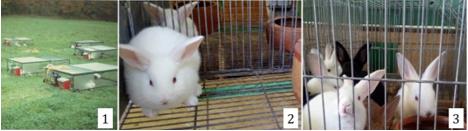
In other study, Bozicovich, et al. [4] based on the increased frequency of social interactions and decreased incidence of stereotyped behavior, recommend housing mixed-gender groups in collective cages from weaning up to 11 weeks of age. However, if the incidence of skin wounds is considered, only females can be housed in same-sex groups. For males, individual cages should be preferred Bozicovich, et al. [4].
In addition, Hansen and Berthelsen [5] cite that rabbits kept in the conventional cage system, showed more restlessness, excessive grooming, bar-gnawing and timidity than rabbits kept in the enriched cage system. This indicates increased stress in the rabbits kept in the conventional cage system. In addition, Bozicovich, et al. [4] cite than enrichment aggressive behaviors were lower in rabbits from enriched cages, suggesting improved welfare.
Reproducing Animals
Unlike in the wild, the captivity doe, kept in the same cage with its litter, is not free to leave and close the nest at her own discretion after suckling (Figure 2). Under current breeding conditions, the separation of the doe from the litter is possible with minor nest adaptation for the first 12 to 15 days of lactation when the kits stay in the closed nest, whereas after the definitive opening of the nest, the doe never stays separate from her litter [2]. Alternative cages with completely separated sectors or elevated platforms could be used to permit does to isolate themselves from their litters.
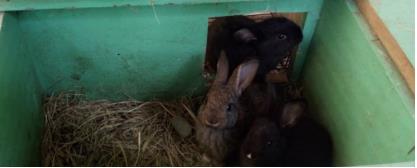
For this reason, as well as increasing objections of the public opinion and by market tendencies are being proposed collective cages [6]. However, although collective cages appear to be better for animals, studies demonstrate the opposite.
In this sense, Aguilar [3] study different productive and sanitary indicators associated to cage design with the aim to evaluate its influence on the production and welfare of reproductive rabbit does. The study began with 50 does, allocated in individual cages or in 4 group. Aguilar [3], cite that the housing conditions did not affect to the majority of parameters related with the reproductive performance of does. However, alive litter weight at birth tend to be heavier in the group of individual-caged females (631g vs 583g). Moreover, rabbit does tend to be also heavier at first insemination (3862g vs 3672 g; P=0.0618) due to a significant increase of their growth (18.1 g/d vs 12.9 g/d; P<0.01). Regarding to the aggressive behavior, rabbits does in the group - housing cages presented higher percentage of cutaneous injuries (32%, vs 5%), which was the main cause for the reduction of their lifespan; only 52% of the rabbits does in the group - housing cages finished the experience, whereas 76% finished it when housed in individual cages. However, in the group - housing were found more severe problems of sore hocks (43% vs 13%).
Conclusion
The most studies show that the group rearing in cages – for growing rabbits up 84 days – is the best choice to satisfy rabbit social behavior. In reproducing animals, alternative housing systems, that permit does to separate themselves from their litters, should be developed. So far, the individual cages seem to be the most suitable for the does.
References
-
Klinger ACK, Toledo GSP (2018) Cunicultura. 1st (Edn.), UFSM, Santa Maria, Brazil, pp: 128.
-
Trocino A, Xiccato G (2010) Animal welfare in reared rabbits: a review with emphasis on housing systems. World Rabbit Sci 14(2): 77-93.
-
Aguilar MD (2016) Comparación de la cría de conejas alojadas en grupo e individual. Monography – Escuela Técnica Superior de Ingeniería Agronómica y de Medio Natural. Valencia, Spain, pp: 40.
-
Bozicovich TF, Moura AS, Fernandes S, Oliveira AA, Siqueira ER (2016) Effect of environmental enrichment and composition of the social group on the behavior, welfare, and relative brain weight of growing rabbits. App Ani Behav Sci 182(1): 72-79.
-
Hansen LT, Berthelsen H (2000) The effect of environmental enrichment on the behaviour of caged rabbits (Oryctolagus cuniculus). App Ani Behav Sci 68(2): 163-178.
-
González-Redondo P, Fernández-Carmona J, Finzi A, López M, González-Mariscal G, et al. (2015) Maternal behaviour and welfare of the domestic and wild rabbit doe and its litter. ITEA 111(15): 326-347.
- In Situ Evaluation of the Anthelmintic Effect of the Aqueous Extract of Syzygium aromaticum (L) Merr and Perry on Bovine Strongyles
- Successful in Vitro Embryo Production with Oocytes Aspirated from Live White-Tailed Deer (Odocoileus Virginianus Texanus) Donors under Captivity in Northeast Mexico
- Bangladeshi Finches with their Evolutionary Thoughts (Aves: Passeriformes)
- Note on the Survival Status of Przewalski’s Horse, Equus ferus przewalskii (Perissodactyla: Equidae)
- In-Situ and Ex-Situ Protection of White-Breasted Waterhen (Amaurornis Phoenicurus) (Pennant, 1769) (Aves: Rallidae)
- Meat Examination in the Laboratory, the Acceptability and the Human Health