
Performance of Broiler Chickens Fed Maggot Meal as a Protein Substitute for Fishmeal
There is rising food insecurity in developing countries caused by rapid population growth which can be partly addressed through poultry keeping. Conventional sources of protein in commercial poultry production are fishmeal (FM) and seed cakes, which are usually scarce, expensive and used extensively by other livestock and humans. The objective of this study was to detect a simple way of producing, harvesting and processing maggots, assess the performance of broiler chickens fed maggot meal as a protein substitute for fishmeal and evaluate cost of production. Maggots of housefly (Musca domestica) were produced from layer droppings spread on the ground under shades and harvested within 4-5days, killed with heated water (70-80°C), dried in the sun to lowest moisture content (
Introduction
In developing countries the population is increasing rapidly and demand for food tends to rapidly increase, especially protein which is still a major problem in less developed countries [1]. Food insecurity is one of the clearest outcomes of poverty in Cameroon and as a consequence, 36% of poor Cameroonian children are seriously underweight [2]. Improving supply of poultry meat in poorer countries can meet the needs for animal protein especially as there are fewer religious or social taboos associated with poultry than there are with pigs and cattle; with the exception of strict vegetarians and vegans [3]. Unfortunately, chicken production in Cameroon, like other countries of sub-Saharan Africa, has not met the demand [4]. Cameroon has resorted over the years to importing poultry products mostly from Europe to address the situation. From 1999 to 2004, the importation of poultry meat into Cameroon witnessed an increase of 286.7% while per unit import value increased by only 6 % during the same period, demonstrating a surge problem [5].
One important advantage in attaining the animal protein need of man through poultry products is that, poultry meat is very rich in unsaturated fatty acids as against saturated fatty acids. Both turkey and chicken have about 30% saturated fatty acids, 43% monounsaturated fatty acids, and 22% polyunsaturated fatty acids. Even though the high level of unsaturated fatty acids with their double bonds will lead to high risk of rancidity due to oxidation, the ratio is a clear indication that poultry meat may stand a better chance as a more healthful alternative for red meat [6, 7]. In Cameroon, the prices of imported chicken are less than the cost price of locally produced chicken due to favourable production conditions and consumer behaviours prevailing in European countries making it very difficult for local production to expand [8, 9].
In most developing countries, the major sources of protein in commercial poultry production are fishmeal (FM) and seed cakes, usually scarce, expensive and used extensively by other livestock and humans [10]. The more reason why chicken production in Cameroon, like other countries of sub-Saharan Africa, has not met demand [4]. According to FAO, globally, an estimated 15% of fish stocks are overexploited, and about 10% have been depleted or are recovering, indicating that total dependence on fish as the only source of animal protein is not a safe venture [11]. This situation has created a need to focus on; better utilization of available feed resources less competed for, Knowledge of nutritional characteristics, optimal levels of inclusion in rations and optimum combination of ingredients [12].
Feed accounts for 60-70% of the total production cost in modern poultry production systems as it has a great effect in poultry growth, egg production and meat quality. Housefly maggots could serve as a cheap potential ingredient (protein) [3, 13, 14]. A range of reports indicate that crude protein content of maggots is high (28.63-63%) and comparable to that of fish meal [15]. Maggots grow on chicken manure, help to aerate it, causing the manure to dry faster solving the environmental problem of pollution and most importantly, they modify the microflora in the manure through consumption and production of bacteriostatic, bacteriocidal and fungicidal compounds that potentially help to reduce harmful species [16]. Teotia and Miller remarked that maggot meal is rich in phosphorus, trace elements and B complex vitamins [17].
Work done in Cameroon on performance of broiler chicken fed maggot meal as protein substitute is scanty, virtually no work done in Cameroon clearly explains the methods of maggot production, this study has as main aim to detect a simple way of producing, harvesting and processing maggots and assessing the performance of broiler chicken fed maggot meal in place of fish.
Materials and Methods
Study Area
The study was executed at the Muyuka Agro-Industrial Farm. Muyuka located between latitudes 4⁰16ʺ and 4⁰23ʺN and longitudes 9°21ʺ and 9°28ʺE in the fourth agro-ecological zone of Cameroon (AEZ IV) is on the windward side of mount Cameroon. As a result, it experiences very high temperatures ranging from 25°C during the rainy season (March to September) to about 30°C in the dry season (October to March). The climate is typically of the equatorial type. The monthly rainfall ranges between 9.2mm to 374.1mm, the lowest realised in January while the heaviest is in August [18].
Maggot Growing: Production, Harvesting and Processing
A trial done on the method of producing maggots by Odesanya, et al. was not successful because droppings were too watery and instead tended to rise and foam in wooden tanks, making it difficult for flies to lay [19]. High temperatures in this area are probably the cause of the watery droppings, as birds tended to drink much water.
We developed a new method on the field, in which pure watery layer droppings were poured on clean ground under the shade for water to be partly absorbed by the soil to levels that permitted flies to lay. Given the high temperatures of the study area, maggots grew faster and were usually ready for collection 4-5days after deposition of the droppings.
During harvesting we used, a bucket of water, two empty buckets and a sieve. The substrate containing maggots was collected with a sieve and immersed in a bucket of water to about 3/4 of the sieve, while holding with one hand and the other used to soften the substrate containing maggots. Constant shaking in water sifted out tiny debris into the bucket. Maggots plus larger debris, mostly wheat bran, were then put into one of the empty buckets and the process repeated again. Due to overcrowding and consequently shortage of air, maggots in the second bucket moved out of the substrate in about 3-4minutes to the top. They were quickly scooped and put into a third empty bucket. The process was repeated several times and at the end of the harvesting exercise, the two buckets, one with pure maggots (much in quantity) and another with maggots mixed with debris (small in quantity) were thoroughly washed again before processing. In processing, heated water at about 70-80oC was poured into the bucket containing maggots and stirred for about 3minutes to kill all of the maggots. Filtered dead maggots were spread on aluminium sheets for solar drying to minimum moisture content (<4%). The drying process took about 24hrs. The dry maggots were ground and preserved in polythene bags inside airtight containers ready for proximate analysis and experimentation.
Chemical Analysis of Maggot Meal
The proximate analysis of the maggot sample was carried out using methods suggested by AOAC.
Birds
Two hundred and twenty-five Tropical Broc day-old broilers brooded for two weeks using the control feed were used for the experiment. Coal pots supplemented heat and prophylactic measures employed. Daylight served as main light source during the day while electric light supplied at night; lanterns aided during power outages [18].
Experimental Design
The experiment used a completely randomized block design (CRBD) in which two weeks old chicks were randomly allocated to 5 treatments, each containing 45 birds; and each treatment had 3 replicates with 15 birds each. Formulated diets contained maggot meal (MM) substituting fishmeal (FM) at graded levels; 0%, 25%,
50%, 75%, and 100% at both the starter and finisher phases. Mineral and vitamin premixes common to poultry production, oyster shell, salt and bone constituted part of the feed. Birds enjoyed natural ventilation on deep litter system, Feed and water supply ad libitum. Broiler starter, 23% crude protein, carried on for 4 weeks and from the end of the 4th week, broiler finisher (19% crude protein) fed till slaughter (8th week) [18].
Data collection
Feed intake, weight gain, feed conversion and efficiency ratios were recorded weekly. Digestibility trial took place over a period of 48hrs on week 7 on dropping samples collected. Ration Formulation for Experimental Diets The diets were compounded as stated in Mbiba, et al. [18]. Cost Benefit Analysis Costing was done mathematically as shown below in francs CFA: Price of chick =500 F / chick. Drugs= 223 F / Chick. Poultry house: 10000 F per production cycle; 45 F/Chick. Drinkers: 15×2300=34500 F; Can be used for three years for a cost of 11500 F per year and for a depreciation cost of 11500/4=2875 F. Cost per chick=13 F / Chick. Smaller drinkers: 3×800=2400 F. Can be used for three years for a cost of 800 F per year and for a depreciation cost of 800/4=200 F. Cost per chick=1 F / Chick. Feeders: 3×1000=3000 F. Can be used for three years for a cost of 1000 F per year and for a depreciation cost of 1000/4=250 F. Cost per chick=1 F / Chick. Charcoal =3000 F. Cost per chick=3000/225= 14 F. Maggot production equipment=15000 F. Can be used for three years for a cost of 5000 F per year for a depreciation cost of 5000/4=1250 F. Cost per chick=6 F / chick. Labour: 30000 F/month; Cost per chick=133 F/month; 133×3months=399F Total cost of consumables and labour =1202 F.
Method of Data Processing and Analysis
Data were organized in Microsoft Office Excel Version 2010 and analyzed using SPSS 17.0 (SPSS Inc, 2008). Data screened for analysis using Kolmogorov Smirnov and Shapiro Wilk tests revealed that the data departed from normal distribution. The non-parametric test, notably Kruskal Wallis test, was then used to compare groups for significant differences and the Dunnett T3 test was for paired comparisons. We performed Measurements of central tendencies and dispersion and presented data using statistical tables and charts and discussed at the 95% CL (Alpha=0.05) [18].
Results and Discussion
Chemical Composition of Maggot Meal
The chemical composition of maggot meal (MM) (Table 1) used in this study falls within the range reported by various researchers. The crude protein content of MM was 48.4% and similar to values reported by as 45%, 45%, 47.1% and 48% respectively. However, others have related values lower and even above the one obtained in this work [19, 20, 21, 22]. Generally, the crude protein content of maggots is high (39-63%) [23]. The variations observed in various reports could be explained by the differences in age of the maggots at collection, Substrate type on which the maggots were grown, species of maggots, methods of processing and even analytical procedures [23, 24].
| Fraction | Proximate Composition |
|---|---|
| Dry matter % | 93.9 |
| Ash % | 14.5 |
| Crude Protein % | 48.4 |
| Ether extract % | 20 |
| Crude fibre % | 13 |
| Metabolizable Energy (kcal/kg DM) | 3302.5 |
Table 1: Chemical composition of maggot meal (%DM).
The fat content (20%) was greater and comparable to 20.7% obtained by Awoniyi, et al. and Atteh and Ologbenla and lies within the range (8.5%-35.5%) presented by others [25, 26]. The high fat content in MM is understandable as maggots reserve food for the pupa stage in the form of fats; therefore fat content increases with age as confirmed by Chapman who stated that the major food reserves of insects are triglycerides.
Crude fibre (13%) was higher than the values 8.25%, 3.58%, 6.3%, 9.05%, 7.5%, 5.89%, and 1,83% reported by Atteh and Ologbenla, Teguia, et al. Awoniyi, et al., Adeniji, Aniebo, et al., Odesanya, et al. and Okah and Onwujiariri respectively [19, 22, 25, 26, 27]. This may be due to the presence of some particles of wheat brand. Ash content (14.4%) was comparable to 14.29% obtained by Okah and Onwujiariri but higher than 6.15%, 9.72%, 8.4%, 7.15%, 6.25% and 10.03% in the studies Okah and Onwujiariri, Ugwumba, et al. , Sogbesan, et al., Adeniji, Aniebo et al., Hwangbo, et al. and Odesanya et al., correspondingly [19, 22, 26, 27, 28, 29, 30, 31]. However, Teguia, et al. got higher ash content (19.12%) [32].
Energy content of MM was greater (3302.5 kcal/kg DM) than that of fishmeal (2860 kcal/kg DM) and this finding was confirmed with even higher values (4140 kcal/kg DM and 3755 kcal/kg DM) reported by Hwangbo, et al. and Odesanya, et al. respectively [19, 31]. Okah and Onwujiariri found a much lower value (2381kcal/kg DM) and Teguia, et al. got 3060.6kcal/kg DM, even though both values were based on prediction equations and not on direct analysis [27, 32]. The high ME value may be due to the fact that maggots are rich in fats (20%) and also act as a source of energy upon oxidation as suggested by Adeniji [30]. The results of chemical composition of MM obtained in this study measure up favorably with FM, proving that MM is suitable for use as animal protein source in broiler feed. Chemical composition of experimental diets at both the starter and finisher phases is explained by Mbiba, et al. [18].
Performance
Results from this study revealed differences in performance of broilers at starter and finisher phases as affected by different levels of inclusion of MM in the diets (Table 4). Significant differences in total FI existed at the finisher phase compared to the starter phase. Feed intake increased with increase replacement of FM. There was a significant difference in average weekly feed intake between treatments and within weeks for the starter phase (weeks 1-4). There was a significant difference (P<0.001) in average weekly feed intake between treatments and within weeks for the finisher phase (weeks 5-8) except for week 8, where a significant difference occurred only between treatments 0 and 4. This study indicated that feed intake increased rather significantly (P<0.001) at both the starter (Table 2) and finisher (Table 3) phases with increase inclusion of MM, giving significantly (P<0.001) higher weight gains in 75% and 100%MM than the control. This, therefore, indicates that MM is more palatable and preferred by chicken. This upsurge in FI and weight gain is in line with the reports of Dankwa, et al. as opposed to the findings of Atteh and Ologbenla who stated that there was rather a reduction in feed intake and weight gain with increase inclusion of maggots [26, 33].
Awoniyi, et al. and Hwangbo, et al. reported no significant differences in feed intake [25, 31]. Adeniji reported that there was no significant difference in FI between the control and treatments, even though there was a decrease in FI at the 75% and 100%
maggot inclusion which was not significant [30]. In the present study, total feed intake was substantially different at the starter phase across treatment groups, with 100%MM recording the highest as compared to the control. This finding agrees with the results obtained by Teguia, et al. [32]. This may have been due to better feed utilization by the birds fed MM which caused higher weight gains and in turn led to high feed intake. These values of FI were lesser than those reported by Hwangbo, et al. at 5 weeks.
During the finisher phase, feed consumption was greater in the control than in the experimental diets, even though the variance was not significant [31]. This might have been due to high energy load in dietary MM, given that at finisher stage CP level in feed dropped while energy was stepped up, added to energy content of MM which was higher. This agrees with previous researches of Moran, Atteh and Ologbenla, Akpodiete and Okah and Onwujiariri who had also reported major reduction in feed intake in birds fed maggot meal [25, 26, 27, 34]. Okah and Onwujiariri indicated that this drop was still greater than FI in the control [27]. Akpodiete, et al. reported no major difference in feed intake between treatments for laying chicken [35].
However, total and average FI at the end of the experimental period increased with increased presence of MM. This is an indication that acceptability is not negatively affected by inclusion of MM as earlier stated by Adeniji that low weight gains may be due to less feed consumed as a result of dull colour of the MM diet [30]. Teguia, et al. rather found out that birds on 50% MM were the best consumers at the finisher stage, and there was no significant difference between the control and the group with 100% MM [32].
For both the starter and finisher phases, there was no important difference between the control and other treatment groups in FCR except for 100%MM which was significantly (P<0.001) superior at starter (Table 2) phase and lower (P<0.001) at the finisher (Table 3) phase. This could be explained by the fact that much growth occurs at the starter phase and tends to slow gradually at the finisher phase. This result differed from the outcomes of Awoniyi, et al. at 3-6weeks and Teguia et al. who detected no substantial differences in FCR in both the starter and finisher phases, as well as Akpodiete, et al. who reported no significant change in FCR between treatments for laying chicken [25, 32, 34]. Meanwhile, Adeniji reported no meaningful differences in FCR amongst treatment groups and the control, but stated that chicks on the 25% replacement level tended to be the best in FCR [30]. Atteh and Ologbenla found increased feed conversion ratio with increase dietary MM, just as Okah and Onwujiariri who stated that FCR was better (P<0.001) in maggot- containing diets than in the control at the finisher phase [26, 27]. Consequently, better utilization by birds fed diets with maggots confirmed the conclusion that inclusion of maggot meal into broiler diets enhances performance than FM-based diets.
| Parameters measured | Weekly average (Mean ± SE) at starter phase | ||||||||
|---|---|---|---|---|---|---|---|---|---|
| T0(N=24) | T1 (N=24) | T2 (N=24) | T3 (N=24) | T4 (N=24) | Kruskal | ||||
| Wallis Test | |||||||||
| Total feed intake (Kg) | 1.534±0.002 | 1.512±0.000 | 1.695±0.002 | 1.841±0.006 | 1.889±0.003 | X2=112.012 P<001 | |||
| Total growth rate (%) | 5.485±0.078a | 5.042±0.049b | 5.101±0.049b | 5.701±0.006a | 4.833±0.038 | X2=65.354 P<001 | |||
| Total feed conversion ratio | 9.225±0.044a | 10.115±0.08 2bc | 9.854±0.114bd | 9.743±0.216 acd | 10.875±0.03 7 | X2=53.256 P<001 | |||
| Average feed conversion ratio | 2.306±0.011a | 2.529±0.021b c | 2.464±0.028bd | 2.436±0.054a cd | 2.719±0.010 | X2=53.256 P<001 | |||
| Total feed efficiency | 1.908±0.028a | 1.772±0.013b | 1.763±0.015b | 1.866±0.017a | 1.634±0.009 | X2=78.468 P<001 | |||
| Average feed efficiency | 0.477±0.007a | 0.443±0.003b | 0.441±0.004b | 0.466±0.004a | 0.409±0.002 | X2=78.468 P<001 |
Table 2: Comparison of performance between treatments at the starter phase.
a, b, c, d, e, f, g, h, and I Dunnett T3: Paired comparison between treatments and within weeks; pairs with the same letter are not significantly different at the 0.05 Level. Table 2: Comparison of performance between treatments at the starter phase.
weeks for the starter phase. There was a significant difference (P<0.001) in average weekly feed efficiency ratio between treatments and within weeks for the finisher phase. Feed efficiency was greater (P<0.001) in the control at the starter phase than in the experimental diets except 75%MM (Table 2) but the 100%MM recorded the highest (P<0.001) feed efficiency at the finisher phase than in the control and the rest of the experimental diets. Akpodiete, et al. reported no substantial difference in feed efficiency between treatments for laying chicken, while Awoniyi, et al. reported a decrease in FE at 3-6 weeks [25, 36]. Teguia, et al. indicated high feed efficiency in the diet containing only maggots at the starter phase, and his conclusion that better feed utilization was in diets containing maggots agreed with the finding in this study, especially for 75% and 100%MM which produced birds with the best performance [32].
The results of birds with superior growth performance being those fed diets containing maggots constitute enough proof that MM is not nutritionally inferior to fishmeal as observed by Rose, et al., Awoniyi and Aletor, Awoniyi, et al. and Okah and Onwujiariri [27, 37, 38]. Increased levels of maggot meal in the diet of broilers resulted in higher weight gain as compared to the control (Table 4), even though the differences between the control, 25% and 50% were not meaningful (P>0.05). These results agree with the findings of Dankwa, et al. and Teguia, et al. who obtained similar results [32, 33]. Greater weight gain with increased levels of maggot presence could be due to the high crude protein and ME digestibility as confirmed by Hwangbo, et al. who remarked that increased dietary protein digestibility aids weight gain in chicks [31]. Zuidhof, et al. also stated that weight gain is seen as a result of protein accumulation and a given energy content of the feed [39]. Atteh and Ologbenla and Adeniji reported a drop in weight gain with increase inclusion of maggot meal which was pronounced in the 75% and 100% treatments, even though not statistically significant [26, 30]. Meanwhile, Awoniyi, et al. found no significant variance at 3-6weeks [25].
| Parameters measured | Weekly average (Mean ± SE) at finisher phase | ||||||||
|---|---|---|---|---|---|---|---|---|---|
| T0 (N=24) | T1 (N=24) | T2 (N=24) | T3 (N=24) | T4 (N=24) | Kruskal | ||||
| Wallis Test | |||||||||
| Total feed intake (Kg) | 3.147±0.007ab c | 3.131±0.002 ef ad | 3.127±0.005 gh bd | 3.122±0.003 gi e | 3.138±0.005 fhi c | X P=0.037 2=10.239 | |||
| Total growth rate (%) | 1.320±0.039ab | 1.269±0.021ac | 1.235±0.010bc | 1.107±0.021 | 1.462±0.010 | X2=58.578 P<001 | |||
| Total feed conversion ratio | 13.638±0.586a bc | 12.379±0.159a de | 12.340±0.076 bdf | 12.212±0.19 8cef | 10.126±0.09 5 | X2=58.197 P<001 | |||
| Average feed conversion ratio | 3.409±0.146ab c | 3.095±0.040ad e | 3.085±0.019bd f | 3.053±0.049c ef | 2.532±0.024 | X2=58.197 P<001 | |||
| Total feed efficiency | 1.366±0.028ab c | 1.331±0.020 e ad | 1.357±0.004 f bd | 1.355±0.020 ef c | 1.631±0.015 | X P<001 2=58.928 | |||
| Average feed efficiency | 0.342±0.007ab c | 0.333±0.005ad e | 0.339±0.001bd f | 0.339±0.005c ef | 0.408±0.004 | X2=58.928 P<001 |
Table 3: Performance between treatments at the finisher phase.
a, b, c, d, e, f, g, h, and I Dunnett T3: Paired comparison between treatments and within weeks; pairs with the same letter are not significantly different at the 0.05 Level. Table 3: Performance between treatments at the finisher phase.
| Parameters measured | Weekly average (Mean ± SE) | ||||||||
|---|---|---|---|---|---|---|---|---|---|
| T0 (N=24) | T1 (N=24) | T2 (N=24) | T3 (N=24) | T4 (N=24) | Kruskal | ||||
| Wallis Test | |||||||||
| Total feed intake (Kg) | 4.681±0.009 | 4.643±0.002 | 4.822±0.006 | 4.963±0.005 | 5.026±0.005 | X2=109.629 P<001 | |||
| Weekly feed intake (Kg) | 0.585±0.001 | 0.580±0.000 | 0.603±0.001 | 0.620±0.001 | 0.628±0.001 | X2=109.629 P<001 | |||
| Total growth rate (%) | 14.008±0.232a c | 12.686±0.019b c | 12.624±0.047b | 13.117±0.143c d | 13.361±0.09 7ad | X2=60.501 P<001 |
| Total Weight gain (Kg) | 1.769±0.015ab | 1.734±0.015ac | 1.767±0.007bc | 1.878±0.012 | 2.004±0.014 | X2=80.369 P<001 |
|---|---|---|---|---|---|---|
| Weekly weight gain (Kg) | 0.221±0.002ab | 0.217±0.002ac | 0.221±0.001bc | 0.235±0.002 | 0.251±0.002 | X2=80.369 P<001 |
| Weight week8/final weight (Kg) | 1.896±0.014ab | 1.871±0.016ac | 1.907±0.007bc | 2.021±0.012 | 2.154±0.014 | X2=85.107 P<001 |
| Total feed conversion ratio | 22.862±0.545a bc | 22.493±0.079a d | 22.195±0.123b de | 21.955±0.042c e | 21.001±0.13 0 | X2=40.828 P<001 |
| Average feed conversion ratio | 2.858±0.068abc | 2.812±0.011ad | 2.774±0.015bde | 2.744±0.005ce | 2.625±0.016 | X2=40.828 P<001 |
| Total feed efficiency | 3.274±0.022ab | 3.102±0.020c | 3.120±0.012c | 3.221±0.025ad | 3.266±0.017 d b | X2=46.528 P<001 |
| Average feed efficiency | 0.409±0.003ab | 0.388±0.003c | 0.390±0.002c | 0.407±0.003ad | 0.408±0.002 d b | X2=46.528 P<001 |
Table 5: Overall performance of broilers for the entire experimental period.
a, b, c, d, e, f, g, h, and I Dunnett T3: Paired comparison between treatments and within weeks; pairs with the same letter are not significantly different at the 0.05 Level. Table 4: Overall performance of broilers for the entire experimental period.
Apparent Digestibility
Table 5 presents the results on apparent digestibility (AD). 50%MM had the highest apparent digestibility of CP, followed by 100%MM and 75%MM. 100%MM and
| Ash (%DM) | Lipids (%DM) | Crude Fibre (%DM) | Crude protein (%DM) | ME (kcal/kg DM) | NFE (%DM) | |
| T0 | -184.7 | -8.2 | -187.1 | 15.8 | 54.8 | 44.9 |
| T1 | -236.4 | 1.6 | -141.1 | 11.3 | 59.1 | 48.7 |
| T2 | -360 | -20.9 | -94.8 | 27.9 | 61.9 | 59.7 |
| T3 | -335.4 | 15.8 | -197.3 | 16.3 | 58 | 40.7 |
| T4 | -150 | 30.4 | -264.5 | 19 | 62.3 | 45.4 |
Table 6: Comparison of apparent digestibility between treatments.
Cost of Production
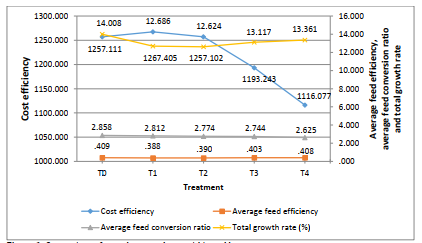
There were meaningful differences between treatments at the starter and finisher phases in production cost and cost efficiency. T1 recorded the lowest cost of production and T3 recorded the highest, but cost efficiency, which was calculated as the ratio of production cost to total weight gain, was lowest in T4 and highest in T1 (Figure 1). An indication that increase inclusion of MM in broiler feed cuts down the cost of production significantly as seen in table 6 beside the benefit of reducing pollution from poultry waste as observed by Hwangbo, et al. [31]. This agrees with Teguia, et al. who noticed reduction in cost of production in treatment groups compared to the control [32, 42, 43].
| Cost parameters | Cost (Mean ± SE) FCFA | |||||
|---|---|---|---|---|---|---|
| Cost parameters | T0(N=24) | T1(N=24) | T2(N=24) | T3(N=24) | T4(N=24) | Kruskal Wallis Test |
| Cost starter phase | 359.580±.609 | 347.300±.000 | 384.387±.446 | 412.160±1.375 | 417.414±.585 | X2=91.281P<0.001 |
| Cost finisher phase | 658.350±1.423 | 644.780±.351 | 634.713±.870 | 624.000±.590 | 614.787±1.019 | X2=90.000P<0.001 |
| Production cost per chick | 2220±2^{ab}$ | $2194±0.3 | 2221±1.2^{ab}$ | $2238±1^{c}$ | $2234±1.5^{c}$ | $X2=80.828P<0.001 |
| Cost efficiency | 1257.111±11.630^{ab}$ | $1267.405±11.288^{ac}$ | $1257.102±4.407^{bc}$ | $1193.243±8.135 | 1116.077±8.053 | X2=22.479P<0.001 |
Table 7: Comparing production cost and cost efficiency by treatment.
a, b, and c Dunnett T3: Pair comparison between treatments and within weeks; pair with the same letter are not significantly different at the 0.05 Level. Table 6: Comparing production cost and cost efficiency by treatment.
Conclusion
The following conclusions can be derived from this study: The method developed in this experiment is the best and recommended method of maggot production in the area covered in this research and other areas with similar conditions. The chemical composition of MM proved that it is rich in protein and other nutrients and as such can be used as a source of animal protein in broiler feed. The increasing trend in feed intake from the control concluded from this study that fish meal at 5% in broiler feed can be completely replaced with maggot meal for better performance, reduced cost of production and increase returns.
Acknowledgement
We acknowledge the support from Mr ZHU LYING who granted us free access to his poultry farm (Muyuka Agro- Industrial Farm) and some materials to carry out this research from the beginning till the end, and the moral support from his staffs.
References
-
FAO (Food and Agriculture Organization) (2004) Small Scale Poultry Production. Animal Production and Health. Village Poultry Consultant. Waimana, New Zealand, pp: 1-5.
-
Michel T, Guy PD (2003) Cameroon: a case study on economic partnership agreements.
-
Smith AJ (1990) Poultry. The Tropical Agriculturalist. Tropical Centre for Agriculture and Rural Cooperation. Macmillan Education Ltd.
-
Etchu KA, Egbunike GN, Woogeng IN (2013) Evaluation of the fertility of broiler breeder cocks fed on diets containing differently processed sweet potato tuber in a humid tropical environment. International Journal of Livestock Production 4(5): 82-87.
-
Pingpoh DP, Senahoun J (2007) Extent and impact of food import surges in developing countries: The case of poultry meat in Cameroon. Poster prepared for presentation at the 106th seminar of the EAAE, pp: 1- 16.
-
Encyclopaedia Britannica (2014) Poultry processing.
-
FAO (2014) Animal Production and Health. Agriculture and Consumer Department.
-
CTA (Technical Centre for Agricultural and Rural Cooperation) (2004) Poultry Farming: A disease called competition. Spores 114: 4.
-
Taru VB, Nkwi GE, Medugu AI, Reuben J (2012) Economics of broiler production in Meme Division of Cameroon. Journal of Agricultural Science 1(2): 83- 87.
-
Gadzirayi CT, Masamha B, Mupangwa JF, Washaya S (2012) Performance of broiler chickens fed on mature Moringa oleifera leaf meal as a protein supplement to soybean meal. International Journal of Poultry Science 11(1): 5-10.
-
FAO (2000) The State of World Fisheries and Aquaculture, FAO, Rome.
-
Kamalzadeh A, Rajabbeygi M, Kiasat A (2008) Livestock production systems and trends in livestock industry in Iran. Journal of Agricultural and Social Science 4: 183-188.
-
Church DC (1991) Livestock Feeds and Feeding. 3rd (Edn.), Prentice Hall. Incorporation cliffs, New Jersey. USA, pp: 465.
-
Wilson KJ, Beyer RS (2000) Poultry Nutrition Information for the Small Flock. Kansas State University Agricultural Experiment Station and Cooperative Extension Service.
-
Veldkamp T, van Duinkerken G, van Huis A, lakemond CMM, Ottevanger E, et al. (2012) Insects as a sustainable feed ingredient in pig and poultry diets – a feasibility study. Wageningen UR Livestock Research and Central Veterinary Institute of Wageningen UR (University & Research centre).
-
Newton L, Sheppard C, Watson W, Burtle G, Dove R (2004) Using the black soldier fly, Hermetiaillucens, as a value-added tool for the management of swine manure. University of Georgia, College of Agriculture and Environmental Science, Department of Animal and Dairy Science Annual Report, pp: 1-19.
-
Teotia JS, Miller BF (1973) Fly pupae as a dietary ingredient for starting chicks. Poult Sci 52(5): 1830- 1835.
-
Mbiba HF, Etchu KA, Ndamukong K (2019) Carcass Characteristics, Hematology, Serum Chemistry, and Enzymes in Broiler Chickens Fed Maggot Meal as a Protein Substitute for Fishmeal. Global Journal of Medical Research 19(1): 7-13.
-
Odesanya BO, Ajayi SO, Agbaogun BKO, Okuneye B (2011) Comparative evaluation of nutritive value of maggots. International Journal Science & Engineering Research 2 (11): 1-5.
-
Gado MS, El-Aggory SM, El-Gawaard AA, Mormond AK (1982) The possibility of applying insect protein in broiler rations. Nutritionist Abstract Review 43.
-
Fasakin EA, Balogun AM, Ajayi OO (2003) Nutrition implication of processed maggot meals; hydrolysed defatted, full-fat, sun-dried and oven-dried, in the diets of Clarias gariepinus fingerlings. Aquaculture Research 9: 733-738.
-
Aniebo AO, Erondu ES, Owen OJ (2008) Proximate composition of housefly larvae (Musca domestica) meal generated from mixture of cattle blood and wheat bran. Livestock Research for Rural Development 20(12).
-
Aniebo AO, Owen OJ (2010) Effects of age and method of drying on the proximat composition of housefly larvae (Musca domestica) meal (HFLM). Pakistan Journal of Nutrition 9(5): 485-487.
-
Teotia JS, Miller BF (1974) Nutritive content of house fly pupae manure residue. British Poultry Science 15(2): 177-182.
-
Awoniyi TAM, Aletor VA, Aina JM (2003) Performance of broiler - chickens fed on maggot meal in place of fishmeal. International Journal of Poultry Science 2(4): 271-274.
-
Atteh JO, Ologbenla FD (1993) Replacement of fish meal with maggots in broiler diet: Effect on performance and nutrient retention. Nigerian Journal of Animal Production 20(1): 44-49.
-
Okah U, Onwujiariri EB (2012) Performance of finisher broiler chickens fed maggot meal as a replacement for fish meal. Journal of Agricultural Technology 8(2): 471-477.
-
Ugwumba AAA, Ugwumba AO, Okunola AO (2001) Utilization of live maggot as a supplement feed on the growth of Clarias gariepinus (Burchell) fingerlings. Nigerian Journal of Science 35(1): 1-7.
-
Sogbesan AO, Ajuuonu N, Musa BO, Adewole AM (2006) Harvesting techniques and evaluation of maggot meal as animal dietary protein source for ‘Heteroclarias’ in outdoor concrete tanks. World Journal of Agricultural Sciences 2(4): 394-402.
-
Adeniji AA (2007) Effect of replacing groundnut cake with maggot meal in the diet of broilers. International Journal of Poultry Science 6(11): 822-825.
-
Hwangbo J, Hong EC, Jang A, Kang HK, Oh JS, et al. (2009) Utilization of house fly maggots, a feed supplement in the production of broiler chickens. J Environ Biol 30(4): 609-614.
-
Téguia A, Mpoame M, Okourou Mba JA (2002) The Production Performance of Broiler Birds as Affected by the Replacement of Fish Meal by Maggot Meal in the Starter and Finisher Diets. Tropicultura 20(4): 187-192.
-
Dankwa D, Nelson FS, Oddoye EOK, Duncan JL (2002) Housefly larvae as a feed supplement for rural poultry - Research and Development Notes. Ghana Journal of Agricultural Science 35(1): 185-187.
-
Moran ET (1982) Comparative nutrition of fowl and swine. The gastrointestinal systems. Published by E.T. Moran Jnr., Guelph, Ontario.
-
Akpodiete OJ, Ologhobo AD, Oluyemi JA (1997) Production and nutritive value of housefly maggot meal on three substrates of poultry faeces. Journal of Applied Animal Research 12(1): 101-106.
-
Akpodiete OJ, Ologhobo AD, Onifade AA (1998) Maggot meal as a substitute for fish meal in laying chicken diet. Ghana Journal of Agricultural Sciences 31(2): 137-142.
-
Awoniyi TAM, Aletor VA (1999) The effect of equi- protien replacement of fish meal with maggot meal in broiler chicken diet on their performance characteristics, organ weights and protein utilization. Proceedings of the 24th Annual Conference of the Nigerian Society for Animal Production, pp: 91-94.
-
Awoniyi TAM, Aletor VA, Adebayo IA, Oyekunle RO (2000) Observation of some erythrocyte indices of broiler chicken raised on maggot meal-based diets. Proceedings of the 25th Annual Conference of the Nigerian Society for Animal Production, pp: 225-228.
-
Zuidhof MJ, Molnar CL, Morley FM, Wray TL, Robinson FE, et al. (2003) Nutritive value of house fly larvae as a feed supplement for turkey poults. Animal Feed Science Technology 105(1-4): 225-230.
-
Schmidt-Nielson K (1993) Animal physiology: Adaptation and environment, 4th (Edn.), Cambridge, Cambridge University Press.
-
Kussaibati R, Leelerg B, Guillanme J (1983) Effect of calcium management and bile salts on apparent metabolizable energy and digestibility of lipids, starch and protein in growing chicks. Annales de zootechvice 32: 7-20.
-
AOAC (2000) Official Method of Analysis. 17th (Edn.), Published by Association of Official Analytical Chemists. Washington DC.
-
Chapman RF (1971) The Insects structure and function. American Elscier Publishers. Co. Inc. New York.
- In Situ Evaluation of the Anthelmintic Effect of the Aqueous Extract of Syzygium aromaticum (L) Merr and Perry on Bovine Strongyles
- Successful in Vitro Embryo Production with Oocytes Aspirated from Live White-Tailed Deer (Odocoileus Virginianus Texanus) Donors under Captivity in Northeast Mexico
- Bangladeshi Finches with their Evolutionary Thoughts (Aves: Passeriformes)
- Note on the Survival Status of Przewalski’s Horse, Equus ferus przewalskii (Perissodactyla: Equidae)
- In-Situ and Ex-Situ Protection of White-Breasted Waterhen (Amaurornis Phoenicurus) (Pennant, 1769) (Aves: Rallidae)
- Meat Examination in the Laboratory, the Acceptability and the Human Health