
Experimental Evaluation of Carbonized Manilkara zapota Leaf for Rhodamine 6G Removal from Aqueous Solution
With the increased amount of use of color in textile industries, there is a need to effectively treat waste water containing dyes. The kinetic study is followed to the second order model. The isotherm model obeys Freundlich model and the adsorption capacity was found to be 6.49 mg/g. The present adsorbent is considered as an alternative adsorbent for the better performance of the Rhodamine 6G from contaminated waters.
Introduction
Dying industry are one among the most dangerous and abundant water contaminant then other organic compounds released into industrial effluents. Some of the dyes are much toxic and when they are present in water, cause mutagenic, carcinogenic and teratogenic effects on humans and aquatic life even in low concentrations [1]. On the other hand the dyes present in water cause the inhibiting the growth of biota, reduction of light penetration, photosynthetic activity is retardation and they have a tendency to chelate with metal ions which form micro-toxins for fish and other organisms [2]. Because of their high thermal and light stability, dyes remain in the environment for a long time [3]. The cationic dye removals from the industrial wastewater can be reached by various methods such as biological (anaerobic digestion, stabilization ponds etc.), chemicals (ion – exchange method, wet air oxidation processes etc.) and physical (coagulation, flotation, adsorption method etc.) [4].
Among all the above, adsorption method is effectively used for its efficiency, low energy consumption, high selectivity at the molecular level, easy operation and ability to separate various chemical compounds [5]. The adsorbents normally used for dye removal in effluent treatment are silica gel, zeolites, alumina and activated carbon [6]. However, the above adsorbents are expensive and require sophisticated management [7].
In order to reduce the costs, alternative adsorbents have been considered, e.g. industrial wastes or plant – derived residues [8]. It has been known that for a good adsorption study, adsorbent should have a porous structure (high surface area) and should be fast to remove dyes in the shortest possible time [9]. In this study, we have tested a natural plant product Manilkara zapota, commonly called as sapota to remove the rhodamine 6G from synthetic dye wastewater by using carbonized sapota leaves powder as a biosorbent. pH and desorption solution, dye concentration, adsorbent load were investigated.
Material and Methods
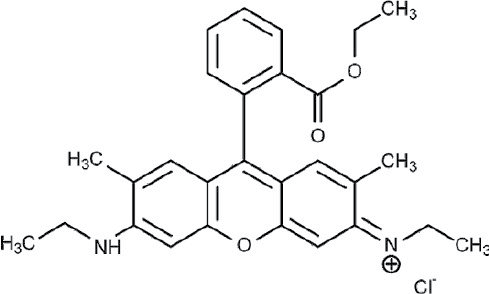
In this study, Rhodamine 6G was selected as an adsorbate. Rhodamine 6G is basically cationic dye. The molecular formula of this cationic dye is molecular formula isC28H31N2O3Cl. In order to prepare 1000 ml mother solution; one gram of the rhodamine 6G was dissolved into one litre of distilled water.
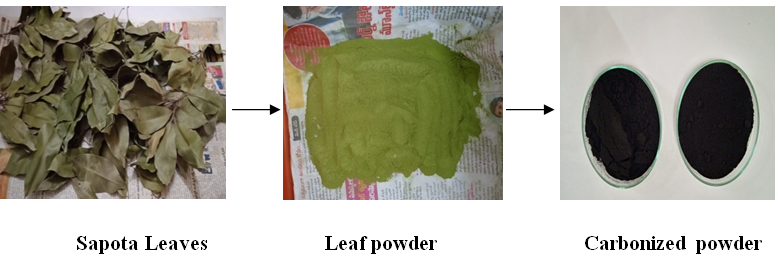
Sapota leaves collected from the agricultural field were utilized as an adsorbent. The adsorbent was cleaned with double distilled water three or four times to remove colour and any of the adhering dirt. It was then dried in a hot air oven at 60o C for 15 min. The obtained powder was grinded and sieved to obtain uniform particle size of 60 µm. It was then carbonized using muffle furnace for 15 min at 500 o C.
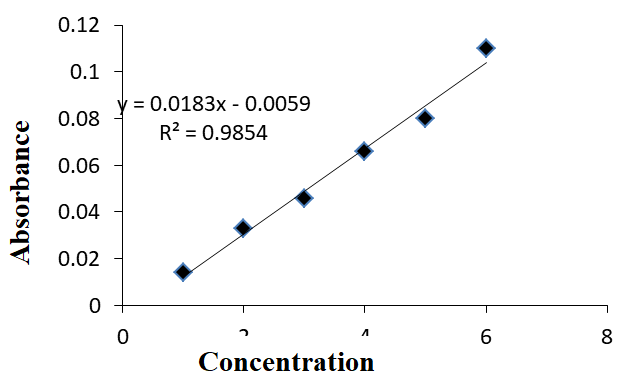
Individual stock solutions of 1000 mg/L of rhodamine 6G were produce by dissolving the dye in water. Rhodamine 6g solutions of required concentrations were prepared by using the above dye solutions. The solutions were kept in brown colour bottles to avoid light degradation. Absorbance measurements were carried out using Shimadzu UV- Vis Spectrophotometer. Maximum absorption of dye were used as the monitoring wavelengths for the measurements of absorbance. An absorption maximum for rhodamine 6G is 525 nm.
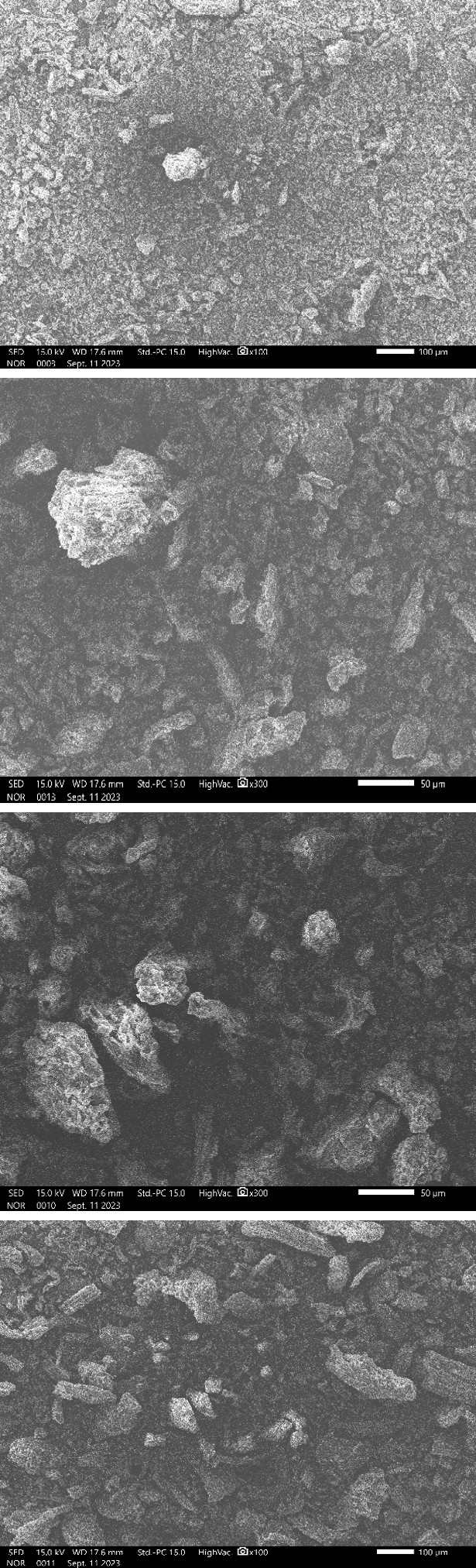
Before Adsorption
After Adsorption Figure 3: SEM photographs.
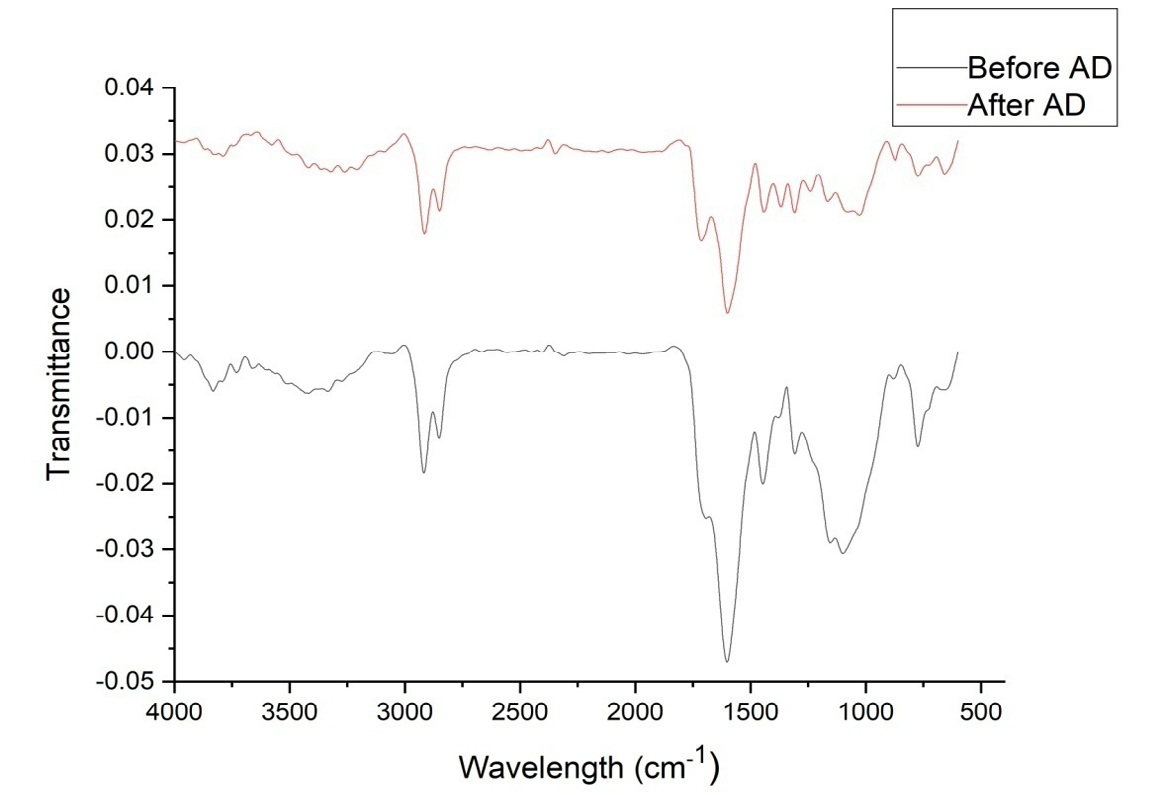
FTIR spectrum of the carbonized sapota leaves as adsorbent was measured to study the surface chemical structure (Figure 4). The peaks approximately at 1570-1580
Results and Discussion
Adsorbent Characterization
SEM images showed the hierarchical morphology of carbonized sapota leaves of before and after adsorption of rhodamine 6G (Figure 3). The different morphologies and sizes affect the dye removal ability from the aqueous solution and the collision between them and the adsorbate.
cm-1 in the dye adsorbed material confirms to that of C= C stretching band.
Batch Adsorption Treatment of Rhodamine 6G
To assess the viability and economy of adsorption study, batch mode laboratory studies were done with carbonized sapota leaves for the rhodamine 6G. Various properties, which control the extent of adsorption are agitation time, adsorbent dose and pH study, was studied. The data were analysed to fit to the Langmuir and Freundlich isotherm formula to calculate the parameters of adsorption. The data were analyzed from the kinetic studies using second order and first order models with respect to rhodamine 6G concentration. The concentrations of the solutions were determined using linear regression equation.
Effect on treatment time and solution concentration on Adsorption of Rhodamine 6G
It were seen that with the time the adsorption increased and reached a optimum value at some point of time wherein no further rhodamine 6G was adsorbed from the solution and the system was in the state of an equilibrium state. With an increase in the initial dye concentration of the rhodamine 6G studied, the equilibrium time increased. The intake of rhodamine 6G at equilibrium (qe) was 3.667 mg/g at 32oC for an initial concentration of rhodamine 6G 10 mg/L. At a piece of agitation set, increase in initial dye concentration decreased the per cent adsorption and increased the amount of rhodamine 6G uptake (q) per unit weight of adsorbent (mg/g) (Figure 5).
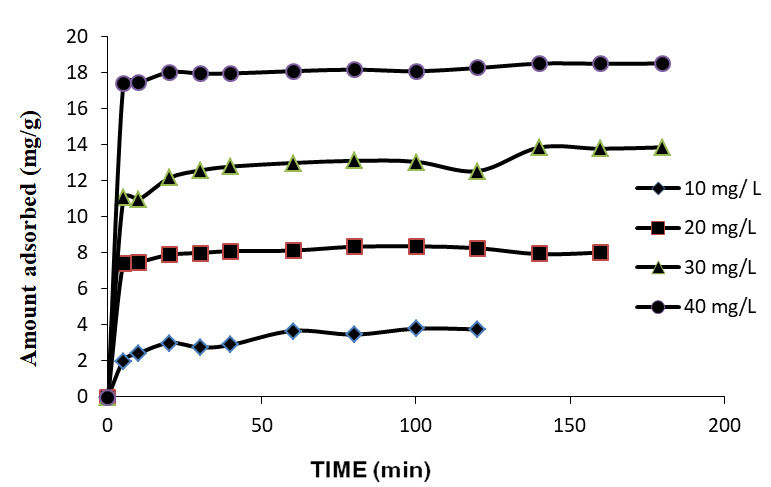
It has noticed that for low initial concentrations, the per cent intake of rhodamine 6G was relatively high. The same findings have been reported by Clitoria fairchildiana pods [9]. The variation curves of adsorption versus time are continuous and smooth, thereby indicating the monolayer coverage formation on the surface of adsorbent.
Kinetics Studies
The kinetic adsorption study is necessary as it gives basal details about the adsorption rate, which are main for the efficiency of the process. Kinetic adsorption models are two different types i.e., Lagergren first order [10] and second order [11].
The First order Lagergren model can be represented as:
Log (qe-q) = log qe – k1t/2.303 (1) Where q & qe are the amounts of rhodamine 6Gadsorbed (mg/g) at time t and at equilibrium, respectively, and k1 is the first order rate constant adsorption (1/min). The value of k1 and qe were calculated from the intercept and slope of the plot of log (qe-q) vs. t for various concentrations of rhodamine 6G (Figure 6).
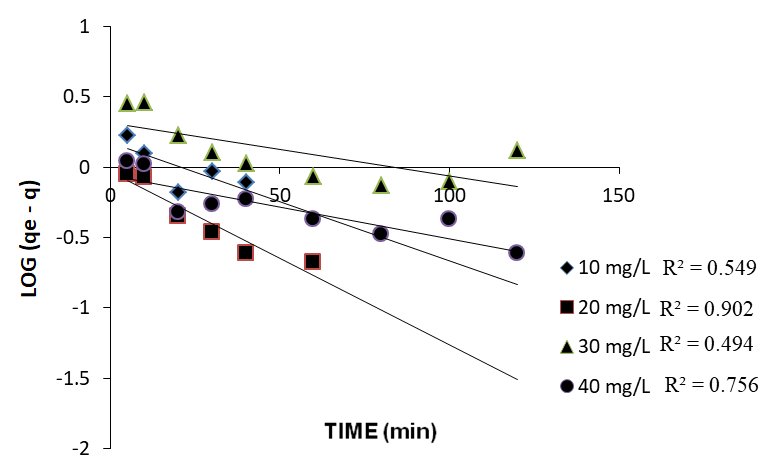
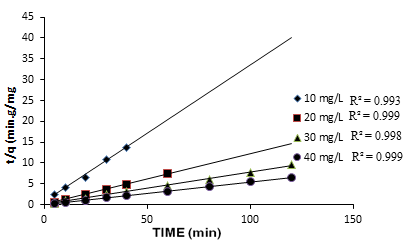
The second order kinetic model is represented as: t/q = 1/k2qe 2 + t/qe (2) The results of kinetic model values fit to the second order and first order model are reported in the Table 1. By Comparing the experimental qe values obtained with those calculated from second order and first kinetic models (Table 1) shows that there was a good agreement between the experimental and the calculated qe values from second order equation for the rhodamine 6G by carbonized sapota leaf powder. This designate that the adsorption process of the rhodamine 6G followed second order model. The regression coefficients are also good. A similar result has been observed in the adsorption of rhodamine 6G onto Clitoria fairchildiana pods [9], clay minerals [12], Litchi chinensis peel [13].
| Initial Conc. (mg/L) | Q (Exp) e (mg/g) | First Order Kinetics | Second Order Kinetics | ||||
|---|---|---|---|---|---|---|---|
| K 1 | Q (Cal) (mg/g) e | R2 | K (g/mg/min) 2 | Q (Cal) (mg/g) e | R2 | ||
| (1/min) | |||||||
| 10 | 3.667 | 0.018 | 1.493 | 0.55 | 0.149 | 3.049 | 0.99 |
| 20 | 8.333 | 0.028 | 1.076 | 0.9 | 0.154 | 8.264 | 1 |
| 30 | 13.835 | 0.007 | 2.07 | 0.49 | 0.104 | 12.987 | 1 |
| 40 | 18.488 | 0.009 | 1.135 | 0.76 | 0.122 | 18.519 | 1 |
Table 1: Comparison of first order and second order model for adsorption of rhodamine 6G.
Adsorbent Dosage on Removal of Rhodamine 6G by Adsorbent
In order to examine the effect of the adsorbent dosage on the removal rhodamine 6G, adsorption experiments were set up with various amounts of carbonized sapota leaves (40, 60, 80, 100, 200, 300, 400 and 500 mg/50 ml) rhodamine 6Gand concentration (10, 20 and 30 mg/L). The per cent removal of rhodamine 6G increased with the increase in adsorbent dose and reached a constant value after a particular adsorbent dose. A larger mass of adsorbent could adsorb larger amount of adsorbate due to the availability of more surface area of the adsorbent, maximum removal of rhodamine 6G found to be around 80.74% for the adsorbent for the initial concentration of 10 mg/L.
Equilibrium Isotherms Models
In the adsorption study, the link between the solution concentration and the pollutant uptake can be described and the equilibrium data are assessed using both Langmuir and Freundlich isotherm models.
Langmuir theory (1918) is predicted on the assumptions that the equilibrium adsorption rates are the same, that the surface of the adsorbent material is homogeneous, and the interaction between the adsorbate molecules and the adsorbent surface is not significant.
The pH value of the solution system affects speciation of adsorbate, and the nature of the surface charge of the adsorbent and hence the extent of adsorption. The pH solutions was adjusted by addition of 1 M solution of HCI or NaOH using ELICO PH meter. Table 4 and Figure 9 confirmed that at alkaline pH value highest removal of the rhodamine 6G occurred for concentrations (10, 20 and 30 mg/L). The percentage removal decreased from 87.4 to 16.59 % for 10 mg/L of rhodamine 6G concentration for adsorbent. But the cationic dye rhodamine 6G were attracted to the negatively charged surface of carbonized sapota leaves at higher solution pH (11.0). Therefore, the adsorption rates were improved with the changing solution of pH values from 3.0 to 11.0, since the number of the negatively charged sites, were increasing for rhodamine 6G (Figure 8). Similar findings have been reported for the adsorption of rhodamine 6G onto orthophosphoric acid activated barks of Prosopis cineraria [3].
The linear form of the Langmuir equation was employed as:
Ce/qe = 1/Qob + Ce/Qo (3)
Langmuir model were obtained by agitating fixed dose of the adsorbent and the rhodamine 6G of various concentrations for a agitation time greater than the equilibrium time. The constant Qo means the monolayer adsorption capacity (mg/g) and b is related to the energy of adsorption (L/mg). At room temperature 320C, the adsorption capacity, Qo, by adsorbent for rhodamine 6G was found to be 6.49 mg/g. The adsorption capacity of carbonized sapota leaves for rhodamine 6G is also comparable with adsorption capacity of rhodamine 6G removal onto Trichoderma harzianum mycelial waste [14], by mustard seed residue [15], onto Aleurites moluccana [16], by coffee ground [4]. The adsorption capacity of monolayer be dependent on the surface groups, pore distribution of the adsorbent and particle size.
The Freundlich isotherm (1906) describes the non- homogeneous surface systems. The underlying premise of the theory is that the adsorption sites on an adsorbent surface have various adsorption energies.
Log qe = log kf + 1/n log Ce (4)
The parameters kf refers to the approximate adsorption capacity and n is related to intensity of adsorption. Least agreement of rhodamine 6G experimental data to the Freundlich isotherm was studied.
Study on pH effect for the removal of Rhodamine 6G
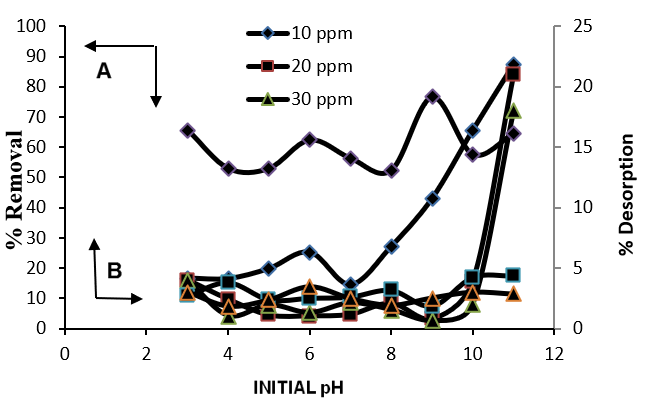
Effect of Desorption on Adsorption of Rhodamine 6G
Desorption studies help to elucidating the nature of dye adsorption and the recycling of the spent adsorbent. Desorption can be carried out using neutral pH water, alkali, mineral acid and organic acid like acetic acid.
Conclusion
In this work, carbonized sapota leaves was used as a low – cost adsorbent for the removal of cationic dye such as rhodamine 6G from aqueous solution with a adsorption capacity of 6.49 mg/g. The adsorption of dye followed Freundlich isotherm. A pseudo- second order kinetic model gave the best fit with high correlation coefficient (R2 = 0.999). The characterization of the adsorption was studied by SEM and FTIR. The significant amounts of rhodamine 6G uptake indicate that carbonized sapota leaves powder are good adsorbents for the removal of cationic dye from water.
References
-
Laasri L, Elamrani MK, Cherkaoui O (2007) Removal of two cationic dyes from a textile effluent by filtration- adsorption on wood saw dust. Environmental Science and Pollution Research International 14: 237- 240.
-
Hamdaoui O (2006) Dynamic sorption of methylene blue by cedar sawdust and crushed brick in fixed bed columns. J of Hazardous Materials 138(2): 293-303.
-
Sangeetha J, Venugopal T (2021) Experimental and optimization studies for the adsorption of cationic dyes from synthetic waste water on the biomass of orthophosphoric acid activated barks of Prosopis cineraria. Iran J Chem Eng 40: 1067-1082.
-
Shen K, Gondal MA (2017) Removal of hazardous Rhodamine dye from water by adsorption onto exhausted coffee ground. J Saudi Chem Soc 21: 120-127.
-
Sampaio CDG, Freitas FA, Souza FTCD (2015) Characterization and use of noni (Morindacitrifolial) seeds for the removal of hexavalent chromium ions from aqueous solutions. Int J Civ Environ Eng 15: 154848- 155102.
-
Gupta VK, Suhas (2009) Application of low-cost adsorbents for dye removal-a review. J Environ Manag 90: 2313-2342.
-
Celestino GG, Henriques RR, Shiguihara AL, Constantino VRL, Siqueira Melo, et al. (2018) Adsorption of galic acid on nanoclay modified with poly(diallyldimethylammonium chloride). Environmental Science and Pollution Research (26): 28444-28454.
-
Marques BS, Frantz TS, Cadaval TR, Pinto LA, Dotto GL (2018) Adsorption of a textile dye onto piacava fibers: kinetic, equilibrium, thermodynamics and application in simulated effluents. Environmental Science and Pollution Research 26: 28584-28592.
-
Silva AMB, Serrao NO, Celestino GDG, Takeno ML, Antunes NT, et al. (2019) Removal of rhodamine 6G from synthetic effluents using Clitoria fairchildiana pods as low –cost biosorbent. Environmental Science and Pollution Research 27: 2868-2880.
-
Lagergren S, Svenska BK (1898) Zurtheorie der sogenannten adsorption geloester stoffe. Vetenskapsakad Handl 24: 1-39.
-
Ho YS, Kay GM (1998) A comparison of chemisorption kinetic models applied to pollutant removal on various sorbents. Transactions of the Institute of Chemical Engineers 76(4): 332-340.
-
Zhaohui Li, Nicholas Potter, Joseph Rasmussen, Weng J, Guocheng L (2018) Removal of rhodamine 6G with different types of clay minerals. Chemosphere 202: 127- 135.
-
Jasper PM, Sumithra S, Ahammad S, Madakka M (2022) Exploring biosorption properties of Litchi chinensis peel for a cationic dye Rhodamine 6G in Liquid/Solid phase system: Kinetics and equilibrium studies. Watershed Ecology and the Environment 4: 66-72.
-
Sadhasivam S, Savitha S, Swaminathan K (2007) Exploitation of Trichoderma harzianum mycelia waste for the removal of rhodamine 6G from aqueous solution. J Environ Manag 85(1): 155-161.
-
Gupta VK, Jain R, Siddiqui MN (2010) Equilibrium and thermodynamic studies on the adsorption of the dye rhodamine B onto mustard cake and activated carbon. J Chem Eng 55: 5225-5229.
-
Postai DL, Demarchi CA, Zanatta F (2016) Adsorption of rhodamine B and methylene blue dyes using waste of seeds of Aleuritesmoluccana, a low-cost adsorbent. Alexandria Eng J 55: 1713-1723.
-
Freundlich H (1906) Uberdie adsorption in lusungen. J Phys Chem 57: 385-470.
-
Langmuir I (1918) The Adsorption of Gases on Plane Surface of Glass, Mica and Olatinum. Journal of the American Chemical Society 40(9): 1361-1403.
- Plant Diversity, Regeneration Dynamics, and Socio-Ecological Impacts at the Forest-Savanna Transition Zone, Cameroon
- Bird Community, Feeding Guilds and Habitat Associations Along the Proposed River Dibombe Hydropower and Transmission Line Project in Nkam and Moungo Divisions, Cameroon
- Plant Diversity and Carbon Storage Potential Across Different Land Use Types in Infrastructure Development Landscapes in Cameroon: Implications for no Net Loss of Biodiversity
- Optimization and Modelling for the Remediation of Brilliant Green Dye and Ni2+ ions from Water Using Advanced gC3N4/PVA@ Alginate Bio-Polymeric Hydrogel Beads
- The Negative Implications of Using Cell Phones on Human Health and Environment
- A Comprehensive Survey of Population Ecology in Insects