
Prospects and Sustainability in Car Parking Systems in select Neighbourhoods of Port Harcourt Municipality
Well-organised parking in cities promotes urban environmental sustainability and livability. The study aimed to explore and sustain the prospects of parking systems in neighbourhoods of Port Harcourt Municipality, Nigeria. The objectives were ascertaining the parking systems of neighbourhoods of the study area, identifying prospects of parking systems of neighbourhoods of the study area, and identifying measures to sustain the prospects of parking systems in neighbourhoods of the study area. The study adopted a quantitative approach using a descriptive research design. The study employed stratified and simple random sampling techniques to select sampled neighbourhoods and respondents for the study. A stratified sampling technique was employed to group the neighbourhoods into 3 strata (high, medium and low densities). 3 neighbourhoods were selected to represent each stratum namely: PH Township (high density), Orominike-D/Line (medium density) and Orije Layout- Old GRA (low density) for the study. A total of 397 respondents were determined and interviewed using the Taro Yamane formula at a 5% precision level. The study revealed that there exist on-street and off-street parking systems with various parking types including parallel, perpendicular, echelon angled and double-parking types. These parking systems are both off-street and on-street types. The prospects of the parking systems parking spaces in the building premises, along the carriageway on the street, in front of the building, space in other premises, public places and open spaces within the neighbourhoods. These conditions have promoted orderliness, safety, and security of road users such as residents, businesses, and visitors. The study found measures to sustain the prospects are creating more parking spaces/lots and designate parking area in the neighbourhoods, building a paid-parking facility in the neighbourhoods, marking parking areas clearly, government should enforce provision of parking spaces on premises, avoiding parking in the front of buildings where the space is inadequate, stop using designated parking spaces for other purposes, parkers to stop double parking in the streets, and impound broken-down vehicles in the streets. Therefore, to further sustain and enhance the prospects of parking systems in the neighbourhoods, the study recommended all government agencies should synergise to prepare parking plans for neighbourhoods. identify vacant spaces at strategic locations in the neighbourhoods where off-street parking facilities will be provided, clearly mark out designated parking spaces and parking lots along the streets, introduce a paid-parking system in the neighbourhoods, introduce one-side (parallel or perpendicular) parking along streets that are narrow in width, regulate and enforce the elimination of street trading, indiscriminate parking, removal of bad vehicles and discourage double parking in the neighbourhoods.
Introduction
The increasing urbanisation phenomenon globally has contributed to an increase in urban assets such as residential neighbourhoods, industries, commercial and open spaces for recreation and leisure activities likewise demand for infrastructure and services provision. Developing economies and urban centres of the Global South of Asia and Africa are experiencing rapid urbanisation which is expected to increase to 68% in 2050 [1, 2]. In these urban centres of developing economies, one intriguing concern of the urbanisation process is the provision of parking spaces and available parking systems in residential neighbourhoods for residents, businesses, and visitors. Thus, the absurd handling of parking systems in neighbourhoods negates the objectives of planning and management of urban centres to achieve sustainability. Complications concomitant with parking in neighbourhoods result in the obstruction of vehicular movement, pedestrian congestion, and parking difficulties for residents, visitors, and businesses [3]. These conditions negatively affect non-motorised transport movement and the loss of open spaces within neighbourhoods contributes to the distortion of the physical, social, and economic conditions of neighbourhoods [3].
The phenomenon of inadequate parking changes the neighbourhoods, street landscapes and functions and further jeopardises residents, business owners and visitors’ security and safety when using roads and other street amenities [4]. However, irrespective of these negative conditions if neighbourhood parking systems are not properly planned and managed, there are prospects if properly harnessed by urban planners, local authorities, and residents of the neighbourhoods to achieve sustainable urban planning and development. Many neighbourhoods in Nigerian urban centres are perplexed with parking inadequacy, though the prospects for improving parking systems have not been adequately explored by local authorities, urban planners and other stakeholders of the neighbourhoods including residents, businesses, and visitors to improve vehicular and pedestrian movements, reduce security and safety concerns and pollution levels to promote good quality of life and liveability. Port Harcourt Municipality like any other urban centre in Nigeria is plagued with the same situation of parking inadequacy. However, in the neighbourhoods of Port Harcourt Municipality, parking systems available are showcased with prospects that will promote sustainability in the urban environment of Port Harcourt Municipality. The local authorities, urban planners and neighbourhood stakeholders have not looked at these prospects to resolve parking inadequacy in the neighbourhoods. These conditions have marred and made the landscape of the neighbourhood obsolete in character and function. The ineptitude of the local authorities and urban planners has increased parking challenges in the neighbourhoods, affecting residential and socioeconomic activities. Therefore, there is a need to explore and sustain the prospects of the parking systems of the neighbourhoods in the municipality to redefine the streets and neighbourhood character, and functions to promote sustainability, liveability, and quality of life.
Statement of the Problem
Parking prospects in neighbourhoods showcase the quality of the neighbourhoods in terms of physical appearance and socioeconomic disposition. Observations indicate that the neighbourhoods of Port Harcourt Municipality represent parking inadequacy affecting residents, businesses, and visitors’ expectations. This condition has generated challenges resulting in low performance of parking systems in the neighbourhoods of the municipality. The parking situation may have been caused by poor urban planning and management attributed to ineffective development control measures by local authorities and developers, and road users not complying with parking provisions. These conditions result in the alteration of streets and neighborhood’s character, landscape, and function. This study seeks to explore and sustain the available prospects of parking systems in the neighbourhoods of the municipality to achieve sustainability and livability in the urban environment.
Aim and Objectives of the Study
The study aims to explore and sustain the prospects of parking systems in neighbourhoods of Port Harcourt Municipality, Rivers State, Nigeria.
The Objectives of the Study are to
- Ascertain the parking systems of neighbourhoods of the study area;
- Identify prospects of parking systems of neighbourhoods of the study area; and
- Identify measures to sustain the prospects of parking systems in neighbourhoods of the study area.
Scope of the Study
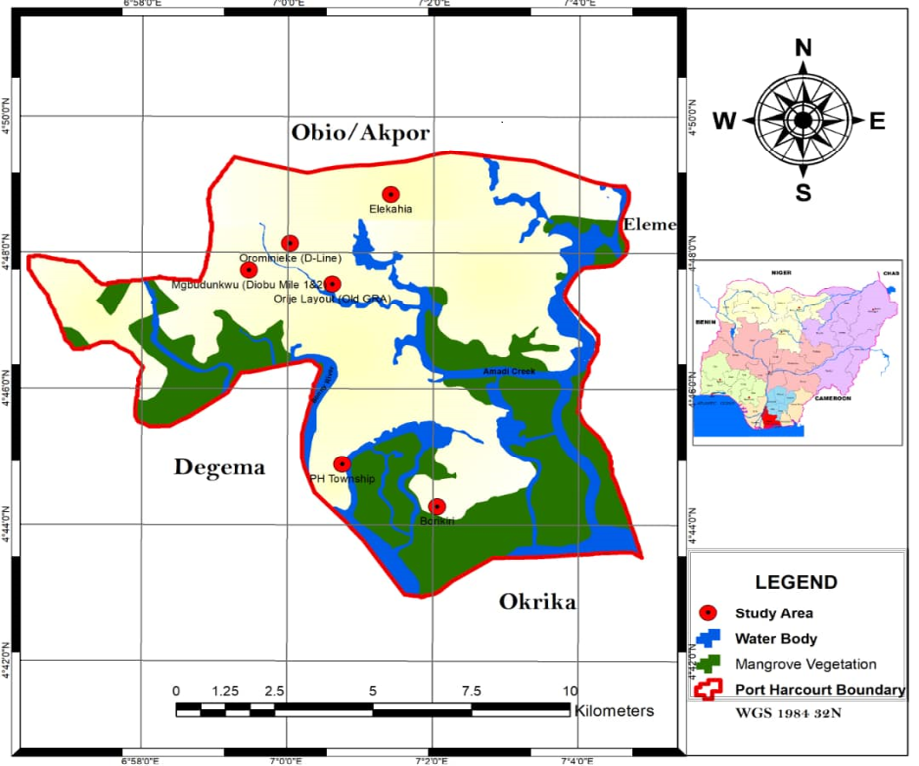
Geographically, the study covers selected neighbourhoods of Port Harcourt Municipality of Rivers State, Nigeria (Figure 1). Contently, the study covers ascertaining the parking systems of neighbourhoods of the study area; identifying prospects of parking systems of neighbourhoods study area; and identifying measures to sustain the prospects of parking systems in neighbourhoods of the study area.
Literature Review
Parking as a Concept
The concept of parking according to Lay MG [5] is described as motorised vehicles such as cars, buses, tricycles, trucks, and other movable modes of land transport in urban streets and neighbourhoods are considered as the act of stopping and disengaging a vehicle and leaving it unoccupied for some time. This condition ensures that a vehicle is parked and disengaged from moving in a carriageway. Hence, for a vehicle to be considered being parked, space will be available for parking such as a parking lot or bay. A parking lot or bay is the space allotted for parkin a vehicle in an environment such as streets and neighbourhoods. Parking Network [6] describes the space allotted for parking are marked with white or yellow lines to form a rectangular or squared shape to fit a vehicle considering the types of vehicles expected to park. Parking lots or bays are the spaces provided or contained in a parking facility. Parking facilities are property specified for parking purposes in a street or neighbourhood which can be publicly or privately owned and managed and indoor or outdoor [7].
Parking facilities are planned, designed, and managed both publicly and privately depending on the country and locality preference. This parking facility is also influenced by the availability of land, technological advancement, economy, and culture of the people in the country and locality. Some countries and localities advocate for parking facilities to be provided in streets, designated open spaces within the neighbourhood, in multi-story buildings, and underground garages as may be found in some developed countries and cities such as Japan (Tokyo), United States of America (New York City, Minnesota, Los Angeles), United Kingdom (London, Manchester, Gloucester), China (Beijing) [5].
Parking Characteristics
On-Street Parking
On-street parking as the name implies is a parking system in which vehicles are parked on the street within a neighbourhood [8]. In this type of parking, vehicles are parked anywhere on or along a street, though there may be restrictions and regulations guiding the parking system depending on the municipal authority and traffic management agency of the city [8]. However, sometimes the conditions and regulations for parking on a neighbourhood street are determined by the right-of-way, width of carriageway and hierarchy of the road. Traffic signs are provided by the authority and there are traffic enforcement officers to direct persons on how to park in a particular street that allows on- street parking in a neighbourhood as presented in Figure 3 [9]. Sometimes a parking permit is needed for a person to park on a particular street. There are different types of on- street parking including parking on one side of the street and parking at both sides of the street, depending on the right-of- way, width of carriageway and road hierarchy.
Off-Street Parking
Off-street parking requires that vehicles can be parked anywhere on the street but off the carriageway and usually in a parking facility such as a garage, parking lot or driveway [8]. Off-street parking can be done indoors or outdoors by the parker [10]. These parking facilities can be a private lot, a garage, or a public parking facility where the parker may pay for the lot where he or she is parking [8]. This may be hourly, daily, or monthly charge by the operator of the facility. This public parking facility might be located in the neighbourhood for easy access by residents and other users.
Parking Types
Perpendicular Parking
The perpendicular parking is also known as bay parking. In this parking arrangement cars or vehicles are parked side- to-side perpendicular to aisles, walls, and curbs in streets or neighbourhood parking facilities [11, 12]. In this type of parking, the cars are parked side-by-side in perpendicular order considering the opening of the doors of each car parked without obstruction [12]. This type of parking arrangement contains more vehicles than the parallel parking arrangement and is commonly used in on-street parking.
Parallel Parking
Parallel parking arrangement is commonly used in on- street parking for vehicles. In this parking arrangement, vehicles are parked in the same line such that the front bumper of a vehicle is facing the back or rear bumper of another vehicle that is adjacent [13, 14]. During parking vehicles are parked and consciously keep a reasonable distance at the front for safety reasons and going out of the parking space without many difficulties. This parking arrangement can be used in parking lots and parking facilities that belong to the off-street parking system [13].
Angled Echelon Parking
The angled echelon also known as angle parking is like the perpendicular parking for these vehicles except that cars are parked or arranged at an angle to the aisle [15]. For example, cars are parked at an acute angle with a direction of approach such that it allows the driver to reverse back out in the carriageway without many difficulties [12, 16]. This type of parking can be organised or arranged in street sides (on- street parking) and in parking facilities in neighbourhoods (off-street parking). This is one of the most common parking arrangements both on the street and in parking facilities within neighbourhoods. This type of parking arrangement in practice accommodates more vehicles than the perpendicular and parallel parking arrangements [15].
Double Parking
Double parking occurs when a vehicle is parked or is standing on a roadside where another vehicle has parked already at an aisle, kerb, or wall [17, 18]. This type of parking is unconventional and should be discouraged in any human activity environment [18]. This type of parking is not an acceptable parking type conventionally [17]. It occurs where there is not enough parking space provided in a street, and the car ownership is higher than the provided space for parking.
Prospects of Adequate Parking and Measures to Improve Parking Systems in Urban Areas
The increase in population density and vehicles on the road space of London City has also increased the demand for parking space [19]. To reduce traffic congestion and improve parking in the United Kingdom, the Smarter Cambridge Transport (SCT) [20] has recommended the extension of residents’ parking zones in residential areas and charge for workplace parking within residential areas [20]. Furthermore, the city has also introduced the Blue Badge holders’ standard and regulation to reduce the usage of cars and optimise parking by encouraging the use of cycles and pedestrian walkways in residential areas [19].
In the city of Paris, the government provided public parking lots underground to reduce parking challenges and traffic congestion on streets and various neighbourhoods annexing midtown, shopping malls and tourist sites.
The parking lots provided were organised with a paid- parking system and operated 24 hours and 7 days a week [21]. This provision has allowed residents the opportunity to have space to rent for parking and even for their visitors if they don’t have such space in their living residence [21]. Accordingly, to improve parking and reduce issues arising from parking in the city of New York, the city authority introduced parking meter rates which are less expensive compared to other cities globally [22]. This system has been introduced in many cities globally such as London, Paris, and Munich. This system has become a more conventional method to provide and manage parking in many neighbourhoods that are moving toward sustainability in urban planning and management affairs. To resolve parking challenges, an African city such as Cairo has also introduced multi-story smart parking lots at different locations in the city including an underground parking system between Hegaz Square and Ghernata Block in Roxy and Tahrir Square neighbourhoods [23]. These provisions have greatly improved parking and promoted sustainability in Cairo.
Methodology
To obtain relevant information and data to achieve the aim and objectives of the study, the study applied a quantitative approach using descriptive research design to explore and sustain the prospects of parking systems of neighbourhoods in Port Harcourt Municipality, Nigeria. The study employed stratified and simple random sampling techniques for data collection. The neighbourhoods were stratified into three (3) strata (high, medium, and low densities). Consequently, the Taro Yamane formula at a 5% precision level was employed to determine the size of the study in which 397 respondents were determined and interviewed (Table 1). Three (3) neighbourhoods were selected to represent each stratum namely: PH Township (high density), Orominike – D/Line (medium density) and Orije Layout- Old GRA (low density) for the study. Therefore, to determine the sample size, the population of the neighbourhoods were projected for the study year 2023 using 1991 population census results with a 6.5% growth rate (National Population Commission [24, 25]. A sample size was actualised using an average of 5 persons per household to determine the number of households in the sampled neighbourhoods (National Bureau of Statistics [26]. The determined sample size was proportionately distributed across the households of the sampled neighbourhoods of the study area. A simple random technique was employed to select respondents who were interviewed. Also, physical observations were used to characterise the parking systems of the neighbourhoods and the prospects were identified in the study area. For collation and analysis, 366 questionnaires were retrieved and valid for analysis.
| Densities and Sampled Neighbourhoods | 1991 Population | 2023 Population (Projected Using 6.5% Growth Rate) | Number of Households (5 Persons per Household) | Number of Households Sampled |
|---|---|---|---|---|
| High Density PH Township | 12,369 | 92,768 | 18,554 | 122 |
| Medium Density Orominike (D/Line) | 21,377 | 160,328 | 32,066 | 211 |
| Low Density Orije Layout (Old GRA) | 6,482 | 48,615 | 9,723 | 64 |
| Total | 40,228 | 301,711 | 60,343 | 397 |
Table 1: Sampling Details for the Study. Source: Authors 2023.
Results and Discussion
Parking Systems of Neighbourhoods of the Study Area
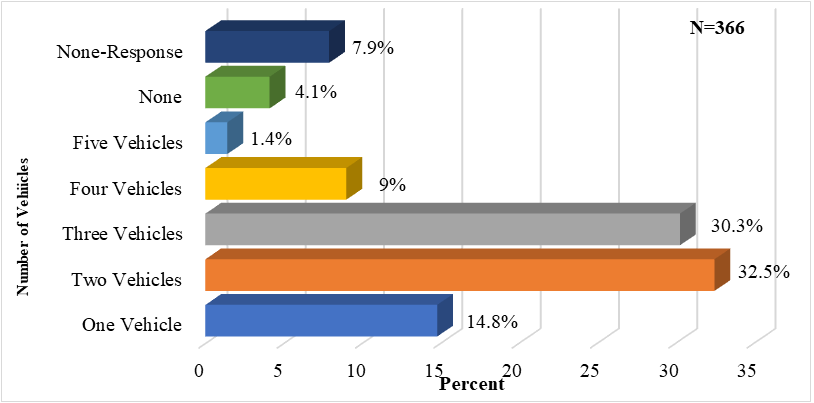
The study has identified varied parking types and characteristics in the neighbourhoods of the study area. These conditions are determined by residents’ vehicle ownership and the type and number of households having vehicles in a building. The study findings showed that the modal types of vehicles owned by the respondents were “salon cars”, “mini-buses (7-seater)” and “combi- buses (13-seater)” represented by 56.6%, 5.5% and 4.9%, respectively. Other types of vehicles indicated by the respondents include “tricycles”, “delivery vans”, “trucks” and “motorcycles” (Table 2). The number of vehicles in buildings draws a relationship with the number of households that owned vehicles in buildings in the study area. From findings in data presented and analysed in Table 7 showed that modal households that owned vehicles in buildings in the study area were “2-households”, “1-household” and ‘3-households” represented 33.3%, 24.9% and 20.2%, respectively. The implication of this data showed an average of “2-households” have vehicles in the buildings of the study area. This further showed that the modal number of vehicles in buildings of the study area were “two-vehicles”, “one-vehicle” and “three-vehicles” represented by 32.5%, 30.3% and 14.8%, respectively. This implies that an average of “two-vehicles” are owned by a household in the buildings sampled in the study area (Figure 2).
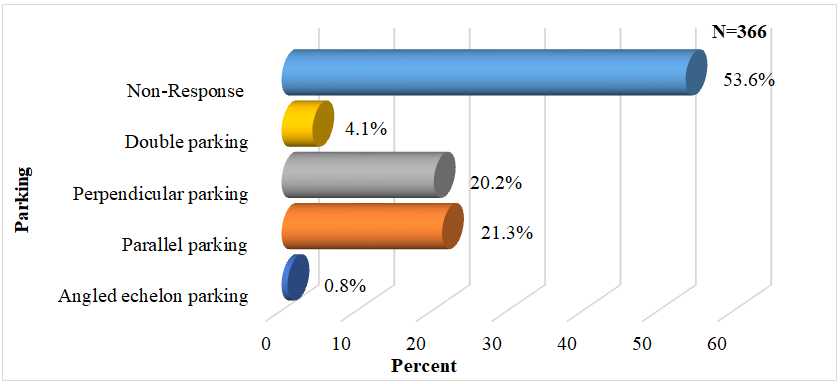
The study from these characteristics of households’ vehicle ownership, types and number of households owning vehicles have indicated the types of parking systems available in the neighbourhoods for parking. From indications, two (2) prominent types of parking systems available on the streets of the neighbourhoods are “parallel parking” and “perpendicular parking” accounting for 21.3% and 20.2%, respectively. Other notable available parking systems as indicated by the residents are “double parking” and “angled echelon parking” which have 4.1% and 0.8%, respectively from the responses in the study area (Figure 3). According to Estepa, et al. [18] and Parkhound [17], double parking is not acceptable in any human settlement and is an unconventional parking type which should be discouraged by any parking system in neighbourhoods. However, double parking occurs where the parking demand is more than the provided parking space in the neighbourhoods such as PH Township and Orominike (D/Line) areas. It is also observed that these parking systems are both off-street and on-street parking types in these neighbourhoods. These parking systems are in line with the descriptions of Chegg [10], Parking Network [8] and Zhang, Li, et al. [9] in them portraying off-street and on-street parking systems as observed in the study area.
| Type of Vehicle Owned | N | % |
|---|---|---|
| Saloon car | 207 | 56.6 |
| Minibus (7-seater) | 20 | 5.5 |
| Combi bus (13-seater) | 18 | 4.9 |
| Delivery van | 5 | 1.4 |
| Truck | 2 | 0.5 |
| Motorcycle | 2 | 0.5 |
| Tricycle | 8 | 2.2 |
| Non-response | 104 | 28.4 |
| Total | 366 | 100 |
Table 2: Types of Vehicles Owned by Respondents. Source: Fieldwork, 2023
Source: Fieldwork, 2023
Prospects of Parking Systems of Neighbourhoods in the Study Area
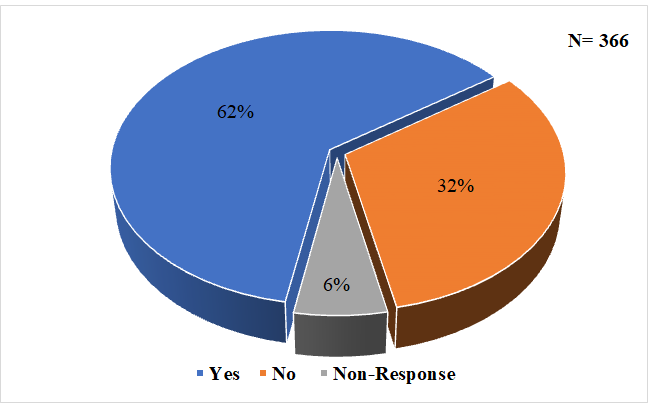
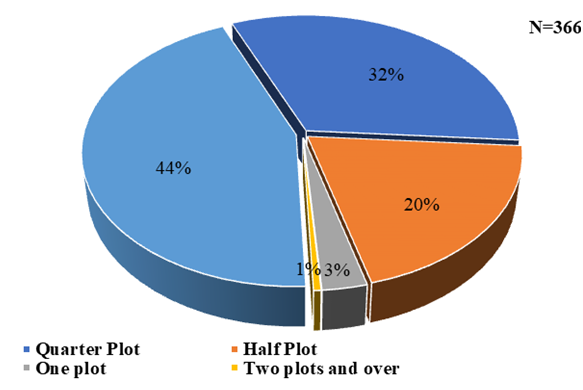
The available parking systems in the neighbourhoods of the study area appear to have prospects that will improve parking and promote environmental sustainability in the neighbourhoods of the Municipality. The study findings further showed that 62% of the respondents affirmed “yes” there are spaces for parking in their buildings while 32% said ‘no” space for parking is not available (Figure 4). The sizes of the available space for parking in the respondents’ premises were highlighted in Figure 5. This showed that the available size as parking space on the premises was mostly “quarter plot” and “half plot” sizes accounting for 32.5% and 20%, respectively as indicated from the responses of the residents in the study area. Apart from the space for parking on the premises of the residents, there are alternative spaces for parking according to the respondents. The other alternative spaces for parking as indicated by the respondents in the study area were “along the carriageway on the street”, “in front of the building”, “in other premises in the neighbourhood” and “a public place provided in the neighbourhood” which accounted for 17%, 10.7%, 2.5% and 0.1%, respectively. The findings show that residents also have alternative spaces for parking when parking spaces are not provided on the premises they live in (Table 3).
From observation, there are open spaces in the neighbourhoods used for parking by residents, businesses, and visitors where the premises lacked parking space. These parking spaces provided are organised by private organisations and individuals. All these provisions are prospects from available parking systems that characterised the neighbourhoods of the study area. The available parking spaces and their sizes in the premises of residents, other premises, public and open spaces are off-street parking types while in front of the building and along carriageway within the neighbourhoods are on-street parking types which can be leveraged by parkers in the neighbourhoods. The parking systems available such as parallel, perpendicular and angle echelons promote orderliness, safety, and security of road users (vehicle owners, pedestrians), residents, businesses and visitors in the neighbourhoods studied.
Source: Fieldwork, 2023
| Alternative Space for Parking | N | % |
|---|---|---|
| Along the carriageway on the street | 62 | 17 |
| In front of the building | 39 | 11 |
| In other premises in the neighbourhood | 9 | 2.5 |
| A public place provided in the neighbourhood | 1 | 0.3 |
| Non-response | 255 | 69 |
| Total | 366 | 100 |
Table 3: Alternative Space for Parking by Respondents. Source: Fieldwork, 2023
Measures to Sustain Prospects of Parking Systems in Neighbourhoods of the Study Area
However, considering the available parking systems, types and their conditions have highlighted measures to sustain and improve the parking prospects in the neighbourhoods studied. Table 4 highlighted the respondents’ suggestions on the most sustainable measures for the prospects of the parking systems such as creating more parking spaces/ lots in the neighborhood, designating parking areas in the neighbourhood, building paid-parking facilities in the neighbourhood, and marking parking areas accounting for 28.1%, 21.8%, 11.5%, and 10.7% of the respondents’ suggestions respectively.
Other suggested measures to sustain and improve the prospects parking systems in the study area were neighbourhoods should designate parking places, the government should enforce a provision of parking space on the premises, avoid parking in front of buildings where the space is inadequate, stop using designated parking spaces for other purposes, parkers to stop double parking in the streets and impound broken-down vehicles in the streets indicating 6%, 5.2%, 3.3%, 2.2%, 0.8%, and 0.3%, respectively from the suggestions. The city of Cairo has planned to introduce multi-story smart parking lots to improve parking in the city [27] which is in line with suggestions for the studied neighbourhoods of the study area. These suggested measures are expected to sustain and improve parking systems, types and conditions in the neighbourhoods and promote liveability and urban environmental sustainability.
| Measures to Sustain Parking Systems in Neighbourhoods | N | % |
|---|---|---|
| Creating more parking spaces/lots in the neighbourhood | 103 | 28 |
| Designate parking areas in the neighbourhood | 80 | 22 |
| Build a paid parking facility in the neighbourhood | 42 | 12 |
| Neighbourhoods should designate a place for parking | 22 | 6 |
| The government should enforce a provision of parking space on premises | 19 | 5.2 |
| Stop using designated parking spaces for other purposes | 8 | 2.2 |
| Avoid parking in front of buildings where the space is inadequate | 12 | 3.3 |
| Mark parking areas clearly | 39 | 11 |
| Impound broken-down vehicles on the streets | 1 | 0.3 |
| Parkers to stop double parking on the streets | 3 | 0.8 |
| Non-response | 37 | 10 |
| Total | 366 | 100 |
Table 4: Measures to Sustain Parking Systems in the Neighbourhoods. Source: Fieldwork, 2023.
Conclusion
Parking is essential and crucial for neighbourhoods of urban areas to achieve environmental sustainability and improve the liveability of residents. The study has explored the parking situation to sustain the parking systems of neighbourhoods of Port Harcourt Municipality. The study has identified the existence of four parking systems in the studied neighbourhoods including parallel, perpendicular, angled echelon and double-parking systems. The first mentioned three parking systems identified are both off-street and on- street parking types found in the neighbourhoods studied. The available parking systems have prospects of spaces for parking in the building premises, along the carriageway on the street, in front of the building, in other premises in the neighbourhood, public places and open spaces within the neighbourhoods which can be leveraged by parkers. These conditions promote orderliness, safety, and security of road users (including vehicle owners, and pedestrians), residents, businesses, and visitors of the neighbourhood. Furthermore, the findings indicated measures to sustain the prospects of the parking systems include creating more parking spaces/ lots in the neighbourhood, designating parking areas in the neighbourhood, building paid-parking facilities in the neighbourhood, marking parking areas, government enforcing the provision of parking space in premises, avoid parking in front of buildings where the space is inadequate, stop using designated parking spaces for other purposes, parkers to stop double parking on the streets, and impound broken-down vehicles in the streets. Therefore, to further sustain and enhance the prospects of parking systems in the neighbourhoods studied to achieve sustainability and liveability in the urban environment, the study has proffered recommendations to improve residents’ businesses and visitors’ quality of life and well-being.
Recommendations
- Rivers State Ministry of Physical Planning and Urban Development and Port Harcourt City Local Government Council should synergise to prepare parking plans for neighbourhoods to enhance the parking prospects to improve the parking conditions for the residents, businesses and visitors.
- Rivers State Ministries of Physical Planning and Urban Development and the Transport counterpart should identify vacant spaces at strategic locations in the neighbourhoods where off-street parking facilities will be provided to accommodate the parking demands of the neighbourhoods.
- Rivers State Ministries of Transport and Physical Planning and Urban Development should collaborate to mark out designated parking spaces and parking lots along the streets of the neighbourhoods to separate vehicular paths, parking areas and pedestrian walkways in streets to enhance the safety of all road users and on- street parking system.
- The government should introduce a paid parking system in the neighbourhoods, especially in off-street parking facilities that will be provided and on-street parking spaces along streets that are close to major commercial facilities and office complexes.
- The government should introduce one-side (parallel or perpendicular) parking along streets that are narrow in width to enhance parking and mitigate double parking systems in the neighbourhoods.
- Rivers State Ministries of Physical Planning and Urban Development, Transport and Environment should regulate and enforce the elimination of street trading, indiscriminate parking, removal of bad vehicles along the streets and discourage double parking to improve parking in the neighbourhoods. References
1. World Economic Forum (2020) 70 Years of Urban Growth in 1 Infographic. Sustainable Development.
2. Enger ED, Smith BF, Bockarie AT (2006) Environmental Science: A Study of Interrelationships. 10th (Edn.), McGraw-Hill Companies Inc, New York, USA.
3. Edano DJC (2000) Urban Transport Problems.
4. Rodrigue J (2020) The Geography of Transport Systems. 5th(Edn.), New York, USA: Routledge, pp: 456.
5. Lay MG (1992) Ways of the World: A History of the World’s Roads and the Vehicles That Used Them. Rutgers University Press, New Jersey, USA. pp: 184.
6. Parking Network (2020a) About Parking.
7. Parking Network (2020b) Parking Facilities.
8. Parking Network (2021) On and Off-street Parking.
9. Zhang Z, Li X, Yuan H, Yu F (2013) A Street Parking System Using Wireless Sensor Network. International Journal of Distributed Sensor Networks 4.
10. Chegg (2023) Off Street Parking Facilities.
11. The Ranty Highwayman (2020) Perpendicular, Parallel or Pitched- The Ranty Highwayman: Parking.
12. Alberta (2023) Parking.
13. Smith H (2018) Parallel Parking.
14. Piao C, Zhang J, Chang K, Li Y, Liu M (2021) Multi-Sensor Information Ensemble-Base Automatic Parking System
for Vehicle Parallel/Nonparallel Initial State. Sensors 21(7): 1-19.
15. Pass Member (2019) What are the Four Types of Parking?
16. Ficek B (2019) Back Angle Parking.
17. Parkhound (2020) Are there Ways to Double Park Successfully?
18. Estepa R, Estepa A, Wideberg J, Jonasson M, Trigell A (2017) More Effective Use of Urban Space by Autonomous Double Parking. Journal of Advanced Transportation 6: 1-10.
19. Transport for London (2017) Residential Car Parking: Part of the London Plan Evidence Base, London, pp: 1-43.
20. Smarter Cambridge Transport (SCT) (2016) Reducing Traffic Congestion and Pollution in Urban Areas.
21. Mona (2020) Parking in Paris: Where to Park, And How
Much Does It Cost?
22. Gazette G (2020) The Perfect Parking Spot for Congestion Pricing.
23. Egypt Today (2018) Cairo to Establish Smart Parking Lots to Reduce Traffic Congestion.
24. National Population Commission (1991) 1991 Population Census Report of Nigeria. Federal Government Press, Lagos, Nigeria.
25. National Population Commission (2018) NPC Puts Nigeria’s Population at 198 Million.
26. National Bureau of Statistics (2016) General Household Survey- Panel Wave 3. National Bureau of Statistics, Abuja, Nigeria.
27. World Bank (2014) Traffic Congestion in Cairo: An Overview of the Causes as Well as Possible Solutions.
- Plant Diversity, Regeneration Dynamics, and Socio-Ecological Impacts at the Forest-Savanna Transition Zone, Cameroon
- Bird Community, Feeding Guilds and Habitat Associations Along the Proposed River Dibombe Hydropower and Transmission Line Project in Nkam and Moungo Divisions, Cameroon
- Plant Diversity and Carbon Storage Potential Across Different Land Use Types in Infrastructure Development Landscapes in Cameroon: Implications for no Net Loss of Biodiversity
- Optimization and Modelling for the Remediation of Brilliant Green Dye and Ni2+ ions from Water Using Advanced gC3N4/PVA@ Alginate Bio-Polymeric Hydrogel Beads
- The Negative Implications of Using Cell Phones on Human Health and Environment
- A Comprehensive Survey of Population Ecology in Insects