
Simultaneous Dislocation of the Interphalangeal and Carpometacarpal Joints of the Thumb
It is rare to encounter cases of simultaneous dislocations of two joints of a finger. We report a case of simultaneous dislocation of the interphalangeal and carpo-metacarpal of an inch with a normal metacarpophalangeal joint.
Introduction
It is rare to encounter cases of simultaneous dislocations of two joints of a finger. We report a case of simultaneous dislocation of the interphalangeal and carpo-metacarpal of an inch with a normal metacarpophalangeal joint. A young engineer of 30 years right-hander laterality was admitted to the emergency after a sports accident, falling on his right hand with a thumb in hyper extension during a football game, complained of pain, Deformity and functional disability of his right thumb. On examination, there was a visible dorsal dislocation of the carpo-metacarpal (CMC) and interphalangeal (IP) joints of the thumb without cutaneous opening or vasculonervous disorder. Radiological examination revealed a pure double dislocation of the CMC and IP joints of the first finger.
Image Article
Under locoregional anesthesia and brightness amplifier control a closed focus reduction supplemented by a double broaching of the two dislocations using Kirschner 12/10 pins was made. Control radiographs confirmed the reduction and absence of associated fracture. Postoperatively, the hand was held in a thumb splint. After six weeks, the patient was seen and the pins were removed under local anesthesia. Functional rehabilitation was started At three months, the joint amplitude balance showed a flexion at 70
- for the CMC and 70
- for the PI, an active extension at 0
- for the CMC and the PI, without pain or residual laxity.
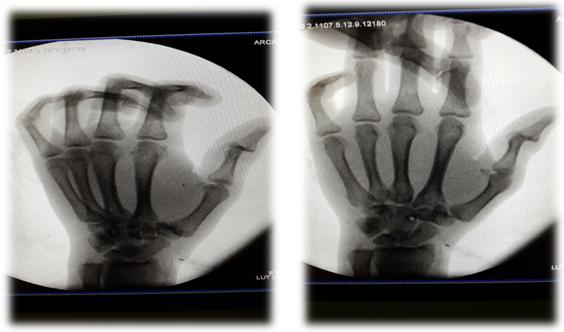
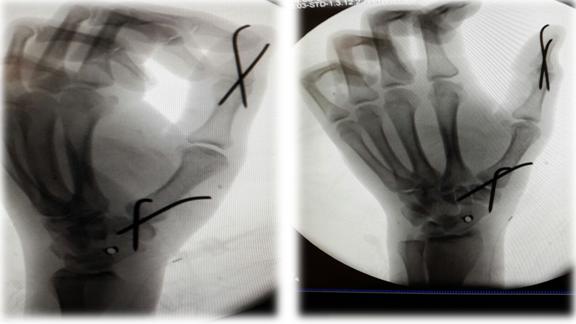
Figure 3,4 : Double Broaching of The Two Dislocations Using Kirschner 12/10 Pins
- Return to Work Among Manual Workers After the Latarjet Procedure: A Cohort Study of 43 Patients
- Refractory Pelvic Collection Following Modified Stoppa Approach for Both-Column Acetabular Fracture Fixation: A Case Report
- Comparative Study of Dynamic Knee Phenotypes Under Loaded and Unloaded Conditions: Clinical Impact
- Locked Intramedullary Nailing of the Tibia Using a Humeral Nail: A Care Case Report
- Subtalar Dislocation: About a Case Report
- Surgical Site Infection in Orthopedics in a Country with LimitedResources: Indications, Treatment and Results