
An Assessment on Water Quality (TDS, EC, ORP, and PH) of Selected Boreholes in Baraton Centre
Drinking water is a very essential part of every living being. Due to shortage of tap water for many households in Kenya, Borehole has become one of the main sources of water, which offers support to human health, diversity in the ecosystem and economic growth. Water quality is essential for policy formulation affecting health. This is due to the fact that, ground water resources are commonly vulnerable to pollution which degrades their quality. Some of the toxicological effect that have been reported of drinking polluted water include cancer, genetic aberrations among other ailments due to borehole minerals and metals. In this study, borehole water quality analysis involved determining the levels of Total dissolved solids (TDS), Electrical conductivity (EC), Oxidation-Reduction potential, and pH to aid in monitoring borehole water data. This was compared against the standards set by W.H.O, who have created water quality guidelines which provides a Limit Value for each parameter for drinking water. It is crucial that a continuous monitoring of water quality is done at regular periods due to global changes in population, increased pollution and use of river waters resulting in the consumption of contaminated drinking water. Many people suffer from varied water borne diseases hence the great interest in having details about various physico-chemical parameters such TDS, EC, ORP, salinity and pH determined. The samples collected were analyzed. The average PH was 5.25 which is not fit to be consumed thus posing a risk to humanity. The electrical conductivity was averagely 113μS/cm. The TDS level was averagely 56.5 ppm. The average ORP was 376.8 mV. There was a variation in the samples collected depending with the season. By use of standard analytical methods, the research investigated the variation of pH, EC, ORP, TDS and salinity which is a good indicator of water quality. WHO has asserted that, the safest water should be of lower conductivity of 200 to 800 μS/cm, ORP of -50 millivolts, TDS of 300 parts per million (ppm) and pH of 6.5-8.5. The study has thus compared the levels against the above standards and also presented the correlation between the parameters in addition to showing the seasonal variations of the above physical –chemical parameters.
Introduction
With increased demand for water due to global climate change and due to unavailability of tap water within Baraton area, a number of households have resorted to digging boreholes to enable them meet the increased demand for water.
This water is then consumed directly without testing or any treatment. This research tries to verify the safety of water using various physical-chemical parameters. They include EC, TDS, Salinity.
- pH is a measure of the hydrogen ion (H+) available in water.
- Salinity is a measure of the amount of salts in the water
- TDS-When compounds are dissolved in water; their ions dissociate and increase both the amounts of dissolved solids in the solution.
Electrical conductivity gives an indication of the amount of total dissolved substitution in water. Groundwater conductance is a function of type of present ions.
Background
The quality of water serves a very crucial role in the lives of humanity. Before ingesting the water, they have to be sure of its quality. The quality of water is affected by the levels of industrial wastes that are non-biodegradable. The poor disposal of wastes plays a major role in poor quality of borehole water that makes it unsafe for human consumption [1].
The quality of water can be detected both chemically and physically. This is referred to as the psycho-chemical quality. The physical properties are properties that are easily detected. They may include the taste, color, smell and temperature. The chemical properties are tested by the laboratory analysis and these include the dissolved salts that cannot be easily seen. These are; toxic metals, inorganic compounds etc. They majorly affect the human health and the other living organisms’ too [2].
Globally, millions of people use the borehole water and a smaller percentage is keen on its quality. Research has shown that most borehole water in the urban centers is not safe due to the pollution that is on a higher rate than the rural areas. This comes about as a result of the industries that are majorly located in the urban centers. Most African urban centers have poor disposal of wastes management due to the many industries located there. The lives of so many Kenyans are at risk as most run to the urban centers for the purposes of employment. Their stay there makes them partake the contaminated borehole water as it’s a major source.
Statement of the Problem
The WHO reports that Kenya is ranked as one of the countries that lack improved water sources. The reason is because there is a lot of pollution beyond the limits as most people end up exaggerating with the way they manage the environment. The improper disposal of the wastes in water sources may cause water borne diseases which may lead to other diseases such as cholera and other waterborne diseases.
Health practitioners persist that a lot of water should be taken by living organisms and hence when the source is contaminated, their lives are at a higher risk. Borehole being a major source of water, its quality should be closely monitored. Its quality varies mostly depending with the season and the environmental management.
According to world health organization. pH 6-8, salinity should be less than 600ppm, EC 300uS/cm3 and TDS 600ppm. Goal is to compare the above levels against the set standards.
Justification
This research will contribute in determining water quality parameters and recommending for suitable action or creating awareness about water quality and water borne diseases.
The information from this research will be used to guide government agencies, researcher’s other development organizations like NGO’s to develop strategies, policies and institutional infrastructures to provide quality and accessible water resources to communities.
Scope of Study
This study was conducted in University of Eastern Africa, Baraton and the samples were obtained from Baraton area.
Literature Review
The purpose of this chapter is to set the present study in the context of other studies of groundwater vulnerability. Since this study employs a statistical approach to vulnerability assessment, the literature review emphasizes those studies that have applied statistical methods to this problem. In addition, the use of nitrate as an indicator of vulnerability to contamination by agricultural chemicals is discussed. This chapter addresses the following questions: What uses are there for groundwater vulnerability analysis? What methods are used for groundwater vulnerability analysis? Why use a statistical approach? How have statistical methods been applied to groundwater vulnerability analysis? What does the occurrence of nitrate indicate about agricultural contaminants? How does the method used in the present study differ from previous statistical approaches?.
Uses for Groundwater Vulnerability Assessment
A groundwater vulnerability analysis identifies regions where groundwater is likely to become contaminated as a result of human activities. The objective of vulnerability analyses is to direct regulatory, monitoring, educational, and policy development efforts to those areas where they are most needed for the protection of groundwater quality. Fundamentally, this is a 31 economic goal, rather than a scientific one. Vulnerability analysis should provide an answer to the question “Where should groundwater protection efforts be directed to return the most environmental and public health benefits for the least cost?” In its 1991 final report, EPA’s Ground-Water Task Force states as part of its “Ground Water Protection Principals” that “Efforts to protect ground water must also consider the use, value, and vulnerability of the resource, as well as social and economic values.” (USEPA, 1991, emphasis added) [3]. The report goes on to list consideration of groundwater resource vulnerability as part of a “mature” method for setting priorities for groundwater protection. As an example of State efforts EPA regional offices should use as indicators while evaluating progress in the implementation of State Ground Water Protection Plans, the report cites development of a comprehensive State vulnerability assessment effort that can assist in developing State Pesticide Management Plans; targeting mitigation measures under State Nonpoint Source Management Plans; and prioritizing ground-water areas for geographically targeted education; permitting; enforcement and cleanup efforts across all ground-water related programs. Two specific examples of EPA’s intended use of groundwater vulnerability analysis are the existing regulations defining National Primary Drinking Water Standards, and the proposed differential protection strategy for imposing more restrictions on pesticide use where groundwater is vulnerable.
Physico-Chemical Quality of Domestic Borehole
The physico-chemical properties of water are a combination of physical and chemical properties of water. The physical qualities include all those qualities of water that can be detected using the human sense of sight, touch, taste and smell. These parameters include; colour, taste and odour, temperature, suspended solid, etc. Chemical quality describes all those substances that are soluble or dissolved in water. Their presence cannot be easily detected except upon laboratory analysis. They can also impair the use of that water for its intended purpose. Examples of those parameters include dissolved cations and anions, toxic metals, organic and inorganic compounds, Biochemical Oxygen Demand (BOD), Chemical Oxygen Demand (COD), etc. Some of these compounds appear in quantities that are detrimental to human health [2].
Water temperature is an important property that determines water suitability for human use, industrial application and aquatic ecosystem functioning [4]. Although it is not used to evaluate directly potable water, but it governs to a large extent the biological species present and their rates of activities [5]. It also has effect on most chemical reactions that occur in natural water systems and solubility of gases in water. Groundwater temperatures vary based on the depth and characteristics of the aquifer from which they are drawn.
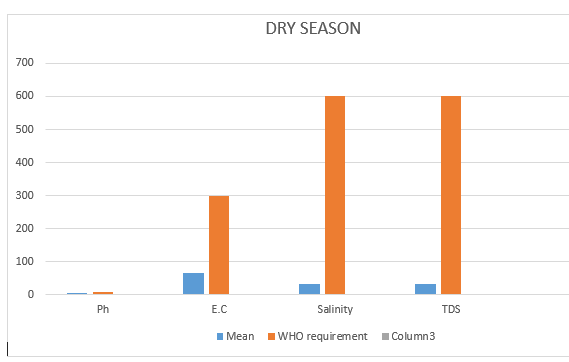
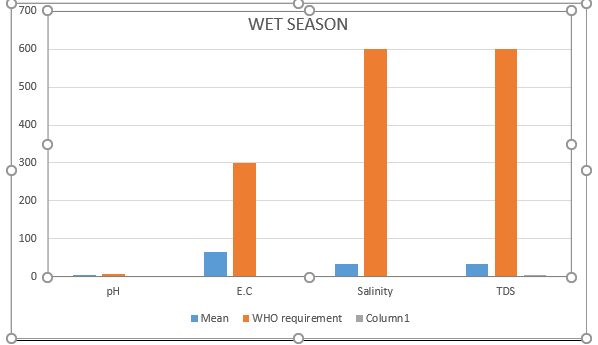
pH has no direct impact on consumers. It is one of the most important operational water quality parameters which determines the suitability of water for various purposes with the optimum pH ranging from 7 – 8.5. It determines the acidic and alkaline nature of water [6]. In general, a water with low pH (<6.5) could be acidic, soft and corrosive. Electrical conductivity is the capacity of electrical current to pass through the water and it is directly related to concentration of ionized substances in water [1]. The salt concentration is measured generally by determining the EC of water.EC is a good measure of salinity hazard to crops [7]. Excess of it reduces the osmotic activity of plants and therefore interferes with water absorption and nutrients from the soil. The TDS in water are represented by the weights of residue left when a water sample has been evaporated to dryness and it gives the general nature of groundwater quality and extent of contaminant [6]. They are compounds of organic and inorganic matter that are soluble in water. Concentrations of TDS in water vary considerably in different geological regions owing to differences in the solubility of minerals [8]. The concentration of dissolved solids in natural water is usually less than 500mg/l and it is satisfactory for domestic use as well as many industrial purposes like dyeing of cloths, manufacturing of plastics, pulp paper, etc [9] (Figures 1-5 & Tables 1 & 2).
Methodology
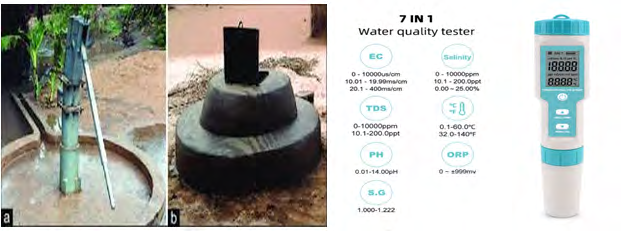
| Baraton centre | Lavington | Lower sang | Upper sang | Spring | Sodom | WHO requirement | |||||||
|---|---|---|---|---|---|---|---|---|---|---|---|---|---|
| Dry | Rainy | dry | wet | dry | wet | Dry | wet | dry | wet | dry | wet | ||
| pH | 4.86 | 4.35 | 5.32 | 5.03 | 5.6 | 5.32 | 4.68 | 4.64 | 4.9 | 4.88 | 4.96 | 4.8 | 6.5-8.5 |
| E.C | 38 | 35 | 110 | 109 | 55 | 54 | 55 | 57 | 44 | 43 | 95 | 95 | Less than 300uS/cm |
| Salinity | 19 | 18 | 55 | 53 | 27 | 26 | 28 | 29 | 23 | 21 | 48 | 47 | Less than 600 ppm |
| TDS | 19 | 18 | 55 | 53 | 27 | 26 | 28 | 28 | 23 | 21 | 48 | 47 | Less than 600 ppm |
Table 1: WHO requirement.
| Mean | WHO requirement | |
|---|---|---|
| Ph | 5.05833 | 6.5-8.5 |
| E.C | 66.1667 | Less than 300uS/cm |
| Salinity | 33.3333 | Less than 600 ppm |
| TDS | 33.3333 | Less than 600 ppm |
Table 2: Mean and requirements.
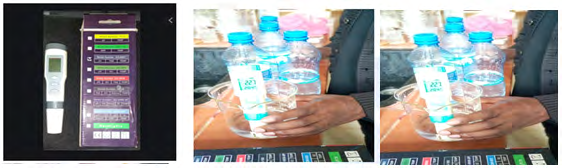
Each borehole was flushed for 3 minutes. The boreholes were then pumped to fill the clean water bottles. Water from boreholes without pumps was drawn into the sample bottles. Labelling was done for identification. PH reading was taken on sight. The bottles were then transported to the laboratory in an insulated box to prevent external factors like high temperatures from changing some of the water parameters. Analysis was conducted using the universal water quality tester com-600 from Explorium Scientists Limited.
Discussion
Electrical conductivity, salinity and TDS values were very low. The water pH was less than that of WHO requirement. Dry and wet seasons had impacts on all borehole water parameters determined. EC, TDS and salinity all increased in the wet season except for pH that decreased in the wet season; therefore, borehole water became more acidic in the wet season. All the other parameters met WHO requirement apart from pH. Low EC could be due to the ions being bound/ bonded to other organic compounds hence unavailable for determination. The low pH level may be due to the fertilizers in the tea farms and this could have lowered the pH more in the rainy season due to increased leaching of the fertilizer. The fertilizer used around Baraton is NPK (Nitrogen, Phosphorus, potassium) fertilizer. The low pH could have been due to leached nitrogen, phosphorus and potassium compounds.
Conclusion and Recommendations
The water in boreholes around Baraton area is acidic. A speciation modelling should be done to determine the form in which the anions and cations exist. A geological study of the above areas should be undertaken to check any link between the pH and the rock/soil formations. Borehole water should be tested before use and continuous monitoring must be undertaken for safety of the consumers. People should monitor farming activities near the boreholes and carry out sanitary inspections so that hygiene and sanitation is maintained around the borehole water resources. Safe distance between the borehole and potential sources of pollutants. If possible, people leaving around Baraton should use the borehole water for no non consumption activities and find a treated source of drinking water or rain water.
References
-
Singh K, Bharati V, Kumar S (2011) Physicochemical and Bacteriological Investigation of Tuikhur Water, Saiha Town, Mizoram, India. Science Vision 11(1): 27-30.
-
Huat BBK, Moayedi H, Moayedi F, Asadi A, Ali TAM (2011) Groundwater Quality Assessment of Labuan Island Using GIS EJGE 6(18): 4441-4449.
-
USEPA (2009) Groundwater and Drinking water.
-
Subramani T, Krishnan S, Kumaresan PK (2012) Study of Groundwater Quality with GIS Application for Coonoor Taluk in Niligisi District. International Journal of Modern Engineering Research (IJMER) 2(3): 586-592.
-
Al-Layla MA, Ahmed S, Middlebrooks E (1978) Water Supply Engineering Design. Ann Arbor Science Publishers Inc. Ann Arbor Michigam pp: 279.
-
Ramesh K, Elango L (2006) Groundwater Quality Assessment in Tondiar Basin. International Journal of Environmental Pollution 26(6): 497-504.
-
Ishaku JM, Ahmed AS, Abubakar MA (2011) Assessment of Groundwater quality Using Chemical Indices and GIS Mapping in Jada. Journal of Earth Sciences and Geotechnical Engineering 1(1): 35-60.
-
Ketata Rokbani M, Gueddari M, Bouhlila R (2011) Use of Geographic Information System and Index to Assess Groundwater Quality in El Khairat Deep AQUIFER. Iranica Journal of Energy of Environment 2(2): 133-144.
-
Karthikeyan N, Saranya A, Shashikumar MC (2013) Spatial Analysis of Groundwater Quality for Visudhunagar District, Tamil Nadu Using GIS. International Journal of Remote Sensing of Geoscience (IJRSG) 2(4): 23-30.
- Capacity Constraints in Pediatric Inpatient Psychiatric Care: A Cross-Sectional Analysis of Bed Availability and Geographic Access in North Carolina
- Why Healthcare Analytics Still Optimizes the Wrong Things
- Coding, Coverage, and Care: The Infrastructure of Transgender Health Inequities
- The Effect of Classroom Attendance on Academic Achievement of Management and Leadership Discipline of Nursing Students at Instituto Superior Cristal and Universidade de Dili, Timor-Leste, 2024: A Case Study
- The Role of Social Bonds in Facilitating Shared Investments and Resource Allocation: Addressing the “Wrong Pocket Problem” in Public Health and Healthcare
- Social-Cultural Factors Contributing to Antimicrobial Resistance in Livestock Farmers and Community Households in Kayonza District, Rwanda