
Personal Career of Research Activities and Future Direction
In 1960, I started my research life on human movements at the Laboratory of Physical Education, Faculty of Education, University of Tokyo. The laboratory had been supervised by Professor M Ikai (1913-1971).
Opinion
In 1960, I started my research life on human movements at the Laboratory of Physical Education, Faculty of Education, University of Tokyo. The laboratory had been supervised by Professor M Ikai (1913-1971). There was no textbook written in Japanese. Therefore, I had to read the English textbooks. The first book was “The Integrative Action of Nervous System” written by Sherrington 1). From this book, I learned that the reflex of the nervous system is the primary function that controls human movements. The second book was “Muscular Movement in Man: The Factors governing Speed Opinion and Recovery from Fatigue” by Hill 2). I understood that the amount of energy required to perform human movements can be estimated by the oxygen consumption.
Through physical movement, man converts chemical energy accumulated in the body into mechanical energy (Figure 1). The total amount of chemical energy in the body is expressed as physical resources. On the other hand, mechanical energy results in physical performance.
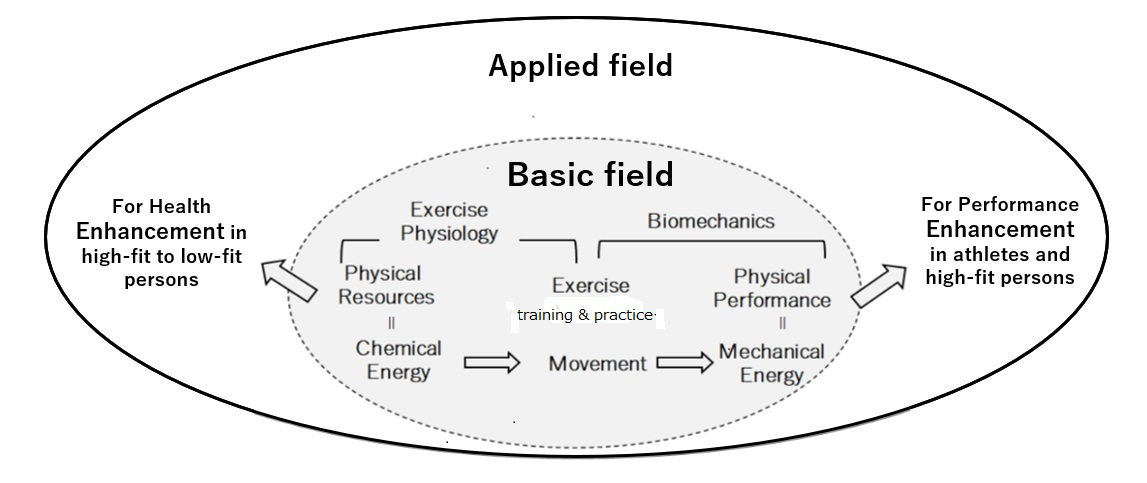
The matters concerning physical resources are studied mainly in the field of exercise physiology, while the matters concerning physical performances are mainly in the field of biomechanics. As both fields form a foundation for physical education, sports and health, I decided to research human movements from two aspects of exercise physiology and biomechanics.
Since 1972 when Professor Ikai died suddenly, I followed his position, and have supervised many graduate students in exercise physiology and biomechanics.
Future Direction
For the past 10-20 years, the remarkable development of computer-controlled motion analysis helps the researchers of biomechanics to investigate human movements more precisely and rapidly than before.
Also, recently, chemical biology, molecular biology, and genetics bring wider views to exercise physiology. Consequently, researchers get a lot of experimental data about the research target: human activity. Therefore, I am afraid that experiments have produced too much data for the recent researchers to deal with.
The research results should be selected and proposed for the instructors to use them with the laypersons. Consequently, the young researchers have to select the research means and purposes, and apply the obtained results effectively for the laypersons.
- Sherrington CS: The Integrative System of Nervous System. (6th printing) Yale University Press. New Haven, 1920
- Hill AV: The Muscular Movement in Man: The Factors Governing Speed and Recovery from Fatigue. McGraw- Hill Publishing Co. London, 1972
- Capacity Constraints in Pediatric Inpatient Psychiatric Care: A Cross-Sectional Analysis of Bed Availability and Geographic Access in North Carolina
- Why Healthcare Analytics Still Optimizes the Wrong Things
- Coding, Coverage, and Care: The Infrastructure of Transgender Health Inequities
- The Effect of Classroom Attendance on Academic Achievement of Management and Leadership Discipline of Nursing Students at Instituto Superior Cristal and Universidade de Dili, Timor-Leste, 2024: A Case Study
- The Role of Social Bonds in Facilitating Shared Investments and Resource Allocation: Addressing the “Wrong Pocket Problem” in Public Health and Healthcare
- Social-Cultural Factors Contributing to Antimicrobial Resistance in Livestock Farmers and Community Households in Kayonza District, Rwanda