
A Healthy Public Policy, Who’s Effectiveness bas been Proven: Restriction of Liquor Sales Hour
This study sought to relate the impact of the time restriction on liquor sales with violent deaths due to alcohol consumption. In 2011 based on an ecological comparison study between 2 districts of Lima, one with restriction and one without, evidenced the difference in the incidence of injuries of external cause related to alcohol. Therefore, the municipality of Lima promulgated ordinance 1586, which established the restriction of liquor sales hours in the 43 districts that make up metropolitan Lima and gave a period of 3 years to establish it. The Institute of Legal Medicine of Lima sent monthly the ethnographic characteristics of violent deaths related to alcohol. This ordinance has shown that it is capable of reducing violent deaths related to alcohol in traffic crashes, hit-and-runs, homicides, and suicides, fundamentally in men, young people, days of the week and time of the greatest incidence. There was also an increase in the age frequency of deaths of traffic accidents by year of the ordinance
Material and Methods
Metropolitan Lima is made up of 43 municipalities, each with a municipal government, headed by an elected mayor every four year and autonomous in its management. The actual population of ML is, 9847000 inhabitants. The Metropolitan Municipality, through its metropolitan council, approved ordinance 1568. This is in accordance with the district mayors should be established within three years. The Institute of Legal Medicine (IML), sent to the Municipality of Lima, monthly information in Excel related to violent deaths, where is characterized the following data: code number, income, time, history, sex, address, age, level of education, occupation, marital status, class of accident: homicide, suicide, accident of transit, place of occurrence, time of the accident, alcohol, and district address [1]. Since 1995 the IML has established that all the violent deaths have to be examined for blood content of alcohol and drugs. The analysis univariate and bivariate are associate with alcohol consumption with violent deaths (traffic accidents, suicides, and homicides) in their monthly occurrence with all data. Those result were analyzed monthly by the Observatory established in March 2012, following the scheme planted by the author of this paper. The relative risk and confidence limits were estimated at 95% and also chi square was also implemented.
- Abbreviations: IML: Institute of Legal Medicine; TA:
- Traffic Accidents.
- Introduction
- Alcohol use in the world is the seventh leading cause of death and DALYs in 2016, representing 2% of deaths in
- Factors/
- Phases
- Humans
- Vehicle and equipment
- Environment
- Information Attitude Good police control SBI (Brief
- Detection and Intervention)
- Before accident
- Lights Breaks
- Vehicle Review
- Accident
- Good functioning of the airbag
- (s) Seat Belt Use
- Seat belt
- Protective design
- Barrel of contentment
- Post-
- Accident
- First aid Emergency telephone exchange
- Fire hazard Easy access to rescue
- Facilities on the roads, for the rescue
Table 1: Haddon Matrix of Accident Prevention.
Results
In the first week of application of the restriction and making use of the surveillance system of traffic accident injuries of the MINSA (Health Minister). The effect of the restriction of hours expended in 3 hospitals emergency transit in Metropolitan Lima was studied. The weeks of 27 November to 4 December 2 011were compared (prior to 1568) against the ordinance of 4 to 10 December 2 011, in three hospitals, with 56 in the period intervened, against 99 in the previous week (not intervened) meaning a reduction of 43%. Possible decrease of more than one-fifth of the wounded, between midnight and 3:00 am, observed, during the first week of validity of the Ordinance (Figure 1) [7].
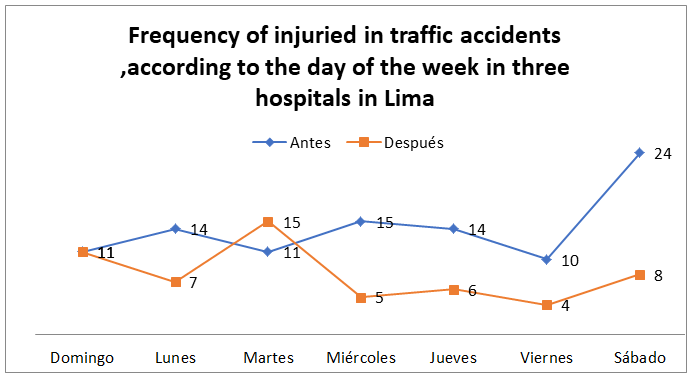
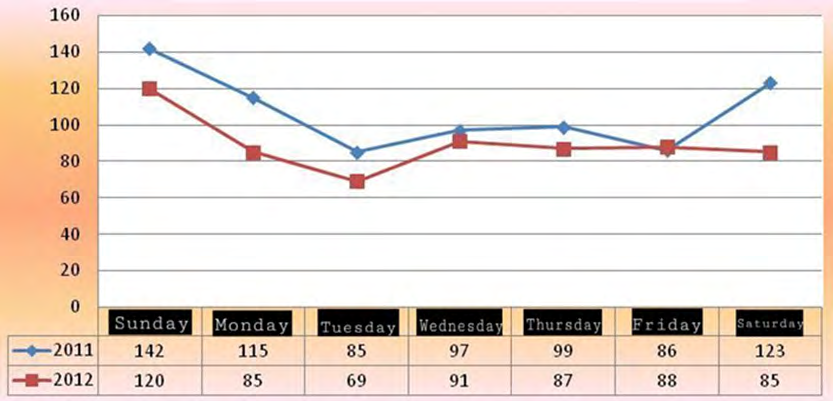
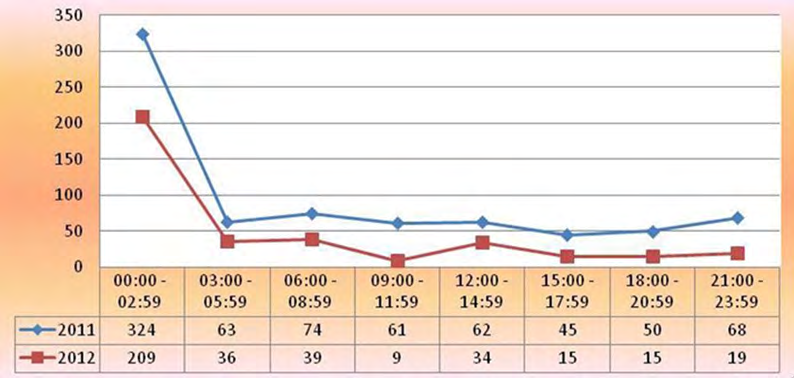
Figure 3: Violent deaths according to hour of occurrence, before and after the ban. The same occurs by age, being the main reduction in younger people of masculine sex, the bachelors, and specially the bodies with alcohol. The same trend was observed for 2013-14. Another change that caught our attention was the increase of the corpses for distillation, which came to be the 20% in 2 014, reaching close to or above 50%, this was the product of the change that was made by ILM, of 0.05 g per liter to cero g of alcohol in the blood, with a tendency to decrease further in 2017, and also the change of authorities in the 43 municipals, that Shaw 13 of them that not apply the ordinance (Figure 4).
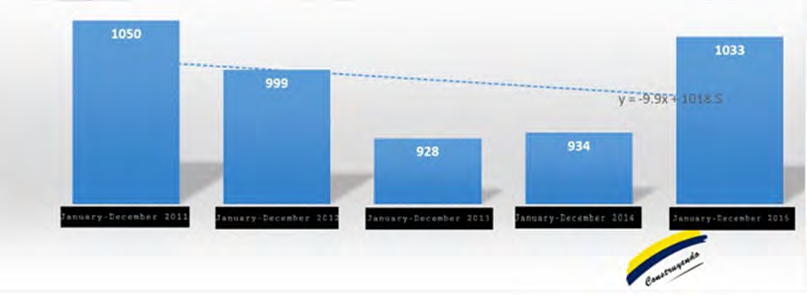
The comparison 2015-17 showed an evident decrease (Table 2).
| Victims | Before F y % 2015 | After F y % 2017 | RR | Confidence limits | X2 (probX2) 1gl |
|---|---|---|---|---|---|
| Traffic Acc. | 326 54.5 | 272 36.7 | 1.5 | 1.30-1.70 | 35.9 .0000 |
| Suicides | 114 58 | 78 43 | 1.4 | 1.1-1.67 | 8.22 .003 |
| Homicides | 232 60 | 173 47 | 1.3 | 1.12-1.48 | 13.27 .0003 |
| Total | 672 58 | 457 49 | 1.4 | 1.26-1.50 | 55.13 .0000 |
Table 2: Comparison of RR between findings of alcohol in the blood (≥.01 grams of alcohol per liter of blood) in corpses of viole
Observing also the displacement of the age of the deceased during the 3 years of observation in the crashes and road accidents [5] (Figure 5).
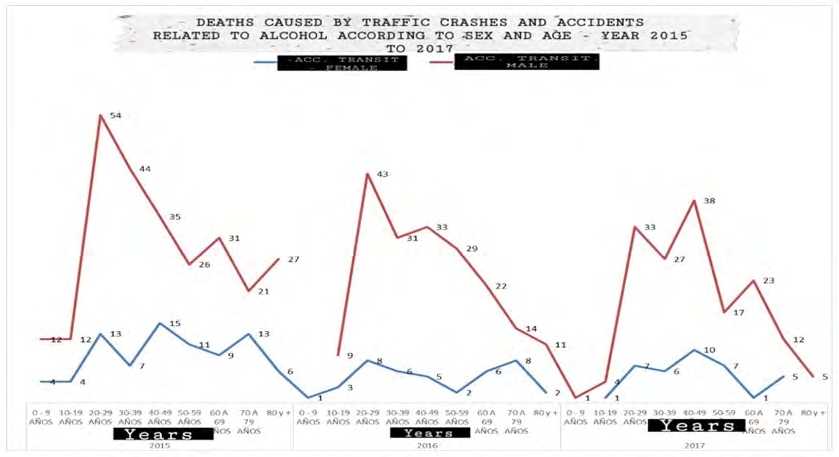
The results obtained for the reduction in traffic crashes and abuses are lower than the results of Bogota, Colombia, which reduced deaths in traffic crashes and abuses and homicides to 50%, [2]. Nonetheless, the starting points were much higher than ours. The difference of the incidence of aggression detected in La Victoria is similar to that detected in Cali, Colombia, where a correlation was found with the number of hours of liquor sales. Since the more hours of sale there would be more homicides, this observation is interesting, related with restrictions of different magnitude by different ordinances in relation to the number of hours of restriction [8]. It is also important to emphasize that at the end of Mayor Guerrero’s term in Cali, the ordinance was withdrawn and homicides increased, Guerrero having been re-elected 10 years later as mayor in 2012, with this as his best achievement. The shift in age was also observed in Cali by Guerrero’s team, since the homicides occurred in older people [9]. The decrease in traffic crashes and abuses related to alcohol was also observed in the clear decrease in Breathalyzer tests, which according to the national police of Peru decreased from 7.29% incidence in 2005 with 10,000 samples to 0.9 in 2016, with more than 200,000 samples [10].
The non-decrease in violent deaths related to alcohol, on Friday, must be related to the fact that the ordinance allows the sale of liquor on Thursday night and early Friday morning until 3:00 am on Friday, remaining the risk similar to the period prior to the establishment of ordinance 1568. We think that our decrease was also evidenced when comparing the findings of the incidence of traffic crashes and accidents related to alcohol and drugs is much lower in Lima than in Sto Domingo without restrictions on sales hours [11]. Before the pandemic, the relationship was no longer monitored, but it was no longer necessary since the curfew was established at twelve at night. This evidenced the great decrease in violent deaths in general. However, as currently the third wave caused by the omicron is in sharp decline, the curfew has been lifted, so monitoring should be restored again [12, 13, 14, 15].
Conclusion
The “Safe Hour” liquor sales schedule is related to the decrease in deaths from traffic crashes and hit-and-runs, homicides and suicides in its alcoholic victims. The fact that the decrease is more marked in the alcoholic than in the non- alcoholic, I would define, an indicator of the effectiveness of the program. The ordinance should be reviewed on the Thursday, being the closed time of cells of liquors by 1:00am of Friday night, as the others days of the week. The monitory sessions should be reinstated as soon as possible.
Acknowledgment
I would like to express my gratitude to the mayor of Lima’s municipality, department of health, department of citizen security, institute of legal medicine, University Ricardo Palma, and all the members of the observatory of violent deaths related with alcohol consumption of the municipality.
References
-
Málaga H (2009) Restriction of spending hours of Alcoholic Bebidas (Municipal Ordinance 008-7) and their possible relation to the violence during the period 2005-2008 in the Municipality of La Victoria, Lima, Peru. Tesis Doctor and Salud Pública. University of Peru Cayetano Heredia.
-
Alcaldia Mayor de Bogotá SdG (2001) Security and Coexistence in Bogotá Logros and Retos. Bogota. pp: 27.
-
Duailibi SPW, Pinsky I, Laranjeira R, Raw M (2007) The effect of Restricting Opening Hours on Alcohol- Related Violence. American Journal of Public Health 97(12): 2276-2280.
-
(2004) Municipality of Asunción. Municipal Plan and Violence Prevention Project Promotion of Citizenship. In: Salud DGAS (Ed,). Asunción, Paraguay, pp: 51.
-
Málaga H, Ronceros J, Delgado L, Palza G (2019) Restrictions On Liquor Sales Hours In Metropolitan Lima, Peru And Its Effect On Violent Deaths 2015-2017. Biotempo 16(2): 233-239.
-
Perú RD (2011) El Peru, Establish the new municipal regime that regulates the commercialization, consumption and advertising of alcoholic beverages of all grades ORDER N 1568, 453445-348.
-
Malaga H (2010) Tools and Strategies for Preventing and Controlling Transit Accidents: Peruvian Experience by Prevention Levels. Rev Peru Med Exp Salud Publica 27(2): 231-236.
-
Sanchez AI, Villaveces A, Krafty RT, Park T, Weiss HB, et al. (2011) Policies for alcohol restriction and their association with interpersonal violence: a time-series analysis of homicides in Cali, Colombia International Journal of Epidemiology 40(4): 1037-1046.
-
Espitia A, Espinoza Gutierrez MI (2002) Homicide, which occurred in the year 2002 CISALVA, Cali, Colombia in, Accessed on January 26, 2018.
-
Franklin B (2017) Alcoholemia data in Metropolitan Lima. PNP Traffic Accident Investigative Division.
-
Cherpitel CJ, Witbrodt J, Ye Y, Monteiro MG, Málaga H, et al. (2021) Road traffic injuries and substance use among emergencydepartment patients in the Dominican Republic and Peru. Rev Panam Salud Publica 45: e31.
-
GBD (2016) Alcohol Collaborators Alcohol use and burden for 195 countries and territories, 1990-2016: a systematic analysis for the global Burden of Disease Study. 392.
-
Malaga H, Gonzale M, Huaco C, Sotelo M (2012) The Relation between the Number of Hours That Authorize the Sale of Alcoholic Beverages and Violence. Health Promotion Perspectives 2(1): 60-71.
-
Malaga H, Palza G, Huánuco M, Ñañez J, Ronceros J (2018) The restriction of hours of sales of liquors: Lima 2010-17: Traffic accidents(TA) and other violent deaths. Journal of Alcoholism and Drug Dependence 6(2): 1000306.
-
Huánuco Toralva M (2017) Description of hours of consumption, expenditure of alcoholic beverages and mortality of transit accidents in Lima Metropolitan 2 010-15, Tesis Maestría in Salud Pública, UNCP.
- Capacity Constraints in Pediatric Inpatient Psychiatric Care: A Cross-Sectional Analysis of Bed Availability and Geographic Access in North Carolina
- Why Healthcare Analytics Still Optimizes the Wrong Things
- Coding, Coverage, and Care: The Infrastructure of Transgender Health Inequities
- The Effect of Classroom Attendance on Academic Achievement of Management and Leadership Discipline of Nursing Students at Instituto Superior Cristal and Universidade de Dili, Timor-Leste, 2024: A Case Study
- The Role of Social Bonds in Facilitating Shared Investments and Resource Allocation: Addressing the “Wrong Pocket Problem” in Public Health and Healthcare
- Social-Cultural Factors Contributing to Antimicrobial Resistance in Livestock Farmers and Community Households in Kayonza District, Rwanda