
Synthesis, Characterization and Biological Screening of Schiff bases derived from 4, 6-difluoro-2-amino Benzothiazole
Novel benzothiazole Schiff bases namely N-(4-chlorobenzylidene)-4,6-difluorobenzothiazole-2-amine; 4,6-difluoro-N-(4- nitrobenzylidene)benzothiazol-2-amine and N-((1H-indol-3-yl)methylene)-4,6-difluorobenzothiazole-2-amine have been synthesized from condensation reaction of 4,6-difluoro-2-amino benzothiazole with different aromatic aldehydes like 4-chlorobenzaldehyde, 4-nitrobenzaldehyde and 1H-indole-3-cardaldehyde. The structures of all the compounds were characterized by elemental analysis, FT-IR, Mass and 1H-NMR spectroscopy. Schiff bases have been screened for antimicrobial activity against bacteria and fungi by using MIC determination. In vitro antibacterial and antifungal activity of ligands were assayed against gram positive (S. Aureus, B.Subtilis), gram negative bacteria (S. Marcescens, E. coli) and Rhizopus sp. and A. Niger. The standard drugs ketoconazole and ciprofloxacin were used to screen antimicrobial activity.
Introduction
Benzothiazole is a heterocyclic and bicyclic ring compound and its bicyclic ring consist of 1,3-thiazole ring fused with benzene ring. Thiazole is a five membered ring containing nitrogen and sulfur heteroatoms. The heterocyclic compounds play a vital role in the metabolism of all the living cells and they are very largely distributed in nature and very essential to living organisms. Among large number of nitrogen heterocycles are the most abundant specially those containing oxygen and Sulphur [1, 2, 3, 4, 5]. Benzothiazole moieties are widely found in bioorganic and medicinal chemistry with application in drug discovery. Benzothiazoles with multiple applications which have been attracted considerable attention of medicinal chemists due to their wide range of biological activities which include antitumor [6, 7], antimicrobial [8], antibacterial [9, 10], antifungal [11], anti-inflammatory [12], anticonvulsive [13], analgesic [14], cytotoxic [15], inhibition of enzyme [16]
and Parkinson’s disease [17]. Schiff base synthesized from benzothiazole derivatives are of great importance due to their wide applications as antimicrobial, anti-degenerative, anti-inflammatory, anti-HIV agents [18, 19, 20, 21] and so forth. Further, some of these schiff bases have other applications as corrosion inhibitor [22], dye manufacture [23], perfumery [24], plant growth regulators [25], Sensor and nanomaterial [1, 2, 3, 4, 26, 27, 28] for various synthesis [29, 30, 31]. Specifically, the study of Schiff bases with benzothiazole derivatives is of considerable current interest in recent years due to their biological and pharmaceutical applications.
Compounds containing azomethine group (-HC=N-) are known as Schiff base [32], which are condensation product of primary amines with aldehydes or ketones (R-CH=N-R’, where R and R’ represents alkyl and/or aryl substituents) and were first reported by Hugo Schiff in 1864 [33]. Schiff bases have been shown to possess/exhibit many biological activities such as anticancer [34], antituberculosis [35], antibacterial [36], antimicrobial [37], plant growth inhibitors [38] and anti-inflammatory activity [39].
Here in this paper, we have reported synthesis and characterization of novel Schiff bases derived from 4,6-difluoro-2-aminobenzothiazole. All the synthesized compounds were screened for their antibacterial and antifungal activity against two gram positive bacteria S. Aureus, B.Subtilis and two Gram negative bacteria i.e. S. Marcescens, E. Coli and fungal strains Rhizopus sp. and A. Niger using MIC determination in solvent DMF/CHCl3.
Experimental
Chemicals and Reagents
All commercially available AR grade chemicals were used as received without further purification. Chemical reagents and solvents were obtained from Sigma-Aldrich. Silica gel and fluorescence active TLC plates (F-2009) were purchased from E.Merck.
Instrumentation
Melting points were determined using capillary and theils tubes filled with paraffin oil and are uncorrected. The Percentage of C, H, N and S were derived using CHN/S/O Analyser, Perkin Elmer, series11, 2400. Elemental analysis data are in accordance with the theoretically calculated percentage of C, H, N and S. FT-IR spectra of the compounds were recorded in the range 4000-400cm-1 on tensor Bruker
27 (Ettlingen, Germany) using KBr pellets. Mass spectra (GC-MS) were determined using Jeol D-300 spectrometer. 1H-NMR spectra were recorded on a model DPX 200 MHz and Advance II 500 MHz Bruker FT-NMR instruments (Ettlingen, Germany) using TMS as internal reference.
Preparation of Amine
Amine was synthesized by reported method [40]. To an ethanolic solution of 3, 5-difluoro aniline and potassium thiocyanate was mixed containing 2ml concentrated HCl. To this mixture, bromine in glaciel acetic acid was added and the reaction mixture was refluxed for 1hr. Then, reaction mixture was poured into crushed ice and precipitates obtained with stirring. Precipitate was filtered, washed with cold water and dried. The crude product was recrystalized from ethanol.
Synthesis of Schiff Base
Synthesis of N-(4-chlorobenzylidene)-4,6- difluorobenzothiazole-2-amine: To a solution of 4,6-difluoro-2-amino benzothiazole (0.186gm,0.001mol) and 4-chloro benzaldehyde (0.140gm, 0.001 mol) were dissolved in methanol using catalytic amount of glacial acetic acid. The reaction mixture was refluxed with constant stirring at 50-60˚C for 4-5 hrs. Then, progress of reaction checked by TLC. It was cooled at room temperature and product was filtered, dried by ether and recrystallized from hot methanol. To remove excess aldehyde, the product was washed with sodium bisulphite and then washed with chilled methanol to remove other impurities. Yield: 58.58% (Scheme 1).
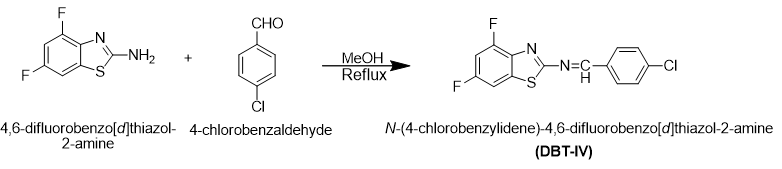
Scheme 1: For C14H7ClF2N2S, Melting point is 169-172˚C and Elemental analysis data found: %C 54.36; %H 2.31; %N 8.99; %S 9.88. In FT-IR, bands observed are at 1669 cm-1 ν(HC=N, azomethine group), 834 cm-1 ν(C-Cl), 1218 cm-1 ν(C-F), 789 cm-1 ν(C- S-C). 1H-NMR (500 MHz, CDCl3): δAr-H, 6.87-7.45 (d, 6H); δN=CH, 8.05 (s, 1H) and Mass spectra (GC-MS) m/z values of DBT-IV correspond to the M+ adduct (309.2).
Synthesis of 4,6-difluoro-N-(4-nitrobenzylidene) benzothiazol-2-amine: To a solution of 4,6-difluoro-2- amino benzothiazole (0.186gm,0.001mol) and 4-nitro benzaldehyde (0.151 gm, 0.001 mol) were dissolved in methanol using catalytic amount of glacial acetic acid. The reaction mixture was refluxed with constant stirring at 50-60˚C for 4-5 hrs. Then, progress of reaction checked by TLC. It was cooled at room temperature and product was filtered, dried by ether and recrystallized from hot methanol. To remove excess aldehyde, the product was washed with sodium bisulphite and then washed with chilled methanol to remove other impurities. The product was isolated, dried by ether and recrystallized from hot methanol. Yield: 78.65% (Scheme 2). The Schiff base ligand exists in amorphous form and yellow in color.
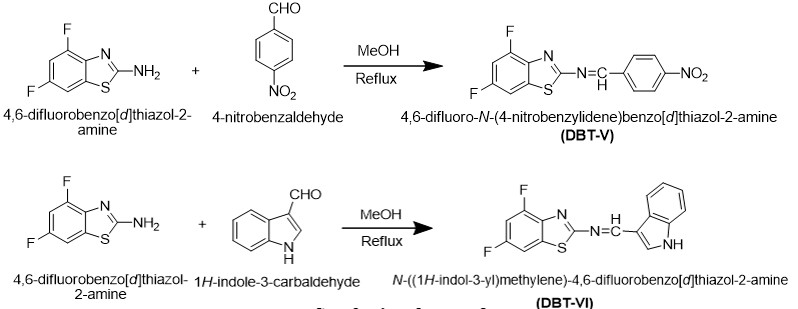
Scheme 2: For C14H7F2N3O2S, Melting point is 178-180˚C and Elemental analysis data found: %C 52.22; %H 2.24; %N 13.06; %S 9.98. In FT-IR, bands observed are at 1699 cm-1 ν(HC=N, azomethine group), 1455 cm-1 ν(C-NO2), 1226 cm-1 ν(C-F), 760 cm-1 ν(C-S-C). 1H-NMR (500 MHz, CDCl3): δAr-H, 6.85-7.77 (d, 6H); δN=CH, 7.26 (s, 1H) and Mass spectra (GC-MS) m/z values of DBT-V correspond to the M+ adduct (320.1).
Synthesis of N-((1H-indol-3-yl)methylene)-4,6- difluorobenzothiazole-2-amine: To a solution of 4,6-difluoro-2-amino benzothiazole (0.186gm,0.001 mol) and 1H-indol-3-carbaldehyde (0.145 gm, 0.001 mol) were dissolved in methanol using catalytic amount of glacial acetic acid. The reaction mixture was refluxed with constant stirring at 50-60˚C for 5-7 hrs. Then, progress of reaction checked by TLC. It was cooled at room temperature and product was filtered, dried by ether and recrystallized from hot methanol. To remove excess aldehyde, the product was washed with sodium bisulphite and then washed with chilled methanol to remove other impurities. The product was isolated, dried by ether and recrystallized from hot methanol. Yield: 55.39% (Scheme 3). The Schiff base ligand exists in crystalline form and pale yellow in color.
Scheme 3: For C16H9F2N3S, Melting point is 169-172˚C. Elemental analysis data found: %C 61.11; %H 2.93; %N 13.21; %S 10.07. In FT-IR, bands are observed at 1597 cm-1 ν(HC=N, azomethine group), 1215 cm-1 ν(C-F), 750 cm-1 ν(C-S-C). 1H-NMR (500 MHz, CDCl3): δAr-NH, 10.08 (s, 1H); δAr-H, 6.81-7.26 (d, 7H); δN=CH, 7.86 (s, 1H) and Mass spectra (GC-MS) m/z values of DBT-VI correspond to the M adduct (313.2).
Antimicrobial Activity
The Schiff bases were screened for its antibacterial activity against two Gram positive bacteria S. Aureus, B. Subtilis and two Gram negative bacteria i.e. S. Marcescens, E. Coli and their antifungal activity against two fungal strains Rhizopus sp. and A. Niger using MIC Determination in DMF/ CHCl3 solvent. Minimum inhibitory concentration (MIC) using suspended Luria Broth in sterile double distilled water as a media. Control test with no active ingredient was also performed by adding just an equivalent amount of solvent. MIC was determined using double fold serial dilution in liquid media containing varying concentration of tested compounds from 0.1–10,000μM. Bacterial growth was measured by the turbidity of the culture after 15h. If particular concentration of the compound inhibited bacterial growth, half the concentration of the compound was tried. This procedure was carried out at a concentration that bacteria grow normally. The lowest concentration that inhibits the bacterial growth totally was determined as MIC value. All equipment and culture media employed during the process were sterile. The prepared discs were placed on the surface of the cultured media with each of bacteria incubated for 24hrs at 37°C. The zone of inhibition were measured against all microorganisms in mm. Ketoconazole and Ciprofloxacin were used as the reference drug. The growth of fungus was measured by recording diameter of fungal colony. Following relation was used to calculate the fungal growth inhibition: Fungal growth inhibition (%) = [(A-B)/A] x 100 Where, A is the diameter of the fungal colony in the control plate and B is the diameter of the fungal colony in the test plate.
Results and Discussion
The novel Schiff base compound DBT-IV, DBT-V and DBT-VI are synthesized according to described process in scheme-1,2 and 3 respectively. The structures of all the compounds were confirmed on the basis of elemental analysis, FT-IR, mass and 1H NMR spectral data. The ligands were insoluble in water but soluble in methanol, ethanol, chloroform, 1,4-dioxane and DMF.
FT-IR Spectral Studies
Formation of Schiff base is confirmed by disappearances of carbonyl and amine group peaks and appearance of peak of azomethine group in IR spectrum. FT-IR spectra of Schiff bases were recorded in the 400-4000 cm-1 on tensor Bruker 27 (Ettlingen, Germany) using KBr pellets technique. The IR spectrum gives information regarding the nature of functional groups present in the molecule. The spectrum of unknown compound can be interpreted and identified by comparision to library of known compounds. In the IR spectra, Schiff bases showed a strong band in the range 1597-1699cm-1, which corresponds to the azomethine (HC=N) group. Aromatic ν(C-H) stretching at 3045-3040cm-1 and ν(C=C) bands at 1519cm-1, 1488cm-1, 1510cm-1 proved existence of aromatic rings. In these molecules, the bands of ν(C-S-C) are observed in the region at 750-789 cm-1. A strong band of nitro functional group ν(C-NO2) of DBT-V Schiff base is observed at 1455 cm-1. The band of chlorine functional group ν(C-Cl) of DBT-IV schiff base observed at 834 cm-1.
Mass Spectral Studies
Schiff bases have been studied for their mass spectral analysis. The mass spectra were measured to confirm the composition and purity of ligands under investigation. The mass spectrum of Schiff bases DBT-IV, DBT-V and DBT-VI exhibit the molecular ion peak at m/z 309.2, 320.1 and 313.2 that corresponds to the molecular weight of Schiff base.
1H NMR Spectral Studies
The data of 1H-NMR spectra of Schiff base were measured in CDCl3 using TMS as an internal reference. In the 1H NMR spectra of benzothiazole Schiff bases, multi signals are assigned to Aromatic protons observed in the range from 6.8 to 7.65 δppm. A singlet is observed for Schiff bases DBT-IV, DBT-V and DBT-VI at 8.05 δppm, 7.26 δppm and 7.86 δppm respectively in spectrum which corresponds to the azomethine proton.
Antimicrobial Activity
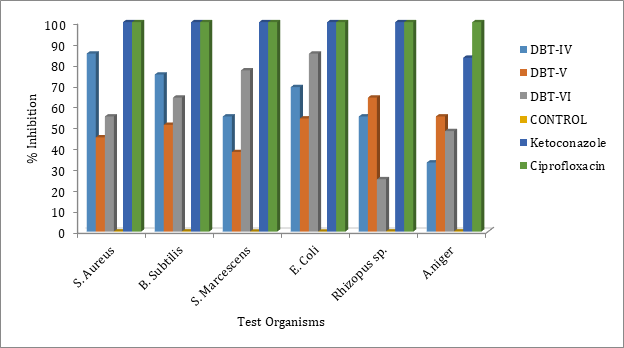
Synthesized Schiff bases were screened for their antimicrobial activity on the some microorganisms in terms of minimum inhibitory concentration (MIC). The bio-efficiency of the ligands have been tested against two Gram-positive (S. aureus, B. subtilis), two Gram-negative (S. marcescens, E. coli) bacteria and two fungus (Rhizopus sp., A. niger). The data reveals that all the synthesized Schiff bases have higher antimicrobial activity. Among the various compounds, DBT-IV has been found to be the most effective against Gram-positive microbes showing maximum clarity of zones. Its antibacterial activity was found maximum against Gram positive bacteria (S. aureus, B. subtilis) and DBT-VI also exhibited maximum inhibition against Gram-negative bacteria S. marcescens and E. Coli. DBT-V exhibited minimum inhibition against all the microorganisms.
Among all compounds DBT-V, has shown maximum antifungal activity compared to DBT-IV, DBT-VI against both the fungal strains Rhizopus sp. and A. Niger while DBT-IV and DBT-VI exhibited moderate antifungal activity against Rhizopus sp. and A. Niger respectively. The comparison chart against standard antibiotics is as given in Figure 1.
Conclusion
In this paper, Three novel Schiff bases have been synthesized by condensation reaction of 4,6-difluoro- 2-amino benzothiazole and different aldehydes like 4-chlorobenzaldehyde, 4-nitrobenzaldehyde and 1H-indole- 3-cardaldehyde in an alcoholic medium using glaciel acetic acid give DBT-IV, DBT-V and DBT-VI with good yield. The structure of Schiff bases have been confirmed by various physicochemical and spectral analyses. In this study, these Schiff base derivatives DBT-IV, DBT-V and DBT-VI are found active antimicrobial compounds. Among the three Schiff base tested, DBT-IV and DBT-VI exhibited the promising antimicrobial activity and DBT-V is most active against both the fungal strains.
Acknowledgment
The authors are thankful to the principal Dr. Atul H. Patel Sir, Kamani Science College and Prataprai Arts College, Amreli (Gujarat), for providing facilities and laboratories.
References
-
Bhatt KD, Shah H, Modi KM, Kongor A, Panchal M, et al. (2017) Novel calix [4] pyrrole assembly: Punctilious recognition of F− and Cu+2 ions. Journal of Molecular Structure 1149: 299-306.
-
Bhatt KD, Shah HD, Modi KM, Narechania MB, Patel C (2019) Calix [4] pyrrole virtuous sensor: a selective and sensitive recognition for Pb (II) ions by spectroscopic and computational study. Supramolecular Chemistry 1-15.
-
Bhatt KD, Shah HD, Panchal M (2017) A switch‐off fluorescence probe towards Pb (II) and cu (II) ions based on a calix [4] pyrrole bearing amino‐quinoline group. Luminescence 32(8): 1398-1404.
-
Makwana BA, Vyas DJ, Bhatt KD, Jain VK (2017) Selective sensing of copper (II) and leucine using fluorescent turn on–off mechanism from calix [4] resorcinarene modified gold nanoparticles. Sensors and Actuators B: Chemical 240: 278-287.
-
Eicher S (2003) Hauptmann, The Chemistry of Heterocycles: Structure, Reactions, Synthesis and Applications. 2nd (Edn.), Wiley VCH.
-
Stojkovic R, Karminski-Zamola G, Racane L, Tralic- Kulenovic V, Glavas-Obrovac L, et al. (2006) Antitumor efficiency of novel fluoro-substituted 6-amino-2- phenylbenzothiazole hydrochloride salts in vitro and in vivo. Methods Find Exp Clin Pharmacol 28(6): 347-354.
-
Bénéteau V, Besson T, Guillard J, Léonce S, Pfeiffer B (1999) Synthesis and in vitro antitumour evaluation of benzothiazole-2-carbonitrile derivatives. European Journal of Medicinal Chemistry 34(12): 1053-1060.
-
Basser M, Mote N (2001) Synthesis and antimicrobial activity of some Schiff bases from benzothiazoles. Asian Journal of Chemistry 13(2): 496-500.
-
Baluja S, Chanda S, Kulshrestha A (2017) Synthesis, physical characterization and antibacterial activity of some derivatives of 2-amino benzothiazoles. Acta Chim Pharam Indica 7(4): 118.
-
Chohan ZH (1999) Biologically active Co (II) and Ni (II) complexes of N-(2-thienylmethylene)-2- aminothiadiazole. Met Based Drugs 8(6): 323-327.
-
Hothi H, Makkar A, Sharma J, Manrao M (2008) Synthesis and antifungal 8 potential of Schiff bases of 2’-hydroxyacetophenone and their Cu (II) complexes. Ind J Agri Chemi 41: 53-58.
-
Pontiki E, Hadjipavlou-Litina D (2007) Synthesis and pharmacochemical evaluation of novel aryl-acetic acid inhibitors of lipoxygenase, antioxidants, and anti- inflammatory agents. Bioorg Med Chem 15(17): 5819- 5827.
-
Hays SJ, Rice MJ, Ortwine DF, Johnson G, Schwarz RD, et al. (1994) Substituted 2‐benzothiazolamines as sodium flux inhibitors: Quantitative structure–activity relationships and anticonvulsant activity. J Pharm Sci 83(10): 1425-1432.
-
Mruthyunjayaswamy B, Shanthaveerappa B (2000) Synthesis and pharmacological evaluation of 3, 5-disubstituted indole-2-[Nβ-(substituted benzopyran-2’-one-3’-carboxyl)] carboxy hydrazides and 2H-3-(various substituted indol-3’-yl) methyl-1, 3-benzothiazoles. Indian Journal of Chemistry 39B: 433- 439.
-
El-Aziz DMA, Etaiw SEH, Ali EA (2013) Synthesis, spectroscopic, cytotoxic aspects and computational study of N-(pyridine-2-ylmethylene) benzo [d] thiazol- 2-amine Schiff base and some of its transition metal complexes. Journal of Molecular Structure 1048: 487- 499.
-
Arjunan V, Sakiladevi S, Rani T, Mythili C, Mohan S (2012) FTIR, FT-Raman, FT-NMR, UV–visible and quantum chemical investigations of 2-amino-4- methylbenzothiazole. Spectrochim Acta A Mol Biomol Spectrosc 88: 220-231.
-
Alain B (1997) Pharmaceutical compositions containind 2-amino benzothiazole for treating Parkinson’s disease and Parkinsonian Syndromes. Patent C A pharmaceuticals 1: 63.
-
Nalawade A, Nalawade R, Patange S, Tase D (2013) Thiazole containing schiffs bases and their transition metal complexes. International Journal of Engineering Science Invention 2: 1-4.
-
Li H, Li J, Chen H, Zhang Y, Huang D (2011) Synthesis and crystal structure of charge transfer complex (CTC) of 2-aminobenzothiazole with its Schiff Base. Journal of Chemical Crystallography 41: 1844-1849.
-
Arjmand F, Mohani B, Parveen S (2006) New Dihydro OO’Bis (Salicylidene) 2, 2’aminobenzothiazolyl borate complexes: Kinetic and voltammetric studies of dimethyltin copper complex with guanine, adenine, and calf thymus DNA. Bioinorg Chem Appl 2006: 32896.
-
Raman N, Selvan A, Sudharsan S (2011) Metallation of ethylenediamine based Schiff base with biologically active Cu (II), Ni (II) and Zn (II) ions: Synthesis, spectroscopic characterization, electrochemical behaviour, DNA binding, photonuclease activity and in vitro antimicrobial efficacy. Spectrochim Acta A Mol Biomol Spectrosc 79(5): 873-883.
-
Salarvand Z, Amirnasr M, Talebian M, Raeissi K, Meghdadi S (2017) Enhanced corrosion resistance of mild steel in 1 M HCl solution by trace amount of 2-phenyl- benzothiazole derivatives: Experimental, quantum chemical calculations and molecular dynamics (MD) simulation studies. Corrosion Science 114: 133-145.
-
Abuamer KM, Maihub AA, El-Ajaily MM, Etorki AM, Abou- Krisha MM, et al. (2014) The role of aromatic Schiff bases in the dyes techniques. International Journal of Organic Chemistry 4(1): 7-15.
-
Pilecki MMZ, Gora J (1984) Schiff bases and their application in perfumery. Kosmetyki 28: 223-227.
-
Zhang W, Shi T, Ding G, Punyapitak D, Zhu J, et al. (2017) Nano Silica Schiff-Base Co:er(II) complexes with sustainable Antimicrobial Activity against Bacteria and Reduced Risk of Harm to Plant and Environment. ACS Sustainable Chem Eng 5(1): 502-509.
-
Bhatt KD, Gupte HS, Makwana BA, Vyas DJ, Maity D, et al. (2012) Calix receptor edifice; scrupulous turn off fluorescent sensor for Fe (III), Co (II) and Cu (II). J Fluoresc 22(6): 1493-1500.
-
Bhatt KD, Makwana BA, Vyas DJ, Mishra DR, Jain VK (2014) Selective recognition by novel calix system: ICT based chemosensor for metal ions. Journal of Luminescence 146: 450-457.
-
Pandya MP, Sameja KD, Patel DN, Bhatt KD (2017) Antimicrobial Activity and Phytochemical Analysis of Medicinal Plant Cassia tora. International Journal of Pharmacy and Chemistry 3(4): 56-61.
-
Rodriguez M, Liwes A, Frnando D (2004) Acenaphtheneqninom thiosemicarbazones and it is transition metal complexes; synthesis, structure and biological activity. Inorg Biochem 98.
-
Hasanen JA, El-Deen IM (2006) Synthesis and biological evaluation of 4-thiazolidinones and their ketoazomethines. Oriental Journal of Chemistry 22(3): 717.
-
Saxsena RK (1987) Synthesis and Antibacterial activity of azomethines and thiazolidinone derivatives of benzimidazoles. J Ind Chem Soc 64: 446-448.
-
Xavier A, Srividhya N (2014) Synthesis and study of Schiff base ligands. Journal of Applied Chemistry 7(11): 6-15.
-
Schiff H (1864) Mittheilungen aus dem Universitätslaboratorium in Pisa: eine neue Reihe organischer Basen. Justus Liebigs Annalen der Chemie 131(1): 118-119.
-
Osowole AA, Ott I, Ogunlana OM (2012) Synthesis, spectroscopic, anticancer, and antimicrobial properties of some metal (II) complexes of (substituted) nitrophenol Schiff base. International Journal of Inorganic Chemistry 2012.
-
Pahlavani E, Kargar H, Rad NS (2015) A study on antitubercular and antimicrobial activity of isoniazid Derivative. Zahedan Journal of Research in Medical Sciences 17(7).
-
Johari R, Kumar G, Kumar D, Singh S (2009) Synthesis and antibacterial activity of M (II) schiff-base complex. J Ind Council Chem 26(1): 23-27.
-
Golcu A, Tumer M, Demirelli H, Wheatley RA (2005) Cd (II) and Cu (II) complexes of polydentate Schiff base ligands: synthesis, characterization, properties and biological activity. Inorganica Chimica Acta 358(6): 1785-1797.
-
Adhikari D, Prakash A (2011) Application of schiff bases and their metal complexes-A Review. International Journal of Chem Tech Research 3(4): 1891-1896.
-
Alam MS, Choi JH, Lee DU (2012) Synthesis of novel Schiff base analogues of 4-amino-1, 5-dimethyl-2- phenylpyrazol-3-one and their evaluation for antioxidant and anti-inflammatory activity. Bioorg Med Chem 20(13): 4103-4108.
-
Bhattacharya J, Pate K, Tailor P, Karthikeyan C, Moorthy N, et al. (2010) Design, synthesis and characterization of novel 1, 3, 4-oxadiazole dimmers from benzoic acids. Int J Chem Tech Res 2(4): 2055-2062.
- Spectrophotometric Determination of Lanthanum (III) and Some Rare Earths with Xylenol Orange
- Introduction and Sources of Molluscicides
- Trimetazidine: An Antianginal Drug and Not Only!
- Nature Inspired Discovery and Development of Antibacterials: An Update
- Fungal Biodegradation of Polycyclic Aromatic Hydrocarbons (PAHs)
- Recent Approaches of Impurity Profiling in Pharmaceutical Analysis: A Concise Review