
Utilization of Tandem Oxyanionic Cyclization/Claisen Rearrangement Strategies for the Construction of Seven and Eight-Membered Carbocyclic Ring Systems
This article describes the development of microwave-assisted oxyanionic 5-exo-dig cyclization-Claisen rearrangement sequence as a convenient “one-pot” route to a variety of seven- and eight membered carbocyclic ring systems. This process was used as the key transformation for the construction of several natural products, including frondosins A, B, and C.
Introduction
Carbocyclic seven- and eight membered rings are found as common structural units in a variety of polycyclic natural products that have been isolated from several different sources, including pathogenic fungi, marine organisms, terrestrial plants and insects. Structurally, they represent sesquiterpenoids, diterpenoids, sesterterpenoid systems, dibenzocyclooctadiene lignans, and polyphenol lignans [1, 2, 3]. Due to their medicinal relevance, numerous research groups are actively engaged in developing strategies for their construction by synthetic means. However, unlike five and six-membered carbocycles which are readily accessible through various cyclization reactions, methods allowing the construction of seven-membered rings are generally limited to processes other than direct intramolecular reactions. Among the most important of these are various cycloaddition strategies, such as the [5+2] and [4+3] reactions (seven- membered rings) [4], including several [4+4] and [4+2+2]
Sequential Oxyanionic Cyclization/Claisen Rearrangement Strategy
We have recently demonstrated that a variety of cycloheptanoid and cyclooctanoid ring systems may be conveniently accessed through a previously reported Marvell, et al. [6] but largely ignored tandem sequence that involves base-catalyzed intramolecular cyclization of appropriately substituted acetylenic alcohols, followed by in situ [3.3]-sigmatropic rearrangement (Claisen rearrangement) of the intermediate 2-alkylidenetetrahydrofurans (Figure 2) [7].
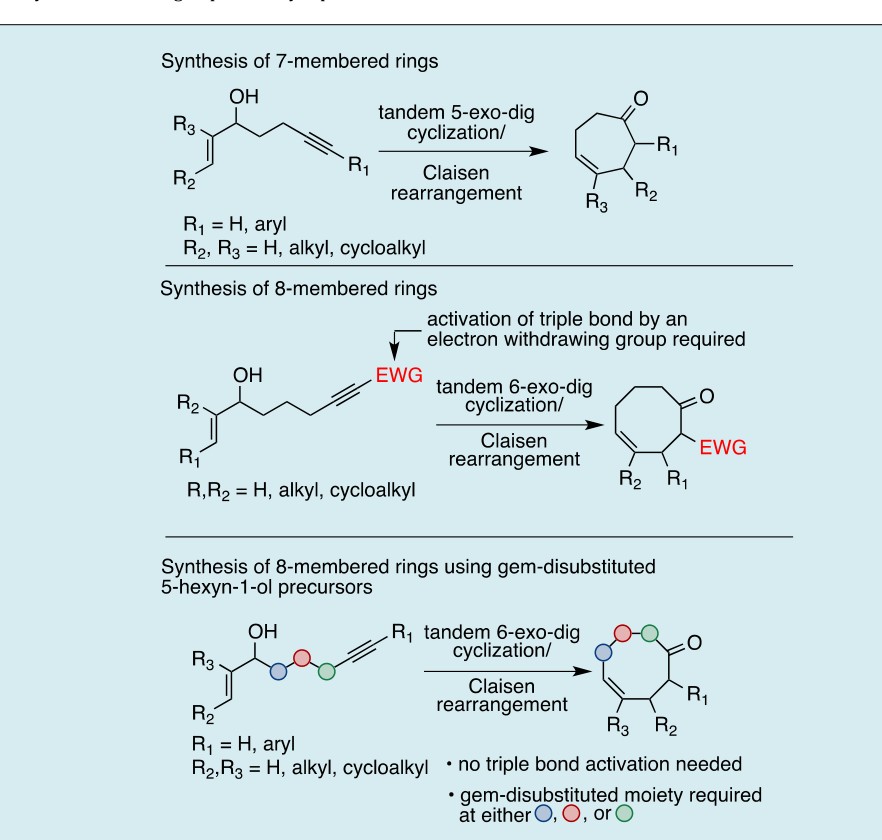
The requisite allyl vinyl ether precursor in these reactions (Figure 3) is produced as a transient species through a 5- or 6-exo dig process, which involves the intramolecular addition of an alkoxide moiety to a proximal triple bond (Figure 3). Upon heating, this intermediate undergoes in situ [3, 3] sigmatropic rearrangement, affording a cyclohept-4-enone or cyclooct-5-enone derivative. In a typical case, this tandem cyclization-Claisen rearrangement process is effected simply by treatment of an appropriately substituted acetylenic alcohol, dissolved in phenetole or DME with approximately 10 mol-% of LiHMDS (or MeLi), and heating the mixture to 150-210 °C for approximately an hour (most conveniently under microwave irradiation). Table 1 highlights some of the cycloheptanoid compounds that are accessible through this methodology.
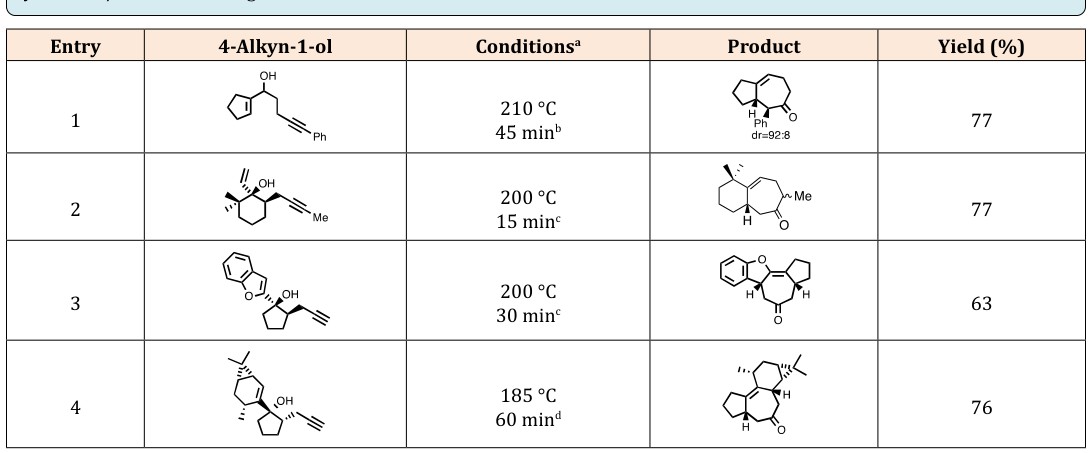
| Entry | 4-Alkyn-1-ol Condi | tionsa Product | Yield (%) |
|---|---|---|---|
| 1 | 210 45 | °C minb | 77 |
| 2 | 200 15 | °C minc | 77 |
| 3 | 200 30 | °C minc | 63 |
| 4 | 185 60 | °C mind | 76 |
Table 1: Synthesis of seven-membered carbocyclic structures by sequential 5-exo cyclization/Claisen rearrangement strategy. aReac
Table 1: Synthesis of seven-membered carbocyclic structures by sequential 5-exo cyclization/Claisen rearrangement strategy. aReactions were performed using a CEM microwave (unless otherwise noted) oven in the presence of 10-15 mol-% MeLi. bphenetole was used as the solvent. c DMF was used as the solvent. d Reaction was done using conventional heating (oil bath).
Our initial attempts to apply of these strategies for the synthesis of eight-membered ring systems were met with failure, stemming largely from the inability of 5-alkyn-1-ol precursors to undergo 6-exo isomerizations. These issues were ultimately resolved by two different strategies: a) “activating” the triple bond with an electron withdrawing group prior to cyclization [8] and 2) taking advantage of the Thorpe-Ingold effect [9]. Examples of these strategies are highlighted in Figure 4.
Application to Natural Product Synthesis: The Frondosins
Frondosins A–E comprise five related novel sesquiterpene hydroquinone derivatives recently isolated from the Micronesian marine sponge Dysidea frondosa [10]. All members of the frondosin family (A–E) are antagonists of interleukin-8 (IL-8) and inhibitors of protein kinase C (PKC) in the low micromolar range [11]. In addition to being involved in cellular inflammatory events, IL-8 is now known to also play an important role in tumor progression and metastasis in several human cancers, including lung cancers [12]. It is has also been reported that IL-8, along with growth- regulated oncogene alpha, is involved in chemoattraction, Figure 5: Total synthesis of (–)-frondosin B.
neovascularization and stimulation of HIV-1 replication both in T-lymphocytes and macrophages [13]. Importantly, it has been demonstrated that compounds which inhibit the actions of IL-8 also inhibit HIV-1 replication [14].
As an example, the bicyclic 6-7 core of frondosin B was readily constructed in a “one-pot” procedure from the optically active secondary alcohol 2 (prepared from the corresponding ketone via CBS reduction) as depicted in Figure 5 [15]. The resulting ketone was subsequently methylated under kinetic conditions, affording compound 3 in excellent yield (the stereochemistry of the dimethoxy precursor to 3 was unequivocally established by X-ray crystallography) [16]. The key step in the remainder of the sequence was the Lewis acid induced cyclization of hydroquinone 4 which provided the entire tetracyclic scaffold of frondosin B. Subsequent isomerization of the trisubstituted double bond on the seven-membered ring was achieved in refluxing benzene in the presence of catalytic TsOH, completing the total synthesis of (–)-frondosin B [15]. The formal total synthesis (±) frondosin A was also achieved from the common intermediate 3 (racemic analogue) [16] in a few additional steps [17].
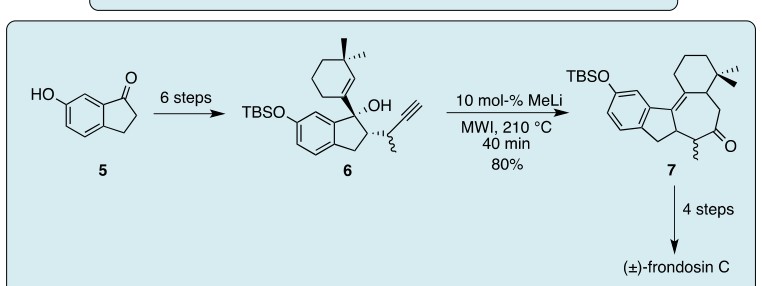
Similarly, frondosin C was synthesized according to the strategy depicted in Figure 5 [18]. Thus, the key tertiary alcohol 6 was readily synthesized from commercially available indanone 5 in six steps. Standard cyclization/ Claisen rearrangement strategy involving catalytic base and microwave irradiation (MWI) at 210 °C afforded the tetracyclic intermediate 7, which was converted to racemic frondosin C in four additional steps (Figure 5).
Conclusion
In summary, sequential oxyanionic 5- and 6-exo-dig cyclization/Claisen rearrangement has been developed, allowing the straightforward synthesis of a number of interesting cycloheptanoid and cylooctanoid ring systems. The methodology is ideally suited for natural product synthesis and has been so far applied to the preparation of three meroterpenoid natural products frondosin A, B and C. In addition, an asymmetric variant of the process has been developed which may be readily employed to access optically active cycloheptenone and potentially cyclooctenone ring systems [15].
Acknowledgment
This research was supported by grants from the National Institutes of Health NIGMS. T.V.O also gratefully acknowledges support from the Hans And Ella McCollum- Vahlteich '21 endowment.
References
-
de Olivera KT, Servilha BM, de C Alves L, Desidera AL (2014) The Synthesis of Seven-Membered Rings in Natural Products. Stud Nat Prod 42: 421-463.
-
Mehta G, Singh V (1999) Progress in the Construction of Cyclooctanoid Systems: New Approaches and Applications to Natural Product Syntheses. Chem Rev 99(3): 881–930.
-
Hu, YJ, Li LX, Han JC, Min L, Li CC (2020) Recent Advances in the Total Synthesis of Natural Products Containing Eight-Membered Carbocycles (2009–2019). Chem Rev 120: 5910-5953.
-
Battiste MA, Pelphrey PM, Wright DL (2006) The Cycloaddition Strategy for the Synthesis of Natural Products Containing Carbocyclic Seven-Membered Rings. Chem Eur J 12(13): 3438-3447.
-
Ojima I, Tzamarioudaki M, Li Z, Donovan RJ (1996) Transition Metal-Catalyzed Carbocyclizations in Organic Synthesis. Chem Rev 96(2): 635-662.
-
Marvell EN, Titterington D (1980) A Novel Synthesis of 4-Cycloheptenones. Tetrahedron Lett 21(22): 2123- 2124.
-
Ovaska TV (2011) Synthesis of Cycloheptanoid Natural Products via Tandem 5-exo Cyclization/Claisen Rearrangement Process. Arkivoc pp: 34-44.
-
Feldman AW, Ovaska SI, Ovaska TV (2014) Facile Access to Cyclooctanoid Ring Systems via Microwave-Assisted Tandem 6-exo dig Cyclization-Rearrangement Sequence. Tetrahedron 70(27-28): 4147-4155.
-
DeLomba WC, Stone EA, Alley KA, Iannarone V, Tarsis E, et al. (2020) Utilization of the Thorpe–Ingold Effect in the Synthesis of Cyclooctanoid Ring Systems via Anionic 6-exo-dig Cyclization/Claisen Rearrangement Sequence. J Org Chem 85(15): 9464-9474.
-
Patil AD, Freyer AJ, Killmer L, Offen P, Carte B, et al. (1997) Frondosins, Five New Sesquiterpene Hydroquinone Derivatives with Novel Skeletons from the Sponge Dysidea Frondosa: Inhibitors of Interleukin-8. Tetrahedron 53(14): 5047-5060.
-
Hallock YF, Cardellina JH, Boyd MR (1998) (–)-Frondosins A and D, HIV-Inhibitory Sesquiterpene Hydroquinone Derivatives from Eyrospongia sp. Nat Prod Lett pp: 153- 160
-
Zhu YM, Webster SJ, Flower D, Woll PJ (2004) Interleukin-8/CXCL8 is a growth factor for human lung cancer cells. Br J Cancer 91(11): 1970-1976.
-
Lane BR, Liu J, Bock PJ, Schols D, Coffe MJ, et al (2002) Interleukin-8 and growth-regulated oncogene alpha mediate angiogenesis in Kaposi’s sarcoma. J Virol 76(22): 11570-11583.
-
Lane BR, Lore K, Bock PJ, Andersson J, Coffey MJ, et al. (2001) Interleukin-8 Stimulates Human Immunodeficiency Virus Type 1 Replication and is a Potential New Target for Antiretroviral Therapy. J Virol 75(17): 8195-8202.
-
Ovaska TV, Sullivan JA, Ovaska SI, Winegrad JB, Fair JD (2009) Asymmetric Synthesis of Seven-Membered Carbocyclic Rings via a Sequential Oxyanionic 5-Exo Dig Cyclization/Claisen Rearrangement Process. Total Synthesis of (–)-Frondosin B. Org Lett 11(12): 2715- 2718.
-
Li, X, Ovaska TV (2007) Total Synthesis of (±)-Frondosin B. Org Lett 9(19): 3837-3840.
-
Li X, Keon AE, Sullivan JA, Ovaska TV (2008) Formal Total Synthesis of (±)**-**Frondosin A. Org Lett 10(15): 3287-3290.
-
Li X, Kyne RE, Ovaska TV (2007) Total Syntheses of (±)-Frondosin C and (±)-8-epi-Frondosin C via a Tandem Anionic 5-Exo Dig Cyclization-Claisen Rearrangement Sequence. Tetrahedron 63(9): 1899-1906.
- Spectrophotometric Determination of Lanthanum (III) and Some Rare Earths with Xylenol Orange
- Introduction and Sources of Molluscicides
- Trimetazidine: An Antianginal Drug and Not Only!
- Nature Inspired Discovery and Development of Antibacterials: An Update
- Fungal Biodegradation of Polycyclic Aromatic Hydrocarbons (PAHs)
- Recent Approaches of Impurity Profiling in Pharmaceutical Analysis: A Concise Review