
Selected Examples of the Metal-Free Synthesis of Allenes (2017 – 2023)
Although metal catalysts are widely used in chemical reactions, there are certain limitations and concerns associated with their use in medicinal chemistry. Many of the metal catalysts used in pharmaceutical production can remain in the final product and be toxic to human health. These impurities might not be easily removed and could negatively impact the quality of the final product. Metal catalysis can also require harsh conditions, such as high temperature and pressure, which can lead to the degradation of sensitive compounds. Furthermore, metal catalysts are from finite resources and their use can have significant environmental impacts. While metal catalysts have their place in organic synthesis, especially in industries outside of pharmaceuticals, the stringent requirements for safety and purity make them less than ideal. This minireview explores some of the latest metal-free methods for the preparation of the highly versatile fictional group, allenes. The methods described within are suitable metal free methods to prepare cumulated dienes which could be used in the production of complex therapeutics.
Introduction
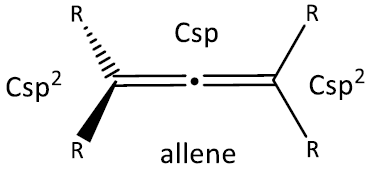
Allenes are a unique class of compounds due to the adjacent double bonds and the two pi-orbitals perpendicular to each other, (Figure 1). The unique structure and high carbon to hydrogen or R-group ratios allow for allenes to be used as versatile building blocks towards biological active compounds and natural products [1, 2, 3]. The unique allene moiety allows for excellent range and complexity to be accomplished in a variety of single-step reactions. Their unique ability to participate in diverse transformation, such as cycloadditions and rearrangements, offers versatile routes to constructing structures found in many bioactive compounds and natural products. Overall, the distinctive geometry and reactivity of allenes make them valuable tools in the synthesis of bioactive molecules, contributing to advancements in drug discovery and chemical biology. Over the last 20 years there have been several excellent reviews that broadly explore the properties and preparation of allenes, including computational studies, metal catalyzed preparations, asymmetric synthesis, and others. The present minireview is meant to be snapshot of some of the most recent articles published on the various synthesis of allenes. Special emphasis is on the procedures using metal-free conditions [4, 5], which are excellent intermediates for the synthesis of bioactive molecules.
Metal-Free Synthesis of Allenes
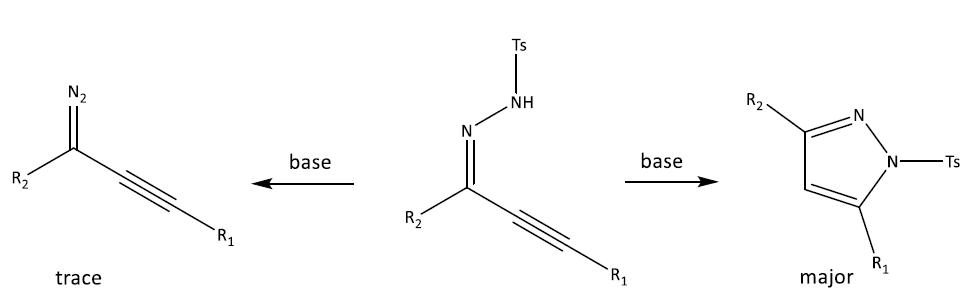
Literature reports exhibited that the formation alkyl- and alkenyl-, or aryldiazomethane carbenes from an N-tosylhydrazones surrogate significantly contributed to the development of carbene chemistry [6, 7, 8, 9]. However, the alkynyl N-tosylhydrazone surrogates revealed that is not a convenient path to alkynl- carbenes due to the favored intramolecular cyclization to pyrazoles (Figure 2).
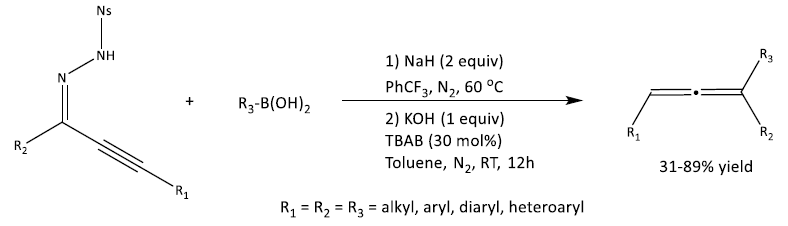
Interestingly Xihe Bi, et al. [10] reported the formation of a wide range of di- and trisubstituted allenes by the coupling of alkynyl N-nosylhydrazones with a variety of boronic acids (Figure 3). Using aryl boronic acids with both electron withdrawing groups and electron donating groups proceed efficiently affording the corresponding 1,3-diarylallenes in good yields. Heteroaryl and naphthyl boronic acids were also tolerated in good yields. This nosyl-based strategy is very attractive because itproceeds smoothly to afford trisubstituted allenes in a synthetically meaningful yield, although stereospecificity of the reaction was not revealed. The reaction works effectively with the use of pbromo- phenyl, phenyl, 3-thiophenyl and isopropyl boronic acids. Preliminary mechanistic investigations demonstrated that g-protodeboration of propargyl boric acid was responsible for the initial allene formation.
The above example of alkynyl N-nosylhydrazones is particularly noteworthy when compared to an earlier, 2008 report by Yong-Qiang Tu, et al. [11]. They showed the one- pot synthesis of trisubstituted and 1, 1-disubstituted allenes from α, β-unsaturated N-tosylhydrazones under mild Lewis basic conditions (Figure 4).
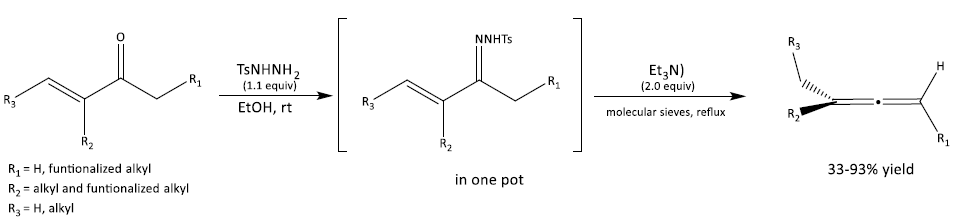
This reaction proceeded readily with regioselective double bond migration. This method also allowed the preparation of several trisubstituted and 1,1-disubstituted allenes under conditions that were highly compatible with sensitive functional groups. The optimization studies of this reaction showed that the use of the molecular sieves and base played a critical role in the protocol. Their studies conclude that the use of secondary organic amines was far less effective and the best yields of the allenes were obtained by using Et3N. In addition, the use of inorganic Bronsted bases led to the thermal decomposition of the α, β unsaturated tosylhydrazones [12, 13]. These examples demonstrate that the use of alkynyl N-nosylhydrazones and N-tosylhydrazones, under the described conditions, is an efficient alternative to prepare allenes without the use of metallic reagents or catalyst.
The generation of tetrasubstituted allenyl iodide compounds via 1,4-sulfonyliodination of a variety of 1,3-enynes in the presence of tert-butyl hydroperoxide has been recently reported [14] (Figure 5).
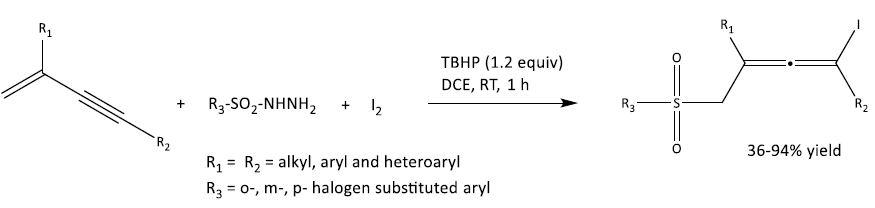
Good yields of the desired allene products were obtained when a series of aryl-sulfonyl hydrazides with electron withdrawing or electron donating groups on the para position of the aromatic ring were used. Halo- substituted, disubstituted and trisubstituted aryl-sulfonyl hydrazides were tolerated and gave the corresponding allenyl products in good yields. Heterocyclic moieties and alkyl sulfonyl hydrazide compounds were tolerated as well, and the reactivity of 1, 3-enynes was also studied. Accordingly, 1, 3- enynes bearing different aryl groups at the 4-position, or bearing halogens at the ortho, meta, and para positions of the aromatic ring work well generating high yields of the desired allenyl iodide products. Mechanistic studies revealed that the reaction proceeds through a radical pathway initiated by the in situ-generated sulfonyl radical. This method demonstrated operational simplicity (open to air), high functional group tolerance, good yields and excellent regioselectivity. Although stereochemical control was not reported, the use of economical and green oxidants makes this methodology highly attractive for the preparation of tetrasubstituted allenes [15, 16, 17].
The synthesis of difluoromethylated allenes via regioselective trifuncionalization of 1,3-enynes have been studied by Bao, et al. [18]. This metal free protocol uses N-flurobenzenesulfonimide (NFSI) as the fluorination and amination source (Figure 6). Substitution of the aromatic ring with electron withdrawing or electron donating groups was tolerated by the reaction. Enynes with primary, secondary, or tertiary alkyl groups linked with the C-C triple bond were suitable reagents to get the target allenes in moderated yields. Moreover, it was reported that substrates bearing a bulky group at the triple bond as well as esters and silyl functionalities afforded the allene products in high yields.
Using non-styrene 1,3-enyne systems and 1,3-enynes bearing a primary alkyl group connected with the C-C triple bond provides very low yield of the desired allenes which is a disadvantage of this protocol.
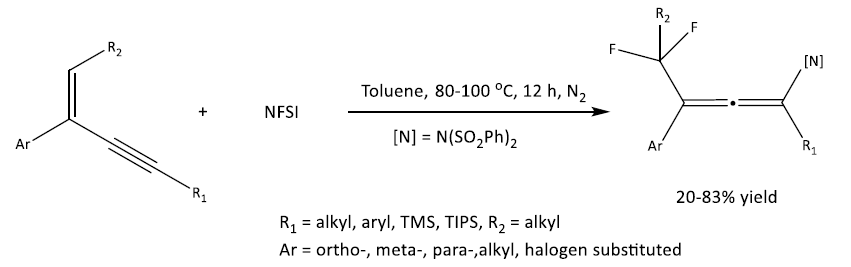
Mechanism studies suggest a two-step pathway where electrophilic fluorination of the 1, 3-enyne by NFSI synchronously generates the dibenzenesulfonimide (DBSI) and a fluorinated enyne as the reactive intermediate. The second NFSI then reacts to afford the major product assisted by the DBSI. The authors also confirmed the structures of two of the difluoromethylated allenes by single crystal X-ray diffraction. These studies offer a convenient approach for the synthesis of a variety difluoromethylated allenes and shows uncommon example of regioselective trifuncionalization of 1, 3-enynes, yet stereochemical control was not reported (Figure 7).
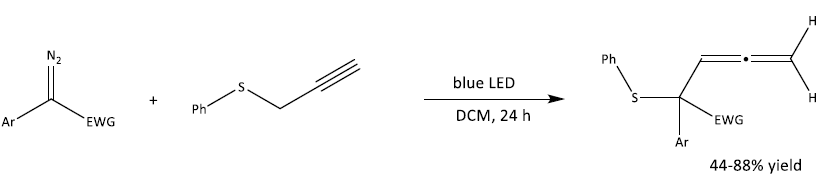
Gryko, et al. reported [19] the formation of highly functionalized allenes in a good to excellent yields by using the Doyle-Kirmse reaction [20, 21, 22] of propargyl sulfides with donor/acceptor diazoalkanes. The reaction was induced by blue-light irradiation and catalyst was not required. This protocol proceeds efficiently for diazoacetates bearing unsubstituted aryl, naphthyl and heteroaromatic rings. The diazoacetates with substituents in the phenyl ring (EWG, EDG and halogens) do not strongly affect the reaction yield. This is a practical and easily scalable route to construct allenes. Mechanistic considerations support the participation of singlet carbenes that react with propargyl sulfides, forming ylides. The subsequent [2, 3]-sigmatropic rearrangement leads to allenes.
Allenes with electron withdrawing and electron donating substituents on the same allene are uncommon and there are few synthetic methods available to make them [23, 24, 25]. Recently, a method to construct germinal acyl/ alkoxy tetrasubstituted allenes from ortho-bromobenzyl propargylic ethers was serendipitously found by Shaw, et al. (Figure 8) [26]. A lithium-halogen exchange reaction of ortho-bromobenzyl propargylic ethers with n-butyllithium followed by the addition of Weinreb amides was expected to make substituted benzophenones, however, geminal acyl/ alkoxy tetrasubstituted allenes were found. The mechanism is believed to indeed start with lithium-halogen exchange due to kinetic favorability, followed by deprotonation of the propargyl proton. An allenyl lithiate is produced by a metallotropic shift and reacts with n-butyl bromide generated in situ, followed by a second reaction with nbutyllithium which leads to the addition of the Weinreb amide and forming the allene product.
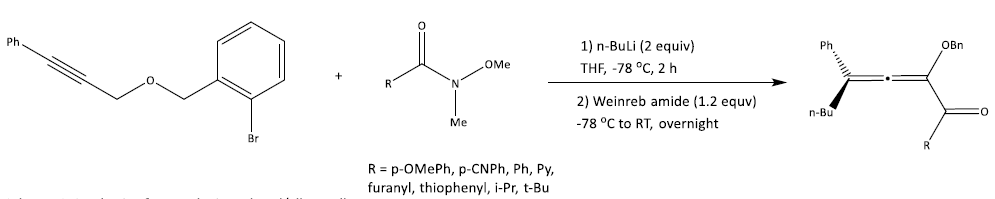
After optimization, the substrate scope was found to tolerate cyclic and acyclic R-groups. Heterocycles were also suitable, affording complex nicotinyl, furyl and thiophenyl substituted acyl allenes. Although the stereospecificity of the allene products were not reported, a subsequent cyclization reaction with an allene produced diastereoselectivities of >95:5 dr. The authors also investigated the reactivity of these structural complex allenes, and they found that those compounds are suitable to several cyclization pathways which allowed the synthesis of novel structures and potential for the construction of new therapeutics.
Conclusion
Currently there are over 150 natural products comprising an allenic type structure that are known. This number clearly shows that allenes cannot simply be considered as oddities, but instead they represent important structural elements for a wide variety of biologically active compounds. Furthermore, allenes have proved to be valuable intermediates that can introduce a high degree of molecular complexity in fewer steps. Because of the broad tolerance of functional groups and the overall excellent scope of reactivity, these metal free protocols can be an effective synthetic tool to generate allenes as valuable intermediates in the synthesis of bioactive compounds.
References
-
Roder AH, Krause N (2004) Synthesis and properties of allenic natural products and pharmaceuticals. Angew Chem Int Ed Engl 43(10): 1196.
-
DeForrest JE, Brummond KM (2007) Synthesizing Allenes Today (1982-2006). Synthesis 6: 795.
-
Yu S, Ma S (2012) Allenes in catalytic asymmetric synthesis and natural product syntheses. Angew Chem Int Ed Engl 51(13): 3074.
-
Movassaghi M, Ahmad OK (2007) N-Isopropylidene- N′-2-Nitrobenzenesulfonyl Hydrazine. A Reagent for Reduction of Alcohols via the Corresponding Monoalkyl Diazenes. J Org Chem 72(5): 1838.
-
Myers AG, Zheng B (1996) New and Stereospecific Synthesis of Allenes in a Single Step from Propargylic Alcohols. J Am Chem Soc 118: 4492.
-
Xiao Q, Zhang Y, Wang J (2013) Diazo compounds and N-tosylhydrazones: novel cross-coupling partners in transition-metal-catalyzed reactions. Acc Chem Res 46(2): 236-247.
-
Shao Z, Zhang H (2012) N-Tosylhydrazones: versatile reagents for metal-catalyzed and metal-free cross- coupling reactions. Chem Soc Rev 41(2): 560-572.
-
Barluenga J, Valdes C (2011) Tosylhydrazones: new uses for classic reagents in palladium-catalyzed cross- coupling and metal-free reactions. Angew Chem Int Ed Engl 50(33): 7486-7500.
-
Fulton JR, Aggarwal VK, Vicente J (2005) The Use of Tosylhydrazone Salts as a Safe Alternative for Handling Diazo Compounds and Their Applications in Organic Synthesis. Eur J Org Chem, pp: 1479-1492.
-
Yang Y, Liu Z, Porta A, Zanoni G, Xihe Bi (2017) Alkynyl N-Nosylhydrazones: Easy Decomposition to Alknynl Diazomethanes and Application in Allene Synthesis. Chem Eur J 23(38): 9009.
-
Tang M, Chun-An F, Fu-Min Z, Yong-Qiang T, Wen-Xue Z, Ai-Xia W, et al. (2008) New metal-free one-pot synthesis of substituted allenes from enones. Org Lett 10(24): 5585.
-
Aggarwal VK, Alonso E, Bae I, Hynd G, Lydon KM, et al. (2003) A new protocol for the in situ generation of aromatic, heteroaromatic, and unsaturated diazo compounds and its application in catalytic and asymmetric epoxidation of carbonyl compounds. Extensive studies to map out scope and limitations, and rationalization of diastereo- and enantioselectivities. J Am Chem Soc 125(36): 10926.
-
Doyle MP, Yan MJ (2002) Effective and highly stereoselective coupling with vinyldiazomethanes to form symmetrical trienes. Org Chem 67(2): 602.
-
Yunhe Lv, Lai J, Pu W, Wang J, Han W, et al. (2023) Metal- Free Highly Regioselective 1,4-Sulfonyliodination of 1,3-Enynes. J Org Chem 88(4): 2034.
-
Joseph D, Idris MA, Chen J, Lee S (2021) Recent Advances in the Catalytic Synthesis of Arylsulfonyl Compounds. ACS Catal 11(7): 4169.
-
Qiu G, Zhou K, Gao L, Wu J (2018) Insertion of sulfur dioxide via a radical process: an efficient route to sulfonyl compounds. Org Chem Front 5(4): 691.
-
Zhou C, Zeng X (2021) Iodosulfonylation of Alkynes under Ultrasound Irradiation. Synthesis 53(24): 4614.
-
Muhammad MT, Jiao Y, Changqing Ye, Mong-Feng C, Israr M, et al. (2020) Synthesis of difluoromethylated allenes through trifunctionalization of 1,3-enynes. Nature Communications 11(1): 416.
-
Orłowska K, Rybicka-Jasinska K, Krajewski P, Gryko D (2020) Photochemical Doyle–Kirmse Reaction: A Route to Allenes. Org Lett 22(3): 1018.
-
Yang Z, Guo Y, Koenigs RM (2019) Photochemical, Metal- Free Sigmatropic Rearrangement Reactions of Sulfur Ylides. Chem 25(27): 6703.
-
Yang J, Wang J, Huang H, Qin G, Jiang Y, et al. (2019) gem- Difluoroallylation of Aryl Diazoesters via Catalyst-Free, Blue-Light-Mediated Formal Doyle–Kirmse Reaction. Org Lett 21: 2654.
-
Hommelsheim R, Guo Y, Yang Z, Empel C, Koenigs RM (2019) Blue-Light-Induced Carbene-Transfer Reactions of Diazoalkanes. Angew Chem Int Ed 58(4): 1203.
-
Sromek AW, Kel’in AV, Gevorgyan VA (2004) A Novel 1,2-Migration of Acyloxy, Phosphatyloxy, and Sulfonyloxy Groups in Allenes: Efficient Synthesis of Tri- and Tetrasubstituted Furans. Angew Chem Int Ed 43(17): 2280.
-
Shiroodi RK, Sugawara M, Ratushnyy M, Yarbrough DC, Wink DJ, et al. (2015) Au-Catalyzed Pentannulation Reaction of Propargylic Esters Occurring at C(sp3)–H Site. Org Lett 17: 4062.
-
Shiroodi RK, Gevorgyan V (2013) Metal-catalyzed double migratory cascade reactions of propargylic esters and phosphates. Chem Soc Rev 42(12): 4991.
-
Bergstrom BD, Toth-Williams G, Lo A, Toman JW, Fettinger JC, et al. (2022) One-Pot Assembly and Synthetic Applications of Geminal Acyl/Alkoxy Tetrasubstituted Allenes. J Org Chem 87(18): 12175-12181.
- Spectrophotometric Determination of Lanthanum (III) and Some Rare Earths with Xylenol Orange
- Introduction and Sources of Molluscicides
- Trimetazidine: An Antianginal Drug and Not Only!
- Nature Inspired Discovery and Development of Antibacterials: An Update
- Fungal Biodegradation of Polycyclic Aromatic Hydrocarbons (PAHs)
- Recent Approaches of Impurity Profiling in Pharmaceutical Analysis: A Concise Review