
Extraction of Lawsone Active from the Henna Leaves (Lawsonia Inermis) by Solvent Extraction Method
Natural hair colour technology recent days very much pronounced by the consumer due to the awareness about the carcinogenic problem of synthetic dyes. Natural hair colour or dyes are safe to use, it does not harm to the hair, does not bleach. Among the various natural hair colour technique, the henna hair colour is very much pronounced in south Asia, since the material readily available for colouring. In this present attempt to aim to identify the potential solvent for the extraction and make the stable format of extracted lawsone for the hair colour application. Present study results immense useful to the personal care industry to derive the suitable extraction plan for the lawsone and helps to make the product to address the regular consumer pain point area especially the henna paste preparation and colour delivery. The pure henna powder was collected from high crop season from Rajasthan Henna growing garden in India and tested the initial lawsone content through HPLC assay. Sigma Aldrich standard 2-hydroxy-1,4 naphthoquinones act as a reference standard. Lawsone from the leaves are extracted by using the organic solvents like toluene, ethyl acetate, diethyl ether, Carbon tetrachloride, isopropyl acetate, n-Hexane and chloroform. Crude extract yield was higher in ethyl acetate solvent extraction followed by diethyl ether and toluene, and it was lower in n-hexane solvent extractions. Among the purity of lawsone was higher in chloroform i.e., 80% purity and followed by carbon tetra chloride (76%) and toluene (75%); among the studied solvent the ethyl acetate shows the less purity i.e. 32% of lawsone. Polarity index directly and positively correlated with yield and lawsone recovery percentage. Ninhydrin test also shows the negative for the solvent extracted lawsone, however it shows the positive for the water extraction. Overall study clearly indicates that the solvent extraction of lawsone molecules from henna leaves delivers the vibrant colour delivery when compared to the regular consumer practices. Overall experiments are confirming that the absence of amino groups helps to maintain the shelf life of the products. Overall study clearly indicates that the toluene extraction of lawsone is beneficial with respect to the cost, yield and performance of the hair swatches. Findings of solvent extractant of lawsone immense useful to make the traditional shade in convenient way.
Jayaganesh Sankar*, Mridula Kini and Puja Sangle
make the traditional shade in convenient way. Keywords: Lawsone Extraction; Polarity Index; Toluene; Ethyl Acetate; Ninhydrin Test
Introduction
Ancient time itself people use the various colouring material for the hair to maintain the hair looking young and nourish look. Ancient days metal and plant dyes plays a crucial role for the hair colour development, continue application of lead or silver salts, helps to covers the grey hair and helps to turns into metallic shades. Natural hair colour technology recent days very much pronounced by the consumer due to the awareness about the carcinogenic problem of synthetic dyes. Natural hair colour or dyes are safe to use, it does not harm to the hair, does not bleach. Many chemical dyes are causing the scalp itching potential, however the plant dyes are safe to use, friendly to the scalp. In addition to that chemical dyes are harm to the environment also. In general, the chemical-based hair colours containing the aryl diamine derivative along with alkali and oxygen releasing materials like hydrogen peroxide, sodium perborate, barium peroxide, calcium peroxide etc. During the colouring process, the aryl diamine undergo polymerisation form a trimer molecule and deliver the colour based on colour modifier present in the formula. Lawsone is important representative for the natural colorant with napthoquinone structure. Henna is a natural hair dye and it derived from Lawsonia innermis. Lawsonia innermis is a shrub and ancient days it is used for the body art, body staining and hair conditioning. The colouring chemical constituents namely called as Lawsone i.e. 2-hydroxy 1,4 napthoquinone [1, 2, 3, 4]. Henna leaf alone does not deliver the colour, since it is active component available in the form of hennosides. During the hydrolysis process it generate the glycosides and aglycone and aglycone further undergo oxidation it forms a 2-hydroxy,1,4-napthoquinone. 2-hydroxy 1,4 naphthoquinone is responsible for the colouring and ranged between 0.5 and 2.0 % in the dried leaves. Chemistry and reaction mechanism between aglycone and glycoside are similar to the natural product chemistry. Many scientists proved that Mehendi leaf extract having many pharmacological properties like anti- fungal, anti-bacterial; anti-cancer [5, 6, 7] activity property. Quantitative analysis of lawsone extracts performed by high performance liquid chromatography (HPLC) method on C18 column [8]. Henna leave powder alone does not contribute any colour to the hair; however, it reacts with water or hydrolysis process it releases the active molecules and active molecules are readily react with the protein moiety of the substrate hair or skin and delivers the colour. If we kept the mixture in longer time, it readily binds with the leave protein molecules and form a protein complex and it does not deliver the colour to the hair and skin. In general consumer take 1 part of pure henna powder and mix with
4 part of water and kept aside for 6 hours to overnight for release the lawsone moiety. Releasable lawsone moiety readily react with protein molecule in leave itself and degradation process started. That is the reason all the market products are available in powder format; however, it is very difficult to end user with respect to the sample preparation and colour delivery. Many people attend the extraction of lawsone actives from the henna leaves in last two decades, however they are not test the colour delivery and product development with the natural extracted molecules of lawsone [9, 10, 11]. Present attempt aims to check the suitable solvent the henna extraction and confirm the yield with respect to the various solvent. Present study also attempts to check the stability of the natural extracted dye molecules and colour delivery. Present study results immense useful to the personal care industry to derive the suitable extraction method for the lawsone molecules from leaves. It immense useful and helps to address the regular consumer pain point especially the henna paste preparation and colour delivery. Present study aims to develop the stable lawsone molecules from solvent extract method.
Materials and Methods
Study Area
The entire study was carried out in MARICO Research and development centre, Mumbai, India between 2021 and 2022.
Sample Collection
The pure henna powder was collected from high crop season between harvested October and November from Rajasthan Henna growing garden in India and tested the initial lawsone content through HPLC assay. Sigma Aldrich standard 2-hydroxy-1,4 naphthoquinones (Purity: Min 98%) acts as a reference standard. All the chemicals and reagents used for the studies were of analytical grade. All the estimations were carried out in triplicate and all the equipment was calibrated as per the good laboratory norms. Lawsone content in the leaves is exclusively measured by method IS-11142-2019. The physico chemical parameters of lawsone powder and furnished in the Table 1. As per BIS specifications the lawsone powder compiles all the quality parameters. Explore the following solvent for the extraction of lawsone from the leaves like toluene, ethyl acetate, diethyl ether, Carbon tetrachloride, isopropyl acetate, n-Hexane and chloroform.
| S.NO | Parameters | Specification | Results |
|---|---|---|---|
| 1 | Appearance | Green colour free flow powder | Compiles |
| 2 | Odour | Green henna note | Compiles |
| 3 | Moisture and volatile matter | Max 10% w/w | 3.24% |
| 4 | Cold water extract | 25-32% w/w | 27.94% |
| 5 | Crude fiber | 10-15% w/w | 13.17% |
| 6 | Mineral matter | 8-12% w/w | 10.24% |
| 7 | Acid Insoluble ash | 3-6% w/w | 3.23% |
| 8 | Extraneous sand | Max 5.0% w/w | 2.76% |
| 9 | Total ash content | Max 15% w/w | 12.12% |
| 10 | Presence of Extraneous dye | Absent | Passes |
| 11 | Lawsone pigment | Min 1.0% | 1.52% |
| 12 | pH of 5% solution | 4.0 – 5.0 | 4.58 |
Table 1: _Lawsonia inermis_ leaf analytical parameters estimation.
Extraction of Lawsone from the Henna Leaves
100 g of crushed leaves powder of lawsonis inermis taken in the 1000 mL glass beaker and added the 1000 mL distilled water at 25-30 deg c for 3 Hrs with continuously stirring at RPM 800-1000. After 3 Hrs checked the pH of the mixture. And then added 13 g of sodium bicarbonate while stirring (500-800 rpm speed) continuously for 10 minutes and mix by stirring for 20 minutes and adjusted the pH between 7.5 and 8.0.
During addition of sodium bicarbonate carbon dioxide released, and filtered the sample. Repeat the same process for three times, collected the filtrate and then added 200 ml of water in remaining mass and stirred for another 10 mins, filtered it again and collected the filtrate. In filtrate further undergo acidify with addition of 1M Hydrochloric acid while stirring for another 10 minutes and maintain the pH between 2.5 and 3.0 and continue the stir for further 20 minutes. Extracted the filtrate three times with 1:1 ratio of solvent. Around 2.5 L solvent required for complete extraction process. The upper phase is recovered, and the aqueous phase being separated because it is practically free from lawsone. The solvent phase filtrated and then dried with rotavapor and completely evaporated the solvent.
Colour Uptake Measurement
The single bundle swatches were used for the complete study to avoid inconsistent results. Prepared hair swatches washed with water and surfactant solution for complete removal of any oil dirt and foreign materials. The chroma meter reading was carried out for the freshly prepared hair swatches, an average of six readings was taken by the instrument and take the average for the calculation [12].
Apply the prepared extracted gel base product into the hair swatch with help of a brush and kept aside for 30 minutes. After 30 minutes, wash the hair swatches with normal tap water until the water runs clear. Dry the washed swatches with a normal air dryer and kept the swatches aside for 2-3 hours and take the colour uptake readings. Then colour reading (L*a*b* values) was taken for coloured swatches by Chromameter as like as pre-reading. Dye uptake (DE) was calculated based on the below formula [13]. Study also compares the regular consumer practice of henna application colour delivery also, i.e. one part of henna powder soak 4 part of water in overnight and applied to the hair and leave it for 2 hours for the colour development, after two hours wash the hair swatches with normal water and dried.
$$ \mathrm {D E} = \sqrt {\left(\mathrm {L} _ {2} ^ {*} - \mathrm {L} _ {1} ^ {*}\right) ^ {2} + \left(\mathrm {a} _ {2} ^ {*} - \mathrm {a} _ {1} ^ {*}\right) ^ {2} + \left(\mathrm {b} _ {2} ^ {*} - \mathrm {b} _ {1} ^ {*}\right) ^ {2}} $$ L scale: Lightness to darkness, where a low number (0-50) indicates dark, and a high number (51-100) indicates light for initial colour uptake L1: before colouring and L2: After colouring a scale: Red to Green, where a positive number indicates red, and a negative number indicates green for initial colour uptake a1: before colouring and a2: After colouring b scale: Yellow to Blue, where a positive number indicates Yellow, and a negative number indicates Blue for initial colour uptake b1: before colouring and b2: After colouring
Results & Discussion
Physicochemical parameters of henna leaf powder (IS 11142:2019) and the results were furnished in Table 1. Lawsone content was estimated through HPLC and quantified the available lawsone content; about 1.52 % of lawsone was present in the leave powder, and the results were identical to the previous study [14, 15]. Many scientists and crop scientists estimated lawsone content varied between 1.0 and 2.0% in the leaf portion. Solvents are selected based on the polarity index and the details are furnished in Table 2. Among the selected solvent n-hexane (PI:0.10) having the low polar and highest in ethyl acetate (PI: 4.4). Around 50 gm henna powder uniformly taken for the extraction study and after extraction yield was calculated. Similar kind of observations also noticed by Pittas, et al. [16] and Rawiwan, et al. [17]. Purity of extracted lawsone was calculated by the HPLC estimation with Sigma Aldrich marker standard of lawsone (CAS. No. 83-72-7).
| Solvent | Polarity index | Yield (in gm) | % of purity by HPLC |
|---|---|---|---|
| Ethyl acetate | 4.4 | 3.76 | 32 |
| Toluene | 2.4 | 1.5 | 75 |
| Diethyl ether | 2.8 | 1.6 | 46 |
| Chloroform | 4.1 | 1.2 | 80 |
| Carbon tetra chloride (CCl ) 4 | 1.56 | 1.3 | 76 |
| n-hexane | 0.1 | 1 | 52 |
Table 2: Lawsone active extraction in leave by different solvent process.
Crude extract yield was higher in ethyl acetate solvent extraction followed by diethyl ether and toluene, and it was lower in n-hexane solvent extractions. Among the purity of lawsone was higher in chloroform i.e., 80% purity and followed by carbon tetra chloride (76%) and toluene (75%); among the studied solvent the ethyl acetate shows the less purity i.e. 32% of lawsone (Table 2).
Total yield of lawsone obtained through the various solvent extraction and summarised in the Figure 1. The highest yield was noticed in solvent ethyl acetate 1.20% however the purity of ethyl acetate solvent yielded lower i.e. 32% and followed by toluene extraction and it yielded 1.125%. Among the tested solvent n-hexane and diethyl ether extraction yielded the very low quantity of low lawsone i.e. 0.520% and 0.736% respectively. According to the fresh leaves the active % of lawsone available is 1.52 (Table 1) and ethyl acetate recovery percentage is higher i.e. 79.2% followed by toluene is 74% recovery noticed in this study. Among the solvent used n-hexane and diethyl ether showed the less recovery percentage i.e. 34.2% and 48.4%. Correlation coefficient calculated between polity index of the solvent and lawsone recovery percentages and the results indicated the positive values i.e. 0.70; it indicates that polarity index positive correlate to the lawsone recovery from the leaves. Similarly the correlation coefficient between polarity index and yield also positive i.e. 0.63. Overall correlation study and the results are clearly indicating that the selection of solvent is critical to obtained the better yield purity of lawsone [9, 10, 11, 16].
![Figure 1: The highest yield was noticed in solvent ethyl acetate 1.20% however the purity of ethyl acetate solvent yielded lower i.e. 32% and followed by toluene extraction and it yielded 1.125%. Among the tested solvent n-hexane and diethyl ether extraction yielded the very low quantity of low lawsone i.e. 0.520% and 0.736% respectively. According to the fresh leaves the active % of lawsone available is 1.52 (Table 1) and ethyl acetate recovery percentage is higher i.e. 79.2% followed by toluene is 74% recovery noticed in this study. Among the solvent used n-hexane and diethyl ether showed the less recovery percentage i.e. 34.2% and 48.4%. Correlation coefficient calculated between polity index of the solvent and lawsone recovery percentages and the results indicated the positive values i.e. 0.70; it indicates that polarity index positive correlate to the lawsone recovery from the leaves. Similarly the correlation coefficient between polarity index and yield also positive i.e. 0.63. Overall correlation study and the results are clearly indicating that the selection of solvent is critical to obtained the better yield purity of lawsone [9-11,16].](/fulltextimages/11649/fig_1.png)
The ninhydrin test is a chemical test useful to identify ammonia, primary/secondary amines, or amino acids. In this test, ninhydrin reagent is added to the test material, resulting in the production of deep blue colour, also known as Ruhemann’s purple, in the presence of an amino group [18, 19, 20]. The ninhydrin reaction is essentially a redox reaction. Here ninhydrin acts as an oxidizing agent, and itself gets reduced. Ninhydrin reacts with the amino group of the free amino acid in the test sample and oxidizes the compound, leading to delamination. In this reaction, two gasses get released. These are ammonia (NH3) and carbon dioxide (CO2). Besides the gasses, we obtain an aldehyde and hydrindantin, which is formed by the reduction of ninhydrin. Now, the released ammonia further reacts with the ninhydrin giving rise to di-ketohydrin, which forms a coloured complex [16, 18, 21, 22]. Complete reaction mechanism furnished in the Figure 2.
The water extraction of lawsone readily reacts with protein molecules in the leaves moiety and degradation started and diminish the colour delivery. Similarly, the freshly prepared and releasable lawsone readily reacts with skin or hair protein and delivers the desirable results and the reaction is happened through the Micheal -Addition reaction mechanism. In this juncture, in this study lysine used as positive control, as per the consumer practice added with water and soak for 2-3 hours and performed the test and the results shows the positive and it indicates the presence of protein moiety present in the leaves and similar kind of observations noticed in sodium bicarbonate solution extraction also. However, the ninhydrin test shows negative (-ive) with respect to the solvent extraction mixture, it indicates that all the amino groups are removed by the polar solvent and obtained only lawsone active moiety. In this study shows that the solvent extracted lawsone free from any form of amino group and stable for long time until reacts with any protein moiety.
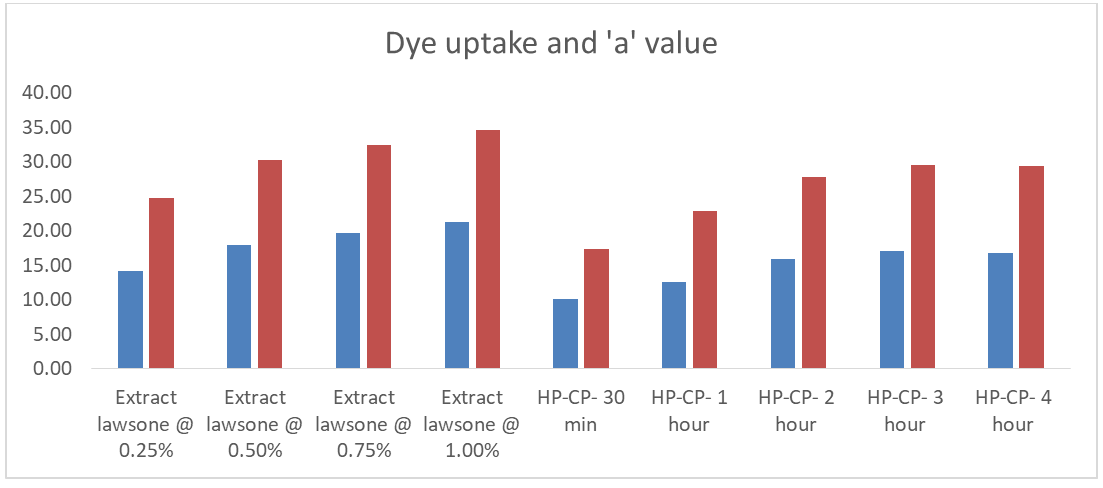
Dye uptake study was carried out in grey swatches and extracted lawsone prepared with 0.25%; 0.50%, 0.75% and 1.0% dosage in final products and applied on the swatches and kept for 30 minutes for the colour development. Similarly another set of study carried out with regular henna powder soak for 6 hours and kept the swatches at various developmental time like 30 minutes, 1 hours, 2 hours, 3 hours and 4 hours. The red (‘a’) hue and DE value are furnished in Figure 3. A red hue was higher, and it noticed in 0.75 and 1.0% lawsone extract i.e. 19.65 % and 21.28 respectively; however 0.50% of lawsone also delivers the vibrant red hue (a-17.90). In the case of regular consumer practice 6 hour soak and 3 hour colour development mimic to the 30 minutes extracted lawsone results. Around 3 hours colour developmental shows ‘DE’ value of 29.51 and ‘a’ value of 17.08. However, the extracted lawsone delivers DE value of 30.21 and ‘a’ value of 17.90 with just 30 minutes developmental times. So the overall study reveals that the extracted lawsone helps to minimize the developmental time of colour and avoid the soaking process. Overall findings immense useful to make the traditional shade in convenient way (Table 3).
| Samples | Ninhydrin Test | Colour | Result |
|---|---|---|---|
| Lysine Solution | Amino group present | Color change | Positive (+ive) |
| Henna + Water paste | Amino group present | Colour Changes | Positive (+ive) |
| Henna extract with sodium bicarbonate | Amino group present | Colour changes | Positive (+ive) |
| Solvent extracted solution | Amino group not present | Colour does not change | Negative(-ive) |
Table 3: Ninhydrin test for the confirmation of amino group absent in solvent extraction.
Conclusion
Overall study clearly indicates that the solvent extraction of lawsone molecules from henna leaves delivers the vibrant colour delivery when compared to the regular consumer practices. In addition to that the solvent extraction of henna extraction shows the negative on the ninhydrin test, it confirms that there is no amino group present in the solvent extraction. Overall experiments are confirming that the absence of amino groups helps to maintain the shelf life of the products. Overall study clearly indicates that the toluene extraction of lawsone is beneficial with respect to the cost, yield and colour delivery of the hair swatches. Furthermore, study will be carried out in the large scale extraction to find out the yield and cost benefit ratio.
References
-
Zaheer Z, Ekram YD, Samia AK (2021) 2-hydroxy 1,4-napthoquinone solubilisation, thermodynamics and adsorption kinetics with surfactant. Chinese Journal of Chemical Engineering 32: 212-223.
-
Shivsharan U, Kothari Y (2020) Antimicrobial Activity and Isolation of Lawsone from Lawsonia inermis using Column Chromatography. Research Journal of Pharmacognosy and Phytochemistry 12(4): 219-223.
-
Alam MM, Rahman ML, Haque MZ (2007) Extraction of henna leaf dye and its dyeing effects on textile fibre. Bangladesh J Scient Ind Res 42: 217-222.
-
El‐Shaer NS, Badr JM, Aboul‐Ela MA, Gohar YM (2007) Determination of lawsone in henna powders by high performance thin layer chromatography. Journal of separation science 30(18): 3311-3315.
-
Singh D, Luqman S (2014) Lawsonia inermis (L): A perspective on anticancer potential of Mehndi/Henna. Biomed Res Ther 1: 18.
-
Anastasia F, Karolina S, Sukmann T, Iŕen JJ, Andrea E (2019) Application of natural dyes on diverse textile materials. Optik 181: 215-219.
-
Bhuiyan MAR, Islam A, Ali A, Islam MN (2018) Color and chemical constitution of natural dye henna (Lawsonia inermis L) and its application in the coloration of textiles J Clean Prod 167: 14-22.
-
Badri BM, Burkinshaw SM (1993) Dyeing of wool and nylon 6.6 with Henna and lawsone. Dyes and Pigments 22(1): 15-25.
-
Jeyaseelan EC, Jenothiny S, Pathmanathan MK, Jeyadevan JP (2012) Antibacterial activity of sequentially extracted organic solvent extracts of fruits, flowers and leaves of Lawsonia inermis L. from Jaffna. Asian Pac J Trop Biomed 2(10): 798-802.
-
Gonzalez V, Wood R, Lee J, Taylor S, Bussemaker MJ (2018) Ultrasound-enhanced hair dye application for natural dyeing formulations. Ultrason Sonochem 52: 294-304.
-
Zohourian TH, Armando T. Quitain, Sasaki M, Goto M (2011) Extraction of Bioactive compounds from leaves of Lawsonia inermis by green pressurized fluids. Separation Science & Technology 47(7): 1006-1013.
-
Vaughn MR, Oorschot RAH, Baindur-Hudson S (2009) A comparison of hair colour measurement by digital image analysis with reflective spectophotometery. Forensic Science International 183(1-3): 97-101.
-
Popov-Raljić JV, Laličić-Petronijević JG (2009) Sensory Properties and Color Measurements of Dietary Chocolates with Different Compositions During Storage for Up to 360 Days. Sensors 9(3): 1996-2016.
-
Gallo FR, Multari G, Palazzino G, Pagliuca G, Zadeh MM, et al. (2014) Henna through the centuries: A quick HPTLC analysis proposal to check henna identity. Rev Bras De Farmacogn 24(2): 133-140.
-
Chaudhary G, Goyal S, Poonia P (2010) Lawsonia inermis Linnaeus: A phytopharmacological review. Int J Pharm Sci Drug Res 2(2): 91-98.
-
Pitts LJ, Pallot MG, Jones P (2014) A Method for Analysing Amino Acids and Reagent for Use with the Same - EP 2735876 A1.
-
Charoensup R, Duangyod T, Palanuvej C, Ruangrungsi N (2017) Pharmacognostic Specification and lawsone content of Lawsonia Inermis Leaves. Pharmacognosy Res 9(1): 60-64.
-
Das S (2020) Recent applications of ninhydrin in multicomponent reactions. RSC Adv 10: 18875-18906.
-
Pilicer SL, Wolf C (2020) Ninhydrin Revisited: Quantitative Chirality Recognition of Amines and Amino Alcohols Based on Nondestructive Dynamic Covalent Chemistry. J Org Chem 85(17): 11560-11565.
-
Friedman M (2004) Applications of the ninhydrin reaction for analysis of amino acids, peptides and proteins to agricultural and biomedical sciences. J Agric Food Chem 52(3): 385-406.
-
Das S (2020) Recent applications of ninhydrin in multicomponent reactions. RSC Adv (10): 18875-18906.
-
Semwal BR, Semwal DK, Combrinck S, Cartwright- Jones C, Viljoen A (2014) _Lawsonia inermis_ L. (henna): Ethnobotanical, phytochemical and pharmacological aspects. J Ethnopharmacol 155(1): 80-103.
- Spectrophotometric Determination of Lanthanum (III) and Some Rare Earths with Xylenol Orange
- Introduction and Sources of Molluscicides
- Trimetazidine: An Antianginal Drug and Not Only!
- Nature Inspired Discovery and Development of Antibacterials: An Update
- Fungal Biodegradation of Polycyclic Aromatic Hydrocarbons (PAHs)
- Recent Approaches of Impurity Profiling in Pharmaceutical Analysis: A Concise Review