
Molecular Insights into the Interaction of Vitamin C (Ascorbic Acid) with Glutathione Peroxidase: A Comprehensive Computational Study
This research investigates the molecular interaction between vitamin C (ascorbic acid) and glutathione peroxidase (GPX), a key enzyme in the antioxidant defense system. Oxidative stress-induced damage, caused by an imbalance in reactive oxygen species (ROS) production, is implicated in various health issues. Vitamin C, a potent antioxidant, is known for its ability to neutralize free radicals and support overall cellular health. Despite numerous studies on the protective effects of vitamin C, the molecular details of its interaction with GPX remain unclear. In this study, we employ computational methods, including molecular docking and dynamics simulations, to predict and visualize the molecular-level interaction between vitamin C and GPX. Our results reveal a favorable binding affinity, supported by negative free energy values, suggesting strong interactions. Detailed analyses of various parameters provide insights into the structural flexibility of the ligand, vibrational dynamics, and clustering characteristics. Overall, this study enhances our understanding of the molecular mechanisms underlying the beneficial effects of vitamin C in combating oxidative stress, with potential implications for therapeutic interventions.
Introduction
Antioxidants are compounds that play a crucial role in protecting cells from the damaging effects of oxidative stress [1, 2, 3, 4, 5]. Oxidative stress occurs when there is an imbalance between the production of reactive oxygen species (ROS) and the body’s ability to neutralize them. ROS, including free radicals, can cause damage to cellular structures such as proteins, lipids, and DNA, contributing to various health issues and the aging process [6]. Antioxidants work by neutralizing ROS, preventing them from causing harm to cells. They do this by donating electrons or hydrogen atoms, stabilizing the free radicals and reducing their reactivity. There are several types of antioxidants, including enzymes produced by the body and antioxidants obtained from the diet [3, 4, 7, 8, 9].
Vitamin C, also known as ascorbic acid (C6H8O6), is a water-soluble vitamin that is well-known for its antioxidant properties that can donate electrons (e−) to neutralize free radicals and reactive oxygen species like singlet oxygen (1O2), like superoxide (O2 •−), hydroxyl radical (OH•) etc. By doing so, it helps prevent cellular damage caused by oxidative stress [10, 11]. Vitamin C works both in the aqueous (water- soluble) and lipid (fat-soluble) phases of cells, making it effective in various cellular compartments. Vitamin C can regenerate other antioxidants, such as vitamin E. After vitamin E donates electrons (e−) to neutralize free radicals, it becomes a radical itself. Vitamin C can help regenerate vitamin E, allowing it to continue its antioxidant function. This interplay between vitamins C and E enhances the overall antioxidant defense in the body [12]. Vitamin C has the ability to chelate (bind to and remove) metal ions, such as iron and copper, which can contribute to the generation of free radicals. By chelating these ions, vitamin C helps prevent the formation of additional reactive oxygen species [13, 14]. Vitamin C is essential for the synthesis of collagen, a structural protein that is crucial for the health of connective tissues, skin, blood vessels, and bones, and collagen provides structural support and helps prevent oxidative damage to tissues [15, 16]. Vitamin C supports the immune system by enhancing the function of white blood cells, which play a key role in immune response. During times of infection or inflammation, the demand for vitamin C may increase, highlighting its importance in maintaining a healthy immune system [17].
Vitamin C has been the subject of numerous research studies investigating its effects on oxidative stress and various health conditions. Researchers often explore the potential benefits of vitamin C due to its well-known antioxidant properties [18]. Some studies have investigated the effects of vitamin C supplementation on exercise-induced oxidative stress. Intense physical activity can lead to increased production of free radicals, and researchers have explored whether vitamin C can help mitigate the oxidative stress associated with exercise [19]. In different research studies of arsenic induced myocardial damage also vitamin C has used as a positive control for its protective effects against oxidative damage of cardiac tissue [3, 4, 20, 21]. Glutathione peroxidase (GPX) is an enzyme that plays a key role in the enzymatic antioxidant defense system. It is involved in the reduction of hydrogen peroxide and organic hydroperoxides, which are harmful byproducts of cellular metabolism. The level of this enzyme is reduced due to oxidative stress but it is increased in presence of vitamin C to reduce oxidative damage [3, 4, 21]. Though there are so many studies conducted on the activity of GPX in presence of vitamin C, but the process of molecular interaction of them is not cleared till now as per the literature study. So, the present study is designed to explore how does vitamin C is molecularly interacted with GPX.
Methods and Materials
Complement experimental approaches with computational methods such as molecular docking and molecular dynamics simulations are used to predict and visualize the interaction at the molecular level of vitamin C and GPX enzyme. For the smooth conduction of the study, we employed highly configured computer system with Autodock4, a freely available software tool for academic users, to conduct molecular docking. In performing these docking procedures, we specifically selected glutathione peroxidase enzyme as proteins from organs documented to be influenced by oxidative stress and ascorbic acid (vitamin C) as a ligand. The Figure 1 shows the name and the structure of the collected structural protein from RCSB Protein Data Bank and Figure 2 shows the ligand name and its structure obtained from PubChem. The steps involved in detailing the molecular docking processes [22] with some modifications are shown below:
![Figure 1: Structure of Glutathione peroxidase (PDB ID 7FC2) in our study [23].](/fulltextimages/11838/fig_1.png)
![Figure 2: Structure of Ascorbic acid (Vitamin C) (PubChem CID 54670067) in our study NCBI [24].](/fulltextimages/11838/fig_2.png)
- The PDB and SDF files for the protein (macromolecule) and ligand were acquired from the Protein Data Bank and PubChem respectively.
- Preparing the protein PDB files involved addressing the presence of additional waters. The files were loaded into the ADT GUI, where water molecules were identified as HOH* from a string and subsequently removed following a warning.
- Macromolecular file preparation included the addition of polar hydrogens without bond order. Subsequently, charges were introduced using ADT, with default Kollman charges being applied (ADT automatically adds Kollman charges for a peptide).
- In the concluding step of protein preparation, parameters were incorporated, and the files were saved as a 7fc
Result and Discussion
The total charge on a molecule is the sum of the charges on its constituent atoms, taking into account the number of electrons and protons. In this study we have found that the overall electric charge associated with the ligand molecule which is vitamin C is -3.001 e. A negative charge indicates an excess of electrons compared to protons, suggesting that the ligand is anionic (it has gained electrons) [25]. A rotatable bond is a single bond (sigma bond) between two non-terminal heavy atoms. Heavy atoms are those that are not hydrogen. Rotatable bonds represent the connections in a molecule that can rotate freely around their axis, allowing for different conformations or spatial arrangements of the atoms. The more rotatable bonds a molecule has, the more potential conformations it can access [26]. In Table 1, we have found that its value is 9 torsions generally indicates a moderate to high level of structural flexibility. Number of atoms in ligand is it is providing information about the molecular composition of a ligand. In chemistry, a ligand is a molecule or ion that can form a coordination complex by binding to a central metal atom. The ligand usually donates electrons to the metal, forming a coordination bond [27]. Table 1 indicates that the ligand under consideration consists of 17 atoms. These atoms could be a combination of different elements, and their arrangement and connectivity determine the structure of the ligand. Non-hydrogen atoms in ligand provide the information about the molecular composition of a ligand, specifically indicating the number of non-hydrogen atoms in the ligand [28]. The non-hydrogen atoms in ligand of this experiment shows that it’s value is 13 (Table 1). These non-hydrogen atoms could be a combination of different elements, and their arrangement and connectivity determine the structure of the ligand. Knowing the count of non-hydrogen atoms is essential for understanding the size, complexity, and potential reactivity of the ligand [28]. In Table 1, the number of vibrational degrees of freedom of ligand is 45,” it indicates that the ligand molecule has a total of 45 distinct ways in which its atoms can undergo vibrational motion. This is a significant amount of vibrational flexibility and suggests that the ligand is likely to have a complex and dynamic structure [29]. Torsional degrees of freedom refer to the ability of parts of a molecule to rotate around single bonds. Each single bond connecting two non-terminal atoms introduces a torsional degree of freedom, representing a way in which the atoms on either side of the bond can rotate relative to each other [30]. In this experiment the number of torsional degrees of freedom is found 9 in Table 1 which indicates that the molecule has nine torsional or rotational degrees of freedom. So, the molecule is relatively flexible, and its structure can vary due to rotations around these specific bonds. This flexibility can have implications for the molecule’s behavior in different environments or when interacting with other molecules.
| Total charge on ligand | -3.001 e |
|---|---|
| Number of Rotatable Bonds in Small Molecule | 9 torsions |
| Number of atoms in ligand | 17 |
| Number of non-hydrogen atoms in ligand | 13 |
| Number of vibrational degrees of freedom of ligand | 45 |
| Number of torsional degrees of freedom | 9 |
| Estimated Free Energy of Binding | -2.74 kcal/mol |
| Information entropy for clustering | 0.36 (rmstol = 2.00 Angstrom) |
| Estimated loss of torsional free energy upon binding | +2.6847 kcal/mol |
Table 1: Information of different parameters of the molecular docking.
A negative free energy of binding indicates that the binding process is energetically favorable. In other words, the binding of the ligand to the target is predicted to release energy. Gibbs Free Energy and Binding Energy are crucial parameters studied using AutoDock, as discussed earlier. The output results, represented by Δ𝐺, provide essential insights into a closed system. AutoDock furnishes the minimum value of Gibbs free energy (Δ𝐺) for each conformer of the ligand when docked to the protein. Additionally, it facilitates the calculation of the equilibrium binding constant (𝐾) in each case, with these two parameters linked by the straightforward relation Δ𝐺 = −𝑅𝑇 ln𝐾 [31]. In Table 1 we have found that the estimated free energy of binding is -2.74 kcal/mol refers to a calculated value that represents the change in free energy associated with the binding of the vitamin C to the target protein glutathione peroxidase in a biological system suggest stronger binding interactions. Here in Figure 3 we can see the interaction of vitamin C with protein in the same way.
![Figure 3: Interaction of ligand (Vitamin C) with protein (7FC2) [GPX6] during molecular docking.](/fulltextimages/11838/fig_3.png)
“Entropy for clustering” likely refers to the entropy associated with the clustering of molecular conformations generated during the docking process. Molecular docking is a computational method used to predict the preferred orientation of one molecule (the ligand) when it binds to another molecule (the target or receptor) [32]. The combination of an entropy value of 0.36 and an RMSD tolerance of 2.00 Angstroms of Table 1 of this study suggests that the clustering process is yielding relatively homogeneous conformations, and the structural diversity within each cluster is limited to deviations within the specified RMSD tolerance.
A positive value indicates an increase in energy [33]. In this experiment the value of loss of torsional free energy upon binding is +2.6847 kcal/mol (Table 1) suggests that the binding process is associated with an increase in the energy required for the torsional rotation of certain bonds within the molecules. The positive value here indicates that the binding process is associated with a higher energy cost for the torsional rotations within the molecules.
“CLUSTERING HISTOGRAM” Table 2 section describes the characteristics of a specific cluster of conformations at Cluster Rank 35 in the molecular docking simulation. The lowest binding energy Figure 4, mean binding energy, and the number of conformations in the cluster provide insights into the energetics and diversity of conformations within this particular cluster. Lower binding energies and a higher number of conformations generally indicate a more favorable and diverse set of docking poses in the cluster which is located in the Figure 5.
| Cluster Rank 35 | 1 |
|---|---|
| Lowest Binding Energy | -4.04 |
| Run | 378 |
| Mean Binding Energy | -2.74 |
| Num in Clus | 216 |
Table 2: Clustering Histogram of the molecular docking.
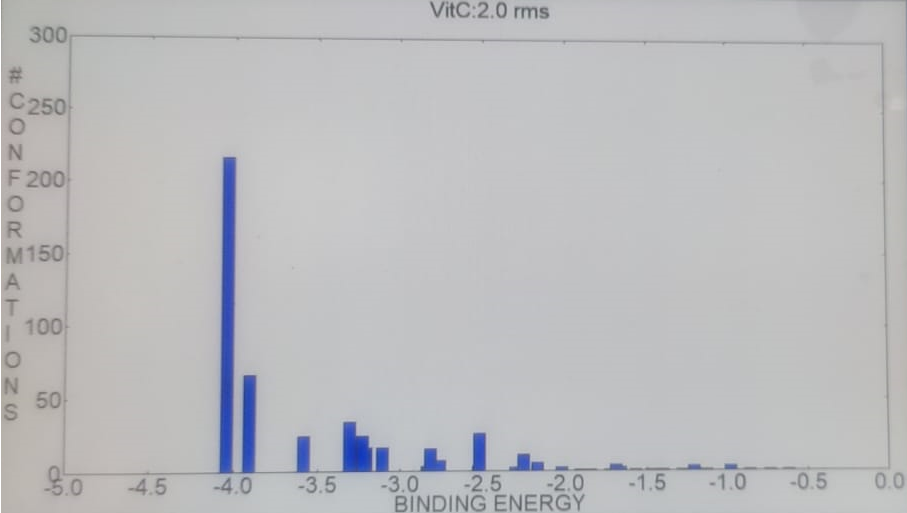

In summary, the presented results provide a comprehensive overview of various parameters and aspects related to the molecular docking of vitamin C with the target protein (GPX6). Here the negative charge on the ligand suggests that the ligand (vitamin C) is anionic, indicating an excess of electrons compared to protons. This information is crucial for understanding the overall charge distribution in the ligand. The presence of 9 rotatable bonds indicates a moderate to high level of structural flexibility for the ligand. This flexibility can be important for the ligand to adapt to the binding site of the target protein, allowing for different conformations. The ligand is composed of 17 atoms, providing insight into its molecular size and complexity. The arrangement and types of atoms influence the ligand’s interactions with the target. The information about 13 non- hydrogen atoms gives a more specific view of the ligand’s composition, excluding hydrogen atoms. This is crucial for understanding the core structure of the ligand. The high number of vibrational degrees of freedom (45) indicates a significant degree of vibrational flexibility in the ligand. This
can influence its behavior in different chemical environments. The presence of 9 torsional degrees of freedom suggests that the ligand is relatively flexible, and its structure can vary due to rotations around specific bonds. The negative value indicates that the binding of the ligand to the protein is energetically favorable. A lower value suggests a stronger binding interaction. The entropy value of 0.36, with an RMSD tolerance of 2.00 Angstroms, suggests that the clustering process has yielded relatively homogeneous conformations. This information is vital for understanding the diversity and reliability of the docking results. Estimated Loss of Torsional Free Energy upon Binding (+2.6847 kcal/mol) which is a positive value suggests an increase in the energy required for the torsional rotation of bonds upon binding. This information provides insights into the structural changes associated with the binding process. The information presented in the clustering histogram provides details about a specific cluster at rank 35. The lowest binding energy, mean binding energy, and the number of conformations in the cluster give a detailed view of the energetics and diversity within this cluster.
Conclusion
The current comprehensive computational study sheds light on the molecular interaction between vitamin C (ascorbic acid) and glutathione peroxidase (GPX), a crucial enzyme in the antioxidant defense system. The negative free energy values obtained from molecular docking signify a favorable binding affinity, indicating strong interactions between vitamin C and GPX. The detailed analyses of various parameters, including the ligand’s structural flexibility, vibrational dynamics, and clustering characteristics, enhance our understanding of this interaction at the molecular level.
Vitamin C’s ability to neutralize free radicals and support cellular health is well-established, and our study provides molecular insights into its interaction with GPX. The presented results offer a nuanced understanding of the structural features and dynamics associated with the binding process. Furthermore, the study highlights the potential implications of this interaction for therapeutic interventions aimed at combating oxidative stress-induced damage, a factor implicated in various health issues.
This research contributes valuable information to the existing body of knowledge regarding the molecular mechanisms underlying the protective effects of vitamin C. The findings not only advance our understanding of the antioxidant defense system but also pave the way for future studies and therapeutic developments in the realm of oxidative stress-related conditions. Overall, our computational study serves as a significant step forward in unraveling the intricate details of the molecular interplay between vitamin C and GPX.
Statement and Declaration
Conflicts of interest
Authors do not have any conflict of interest.
Funding
Not applicable.
Acknowledgements
I am thankful to all the participants and authors for their cooperation, continued support and hard work for the successful completion of this study.
Data Availability Statement
Raw data may be available upon request.
References
-
Kunitomo M (2007) Oxidative stress and atherosclerosis. Journal of the Pharmaceutical Society of Japan 127(12): 1997-2014.
-
Bhattacharjee S, Sarkar C, Pal S (2013) Additive beneficial effect of folic acid and vitamin B12 co-administration on arsenic-induced oxidative damage in cardiac tissue in vivo. Asian journal of phamaceutical and clinical research 6(1): 64-69.
-
Bhattacharjee S, Pal S (2014) Additive protective effects of selenium and vitamin E against arsenic induced lipidemic and cardiotoxic effects in mice. International journal of pharmacy and pharmaceutical sciences 6(5): 406-413.
-
Bhattacharjee S, Pal S (2014) Antilipidemic and cardioprotective effects of vitamin B12 and folic acid against arsenic toxicity. International journal of pharmaceutical, chemical and biological sciences 4(2): 353-360.
-
Yang X, Dong WB, Li QP, Kang L, Lei XP, et al. (2016) Resveratrol increases sirtuin 1 expression in peripheral blood mononuclear cells of premature infants and inhibits the oxidative stress induced by hyperoxia in vivo. Chinese journal of contemporary pediatrics 18(1): 72-77.
-
Zeber-Lubecka N, Ciebiera M, Hennig EE (2023) Polycystic Ovary Syndrome and Oxidative Stress-From Bench to Bedside. International journal of molecular sciences 24(18): 14126.
-
Barzegar A (2012) Proton-coupled electron-transfer mechanism for the radical scavenging activity of cardiovascular drug dipyridamole. PloS one 7(6): e39660.
-
Chen J, Yang J, Ma L, Li J, Shahzad N, et al. (2020) Structure- antioxidant activity relationship of methoxy, phenolic hydroxyl, and carboxylic acid groups of phenolic acids. Scientific reports 10(1): 2611.
-
Thbayh DK, Reizer E, Kahaly MU, Viskolcz B, Fiser B (2022) Antioxidant Potential of Santowhite as Synthetic and Ascorbic Acid as Natural Polymer Additives. Polymers 14(17): 3518.
-
Akorede GJ (2020) Protective effect of vitamin C on chronic carbamazepine-induced reproductive toxicity in male wistar rats. Toxicology reports 7: 269-276.
-
Ludke A, Akolkar G, Ayyappan P, Sharma AK, Singal PK (2017) Time course of changes in oxidative stress and stress-induced proteins in cardiomyocytes exposed to doxorubicin and prevention by vitamin C. PloS one 12(7): e0179452.
-
Traber MG, Stevens JF (2011) Vitamins C and E: beneficial effects from a mechanistic perspective. Free radical biology & medicine 51(5): 1000-1013.
-
Kontoghiorghes GJ, Kolnagou A, Kontoghiorghe CN, Mourouzidis L, Timoshnikov VA, et al. (2020) Trying to Solve the Puzzle of the Interaction of Ascorbic Acid and Iron: Redox, Chelation and Therapeutic Implications. Medicines 7(8): 45.
-
Shen J, Griffiths PT, Campbell SJ, Utinger B, Kalberer M, et al. (2021) Ascorbate oxidation by iron, copper and reactive oxygen species: review, model development, and derivation of key rate constants. Scientific reports 11: 7417.
-
Chambial S, Dwivedi S, Shukla KK, John PJ, Sharma P (2013) Vitamin C in disease prevention and cure: an overview. Indian journal of clinical biochemistry 28(4): 314-328.
-
DePhillipo NN, Aman ZS, Kennedy MI, Begley JP, Moatshe G, et al. (2018) Efficacy of Vitamin C Supplementation on Collagen Synthesis and Oxidative Stress After Musculoskeletal Injuries: A Systematic Review. Orthopaedic journal of sports medicine 6(10).
-
Carr AC, Maggini S (2017) Vitamin C and Immune Function. Nutrients 9(11).
-
Lee EY, Lee MY, Hong SW, Chung CH, Hong SY (2007) Blockade of oxidative stress by vitamin C ameliorates albuminuria and renal sclerosis in experimental diabetic rats. Yonsei medical journal 48(5): 847-855.
-
Ristow M, Zarse K, Oberbach A, Klöting N, Birringer M, et al. (2009) Antioxidants prevent health-promoting effects of physical exercise in humans. Proceedings of the National Academy of Sciences of the United States of America 106(21): 8665-8670.
-
Nabavi SF, Nabavi SM, Mirzaei M, Moghaddam AH (2012) Protective effect of quercetin against sodium fluoride induced oxidative stress in rat’s heart. Food & function 3(4): 437-441.
-
Manna P, Sinha M, Sil PC (2008) Arsenic-induced oxidative myocardial injury: protective role of arjunolic acid. Archives of toxicology 82(3): 137-149.
-
Huey R, Morris G (2008) Using autodock 4 with autodock tools: a tutorial by the Scripps Research Institute.
-
Sun J (2022) Crystal Structure of GPX6.
-
National Center for Biotechnology Information [NCBI] (2023) Ascorbic Acid.
-
Taakili R, Canac Y (2020) NHC Core Pincer Ligands Exhibiting Two Anionic Coordinating Extremities. Molecules (Basel, Switzerland) 25(9): 2231.
-
Seidel T, Permann C, Wieder O, Kohlbacher SM, Langer T (2023) High-Quality Conformer Generation with CONFORGE: Algorithm and Performance Assessment. Journal of chemical information and modeling 63(17): 5549-5570.
-
Goodman H, Mei L, Gianetti TL (2019) Molecular Orbital Insights of Transition Metal-Stabilized Carbocations. Frontiers in chemistry 7: 365.
-
Smith RD, Engdahl AL, Dunbar JB, Carlson HA (2012). Biophysical limits of protein-ligand binding. Journal of chemical information and modeling 52(8): 2098-2106.
-
Tuffery P, Derreumaux P (2012) Flexibility and binding affinity in protein-ligand, protein-protein and multi- component protein interactions: limitations of current computational approaches. Journal of the Royal Society, Interface 9(66): 20-33.
-
Bodmer NK, Havranek JJ (2018) Efficient minimization of multipole electrostatic potentials in torsion space. PloS one 13(4): e0195578.
-
Majumder D. Mukherjee S (2013) Molecular Docking Assessment of Efficacy of Different Clinically Used Arsenic Chelator Drugs. Journal of Computational Medicine, pp: 1-8.
-
Meng XY, Zhang HX, Mezei M, Cui M (2011) Molecular docking: a powerful approach for structure-based drug discovery. Current computer-aided drug design 7(2): 146-157.
-
Deng Y, Roux B (2009) Computations of standard binding free energies with molecular dynamics simulations. The journal of physical chemistry B 113(8): 2234-2246.
- Spectrophotometric Determination of Lanthanum (III) and Some Rare Earths with Xylenol Orange
- Introduction and Sources of Molluscicides
- Trimetazidine: An Antianginal Drug and Not Only!
- Nature Inspired Discovery and Development of Antibacterials: An Update
- Fungal Biodegradation of Polycyclic Aromatic Hydrocarbons (PAHs)
- Recent Approaches of Impurity Profiling in Pharmaceutical Analysis: A Concise Review