
Role of Nurse in Polypharmacy
<p style="text-align: justify;">The term polypharmacy refers to the group of medications one person may be taking it’s known as polypharmacy. The term polypharmacy refers to the group of medications one person may be taking the specter of polypharmacy is an ever-increasing problem. Among older adults, polypharmacy is a common problem. Currently, 44% of men and 57% of women older than age 65 take five or more medications per week; about 12% of both men and women take 10 or more medications per week. These agents include both prescription and over-the-counter (OTC) preparations, such as vitamin and mineral supplements and herbal products. Nurses play a functional role in assisting patients to understand the dangers of polypharmacy. The specter of polypharmacy is an ever-increasing problem faced by the health care professionals.</p>
Sound alike look alike
Polypharmacy refers to the effects of taking multiple medications concurrently to manage coexisting health problems, such as diabetes and hypertension. Too often, polypharmacy becomes problematic, such as when patients are prescribed too many medications (elderly) by multiple healthcare providers working independently of each other [1]. Also, drug interactions can occur if no single healthcare provider knows the patient's complete medication picture. The term polypharmacy refers to the group of medications one person may be taking. It comes from two Greek root words: Poly, meaning many, - Pharmakeia meaning medicines or drugs. It is generally used when that one person is taking too many medications, or when the drugs have been prescribed by many doctors, and may not have been coordinated well by professional example. Nurse to Nurse communication
Definition
Polypharmacy, defined by the World Health Organization as "the administration of many drugs at the same time or the administration of an excessive number of drugs" is frequent among the elderly as they often suffer from chronic diseases with concomitant pathologies [2]. Polypharmacy is defined as the practice of prescribing four or more medications to the same person. This often occurs with older people who have concurrent disease processes, each needing a specific treatment regime. Older people receive more prescriptions per head than any other group. The term polypharmacy means "many drugs" and is used to indicate the use of more medication than is clinically indicated or warranted. No specific number of drugs is indicated but in some studies, the use of five or more drugs is defined as polypharmacy.
Incidence
Geriatrics is an upcoming field in India. The field of ageing and health has become a dominant area of concern in the 21st century [3]. This is mainly due to an increase in the numbers of older people in both developed and developing countries. In the year 2000, there were an estimated 600 million people aged 60 years and above in the world. By 2025, this would double to about 1.2 billion people and by 2050 there will be 2 billion, with 80% of them living in developing countries. Information about appropriateness of prescription medication use among elderly is limited in India [4].
The National Service Framework for Older People (DOH, 2001) shows that 5–17 per cent of hospital admissions are caused by adverse reactions to medicines. It also indicates that 6–17 per cent of older patients in hospital experience adverse drug reactions [5].
Hitler was known to take many, many different medications. He has been rumored to have had syphilis, schizophrenia, GI issues, insomnia, Parkinson's, and an expert in autism spectrum disorders reported that Hitler met all the criteria of Asperger Syndrome. Regardless of what Hitler may or may not have had, it has been well documented that he was taking multiple medications simultaneously.
Wikipedia states that by April 1945, Hitler was taking 28 different pills a day along with numerous injections (including many of glucose) every few hours and intravenous injections of methamphetamine at least one almost every day. That seems like it could really effect one's decision making skills and rational thought... too bad he was trying to take over the world!
Physiological Changes of Elderly
A. Normal physiologic changes that affect absorption include delayed gastric emptying, decreased gastric acidity, and decreased splanchic blood flow. Absorption is not significantly altered with age, but may be delayed, postponing onset of action and peak effect of medications.
B. Normal physiologic changes that affect drug distribution include a higher percentage of fat compared to lean body mass, a decrease in total body water, and decreased plasma albumin concentration.
C. Changes in body composition affect the serum concentrations of water-soluble drugs and changes in fat mass affect fat-soluble medications.
D. Normal physiologic changes that affect drug clearance include altered liver metabolism of
E. Certain drugs and decreased renal excretion of drugs
Why Polypharmacy Happen
a. Multiple pathology; the use of repeat prescriptions, which may result in a lack of direct Patient
b. Contact between prescriber or pharmacist;
c. Computerized records not being updated after home visits where Prescriptions are issued;
d. Poor communication between health care providers [6];
e. Lack of knowledge about ageing;
Factors Lead for Polypharmacy of Elderly
Physician Factors that Play a Role in Polypharmacy Include
• Presuming that patients expect prescription medications
• Prescribing drugs without sufficiently investigating clinical situations
• Providing unclear, complex, or incomplete instructions on how to take a medicine
• Not simplifying medication regimens as much as possible
• Not conducting a medication review with the patient on a regular basis
• Ordering automatic refills without adequate follow-up
• A lack of knowledge of geriatric clinical pharmacology can lead to inappropriate prescribing [7]
Patient Factors Include
• Seeing multiple physicians and using multiple pharmacies. This leads to incomplete knowledge by physicians of all the drugs a patient is taking
• Hoarding of medications and insisting on taking medications that may no longer be appropriate
• Patients not accurately reporting all medicines that they are concurrently taking, or symptoms they are experiencing (that might be drug induced); this can result in duplicate prescriptions or treating drug effects with additional drugs
• Patients tend to assume that once most medications are started, they should be continued indefinitely
• Changes in patient's daily habits may affect the action of medications, such as smoking, changes in activity level, food and fluid intake Nursing & Healthcare International Journal
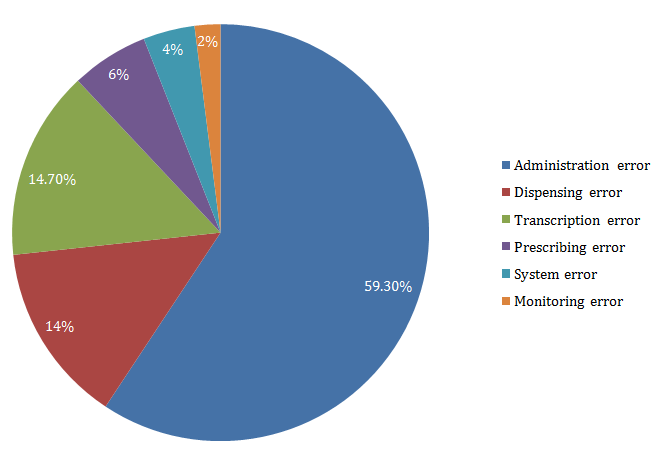
Medication Error Factor
- Ambiguous strength designation on labels or in packaging Drug product nomenclature (look-alike or sound-alike names, use of lettered or numbered prefixes and suffixes in drug names)
- Equipment failure or malfunction
- Illegible handwriting
- Improper transcription
- Inaccurate dosage calculation
- Inadequately trained personnel
- Inappropriate abbreviations used in prescribing
- Labeling errors Excessive workload
- Lapses in individual performance Medication unavailable (Figure 1)
Role of Nurse
There are many ways in which nurses can contribute to the reduction in the number of prescribed drugs including taking a lead role in the management of chronic health problems.
Practical Measures Include
- Supported self-administration of medications for people in hospital;
- Evaluating how the patient manages to take prescribed medicines;
- Being alert to unexpected interactions, and effects of medicines (Mallett Dougherty)
- Providing written materials for patients, that complement pharmaceutical leaflets with larger print and good colour contrast between paper and print for people with poor vision;
Verifying that the Patient Understands and Agrees to the Regimen
- Advising on lifestyle changes that may reduce the need for medication and combat the side-effects of necessary medicines;
- At times of illness, older people may experience temporary cognitive problems, and nurses must be acutely aware of the need to provide prompts and aids so the patient can revise, rehearse and remind themselves about their medicines.
- Nurses and pharmacists can play an important part in prevention, health promotion and the management of common physical problems such as constipation, insomnia and pain relief, which can avoid the use of prescribed medicines.
Information
Discuss with patients the need to:
- Keep an accurate list of all medications, including generic and brand names, dosages, dosing frequency, and reason for taking the drug
- Keep a complete list of medical providers and their contact information
- Post the name and telephone number of the local pharmacy.
Instruction
| Teach patients about: | |||
|---|---|---|---|
| Each medication, including its name, appearance, | |||
| purpose, and effects | |||
| Potential adverse effects and interactions of each | |||
| medication | |||
| Importance of contacting the healthcare provider with | |||
| concerns or questions | |||
| Potential drug-related problems that warrant | |||
| emergency care | |||
| Importance of taking medications exactly as directed | |||
| Importance of using only one pharmacy to obtain | |||
| drugs. | |||
| Organization |
To help patients manage their drugs, caution them to:
- avoid sharing medications
- store medications in a secure, dry location away from sunlight
- Refrigerate medications if necessary
- Dispose of old medications properly.
Here are Some Simple Tips for Avoiding Polypharmacy
- Always read labels. They may tip you off to possible drug interactions
- Use only one pharmacy to fill prescriptions
- Learn your medications by name and what they are for
- Make a list of all your medications including pill strength and dose, as well as herbal products, vitamins, supplements, and over-the-counter drugs. Update it after every doctor visit
- Carry your medications list everywhere. Bring it every doctor visit, along with the pill bottles
- If you have more than one doctor, make sure each one knows what the other is prescribing
- Ask your primary caregiver or pharmacist to run your medication list through a drug interactions database to identify possible problems, especially if you’re on five or more drugs.
- Avoid combination products such as cold formulas. Ask your pharmacist to help you find a product just for the symptoms you’re experiencing – not for every possible symptom
- Never take a new drug without asking your pharmacist about its side effects and interactions with other drugs
• Get familiar with your medications. Learn about them from your physician or pharmacist.
References
-
NIH Seinor Health.
-
Haque R (2009) ARMOR: a tool to evaluate polypharmacy in elderly persons. Annals of long term care 17(6): 26-30.
-
CDC-Healthy Aging.
-
Gray MW (1990) Polypharmacy in the elderly: implications for nursing. Orthop Nurs 9(6): 49-54.
-
American Geriatric Society.
-
Rahmawati F, Pramantara IDP, Romah W, Sulaiman SAS (2009) Polypharmacy and unnecessary drug therapy on geriatric hospitalised patients in Yogyakarta Hospital, Indonesia, International Journal of Pharmacy and Pharmaceutical Sciences 1(1): 6-11.
-
AHRQ Improving the Health care of Older Americans.
- Teaching Cognitive Behavioral Therapy to Graduate Psychiatric Mental Health Nurse Practitioner Students: Utilizing A Mixed Methods Course Evaluation
- The Role of Pharmacogenetic Testing in Clinical Practice: A Path toward more Effective, Personalized and Cost-effective Care
- Implementing Screening with the GAD-7 in an Outpatient Mental Health Setting: A Quality Improvement Project
- Social Media and Health Promotion
- Impact of Covid-19 Pandemic on the Academic Performance and Attitude of Nursing Students towards E-Learning
- A Study to Assess the Knowledge Regarding Ill Effects of Tobacco Consumption on Health among Adolescents in Selected Higher Secondary School in Nadiad City