
The Importance of Maintaining Intergenerational and Community Links with Care Home Residents throughout Covid-19 Restrictions: A Commentary on the Change and Increase in Resident Socialisation and Well-Being through Reminiscence, Cognitive and Creative Stimulation
When Colten Care home residents found themselves isolated from their relatives, friends and outside communities during the first UK national lockdown in March 2020 no-one could have predicted that 10 months later, in mid-January 2021 this prolonged period of restricted living would still be in place.
A Creative Journey
There were four main objectives:
- To establish whether the experience through Zoom comprised engagement and interaction.
- To discover whether residents’ capacity to engage and socialise creatively had changed a result of the UK lockdown.
- To establish if there was an increase in socialisation leading to an improvement in feelings of well-being.
- To discover if the role of facilitator was a factor in increased engagement.
• Phase One Two final year Performing Arts students at the University of Winchester Amelia Pearce and Rosie Oliver, approached me to run a creative collaborative project between residents and school children that would explore various themes and stimulate a creative response in a chosen medium.
In considering isolation objectively as the result of the subjective state of loneliness, I considered the experience of living in residential care and whether the lack of meaningful interaction was impacting on their feelings of loneliness. Working with care home staff I was able recruit participants that due to a reduction in social interactions may have increased feelings of loneliness. My role was to coordinate and facilitate interactions between the students, the children and the residents and observe and document change.
Immediate responses from residents were inquisitive but cautious, however within minutes they became absorbed in the video experience.
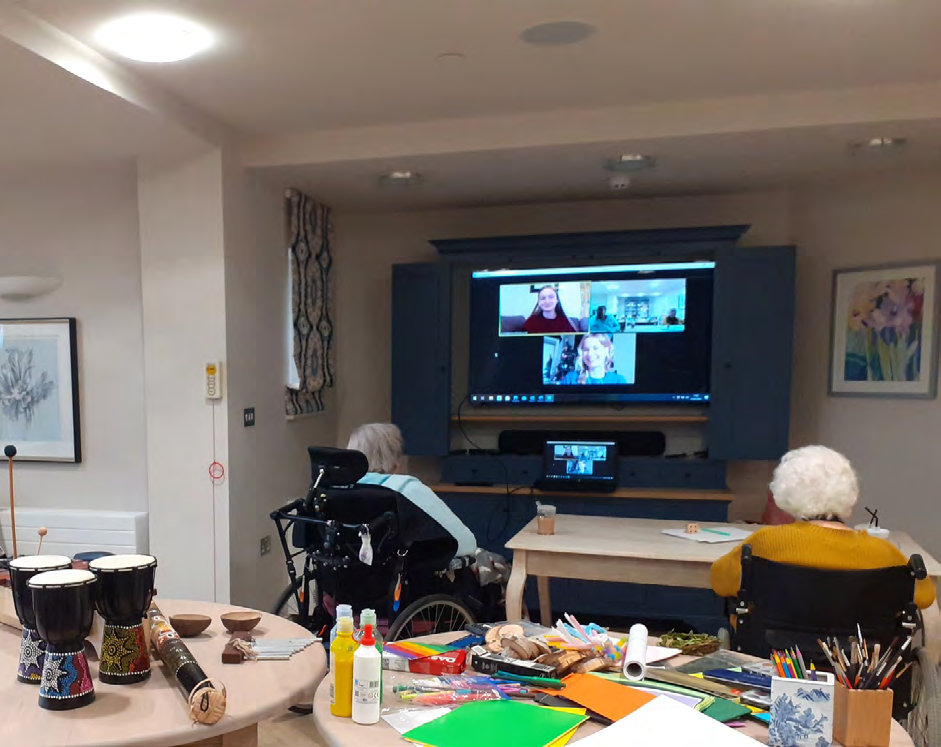
The exchanges promoted a spontaneous creative response in residents with multiple exchanges through the screen and in the room with moments of extensive reminiscence and the sharing and appreciation of each other’s ideas and memories.
In the spring you can hear the birds. Wretched seagulls, they really were so noisy. Little robins and chaffinches. And my grandchildren in their tent and they made a little shop in the summer house and they made things like apples and bananas out of plasticine for us to pretend to buy.
There was increased interest in the project with residents reporting they were looking forward to the sessions. They began to bring items from their rooms and reflect on sessions afterwards creating poems and pictures to share with the children and students.
As facilitator I was able to manage the technical element and liaise between the room and the screen so questions and responses could be conveyed easily. The combination of resources and props in the room and in the moment creativity taking place, enabled participants to focus on the creative process and not be restricted by the virtual exchange. Following an imaginary trip to Scotland and some highland drumming residents reported their feelings:
- Quite exhilarating.
- Makes you feel happy.
- We all came to life.
• Life-a love of life! Residents had the opportunity to engage in the generative act of advising or sharing a life experience with the children that increased feelings of empowerment and the taking on of a caring or protective role similar to that of a grandparent. However, it was not just residents who benefitted from this intergenerational exchange [3] as the children enjoyed learning from older and experienced generation. This collaboration, cooperation and sharing the creative process was not comprised by the virtual exchange when supported by a facilitator. Anderson and Willingham [4] state that it is by facilitating an enabling environment one can create space for both acquiring and using lifelong skills in participatory contexts.
The project culminated in shared story writing with the process enhance by the exchange of ideas, pictures and video clips with residents leaning forward and gasping with delight as the children showed their creations. I observed not only increased socialisation but feelings of comradery, partnership, friendship and affection with the sharing of thank you cards tearful goodbyes.
The Observations Identified Four Outcomes
- The virtual experience increased focus and concentration and an awareness of others, themselves, the activity and the moment
- The benefit of intergenerational collaboration to the creative process
- The virtual exchange increased socialisation leading to an improvement in feelings of well-being
- The role of facilitator was a necessary factor in increased engagement and interaction
- These outcomes led to extending the project into our dementia care homes St Catherine’s View in Winchester and Linden House in Lymington with a view to collaborating with local schools as the children began to return to classes. These small group sessions created the first opportunity for residents to spend time together in a social space. As the creative process began residents were wary, almost unfamiliar with everything. They expressed this in their feelings:
- A bit bewildered. Nothing, anticipation.
- Concentrating as struggling to hear today.
- Hopeful, hoping to enjoy myself.
Gradually ideas emerged as they looked and images and contributed through conversation that prompted extended reminiscence:
I was thinking most about the flowers. When mummy wasn’t looking, I used to pinch them and put them in my own little garden behind the shed cos of course she couldn’t get flowers for her garden and my garden too. It was behind the shed, it was fabulous. This is true!
The safe and enabling environment was reassuring and residents verbally expressed this following the session. One resident said: ‘I people like a small group because it feels more cosy and you don’t need to be scared.’ In the following sessions observations noted that everyone was more relaxed, greeting each other and smiling. The space was bright and possibly more familiar as were the faces of the others. There was conversation and smiling and everyone seemed interested in what might happen. All participated fully, were more engaged in conversation, life story sharing and there was a bright mood in the room. This socialisation went beyond an ‘in the moment ‘experience and was sustained and continued as they left and walked to lunch.
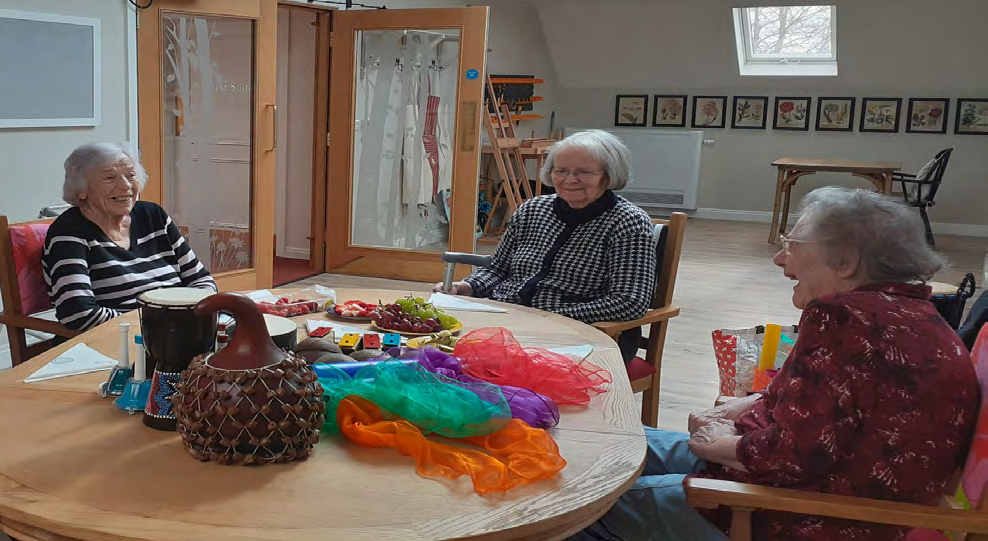
My role in phase two was to facilitate the sessions in homes and then visit the schools to present the resident contributions for the children to finish and illustrate. This process is ongoing with both the residents and children becoming visibly animated and enthusiastic about sharing the process and the anticipated outcomes of this shared creativity and the opportunity to meet and celebrate this in the future.
The two phases of this project both confirm that this creative collaboration had a positive effect on feelings of socialisation and wellbeing following a period of isolation following the UK national lockdown in March 2020. Residents had experienced a prolonged period of restricted living and engaging in a creative project with an intergenerational collaboration reduced negative feelings of loneliness and isolation and promoted wellbeing through increased feelings of pleasure.
References
-
Hawton A, Green C, Dickens A, Richards S, Taylor R, et al. (2010) The impact of social isolation on the health status and health related quality of life of older people. Quality of Life Research 20(1): 57-67.
-
Meyer RP, Schuyer D (2011) Old Age and Loneliness. Primary Care Companion for CNS Disorders 13(2).
-
Erikson EH (1950) Childhood and Society. New York: Norton.
-
Anderson K, Willingham L (2020) Environment, intention and intergenerational music making: facilitating participatory music making in diverse contexts of community music. International Journal of Community Music 13(2): 173-185.
- Teaching Cognitive Behavioral Therapy to Graduate Psychiatric Mental Health Nurse Practitioner Students: Utilizing A Mixed Methods Course Evaluation
- The Role of Pharmacogenetic Testing in Clinical Practice: A Path toward more Effective, Personalized and Cost-effective Care
- Implementing Screening with the GAD-7 in an Outpatient Mental Health Setting: A Quality Improvement Project
- Social Media and Health Promotion
- Impact of Covid-19 Pandemic on the Academic Performance and Attitude of Nursing Students towards E-Learning
- A Study to Assess the Knowledge Regarding Ill Effects of Tobacco Consumption on Health among Adolescents in Selected Higher Secondary School in Nadiad City