
A Descriptive Study of Knowledge and Perception regarding Reproductive Health among Female Adults at selected colleges of Bihar
Introduction: A descriptive study to assess the knowledge and perception regarding reproductive health female adults at selected college of Bihar. The World Health Organisation define reproductive health is a state of complete physical, mental and social well-being and not merely the absence of disease and infirmity, in all matters relating to the reproductive system and to its function and processes. Objectives: Objective of the study were to assess the knowledge and perception of female adults, and to find out the association between the knowledge and socio-demographic variable. Methodology: Qualitative non-experimental design and convenient sampling technique was adopted to 124 female adults. The knowledge of female adults regarding reproductive health was assessed by using self-structured questionnaire. Results: The findings of the study result shows that majority of female belong to Hindu religion (90.3%), most of the female are in the age group of 17-19 years (52.4%), 71.8% females are from urban area, 54% females are living in nuclear family, majority are unmarried, majority of the females have source of information from other sources rather than mass media, social network, friends and teachers, 35.8% females belong to 3rd year. 90.3% females have good knowledge regarding reproductive health, 57.3% females have poor perception, 41.9% females have average perception and 0.8% good perception towards reproductive health. There is association between level of knowledge and religion. Conclusion: The study reveals that majority of the females had good knowledge but poor perception regarding reproductive health. There is an association between level of knowledge regarding reproductive health and religion of female adults.
Introduction
Reproductive health is a part of sexual and reproductive health that help in addressing the wellbeing of person in relation to reproductive process, function and system of all stages of life. WHO defines health as collective stages of complete well-being, including reproductive health in addition to others like physical, mental and social well-being [1].
Reproductive health is important for psychological well-being in addition to its physical necessities. It is very important for safe sexual reproduction that can be defined as the natural way of producing young ones, where two parental organisms are involved in a course of events that undergoes sexual reproduction. The reproductive health refers to the condition of male and female reproductive systems during all life stages. These systems are made up of organs and hormone producing glands including the pituitary gland in the brain. Ovaries in females and testicles in males are reproductive or gonads that maintain health of their respective systems. They also function as glands because they produce and release hormones.
Background of the Study
According to WHO, reproductive and sexual ill- health account for about 20% in women and 14% in men of the global burden of ill- health. It is closely related to other aspect of health. Love, affection and sexual intimacy, all play a role in healthy relationship. Reproductive health is a crucial aspect of general health; it is a reflection of health and well- beings [2].
A literature review showed that some of the college students have already engaged in vaginal sex and awareness of contraception among them is high. However, based on the study of Pastuszak (2016), it was revealed that the participants lack sexual and reproductive health knowledge and they were engaged in risky sexual behaviour [3]. Reproductive and sexual health issues are becoming more prominent and are growing as a global burden all over the world [4].
Need of the Study
According to the study conducted by UNICEF in 1999, 38% of girls were unaware of menstruation at the time of their first period [5]. Globally sexual and reproductive health issues is becoming increasingly prominent and arousing widespread international concern. It is estimated that 14 to 15 million young women between the age of 15 and 19 years give birth every year, whereas more than 40% of all new HIV infections are among young people between 15 and 24 years of age [6]. India was among the first countries to initiate actions and plans to attain total reproductive health as social goal in 1951. These programmes were called “Family planning” and were periodically assessed over the past decades.
John Mark R Also conducted a descriptive study was conducted to assess the reproductive health awareness among college students of selected colleges in Olangappo city. The study was conducted among 100 respondents from there selected private colleges in Olangappo city using structured survey questionnaire. The result showed that 15.3% had excellent knowledge, 40% had good knowledge but remaining had unsatisfactory level of knowledge and study recommend to establish programme for increasing the knowledge and attitude of young female adults on reproductive health [7].
T. Radhakrishnan conducted a descriptive study was conducted to assess the knowledge on reproductive health among graduate student in northern Kerala. The data was collected from 1640 graduate students in the age group of 18-24 studying in the arts and science colleges in Kannur and Malappuram using self- administered structured questionnaire. The key finding of the study is that the level of knowledge on reproductive health issues among young adults in northern Kerala was poor, only 6.8% of young adults has sound knowledge. The study also recommends programmes for strengthening knowledge and attitude of young female adults on reproductive health. From the above data, it is evident that the knowledge level of young adults on reproductive health is considerably low which is indicative of the further need to assess the knowledge of young female adults regarding reproductive health [8].
Objectives
- To assess the level of knowledge regarding reproductive health among female adults.
- To assess the level of perception regarding reproductive health among female adults.
- To find out the association between the level of knowledge and selected socio-demographic variables.
Assumptions
- Female adults who have higher education will have good knowledge regarding reproductive health.
- Female adults who reside in urban area will have more knowledge regarding reproductive health.
- Female adults who are married will have good perception regarding reproductive health.
- Female adults who are college students will have minimal knowledge regarding reproductive health.
Delimitations
Female college students both married and unmarried included in the study.
Research Methodology
Research Approach: Research approach involves the description of plan to investigate the phenomenon under study. In this study quantitative non-experimental descriptive study was used.
Tools used for Data Collection: The questionnaire was divided into three sections:
A. Socio-demographic Proforma.
B. Structured Knowledge Questionnaire on reproductive health.
C. Perception Questionnaire on reproductive health.
Section A - socio-demographic proforma included information on age, religion, residential area, socio-economic status, type of family, father’s education, mother’s education, marital status, if married then the age of marriage, age of pregnancy and abortion, if any and academic year, age of menarche.
Section B - The structured knowledge questionnaire consisted of 25 questions. For every right answer 1 mark is assigned, for every wrong answer 0 is assigned.
Validity of Research Tool
Validity concerns what an instrument measure and how well it does so. Validity identifies the degree of relation between the test and criteria of the study. In this study, to ensure the content, and face validity, the questionnaire was reviewed and refined based on the aims, objectives and research questions [9, 10]. The tools were given to five Nursing Experts of AIIMS, Patna. Corrections were made as per the suggestions of the experts [11, 12].
Data Collection Procedure
Data collection is the systematic, precise gathering of information relevant for research purpose. This study was conducted in selected college of Patna, Bihar, Magadha Mahila College. 124 female adults were selected through non probability convenient sampling technique [13, 14]. A structured questionnaire was developed to collect socio-demographic data and assessed knowledge and attitude of adult female regarding reproductive health. The questionnaire was sent to the female adults through email address.
Ethical Clearance
Formal administration approval was obtained from the DRC, Ethical committee and also from the concerned authorities of college of Nursing, AIIMS, Patna to conduct the final study. The participants were enrolled in the study after online informed consent and they were assured about the confidentiality of the response [15, 16].
Plan for Data Analysis
Plan for data analysis is the most important phase of research process which involves the computation of the certain majors along with searching for patterns of relationship that exist among data group [17].
In this study, data analysis was done by descriptive and inferential statistics. Descriptive statistics is used to describe the basic features of data and summarize the data for meaningful interpretation. It describes the main features of the data in quantitative form. Percentage, mean of central tendency and means of dispersion are used for analysis of the frequency of socio-demographic variables.
Inferential statistics is used for drawing inferences from the data with the help of Fisher Exact test and Pearson’s correlation coefficient [18].
In this study, Fisher Exact test is used to find out the association between level of knowledge and socio- demographic variables. Pearson’s correlation coefficient helped in assessing the correlation between level of knowledge and age of menarche [19, 20].
Research Findings
The findings of the study reveals that among 124 females, majority of females belongs to Hindu religion(90.3%),71.8% females are from Urban area, (52.4%) females are in the age group of 17-19 years, (51.6%) females comes in between income range from 30,000-40,000, 54% living in nuclear family, (41.1%) father are graduated, while (74.2%)mother are in school education, 100% females are unmarried, 41.1% females got information regarding reproductive health from sources other than mass media, social network, friends, teachers. (35.5%) females are in 3rd year.
Table 1 Reveal that among 124 females, majority of females belongs to Hindu religion (90.3%), (71.8%) females are from urban area, most of the females are in the age group of 17-19 years (52.4%), (41.1%) fathers are graduated while (74.2%) mothers are in school education, 100% females are unmarried.
| Socio- demographic variable | Variables | Frequency (f) | Percentage (%) |
|---|---|---|---|
| 1. Age | a) 17-19 years | 65 | 52.40% |
| b) 20-25 years | 59 | 47.60% | |
| 2. Religion | a) Hindu | 112 | 90.30% |
| b) Muslim | 12 | 9.70% | |
| c) Christian | 0 | 0% | |
| d) Other | 0 | 0% | |
| 3. Residential area | a) Rural | 35 | 28.20% |
| b) Urban | 89 | 71.80% | |
| 4. Father’s education | a) Illiterate | 0 | 0% |
| b) Schooling | 33 | 26.60% | |
| c) Graduation | 51 | 41.10% | |
| d) Post graduation | 40 | 32.30% | |
| 5. Mother’s education | a) Illiterate | 7 | 5.60% |
| b) Schooling | 92 | 74.20% | |
| c) Graduation | 0 | 0% | |
| d) Post graduation | 25 | 20.20% | |
| 6. Marital status | a) Married | 0 | 0% |
| b) Unmarried | 124 | 100% |
Table 1: Frequency and Percentage of Socio-demographic Variables of Female Adults of Age Group 18-35 Years.
(n=124)
| Level of Knowledge | Frequency (f) | Percentage (%) |
|---|---|---|
| Poor knowledge | 1 | 0.8 |
| Average knowledge | 11 | 8.9 |
| Good knowledge | 112 | 90.3 |
Table 2: Frequency and Percentage of Knowledge Score.
Table 2 reveals that among 124 females participated in the study, 112 (90.3%) females have good knowledge, 11 (8.9%) females have average knowledge and 1 (0.8%) female have poor knowledge regarding reproductive health.
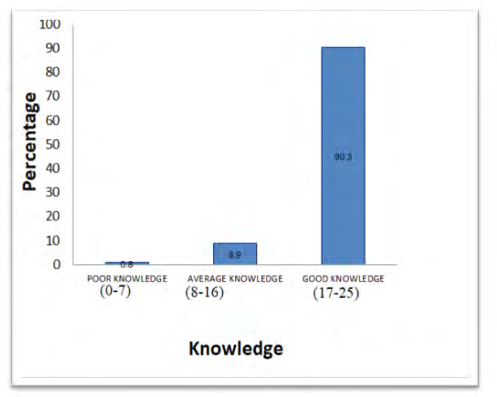
Figure 1 Depicts that majority of participants 90.3 %have good knowledge, 8.9% have average knowledge and 0.8% have poor knowledge.
Table 3 Reveals frequency and percentage of perception score. Among 124 female participants, 71(57.3%) females have poor perception, 52(41.9%) females have average perception and only 1(0.8%) female have good perception regarding reproductive health.
| Perception | Frequency (f) | Percentage (%) |
|---|---|---|
| Poor perception | 71 | 57.3 |
| Average perception | 52 | 41.9 |
| Good perception | 1 | 0.8 |
Table 3: Frequency and Percentage of Perception Score.
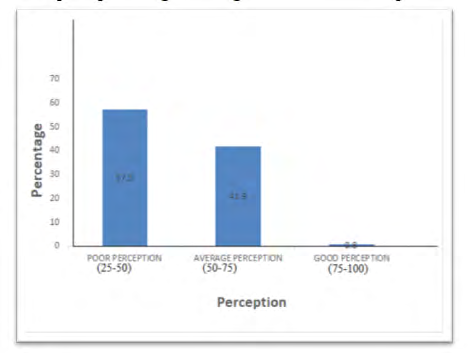
Table 4 Depicts that majority of females have good knowledge but poor perception regarding reproductive health as mean of knowledge score is 19.87 and mean of perception score is 1.44.
| Variables | Mean | Standard deviation |
|---|---|---|
| Level of knowledge | 19.87 | 3.058 |
| Level of perception | 1.44 | 0.514 |
Table 4: Mean and Standard Deviation of Knowledge and Perception Score.
| Level of Knowledge | ||||||
|---|---|---|---|---|---|---|
| Variables | Poor Knowledge | Average Knowledge | Good Knowledge | Fisher’s Exact test | p value (0.05) | |
| Age | 17-19 years | 0 | 7 | 58 | 1.595 | 0.439 |
| 20-25 years | 1 | 4 | 54 | |||
| Religion | Hindu | 0 | 8 | 104 | 9.529 | 0.007** |
| Muslim | 1 | 3 | 8 | |||
| Christian | - | - | - | |||
| Other | - | - | - | |||
| Residential area | Rural | 0 | 5 | 30 | 2.225 | 0.491 |
| Urban | 1 | 6 | 82 | |||
| Socio-economic status | >60000 | 0 | 1 | 3 | 8.453 | 0.664 |
| 40000-50000 | 0 | 3 | 43 | |||
| 30000-40000 | 1 | 7 | 56 | |||
| 20000-30000 | 0 | 0 | 7 | |||
| <10000 | 0 | 0 | 3 | |||
| Type of family | Joint | 0 | 4 | 48 | 6.987 | 0.142 |
| Nuclear | 1 | 5 | 61 | |||
| Extended | 0 | 2 | 3 | |||
| Father’s education | Illiterate | - | - | - | 3.545 | 0.46 |
| Schooling | 0 | 5 | 28 | |||
| Graduation | 1 | 3 | 47 | |||
| Post- graduation | 0 | 3 | 37 | |||
| Mother’s education | Illiterate | 0 | 0 | 7 | 2.724 | 0.707 |
| Schooling | 1 | 10 | 81 | |||
| Graduation | - | - | - | |||
| Post- graduation | 0 | 1 | 24 | |||
| Source of information regarding reproductive health | Mass media | 0 | 1 | 12 | 6.506 | 0.328 |
| Social network | 1 | 6 | 33 | |||
| Peer/ Friends | 0 | 0 | 20 | |||
| Teachers | - | - | - | |||
| Any others | 0 | 4 | 47 | |||
| Academic year | 1st year | 0 | 3 | 39 | 3.62 | 0.416 |
| 2nd year | 0 | 2 | 36 | |||
| 3rd year | 1 | 6 | 37 | |||
| 4th year | - | - | - |
Table 5: Association between the Knowledge and Selected Demographic Variables Regarding Reproductive Health of Female Adults of A
Note: Fisher’s Exact test method is used. **Significance Table 5: Association between the Knowledge and Selected Demographic Variables Regarding Reproductive Health of Female Adults of Age Group 18-35 Years.
Table 5 Represents that there is only association between level of knowledge and religion of the female participants as obtained by fisher’s exact value 9.529 and (p value 0.007) at 0.05 level of significance.
| Variables | r value | p value -0.05 |
|---|---|---|
| Age of menarche | 0.155 | 0.131 |
| Level of knowledge |
Table 6: Correlation between Age of Menarche and the Level of Knowledge of Females of Age Group 18-35 Years.
Table 6 Depicts that there is no any significant correlation between level of knowledge and age of menarche of sample as obtained by Pearson Correlation coefficient (r) 0.155 and (p value 0.131) at 0.05 level of significance.
Conclusion
The study reveals that majority of the females had good knowledge but poor perception regarding reproductive health. There is an association between the level of knowledge regarding reproductive health and religion of female adults.
References
-
WHO (2006) Constitution of the World Health Organization–Basic documents, 45th(edn), World Health Organization.
-
WHO (2001) Global Prevalence and Incidence of Selected Curable Sexually Transmitted Infection: Overview and Estimates. Geneva, World Health Organization.
-
Bickenbach J (2015) WHO definition of health Philosophical Analysis. In: Schramme T, Edward S, (eds), Handbook of philosophy of Medicine springs, Dordrecht.
-
Hoopes AJ, Agarwal P, Bull S, Chandra Mouli V (2021) Measuring adolescent friendly health services in India. A scoping review of evaluation. Reproductive health 13(1): 137.
-
Lehan Mackeis M, clark MK, MC Carthy AM, Farris K (2015) Knowledge use and emergency contraception in college women. West J Nurse 37(4): 462-480.
-
WHO (2017) Global Accelerated Action for the health of Adolescents (AA-HA): Guidance to support country implementation, World Health Organization, Geneva.
-
Asio JMR (2019) Reproductive health awareness of college students of selected private college in Olongapo City. BREO Journal of Allied Health Studies 1(1): 32-43.
-
Radha Krishnan T (2017) Knowledge on reproductive health among graduate student in northern Kerala. Int J Health Sci Res 7(4): 183-190.
-
(2020) Bihar Profile. Census. gov. in.
-
Miles MB, Huberman AM (1994) Qualitative Data Analysis 2nd(Edn.), Thousand Oaks, CA: Sage Publications.
-
Rosenstoch I (1974) Historical origin of the health belief model, Health Edu Monger 2(4): 334.
-
John A, Khan Hafiz TA, Robert R (2007) Research methods for graduate business and social science students. New Delhi: SAGE Publication.
-
Sharma Suresh K (2018) Nursing Research and Statistics review of literature, Elsevier Publication, 3rd (edn), pp: 115-118.
-
Kumari B, Prakash K (2018) Health Problems of Reproductive System and Treatment Seeking Behaviour among Married Women in Selected Rural Community Dehradun, Uttarakhand. International Journal of science and Research 7(5): 693-699.
-
Gopalakrishnan S, Anantha Eashwar VM, Mohan Kumar P, Uma Devi R (2017) Reproductive health status of rural married women in Tamil Nadu: A descriptive cross- sectional study. J Family Prim Care 8(11): 3607-3613.
-
Hamdanieh M. Ftounil Al Jardali B, Ftoui R (2021) Assessment of sexual and reproductive health knowledge and awareness among single unmarried women living in Lebanon: a cross-sectional study 18 (1): 24.
-
Jose MJ, Farah F, Joseph ST, Fernandez AC (2019) Knowledge regarding reproductive health among women of reproductive age group in three sub centre area of primary health centre, sarjapur, bengaluru, Karnataka. International journal of community medicine and public health 6(9): 4082-4087.
-
Sharma K (2017) A descriptive study to assess the knowledge regarding reproductive health care among bsc nursing 1st year students at SGRD college of nursing, Amritsar. Int J Pregn and Chi birth 2(2): 45-47.
-
Rahimi Naghani S, Merghati khoei E, Shahbazi M, Farahani FK, Motamedi M, et al. (2016) Sexual and reproductive health knowledge among men and women aged 15 to 49 years in metro politan tehran 53(9): 1153-1164.
-
Mou Sabeuna Zaman, Bhuya FA, Islam SM (2015) Knowledge and perception of sexually transmitted disesse HIV/AIDS and reproductive health among female students in Onaka, Bangladesh. J Adv Med Health Res 2(1): 9-15.
- Teaching Cognitive Behavioral Therapy to Graduate Psychiatric Mental Health Nurse Practitioner Students: Utilizing A Mixed Methods Course Evaluation
- The Role of Pharmacogenetic Testing in Clinical Practice: A Path toward more Effective, Personalized and Cost-effective Care
- Implementing Screening with the GAD-7 in an Outpatient Mental Health Setting: A Quality Improvement Project
- Social Media and Health Promotion
- Impact of Covid-19 Pandemic on the Academic Performance and Attitude of Nursing Students towards E-Learning
- A Study to Assess the Knowledge Regarding Ill Effects of Tobacco Consumption on Health among Adolescents in Selected Higher Secondary School in Nadiad City