
Electrochemical Investigations of Biomolecules Using Carbon Nanotube and Graphene Based Modified Electrodes
Carbon nanostructures, carbon nanotubes (CNTs) and reduced graphene oxide (rGO) have been used to modify the electrodes to decrease the over potential and improve the sensitivity. In this tutorial article, we focus on recent literature that describes how CNTs- and rGO-modified electrodes are being used for electrochemical investigations of several biologically important molecules or pharmaceutical drugs. Huge electroactive surface area and superior electron transfer properties make CNTs and rGO good candidates for electrode materials. Various electrochemical techniques viz., cyclic voltammetric, differential pulse voltammetric, stripping voltammetric, amperometric etc., have been used to explore detailed electrochemistry of biomolecules and to develop electroanalytical methods for their assay in pharmaceutical formulations and biological samples. Future challenges lie in the development of selective, sensitive, reproducible and simultaneous determination of biomolecules.
Introduction
Carbon nanomaterial’s viz., carbon nanotubes (single and multi-walled) and graphene-based materials (graphene oxide, reduced graphene oxide and pristine graphene) offer many significant benefits because of their extraordinary huge electroactive surface area, great electrical conductivity, chemical durability, biocompatibility and strong mechanical strength [1, 2, 3]. These unique properties of CNTs (Figure 1a) and graphene-based materials (Figure 1b) generated a huge and widespread research interest in the sensors field [4]. The electrodes modified with carbon based materials (CNTs and graphene-based materials) exhibit great sensitivities (low detection limits) towards the sensing of various biomolecules. The superior structural features, surface morphology and ease of functionalization make these carbon based nanomaterial’s a good candidate for electrode modification in selective and sensitive determination of biomolecules. Further, the presence of edge- and basal-planes is also being responsible for the tremendous electro catalytic activity and sensing performance of these carbon nanomaterial’s [5].

(a)
(b) Figure 1: Carbon Nanotube (a) and Graphene (b).
CNTs, one-dimensional nanostructures and sp2 hybridized carbon atoms arranged in hexagonal cylindrical passion have fascinating properties associated with their structures, ease of functionality, morphology, aptness in hybrid materials, extraordinary electron transfer capability etc. Single-walled nanotubes (SWNTs), double-walled nanotubes (DWNTs) and multi-walled nanotubes (MWNTs) are the main categories of CNTs based on contingents on the number of graphite layers. Due to their superior physicochemical properties, CNTs are intensively explored to improve the sensing performance of the modified electrodes for the detection as well as determination of several biomolecules[6]. Ease of functionalization with chemical moieties and other materials viz., M/MOx, polymers, etc., opens up a wide variety of applications of CNTs in sensor and energy storage and conversion technology [6].
Graphene is a two-dimensional sp2 hybridized carbon network with a hexagonal lattice similar to a honeycomb structure. Excellent electron transfer capability and huge electroactive surface area make graphene based materials the exceptional candidates for electrode fabrication in the development of electroanalytical methods. Graphene based materials exhibit superior electrochemical properties such as high sensitivity, selectivity, reproducibility, low over potential, wide potential window, slight capacitive current, and electrocatalytic activity [7]. Various forms of graphene viz., graphene oxide (GO), reduced graphene oxide (rGO), graphene oxide nanoribbons (GONRs) and reduced GONRs are being exploited for electrode modification in the electroanalysis of biomolecules. Ease of their surface modification (with various materials, M/MOx nanoparticles, polymers, etc) allows tuning their physicochemical properties that further permit to sense targets selectively with high degree of sensitivity [7, 8]. In view of flexible properties of CNTs and graphene-based materials, we have described the state of the art in modifying the electrodes for bio-electroanalysis.
Carbon Nanotubes Modified Electrodes
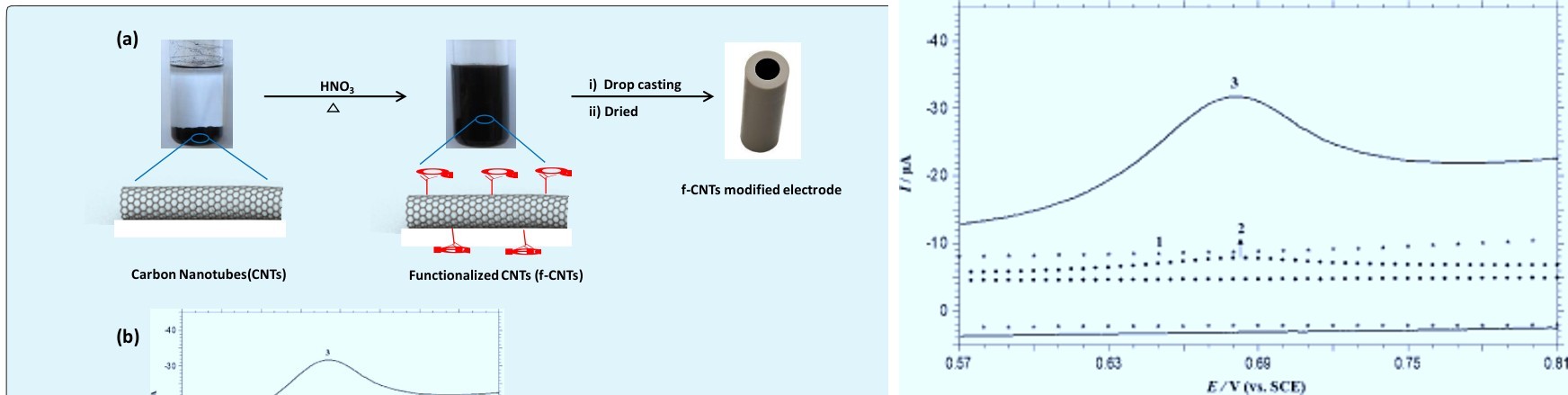
The huge electroactive surface area and inherent excellent electron transfer properties of CNTs are being explored extensively in the field of electroanalytical chemistry as CNTs modified electrode offers low detection limit, high sensitivity, reduction of overpotential and resistance to surface fouling [9]. Seetharamappa, et al., have exploited MWCNTs modified glassy carbon electrodes (GCE) for detailed electrochemical investigations and development of analytical methods for several biologically important molecules or drugs [9, 10]. Specifically, functionalized-MWCNTs (MWCNTs-COOH) prepared through refluxing with HNO3 and H2SO4, was used to modify the GCE surface (Figure 2a & b). The modified GCE, MWCNTs/GCE was practically utilized for electrochemical investigation of an antimigraine drug, almotriptan malate (ALM) [9]. The drug molecule, ALM exhibited ~3-fold enhancement in its electrochemical response at MWCNTs/GCE when compared to that at bare GCE (Figure 2c). Based on the improved electrochemical response, MWCNTs/GCE was used successfully for the development of an electroanalytical method for the assay of ALM in pharmaceutical formulations [9]. The enhanced ALM response was attributed to accelerated electron transfer capability and huge electroactive surface area [9]. There are several reports available wherein CNTs have been utilized to modify the electrode to explore electrochemistry of various interesting biomolecules and for the development of electroanalytical methods for their assay in pharmaceutical formulations and analyte fortified samples [11, 12, 13].
The electrocatalytic performance and sensitivity of the modified electrode was improved by the incorporation of metal/metal oxide (M/MOx) nanoparticles into CNTs matrix as M/MOx nanoparticles are known for their high conductivity, huge surface-to-volume ratio and catalytic properties [14, 15, 16]. In particular, Brett et al., have developed a sensing platform based on Au nanoparticles/MWCNTs modified electrode, prepared through layer by layer deposition method (Figure 3a) for sensitive determination (detection limit of 16.3 nM) of an estrogenic active agent, Bisphenol A (BPA) [15]. The improved sensitivity for BPA was due to enhanced electroactive surface area of MWCNTs upon the deposition of Au nanoparticles [15]. In yet another study, Wang and co-workers have fabricated an electrode material, Au/MWCNTs, via HSAB chemistry between thiol (N-acetyl-L-cystein) functionalized MWCNTs and Au nanoparticles [16] (Figure 3b). In this system, improved electrochemical response was attributed to anchored Au nanoclusters on MWCNTs. Au nanoclusters amplified the electron transfer capability and electrocatalytic property of MWCNTs towards the sensing of dopamine and uric acid and hence, the composite was utilized for simultaneous and selective determination of dopamine and uric acid. Other examples of CNTs-M/MOx composites were also reported for exploring electrochemistries of various biomolecules and their sensitive assays [17, 18].
A variety of polymers have been grafted on CNTs (without perturbing the electron conductivity of CNTs) to achieve selectivity or cross selectivity of the modified electrode for the determination of biomolecules [19, 20, 21]. The cross selectivity of the electrode are being achieved through particular interaction (either covalent or non- covalent) between grafted polymers and analyte molecules. As an example, Jia, et al. constructed a selective electrode platform, polyethylenimine-MWCNTs (MWCNTs-PEI), prepared through the electrostatic interaction between positively charged PEI (as it contains amine groups) and carboxyl groups of MWCNTs (Figure
4a), was used for the determination of bisphenol A (BPA) [19]. In the system, grafting of PEI makes MWCNTs surface positively charged that accumulates negatively charged analyte, BPA, which in turn achieves the selectivity of the modified electrode [19]. In an another study, the simultaneous voltammetric determination of dopamine and uric acid at their physiological level in the presence of ascorbic acid was achieved by using poly(acrylic acid)-MWCNTs(MWCNTs-PAA) composite (Figure 4b) modified GCE [20]. The selectivity in the system was due to PAA that has affinity to adsorb dopamine and uric acid but not ascorbic acid [20].
Figure 3: Construction of metal/metal oxide-MWCNTs modified electrode. (a) Scheme represents the layer-by-layer deposition method to prepare Au-Nps/MWCNTs modified glassy carbon electrode or the detection of bisphenol A. (b) Outline shows Au-Nps/MWCNTs modified electrode for the simultaneous determination of dopamine and uric acid.
Figure 4: Polymer grafted MWCNTs. Schemes represents the grafting of polyethyleneimine (a) through electrostatic interaction and poly (acrylic acid) (b) via non-covalent interactions. The respective polymer nanocomposites were used for the selective detection bisphenol A and dopamine and, uric acid.
**Graphene based Electrodes**
Graphene based materials, graphene oxide (GO), electrochemically reduced GO (ErGO), chemically reduced GO (CrGO), hydrothermally reduced GO (HrGO), etc are being used to modify electrode substrates for various electronic applications. The material, rGO has numerous unexpected properties where electrons obey a linear dispersion relation and behave like massless relativistic particles, resulting in the observation of a number of very peculiar electronic properties such as the quantum Hall effect and transport via relativistic Dirac fermions [22, 23]. Their unusual electronic and robust transport properties may be useful in the electronics or in the related applications [25]. As an example, Seetharamappa and co-workers have fabricated the rGO modified glassy carbon electrode, rGO prepared through different reduction approaches (Figure 5) [i.e. chemical (Figure 5B), electrochemical and hydrothermal (Figure 5C) [25]. These were used to investigate the electrochemistry of smoking cession drug, varenicline(VAR) and further utilized to develop an alternative electroanalytical methods for its determinations in biological fluids [25]. In the system, VAR exhibited increased electrochemical response at CrGO/GCE when compared to that at HrGO and ErGO modified electrodes (Figure 5C). This was attributed to huge electroactive surface area and fast electron transfer property (lesser ΔEp and higher Ip values) [Figure 5D] of CrGO. The porous morphology makes CrGO (Figure 5B) to expose more of its electrochemical active sites to VAR. Hence, the electrode, CrGO/GCE was utilized to develop electroanalytical method for the sensitive determination of VAR with detection limit of 7.03 nM [25]. The same research group also exploited the use of ErGO modified GCE for sensing of various drug molecules in pharmaceutical formulations [26, 27, 28]. ErGO/GCE was fabricated by applying potential in the range of -1.6 to 0.7 V to GO/GCE in phosphate buffer of pH of 6.
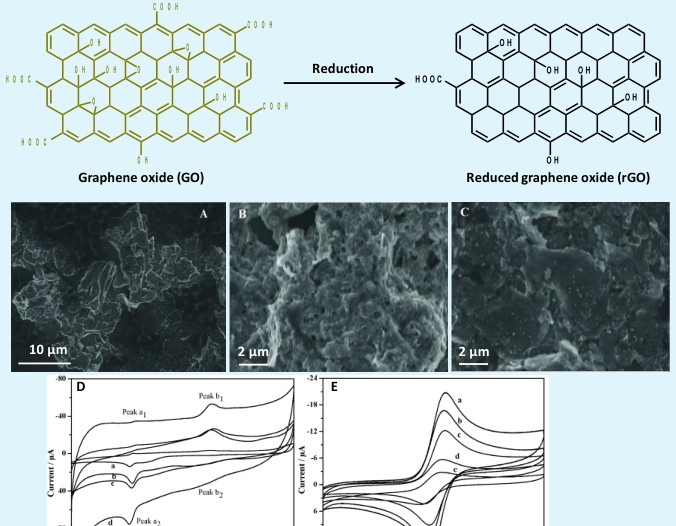
Figure 5: Characterization of rGOmaterials. Scheme represents the reduction of graphene oxide. SEM images of graphene oxide (A), chemically (B) and hydrothermally (C) reduced graphene oxide. (D) Cyclic voltammograms of 10 µMvarenicline in phosphate buffer of pH 6 at GCE (a), ErGO/GCE (b), HrGO/GCE (c), and CrGO/GCE (d). (E)Cyclic voltammograms of 0.1 mM [Fe(CN)6]3−/4− in 1 mM KNO3 at CrGO/GCE (a), HrGO/GCE (b), ErGO/GCE (c), GO/GCE (d), and bare GCE (e). Figures A-E reprinted with the permission from [25].
Metal or metal oxide nanoparticle induced graphene based materials are being explored in order to catalyze the electrochemical responses of various biomolecules [29, 30]. Specifically, Peng et al have developed an electrode material, CuO nanoparticles anchored S-doped graphene by microwave-assisted method (Figure 6a) and was utilized to modify GCE for the sensitive determination of glucose in blood samples with a detection limit of 80 nM [29]. Determination of glucose in the blood assumes importance in clinical diagnostics of diabetes mellitus.
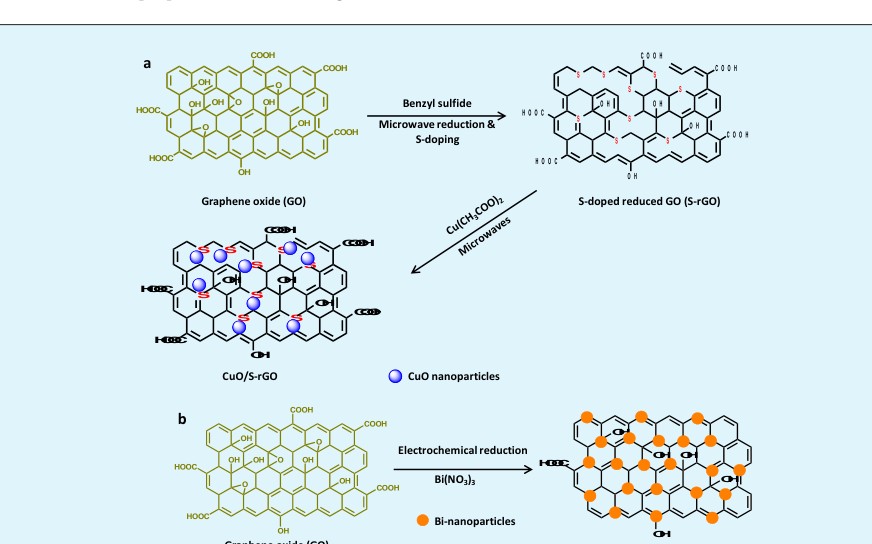
Figure 6: Fabrication of metal oxide/graphene and metal/graphene nanocomposites. (a) Flow chart represent the synthesis of CuO/rGO_via_ microwave-assisted method i.e. sulphur doped reduced graphene acted as anchoring sites for CuO nanoparticles. (b) Electrochemical reduction is the simultaneous green reduction approach for the preparation of Bi/rGO in the potential range of -1.7 to 0.6 V.
Various approaches have been reported to anchor metal nanoparticles on graphene based materials to enhance the electrochemical activity towards biomolecules sensing [30, 31, 32]. For example, Seetharamappa and coworkers fabricated a material, Bi nanoparticles embedded rGO for the sensitive determination of an anticancer drug, gemcitabine [30]. In the system, Bi/rGO nanocomposite, prepared through an eco-friendly approach i.e electrochemical reduction of graphene oxide and Bi-salt solution simultaneously in the potential range of -1.7 to 0.6 V in phosphate buffer of pH 6 (Figure 6b). Improved electrochemical response was noticed upon the incorporation of metallic Bi nanoparticles, as Bi nanoparticles are known for their electrocatalytic activities [30]. Similarly, Chen et al have developed Au nanoparticles embedded graphene, prepared through electrochemical approach, and was used for simultaneous and selective electrochemical determination of dihydroxybenzene isomers [31].
It is also interesting to note that, mixed metal or metal oxide nanoparticles decorated graphene-based materials are being exploited to achieve sensitivity, selectivity and simultaneous determination of various analyte biomolecules [33, 34]. As an example, Qu and coworkers have developed an electrode modified with Au/Pd/rGO for simultaneous determination of acetaminophen (analgesic and antipyretic drug) and 4-aminophenol (the primary hydrolytic degradation product of paracetamol) [34]. The nanocomposite, Au/Pd/rGO was prepared via two steps i.e GO refluxed with Pd salt in presence of poly- (vinylpyrrolidone) to obtain Pd/rGO and followed by electrodeposition of Au nanoparticles (Figure 7). In the system, Pd and Au nanoparticles were used to improve the electrocatalytic activity and electron transfer between acetaminophen and 4-aminophenol and, electrode surface [34]. Demonstrated nanocomposite successfully utilized for the sensitive and simultaneous determination of acetaminophen and 4-aminophenol.
Polymers are also being used to improve the electrochemical performance of modified electrodes towards bimolecular sensing. In particular, various polymers are incorporated into the graphene matrix to catalyze the electrochemical responses of biomolecules [35, 36]. As an example, Karpoormath and co-workers have developed poly-glycine/rGO nanocomposite for sensitive determination of neurotransmitter, levodopa and uric acid [35]. In this method, the demonstrated nanocomposite, poly-glycine/rGO, was fabricated in two steps-initially poly-glycine was deposited on bare GCE through electropolymerization in the potential range of 0.8 to 1.8 V followed by drop casting of GO and its electrochemical reduction in the potential range of -1.5 to 0.6 V (Figure 8). The demonstrated electrode further utilized successfully for the simultaneous determination of levodopa and uric acid with a detection limit of 0.15 µM. Enhanced sensitivity of the electrode was attributed to synergetic effect of both rGO and poly-glycine in the composite. In yet another study, Shim et al have fabricated the electrode material, poydopamine-rGO, prepared through electrochemical reduction of GO on GCE surface followed by electropolymerization of dopamine, was utilized for the determination of free chlorine in swimming pool water with the detection limit of 44 nM [35].
Summary and Future Prospective
This article describes the use of graphene and nanotube based material modified electrodes for sensing of biologically important molecules. In particular, preparation and the use of carbon nanotube and reduced graphene and, their composites with metal or metal oxide nanoparticles, and polymers in the modification electrode for the sensing of various biomolecules. Practical utility of the fabricated electrodes was also discussed. However, the reported modified electrodes suffer from some limitations such as selectivity, simultaneous measurement and reproducibility. Selectivity of the modified electrodes could be achieved through the covalent or non-covalent functionalization of carbon nanomaterial’s with appropriate function groups or with proper host macromolecules. Simultaneous measurements could be accomplished through the incorporation of suitable multi metal nanoparticles onto the graphene matrix, where particular metal nanoparticle could catalyze the electrochemical reaction of particular analyte. Further, reproducibility of the modified electrodes could be improved by making stable suspension of modifier for drop casting and/or modifying the electrode through spin coating that can ensure the even distribution of the nanoparticles on the electrode surface.
References
-
Teradal NL, Jelinek R (2017) Carbon Nanomaterials in Biological Studies and Biomedicine. Advanced Healthcare Materials 6(17): 1700574.
-
Zhang A, Lieber CM (2015) Nano-Bioelectronics. Chemical Reviews 116(1): 215-257.
-
Kim M, Jang J, Cha C (2017) Carbon nanomaterials as versatile platforms for theranostic applications. Drug Discovery Today 22(9): 1430-1437.
-
Jacobs CB, Peairs MJ, Venton BJ (2010) Review: Carbon nanotube based electrochemical sensors for biomolecules. Analytica Chimica Acta 662(2): 105- 127.
-
Jariwala D, Sangwan VK, Lauhon LK, Marks TJ, Hersam MC (2013) Carbon nanomaterials for electronics, optoelectronics, photovoltaics, and sensing. Chemical Society Reviews 42(7): 2824-2860.
-
Maduraiveeran G, Sasidharan M, Ganesan V (2017) Electrochemical sensor and biosensor platforms based on advanced nanomaterials for biological and biomedical applications. Biosensors and Bioelectronics 103: 113-129.
-
Yu X, Zhang W, Zhang P, Su Z (2017) Fabrication technologies and sensing applications of graphene- based composite films: Advances and challenges. Biosensors and Bioelectronics 89(1): 72-84.
-
Zhang R, Chen W (2017) Recent advances in graphene-based nanomaterials for fabricating electrochemical hydrogen peroxide sensors. Biosensors and Bioelectronics 89(1): 249-268.
-
Narayan PS, Teradal NL, Kalanur SS, Seetharamappa J (2013) Fabrication of an Electrochemical Sensor Based on Multiwalled Carbon Nanotubes for Almotriptan. Electroanalysis 25(12): 2684-2690.
-
Prashanth S, Kalanur SS, Teradal NL, Seetharamappa J (2012) International Journal of Electrochemistry 2012: 1-6.
-
Leniart A, Brycht M, Burnat B, Skrzypek S (2009) Voltammetric determination of the herbicide propham on glassy carbon electrode modified with multi-walled carbon nanotubes. Sensors and Actuators B: Chemical 231: 54-63.
-
Hegde RN, Shetti NP, Nandibewoor ST (2009) Electro- oxidation and determination of trazodone at multi- walled carbon nanotube-modified glassy carbon electrode. Talanta 79(2): 361-368.
-
Hegde RN, Hosamani RR, Nandibewoor ST (2009) Voltammetric oxidation and determination of cinnarizine at glassy carbon electrode modified with multi-walled carbon nanotubes. Colloids and Surfaces B: Biointerfaces 72(2): 259-265.
-
Vilian AE, Madhu R, Chen SM, Veeramani V, Sivakumar M, et al. (2015) Facile synthesis of MnO2/carbon nanotubes decorated with a nanocomposite of Pt nanoparticles as a new platform for the electrochemical detection of catechin in red wine and green tea samples. Journal of Materials Chemistry B 3(30): 6285-6292.
-
Messaoud NB, Ghica ME, Dridi C, Ali MB, Brett CM (2017) Electrochemical sensor based on multiwalled carbon nanotube and gold nanoparticle modified electrode for the sensitive detection of bisphenol A. Sensors and Actuators B: Chemical 253: 513-522.
-
Wang Z, Guo H, Gui R, Jin H, Xia J, et al. (2018) Simultaneous and selective measurement of dopamine and uric acid using glassy carbon electrodes modified with a complex of gold nanoparticles and multiwall carbon nanotubes. Sensors and Actuators B: Chemical 255(2): 2069- 2077.
-
Kumar KR, Manoj D, Santhanalakshmi J (2013) Optimization of site specific adsorption of oleylamine capped CuO nanoparticles on MWCNTs for electrochemical determination of guanosine. Sensors and Actuators B: Chemical 188: 603-612.
-
Moyo M, Florence LR, Okonkwo JO (2015) Improved electro-oxidation of triclosan at nano-zinc oxide- multiwalled carbon nanotube modified glassy carbon electrode. Sensors and Actuators B: Chemical 209: 898-905.
-
Yang Y, Zhang H, Huang C, Jia N (2016) MWCNTs-PEI composites-based electrochemical sensor for sensitive detection of bisphenol A. Sensors and Actuators B: Chemical 235: 408-413.
-
Liu A, Honma I, Zhou H (2007) Simultaneous voltammetric detection of dopamine and uric acid at their physiological level in the presence of ascorbic acid using poly(acrylic acid)-multiwalled carbon- nanotube composite-covered glassy-carbon electrode. Biosensors and Bioelectronics 23(1): 74- 80.
-
Vicentini FC, Ravanini AE, Silva TA, Janegitz BC, Zucolotto A, et al. (2014) A novel architecture based upon multi-walled carbon nanotubes and ionic liquid to improve the electroanalytical detection of ciprofibrate. Analyst 139(16): 3961-3967.
-
Zhang Y, Tan YW, Stormer HL, Kim (2005) Experimental observation of the quantum Hall effect and Berry's phase in grapheme. Nature 438: 201-204.
-
Novoselov KS, Geim AS, Morozov S, Jiang D, Katsnelson M, et al. (2005) Two-dimensional gas of massless Dirac fermions in graphene. Nature 438: 197-200.
-
Li X, Wang X, Zhang L, Lee S, Dai H (2008) Chemically Derived, Ultrasmooth Graphene Nanoribbon Semiconductors. Science 319(5867): 1229-1232.
-
Teradal NL, Narayan PS, Seetharamappa J, Satpati AK (2014) Electrosensing Platform for Varenicline Based on Reduced Graphene Oxide. Electroanalysis 26(10): 2173-2181.
-
Teradal NL, Narayan PS, Satpati AK, Seetharamappa J (2014) Fabrication of electrochemical sensor based on green reduction of graphene oxide for an antimigraine drug, rizatriptan benzoate. Sensors and Actuators B: Chemical 196: 596-603.
-
Prashanth SN, Teradal NL, Seetharamappa J, Satpati AK (2014) Fabrication of an Electrochemical Sensor Based on Electroreduced Graphene Oxide for the Determination of Valganciclovir. J Electrochemical Society 161(6): 117-122.
-
Teradal NL, Narayan PS, Seetharamappa J (2013) Electro-reduced graphene oxide film modified glassy carbon electrode as an electrochemical sensor for sibutramine. Analytical Methods 5(24): 7090-7095.
-
Tian Y, Liu Y, Wang WP, Zhang X, Peng W (2015) CuO nanoparticles on sulfur-doped graphene for nonenzymatic glucose sensing. Electrochimica Acta 156: 244-251.
-
Tandel R, Teradal N, Satpati A, Seetharamappa J (2016) Fabrication of the electrochemically reduced graphene oxide-bismuth nanoparticles composite and its analytical application for an anticancer drug gemcitabine. Chinese Chemical Letters 28(7): 1429- 1437.
-
Palanisamy S, Karuppiah C, Chen SM, Yang CY, Periakaruppan P (2014) Simultaneous and selective electrochemical determination of dihydroxybenzene isomers at a reduced graphene oxide and copper nanoparticles composite modified glassy carbon electrode. Analytical Methods 6(12): 4271-4278.
-
Thirumalraj B, Rajkumar C, Chen SM Palanisamy S (2017) One-Pot Green Synthesis of Graphene Nanosheets Encapsulated Gold Nanoparticles for Sensitive and Selective Detection of Dopamine. Scientific Reports 7: 41213.
-
Yuan M, Liu A, Zhao M, Dong W, Zhao T, et al. (2014) Bimetallic PdCu nanoparticle decorated three- dimensional graphene hydrogel for non-enzymatic amperometric glucose sensor. Sensors and Actuators B: Chemical 190: 707-714.
-
Wang H, Zhang S, Li S, Qu J (2018) Electrochemical sensor based on palladium-reduced graphene oxide modified with gold nanoparticles for simultaneous determination of acetaminophen and 4-aminophenol. Talanta 178: 188-194.
-
Palakollu VN, Thapliyal N, Chiwunze TE, Karpoormath R, Karunanidhi S, et al. (2017) Electrochemically reduced graphene oxide/Poly-Glycine composite modified electrode for sensitive determination of l- dopa. Materials Science and Engineering C 77: 394- 404.
-
Salavagione HJ, Díez-Pascual AM, Lázaro E, Vera S, Gómez-Fatou MA (2014) Chemical sensors based on polymer composites with carbon nanotubes and graphene: the role of the polymer. J Materials Chemistry A 2(35): 14289-14328.
- Solution-Processed Chiral Perovskites for Biomedical Applications
- Nanotechnology in Health Chemistry and Medicine: Current Challenges and Future Directions
- Human Exposure to Micro- and Nanoplastics: Pathways, Toxicity, and Intervention Strategies
- Exosome Nanomedicine for Cancer Therapy
- Micro and Nanoplastics–Plastisphere, Biotoxicity, Impact on Human Health, and Mitigation Strategies
- Process Validation of Cefixime Powder for Suspension Dosage Form, 50 mL