
Physicochemical and Thermal Characterization of Consciousness Energy Healing Treated Copper (II) Chloride Using PXRD, DSC, and TGA/DTG
Copper chloride is a source of copper ion. Copper which is an essential trace element used for the treatment of cancer, inflammation, hematological, neurological disorder, etc. The impact of the Trivedi Effect®-Consciousness Energy Healing Treatment on the physicochemical and thermal properties of copper chloride was evaluated using sophisticated analytical techniques. The test sample copper chloride was divided into control and treated parts. Only the treated part received the Trivedi Effect®-Biofield Energy Healing Treatment remotely by a renowned Biofield Energy Healer, Dahryn Trivedi. The powder X-ray diffraction relative peak intensities of the treated sample were significantly altered from - 84.64% to 108.82% compared with the control sample. Similarly, the crystallite sizes of the treated sample were significantly altered from -33.34% to 42.89%, but the overall crystallite size was decreased by 3.76% compared to the control sample. The evaporation, melting and decomposition temperatures of the treated copper chloride were significantly increased by 12.24%, 3.44%, and 2.86%, respectively compared to the control sample. Similarly, the latent heat of the evaporation, melting and decomposition of the treated sample was significantly altered by 46.38%, -26.34%, and 65.08% compared with the control sample. The overall weight loss in the treated sample was decreased by 1.32% compared to the control sample. Whereas, the maximum thermal degradation temperature values in the 1st, 2nd, and 3rd peaks of the Biofield Treated sample was decreased by 11.65%, 3.38%, and 2.04%, respectively compared with the control sample. After the Consciousness Energy Healing Treatment polymorphic form of copper chloride might have altered. The new form of copper chloride would be thermally more stable during manufacturing, delivery or storage conditions compared to the control sample. Hence, Biofield Energy Treated copper chloride would be advantageous to design better and more efficacious nutraceutical and pharmaceutical formulations that may provide a better therapeutic response against cancer, inflammation, wound healing, etc.
Introduction
Copper is an essential trace element in the plants and animals. Copper is absorbed in the gut and found in the human body at a level of 1.4 to 2.1 mg/kg of body weight [1, 2]. Copper exists in the human body mostly in bound form with the proteins, i.e. transport proteins, storage proteins or metalloenzymes. Copper proteins have various roles in biological electron transport and oxygen transportation processes, that exploit the easy Cu(I) and Cu(II) interconversion [1, 2, 3]. Copper (II) chloride (CuCl2) is an inorganic compound and naturally found as both the anhydrous (tolbachite) and dihydrate (erichalcite) forms. The anhydrous copper chloride (light brown) absorbs moisture to form blue-green dihydrate [1, 4, 5]. Copper chloride is widely used as a catalyst in various organic reactions, i.e. Wacker process, organic synthesis, production of chlorine, etc. and also used as agricultural chemical, plating agent, surface treating agent, and processing aid [1, 2, 3, 4, 5, 6]. Copper complexes can be used as an antitumor, anti-inflammatory and wound healing agent [4, 7]. Copper chloride is used as a source of copper ion in copper deficiency disorder, i.e. hematological and neurological disorder.
Biofield referred as a quantum of energy matrix that is found surrounding the human body generated from the continuous movement of the charged particles (ions, cells, etc.) inside the body and the electromagnetic waves discharge in the form of biophotons. Biofield Energy Healing practitioners have the ability to acquire the energy from the “Universe” and can transfer into any living or nonliving object(s). The process by which the object(s) receive the Biofield Energy and respond in a useful way is called as Biofield Energy Healing Treatment [8, 9]. Biofield Energy Therapy has been recognized as a Complementary and Alternative Medicine (CAM) health care approach by the National Center of Complementary and Integrative Health (NCCIH) with other therapies, medicines and practices such as acupressure, acupuncture, yoga, Qi Gong, Tai Chi, meditation, homeopathy, Reiki, healing touch, hypnotherapy, chiropractic/osteopathic manipulation, movement therapy, naturopathy, Ayurvedic medicine, traditional Chinese herbs and medicines, aromatherapy, cranial sacral therapy, etc [10, 11]. The Trivedi Effect®- Consciousness Energy Healing Treatment (Biofield Energy Healing Treatment) is scientifically gained Trivedi D and Jana S. Physicochemical and Thermal Characterization of Consciousness Energy Healing Treated Copper (II) Chloride Using PXRD, DSC, and TGA/DTG. Nanomed Nanotechnol 2019, 4(2): 000163.
importance in several fields include material science [12, 13], organic compounds [14, 15], pharmaceuticals [16, 17, 18], nutraceuticals [19, 20], biotechnology [21, 22], genetics [23, 24], medical science [25], microbiology [26, 27], and agriculture [28, 29], due to its amazing ability to alter the characteristic properties of the numerous non-living and living substances. It can be assumed that Biofield Energy Treated pharmaceutical/nutraceutical compounds would be beneficial for the enhancement of their therapeutic efficacy against various disease. The physicochemical and thermal properties of a pharmaceutical solid compound play an important role in bioavailability, therapeutic efficacy, and toxicity [30, 31]. The Consciousness Energy Healing Treatment might change the physicochemical and thermal properties through the possible intervention of neutrinos [32]. Therefore, the experiment was designed to investigate the impact of the Trivedi Effect® on the physicochemical and thermal properties of copper chloride using modern analytical techniques.
Materials and Methods
Chemicals and Reagents
The test sample copper (II) chloride (≥ 98%) was purchased from VETEC, Sigma-Aldrich, India. Similarly, the other chemicals used in the experiments were purchased in India.
Consciousness Energy Healing Treatment Strategies
The test sample copper chloride was divided into control and treated parts. The control copper chloride sample did not receive the Trivedi Effect®-Consciousness Energy Healing Treatment. But, the control copper chloride was treated with a “sham” healer who did not have any knowledge about the Biofield Energy Treatment. The treated part of copper chloride was received the Consciousness Energy Healing Treatment remotely for 3 minutes under the standard laboratory conditions by the renowned Biofield Energy Healer, Dahryn Trivedi. After all the treatment, both the samples were kept in sealed conditions and characterized using different techniques.
Characterization
The powder X-ray diffraction (PXRD) analysis of copper chloride powder samples was performed with the Copyright© Trivedi D and Jana S.
help of PANalytical X’Pert3 powder X-ray diffractometer, UK [11, 17, 20]. The average size of crystallites was calculated using the Scherrer’s formula (1) G = kλ/βcosθ (1) Where, G: crystallite size, λ: radiation wavelength, k: equipment constant, β: full-width half maximum, and θ: Bragg angle [33].
Similarly, the differential scanning calorimetry (DSC) analysis of copper chloride was performed with the help of DSC Q200, TA instruments. The thermal gravimetric analysis (TGA) thermograms of copper chloride samples were obtained with the help of TGA Q50 TA instruments [11, 17, 20].
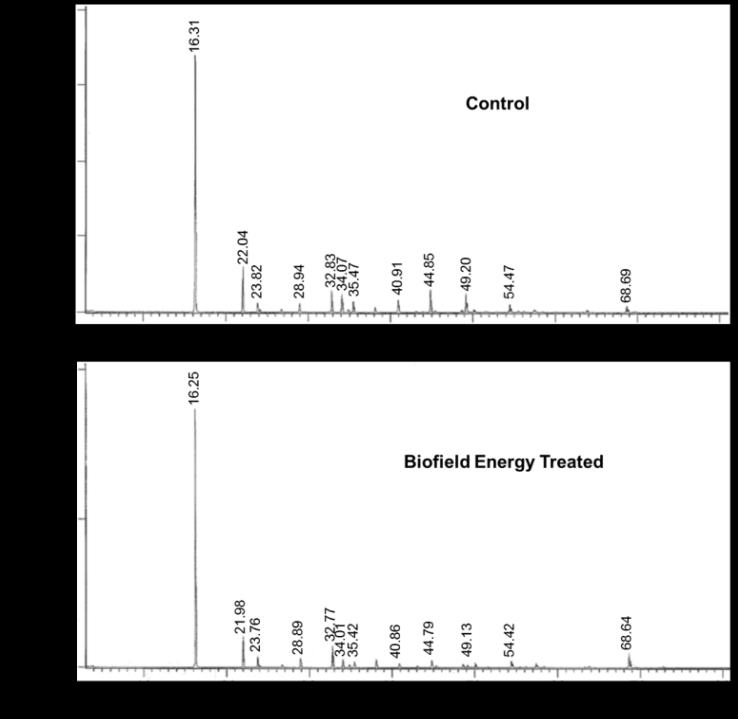
The PXRD relative peak intensities of the Biofield Energy Treated sample were significantly altered from - 84.64% to 108.82% compared with the control sample (Table 1, entry 1-12). Similarly, the crystallite sizes of the treated sample were significantly altered from -33.34% to 42.89% compared with the control sample (Table 1, entry 1-12). The average crystallite size was decreased by 3.76% in the treated sample (52.93 nm) compared to the control sample (55.00 nm).
The % change in the parameters in the treated copper chloride was calculated compared to the control sample using the following equation 2:
[ ]
(2) Results and Discussion
Powder X-ray Diffraction (PXRD) Analysis
The PXRD diffractograms of both the samples of copper chloride exhibited sharp and intense peaks (Figure 1) indicating that both the samples were crystalline. The diffractograms of both the copper chloride samples showed the highest peak intensity at Bragg’s angle (2θ) equal to 16.3° (Table 1, entry 1).
Trivedi D and Jana S. Physicochemical and Thermal Characterization of Consciousness Energy Healing Treated Copper (II) Chloride Using PXRD, DSC, and TGA/DTG. Nanomed Nanotechnol 2019, 4(2): 000163.
pharmaceuticals have a significant impact on drug performance [35, 36]. Therefore, it can be anticipated that the treatment could be a very useful method for the production of novel crystal polymorph of copper chloride that would provide an improved in its therapeutic performance.
Copyright© Trivedi D and Jana S.
| Relative Intensity (%) | Crystallite size (G, nm) | ||||||||||||||||||||||
|---|---|---|---|---|---|---|---|---|---|---|---|---|---|---|---|---|---|---|---|---|---|---|---|
| Entry No. | Bragg angle (°2) | ||||||||||||||||||||||
| Control | Treated | % Change | Control | Treated | % Change | ||||||||||||||||||
| 1 | 16.3 | 100.00 | 100.00 | 0.00 | 49.68 | 43.46 | -12.52 | ||||||||||||||||
| 2 | 22.0 | 16.95 | 11.71 | -30.91 | 38.96 | 38.96 | -0.01 | ||||||||||||||||
| 3 | 23.8 | 3.60 | 3.98 | 10.56 | 50.26 | 50.26 | -0.01 | ||||||||||||||||
| 4 | 28.9 | 3.30 | 3.42 | 3.64 | 35.55 | 50.79 | 42.89 | ||||||||||||||||
| 5 | 32.8 | 8.41 | 8.33 | -0.95 | 58.84 | 58.83 | -0.02 | ||||||||||||||||
| 6 | 34.1 | 6.93 | 3.23 | -53.39 | 59.03 | 49.18 | -16.68 | ||||||||||||||||
| 7 | 35.5 | 4.21 | 2.15 | -48.93 | 74.07 | 49.37 | -33.34 | ||||||||||||||||
| 8 | 40.9 | 4.84 | 1.57 | -67.56 | 60.25 | 60.24 | -0.02 | ||||||||||||||||
| 9 | 44.9 | 8.80 | 2.84 | -67.73 | 61.07 | 61.06 | -0.02 | ||||||||||||||||
| 10 | 49.2 | 7.29 | 1.12 | -84.64 | 51.74 | 51.73 | -0.03 | ||||||||||||||||
| 11 | 54.5 | 3.07 | 2.68 | -12.70 | 63.50 | 52.91 | -16.69 | ||||||||||||||||
| 12 | 68.7 | 2.72 | 5.68 | 108.82 | 57.01 | 68.40 | 19.96 |
Table 1: PXRD data for the control and treated copper chloride.
Differential Scanning Calorimetry (DSC) Analysis
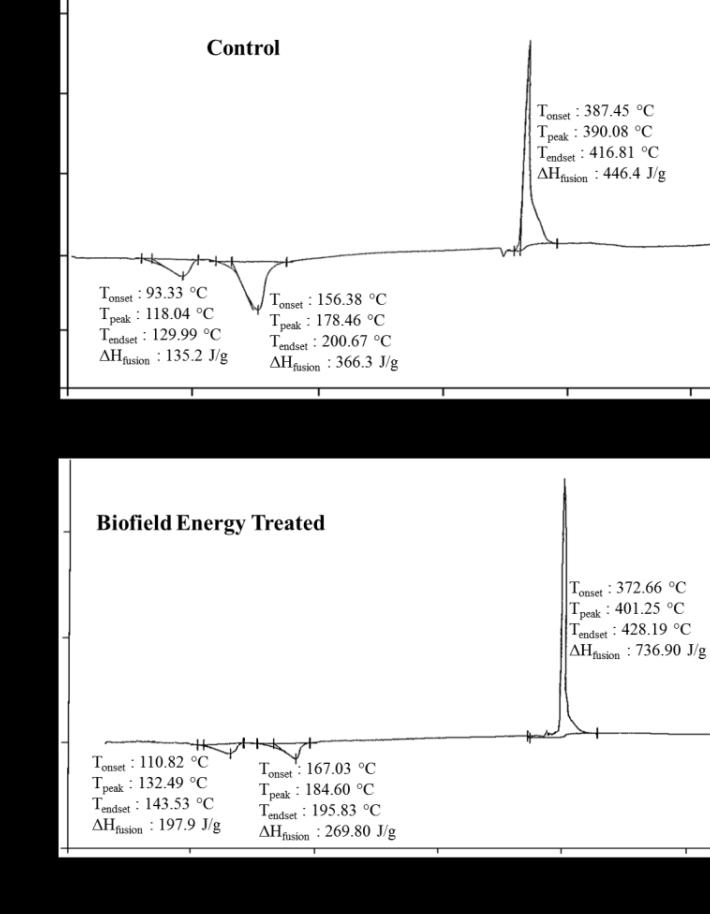
The DSC thermograms of both the sample of copper chloride exhibited two broad endothermic peaks and one sharp exothermic peak (Figure 2). According to the literature, the DSC curve of copper (II) chloride dihydrate shows a broad endothermic peak at 129.13 °C is due to the melting point of copper chloride [37].
Trivedi D and Jana S. Physicochemical and Thermal Characterization of Consciousness Energy Healing Treated Copper (II) Chloride Using PXRD, DSC, and TGA/DTG. Nanomed Nanotechnol 2019, 4(2): 000163.
Copyright© Trivedi D and Jana S.
After the Biofield Energy Treatment, the melting point of the Biofield Energy Treated copper chloride was significantly increased by 12.24% compared to the control sample (Table 3). The latent heat of fusion (∆H) of the Biofield Energy Treated copper chloride was significantly increased by 46.38% compared to the control sample. Thus, Biofield Energy Treated copper chloride required more energy in the form of ∆H to undergo the whole process of melting after Dahryn’s Biofield Energy Treatment.
| Melting /Decomposition Temperature (°C) | ∆H(J/g) | |||||||||||||||||||
|---|---|---|---|---|---|---|---|---|---|---|---|---|---|---|---|---|---|---|---|---|
| Sample | ||||||||||||||||||||
| 1st Peak | 2nd Peak | 3rd Peak | 1st Pea | k | 2nd Peak | 3rd Peak | ||||||||||||||
| Control Sample | 118.04 | 178.46 | 390.08 | 135.20 | 366.30 | 446.40 | ||||||||||||||
| Biofield Energy Treated | 132.49 | 184.60 | 401.25 | 197.90 | 269.80 | 736.90 | ||||||||||||||
| %Change | 12.24 | 3.44 | 2.86 | 46.38 | -26.34 | 65.08 |
Table 2: DSC data for both control and treated samples of copper chloride ΔH: Latent heat of fusion/ decomposition.
Subsequently, the 2nd broad endothermic peak was observed in the control sample that might be due to the melting temperature of copper chloride monohydrate produced from the dihydrate during the thermal reaction. The 2nd melting temperature of the treated sample was increased by 3.44% with a significant decline of ∆H by 26.34% compared to the control sample. Copper (II) chloride dihydrate decomposes at above 300 °C and releases chlorine gas [38]. Thus, a sharp exothermic peak at 390.08 and 401.25 °C were observed in the control and Biofield Energy Treated samples, respectively. It might be the decomposition of the copper chloride sample. The decomposition temperature and ∆H of the Biofield Energy Treated copper chloride were increased by 2.86% and 68.08% compared with the control sample (Table 2). The DSC results suggested that the thermal stability of the Biofield Energy Treated sample was significantly improved compared with the control sample.
Thermal Gravimetric Analysis (TGA) / Differential Thermogravimetric Analysis (DTG)
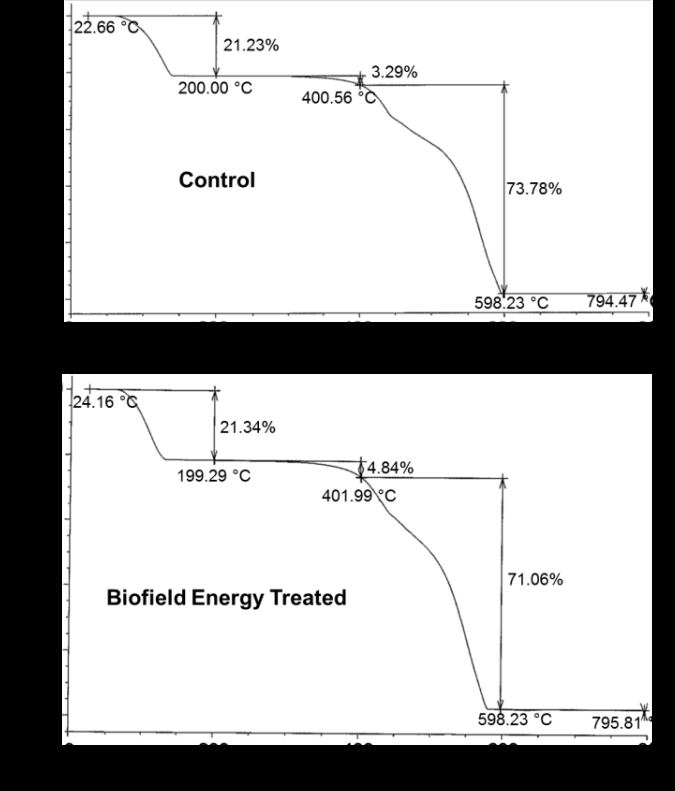
The TGA thermograms of the control and Biofield Energy Treated copper chloride showed three steps of thermal degradation (Figure 3).
Trivedi D and Jana S. Physicochemical and Thermal Characterization of Consciousness Energy Healing Treated Copper (II) Chloride Using PXRD, DSC, and TGA/DTG. Nanomed Nanotechnol 2019, 4(2): 000163.
Copyright© Trivedi D and Jana S.
Mohamed and Halawy reported that the copper chloride dihydrate loses its two water molecules in one step from the temperature 66 to 132°C. As per the literature, copper chloride dihydrate exhibited a weight loss of 21.40% and maximum thermal degradation temperatures (Tmax) of 108.6°C at 10°C/min heating rate under a dynamic nitrogen atmosphere [37]. The total weight loss of the control and Biofield Energy Treated samples were 98.30% and 97.24%, respectively. The overall weight loss of the Biofield Energy Treated copper chloride was decreased by 1.08% compared with the control sample (Table 3). The 1st step degradation was due to the evaporation of water molecule in the Biofield Energy Treated and the control samples. The 2nd and 3rd step of degradations observed in both control and Biofield Treated samples might be due to the dehydration of water molecule from copper chloride monohydrate and decomposition of copper chloride, respectively.
| Sample | TGA Weight loss (%) | DTG T (°C) max | |||||
|---|---|---|---|---|---|---|---|
| 1st step | 2nd step | 3rd step | Total | 1st step | 2nd step | 3rd step | |
| Control Sample | 21.23 | 3.29 | 73.78 | 98.30 | 124.25 | 435.63 | 566.9 |
| Biofield Energy Treated Sample | 21.34 | 4.84 | 71.06 | 97.24 | 109.78 | 420.92 | 555.34 |
| % Change | 0.52 | 47.11 | -3.69 | -1.08 | -11.65 | -3.38 | -2.04 |
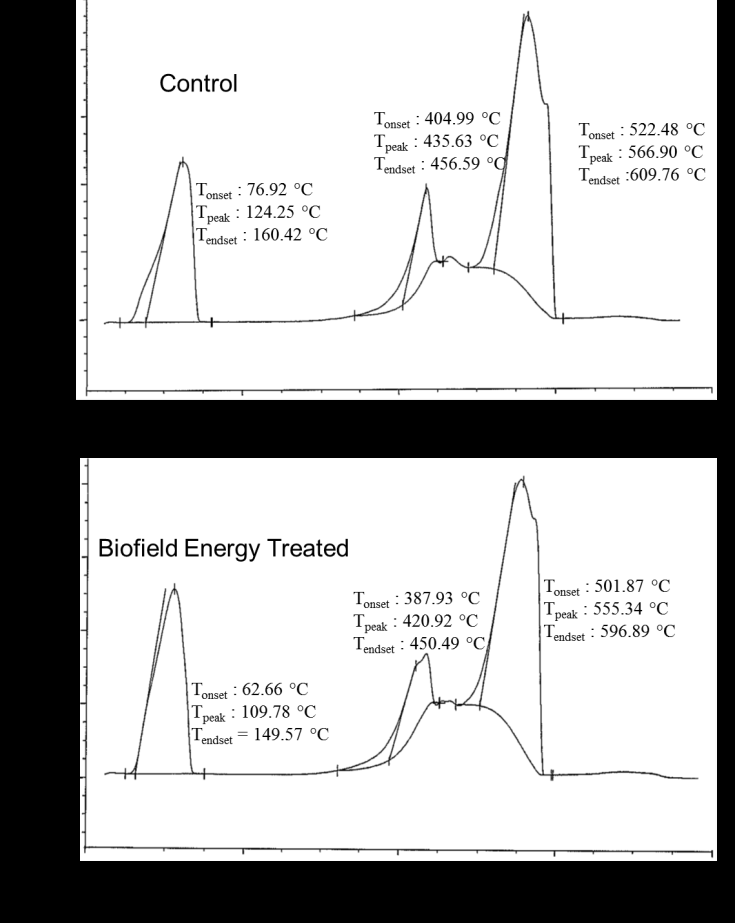
Table 3: TGA/DTG data of the control and treated samples of copper chloride Tmax: the maximum thermal degradation temperatures at
Trivedi D and Jana S. Physicochemical and Thermal Characterization of Consciousness Energy Healing Treated Copper (II) Chloride Using PXRD, DSC, and TGA/DTG. Nanomed Nanotechnol 2019, 4(2): 000163.
Copyright© Trivedi D and Jana S.
The DTG thermograms of the control and treated samples (Figure 4) exhibited three peaks. The Tmax values in the 1st, 2nd, and 3rd peaks of the treated sample were decreased by 11.65%, 3.38%, and 2.04% compared with the control sample (Table 3). Overall, TGA/DTG data revealed that the thermal stability of the Biofield Energy Treated copper chloride was altered compared to the control sample.
Conclusions
The current study confirmed that the Trivedi Effect®- Consciousness Energy Healing Treatment has a significant effect on the relative peak intensities, crystallite size, and thermal stability of copper chloride. The powder X-ray diffraction relative peak intensities of the Biofield Energy Treated copper chloride were significantly altered from - 84.64% to 108.82% compared with the control sample. Similarly, the crystallite sizes of the Biofield Energy Treated copper chloride were significantly altered from - 33.34% to 42.89%, but the overall crystallite size was decreased by 3.76% compared to the control sample. The evaporation, melting and decomposition temperatures of the Biofield Energy Treated copper chloride were significantly increased by 12.24%, 3.44%, and 2.86%, respectively compared to the control sample. Similarly, the latent heat of the evaporation, melting and decomposition of the Biofield Energy Treated copper chloride was significantly altered by 46.38%, -26.34%, and 65.08% compared with the control sample. The total weight loss in the Biofield Energy Treated copper chloride was decreased by 1.32% compared to the control sample. Whereas, the Tmax values in the 1st, 2nd, and 3rd peaks of the Biofield Energy Treated copper chloride was decreased by 11.65%, 3.38%, and 2.04%, respectively compared with the control sample. After the Trivedi Effect®-Consciousness Energy Healing Treatment polymorphic form of copper chloride might have altered. The new form of copper chloride would be thermally more stable during manufacturing, delivery or storage conditions compared to the control sample. Hence, Biofield Energy Treated copper chloride would be advantageous to design more efficacious nutraceutical and pharmaceutical formulations that may provide a better therapeutic response against cancer, inflammation, wound healing, etc.
Acknowledgements
The authors are grateful to GVK Biosciences Pvt. Ltd., Trivedi Science, Trivedi Global, Inc., Trivedi Testimonials, Trivedi D and Jana S. Physicochemical and Thermal Characterization of Consciousness Energy Healing Treated Copper (II) Chloride Using PXRD, DSC, and TGA/DTG. Nanomed Nanotechnol 2019, 4(2): 000163.
and Trivedi Master Wellness for their assistance and support during this work.
References
-
https://en.wikipedia.org/wiki/Copper. Retrieved 27 June 2019.
-
Adelstein SJ, Vallee BL (1961) Copper metabolism in man. N Engl J Med 265: 892-897.
-
Morzyk-Ociepa B, Rózycka-Sokołowska E, Michalska D (2012) Revised crystal and molecular structure, FT- IR spectra and DFT studies of chlorotetrakis (imidazole) copper(II) chloride. Journal of Molecular Structure 1028: 49-56.
-
Ronconi L, Sadler PJ (2008) Applications of heteronuclear NMR spectroscopy in biological and medicinal inorganic chemistry. Coordn Chem Rev 252(21-22): 2239-2277.
-
Mannard ME (2013) Magnesium and copper (II) chloride: A curious redox reaction, Indiana University of Pennsylvania.
-
Young JA (2008) Copper (II) Chloride dihydrate. J Chem Educ 85(3): 365.
-
Pickart LR (1992) Method of using copper (II) containing compounds to accelerate wound healing. US Patent, 5164367.
-
http://www.redspiritenergyhealing.com/humanbiofi eld.html. Retrieved 27 June 2019.
-
Nemeth L (2008) Energy and biofield therapies in practice. Beginnings 28(3): 4-5.
-
Koithan M (2009) Introducing complementary and alternative therapies. J Nurse Pract 5(1): 18-20.
-
Trivedi MK, Branton A, Trivedi D, Nayak G, Lee AC, et al. (2017) A comprehensive analytical evaluation of the Trivedi Effect®-Energy of Consciousness Healing Treatment on the physical, structural, and thermal properties of zinc chloride. American Journal of Applied Chemistry 5(1): 7-18.
-
Trivedi MK, Nayak G, Patil S, Tallapragada RM, Latiyal O, et al. (2015) Impact of biofield treatment on atomic and structural characteristics of barium titanate powder. Ind Eng Manage 4: 166. Copyright© Trivedi D and Jana S.
-
Trivedi MK, Tallapragada RM, Branton A, Trivedi D, Nayak G, et al. (2015) Evaluation of physical and structural properties of biofield energy treated barium calcium tungsten oxide. Advances in Materials 4(6): 95-100.
-
Trivedi MK, Branton A, Trivedi D, Nayak G, Singh R, et al. (2015) Characterization of physical, thermal and spectroscopic properties of biofield energy treated p- phenylenediamine and p-toluidine. J Environ Anal Toxicol 5(6): 329.
-
Trivedi MK, Branton A, Trivedi D, Nayak G, Singh R, et al. (2015) Characterization of biofield energy treated 3-chloronitrobenzene: Physical, thermal, and spectroscopic studies. J Waste Resources 5: 183.
-
Trivedi MK, Patil S, Shettigar H, Singh R, Jana S (2015) An impact of biofield treatment on spectroscopic characterization of pharmaceutical compounds. Mod Chem Appl 3: 159.
-
Trivedi MK, Branton A, Trivedi D, Nayak G, Plikerd WD, et al. (2017) Evaluation of the Physicochemical, Spectral, Thermal and Behavioral Properties of Sodium Selenate: Influence of the Energy of Consciousness Healing Treatment. American Journal of Quantum Chemistry and Molecular Spectroscopy 1(1): 31-40.
-
Trivedi MK, Branton A, Trivedi D, Shettigar H, Bairwa K, et al. (2015) Fourier transform infrared and ultraviolet-visible spectroscopic characterization of biofield treated salicylic acid and sparfloxacin. Nat Prod Chem Res 3: 186.
-
Trivedi MK, Tallapragada RM, Branton A, Trivedi D, Nayak G, et al. (2015) Physicochemical characterization of biofield energy treated calcium carbonate powder. American Journal of Health Research 3(6): 368-375.
-
Trivedi MK, Branton A, Trivedi D, Nayak G, Wellborn BD, et al. (2017) Characterization of physicochemical, thermal, structural, and behavioral properties of magnesium gluconate after treatment with the Energy of Consciousness. International Journal of Pharmacy and Chemistry 3: 1-12.
-
Trivedi MK, Patil S, Shettigar H, Bairwa K, Jana S (2015) Evaluation of phenotyping and genotyping characteristic of Shigella sonnei after biofield treatment. J Biotechnol Biomater 5: 196. Trivedi D and Jana S. Physicochemical and Thermal Characterization of Consciousness Energy Healing Treated Copper (II) Chloride Using PXRD, DSC, and TGA/DTG. Nanomed Nanotechnol 2019, 4(2): 000163.
-
Trivedi MK, Branton A, Trivedi D, Nayak G, Gangwar M, et al. (2015) Bacterial identification using 16S rDNA gene sequencing and antibiogram analysis on biofield treated Pseudomonas fluorescens. Clin Med Biochemistry Open Access 1: 101.
-
Trivedi MK, Branton A, Trivedi D, Nayak G, Gangwar M, et al. (2015) Characterization of phenotype and genotype of biofield treated _Enterobacter aerogenes_. Transl Med 5(4): 155.
-
Trivedi MK, Branton A, Trivedi D, Shettigar H, Nayak G, et al. (2015) Phenotyping and genotyping characterization of _Proteus vulgaris_ after biofield treatment. International Journal of Genetics and Genomics 3(6): 66-73.
-
Trivedi MK, Patil S, Shettigar H, Mondal SC, Jana S (2015) The potential impact of biofield treatment on human brain tumor cells: A time-lapse video microscopy. J Integr Oncol 4(3): 141.
-
Trivedi MK, Patil S, Shettigar H, Mondal SC, Jana S (2015) Evaluation of biofield modality on viral load of Hepatitis B and C viruses. J Antivir Antiretrovir 7: 083-088.
-
Trivedi MK, Branton A, Trivedi D, Nayak G, Bairwa K, et al. (2015) In vitro evaluation of antifungal sensitivity assay of biofield energy treated fungi. Fungal Genom Biol 5: 125.
-
Trivedi MK, Branton A, Trivedi D, Nayak G, Mondal SC, et al. (2015) Evaluation of biochemical marker - glutathione and DNA fingerprinting of biofield energy treated _Oryza sativa_. American Journal of BioScience 3(6): 243-248.
-
Trivedi MK, Branton A, Trivedi D, Nayak G, Mondal SC, et al. (2015) Morphological characterization, quality, yield and DNA fingerprinting of biofield energy treated alphonso mango (_Mangifera indica_ L.). Journal of Food and Nutrition Sciences 3(6): 245-250.
-
Gupta KR, Askarkar SS, Joshi RR, Padole YF (2015) Solid state properties: Preparation and characterization. Der Pharmacia Sinica 6(4): 45-64.
-
Storey RA, Ymen I (2011) Solid state characterization of Pharmaceuticals, Wiley-Blackwell, UK. Copyright© Trivedi D and Jana S.
-
Trivedi MK, Mohan TRR (2016) Biofield energy signals, energy transmission and neutrinos. American Journal of Modern Physics 5: 172-176.
-
Langford JI, Wilson AJC (1978) Scherrer after sixty years: A survey and some new results in the determination of crystallite size. J Appl Cryst 11: 102- 113.
-
Raza K, Kumar P, Ratan S, Malik R, Arora S (2014) Polymorphism: The phenomenon affecting the performance of drugs. SOJ Pharm Pharm Sci 1: 10.
-
Censi R, Martino PD (2015) Polymorph Impact on the Bioavailability and Stability of Poorly Soluble Drugs. Molecules 20: 18759-18776. Trivedi D and Jana S. Physicochemical and Thermal Characterization of Consciousness Energy Healing Treated Copper (II) Chloride Using PXRD, DSC, and TGA/DTG. Nanomed Nanotechnol 2019, 4(2): 000163.
-
Zhao Z, Xie M, Li Y, Chen A, Li G, et al. (2015) Formation of curcumin nanoparticles _via_ solution- enhanced dispersion by supercritical CO2. Int J Nanomedicine 10: 3171-3181.
-
Mohamed MA, Halawy SA (1994) Non-isothermal kinetic and thermodynamic study for the dehydration of copper (II) chloride dihydrate and nickel chloride hexahydrate. J Thermal Anal 41(1): 147 - 159.
-
Wirtz MC (2008) Oven versus bunsen burner when heating copper (II) chloride dihydrate. J Chem Educ 85: 1345. Copyright© Trivedi D and Jana S.
- Solution-Processed Chiral Perovskites for Biomedical Applications
- Nanotechnology in Health Chemistry and Medicine: Current Challenges and Future Directions
- Human Exposure to Micro- and Nanoplastics: Pathways, Toxicity, and Intervention Strategies
- Exosome Nanomedicine for Cancer Therapy
- Micro and Nanoplastics–Plastisphere, Biotoxicity, Impact on Human Health, and Mitigation Strategies
- Process Validation of Cefixime Powder for Suspension Dosage Form, 50 mL