
Biophysics Interfaces between Biofilms & Aqueous Solutions: Electronics versus Electromagnetic-Optical Methods
In physical science such as in general the physical chemistry and more specifically in the electrochemistry, interfaces between a solid, i.e., metal, oxide film, biofilm, ionexchange membrane, catalysis, and so on, and an aqueous solution are difficult regions to directly characterize
Editorial
In physical science such as in general the physical chemistry and more specifically in the electrochemistry, interfaces between a solid, i.e., metal, oxide film, biofilm, ion- exchange membrane, catalysis, and so on, and an aqueous solution are difficult regions to directly characterize. In these regions, one can theoretically determine direct current (DC) electrochemical parameters (i.e., polarization resistance & current density), and alternating current (AC) parameters (i.e., AC. impedance & double layer capacitance). The difficulty stems from the fact that interfaces, by default are discontinuous zones between the solid and the aqueous solution. In other words, direct measurements of the electrochemical parameters of the interfacial regions are not possible because of the following constrained assumptions of continuum mechanics; solid materials should be homogeneously continuous; the physical chemistry parameters of the solid materials should maintain steady- state values concerning time, aging, and the mass & energy of the solid materials should comply with the mass & energy constitutional (conservation) laws. However, throughout the past several decades, indirect electrochemical methods such as DC techniques, i.e., Tafel plot, cyclic polarization, linear polarization, electrochemical noise, and AC techniques, i.e., AC impedance, have been used not only to characterize interfaces [1, 2] but also to measure the corresponding DC & AC electrochemical parameters in solutions. In contrast, there are several non-contact, i.e., electromagnetic- optical, methods [3, 4] of characterizing interfaces. The non-contact methods are solely dependent on light as a quantum means to traverse the information of the interfaces in aqueous solutions to an optical sensor for determining the electrochemical parameters of interfaces in aqueous solutions. The advantages of the non-contact methods of characterizing interfaces, in comparison to the classical DC & AC methods, are non-destructive, non-invasive, and environmentally friendly tools. Besides, the methods can be used as a 3D-microscope for imaging the interface in remote locations, hazardous sites, and different transparent media.
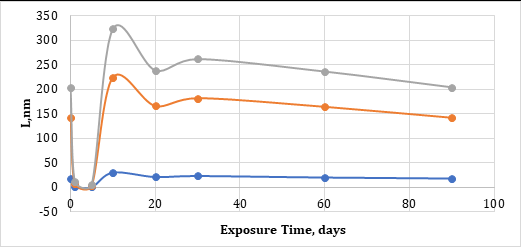
For instance, Figure 1 illustrates the growth (L) of the biofilm as a function of exposure time of a carbon steel sample in seawater, in a nanometer scale. The L values of the biofilm were obtained from the value of the AC impedance of the interface between the sample and the seawater, at 18oC during the 90 days exposure of the sample to the seawater, November-February [5].
References
-
Baboian R (1977) Electrochemical technique for corrosion Houston TX: NACE, pp: 58.
-
ASTM (1984) Standard Test Method for Measurement of Impedance of Anodic Coating on Aluminum. Annual Book of ASTM standards, B457-67, pp: 179-181.
-
Habib K, Al-Sabti F, Al-Mazedi H (1997) Optical Corrosion Meter. Optics and Lasers in Engineering 27(2): 227-233.
-
Habib K (1997) Interferometric Sensor for Electrochemical Studies of Metallic Alloys in Aqueous Solution. Optical Review 4(2): 324-328.
-
Al-Muhanna K (2019) Nanometer growth of marine bio-films of different metallic alloys in seawater by electrochemical impedance spectroscopy. AIP Advances 9: 045026.
- Solution-Processed Chiral Perovskites for Biomedical Applications
- Nanotechnology in Health Chemistry and Medicine: Current Challenges and Future Directions
- Human Exposure to Micro- and Nanoplastics: Pathways, Toxicity, and Intervention Strategies
- Exosome Nanomedicine for Cancer Therapy
- Micro and Nanoplastics–Plastisphere, Biotoxicity, Impact on Human Health, and Mitigation Strategies
- Process Validation of Cefixime Powder for Suspension Dosage Form, 50 mL