
Reconfigurable Nanoparticle Assemblies
One of the nanotechnology aims is to develop reconfigurable micrometer-scaled electronic devices. Their reconfiguration would switch their desired functionality, leading to a controllable multiple-action device. One could achieve this goal by exploiting the nonlinear behavior of relatively simple systems, which allows them to display their rich complexity. Below we illustrate this feature by using as a base material seemingly “boring” nematic liquid crystal (LC) phase [1], which is famous for revolutionizing the display market.
Opinion
One of the nanotechnology aims is to develop reconfigurable micrometer-scaled electronic devices. Their reconfiguration would switch their desired functionality, leading to a controllable multiple-action device. One could achieve this goal by exploiting the nonlinear behavior of Opinion relatively simple systems, which allows them to display their rich complexity. Below we illustrate this feature by using as a base material seemingly “boring” nematic liquid crystal (LC) phase [1], which is famous for revolutionizing the display market.
For demonstration purpose, we use thermotropic LCs consisting of rod-like molecules [1]. Their orientational order could be well described by the nematic director field.
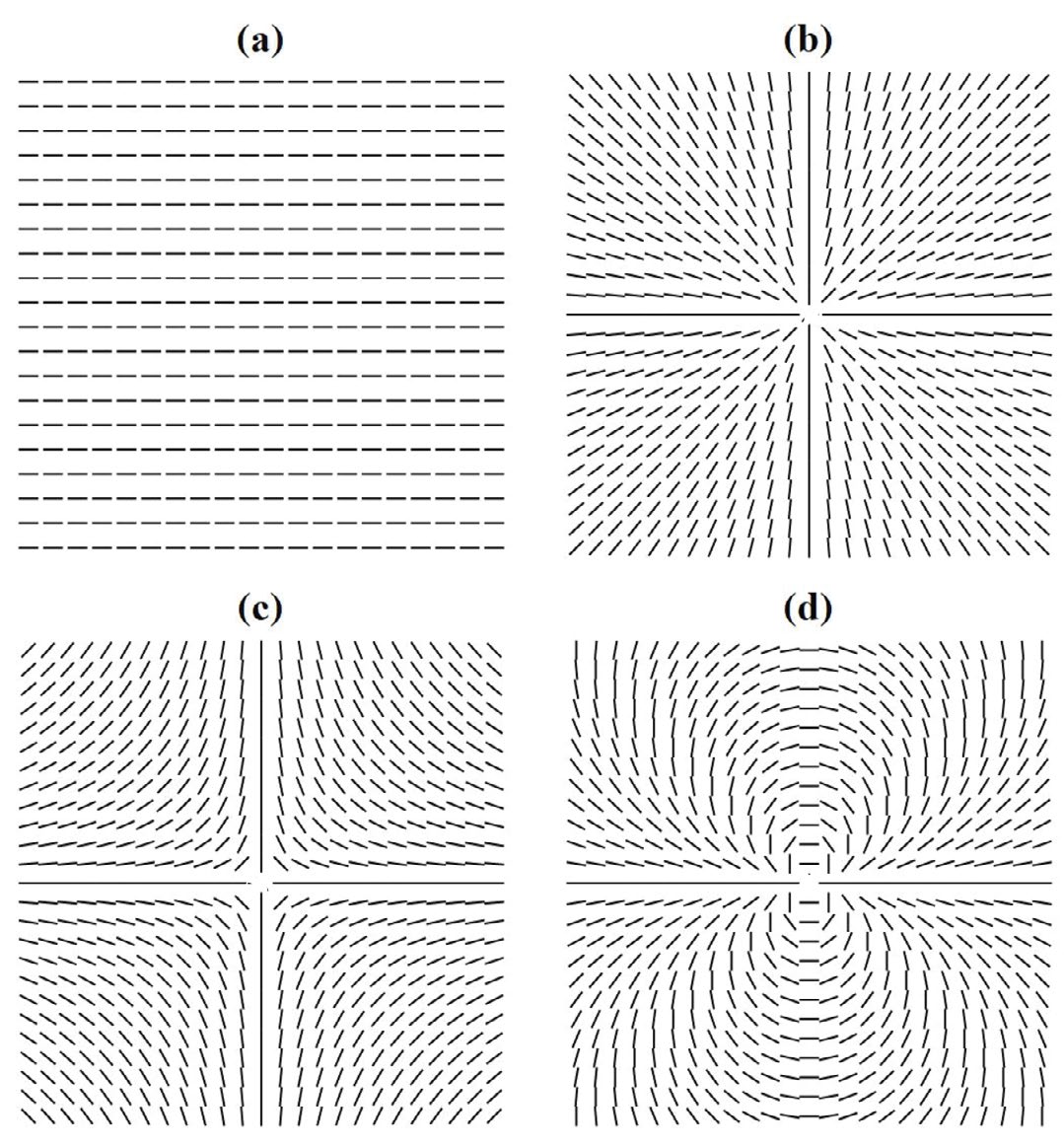
This continuum field points along local average molecular orientation, while the molecules are allowed to flow. The director field exhibits the so-called head-to-tail invariance, and the states are physically identical. The degree of NLC order is measured by the nematic order parameter s. Therefore, for s=0 the field is absent (“melted”). In bulk equilibrium nematic phase, and s are spatially homogeneous and is aligned along a single symmetry breaking direction, as illustrated in Figure 1a. Such an order is stable in a temperature interval below the critical temperature. Above it, LC enters isotropic (ordinary liquid phase), where s=0. In commercial LCs, the nematic phase is stable at room temperatures.
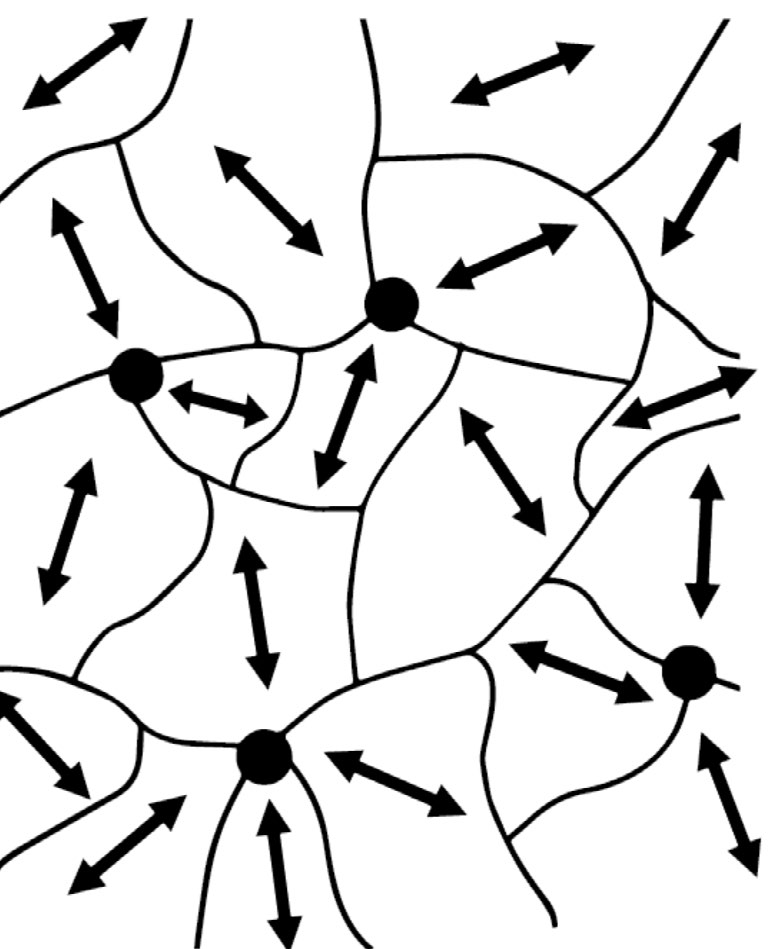
However, one could invoke excitations in the nematic phase, embodied in topological defects [2]. For example, in a simple planar two-dimensional (x,y) system, where nematic elasticity is approximated by a single elastic constant [1], the Euler-Lagrange equation determining possible configurations is given by A possible solution to this equation reads where , is the so-called winding number and is a constant. Solutions for k=0 correspond to homogeneous nematic structures, aligned along see Fig. 1a. On the other hand solutions for correspond to topological point defects (TDs) [2], localized at the origin of the Cartesian system (x,y). Some of these structures are depicted in Figure 1b-1d. Each isolated TD is for a fixed boundary condition topologically stable. Furthermore, pairs {k>0,-k} are referred as {defect, antidefect}, because they could annihilate each other. An example of a pair {1_,-_1} is shown in Figure 2.
Note that the presence of these defects is energetically expensive and their local free energy penalty scales as Consequently, “elementary” excitations, characterized by, are most commonly formed if the system is excited. Furthermore, in two dimensions k plays the role of topological charge [2, 3], which is a conserved quantity. Topological defects in many ways interact similarly as familiar electric charges: in general, like charged TDs repel, oppositely charged attract and there is strong energy-driven tendency to form neutral (chargeless) configurations. In three dimensions (3D) in addition to point defects also line defects are formed which are characterized by relevant 3D topological charge [2]. Note that the physics of TDs exhibits due to its topological origin several universalities and is consequently of interest for all branches of physics, i.e., in addition to different condensed matter systems also for particle physics and cosmology [4]. For example, TDs in appropriate fields might play the role [5] of “fundamental particles” if these fields represent a fundamental entity of nature [6].
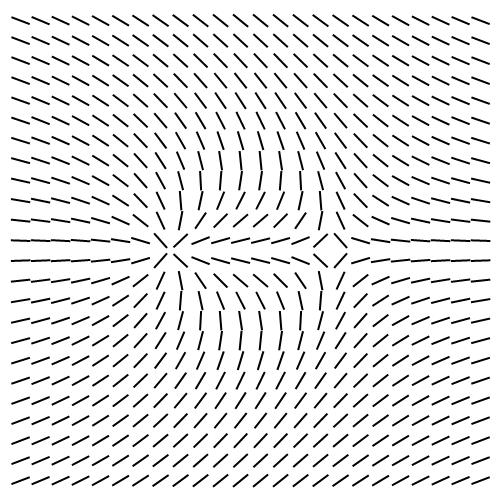
Figure 3: Domain type pattern of a system. Double arrows indicate average orientation within domains. Black dots correspond to topological defects where orientational order is not uniquely defined. In bulk, such a configuration gradually transforms into a defectless state. A possible final configuration is shown in Figure 1a. The domain growth is enabled via the annihilation of pairs {defect, antidefect}.
How TDs could be formed and stabilized in a LC which is, for example, confined within a plane-parallel cell? One way is to quench fast enough LC from the isotropic phase below In this event a dense tangle of point and line defects form due to the universal Kibble-Zurek mechanism [4, 7] (which was originally developed in cosmology [8] to understand coarsening dynamics in the Higgs field in the early universe following the big bang). Namely, if the symmetry breaking isotropic-nematic phase transition is enforced fast enough, then separated regions do not have time to communicate [4]. Consequently, in them, the symmetry is in general broken in different directions. As a result, transient domain-type structures are formed [7, 9] as schematically shown in Figure 3. In each domain, LC molecules are roughly aligned along the same direction and the orientational mismatch between neighboring domains is resolved by TDs, localized at domain boundaries. With time the average domain length grows
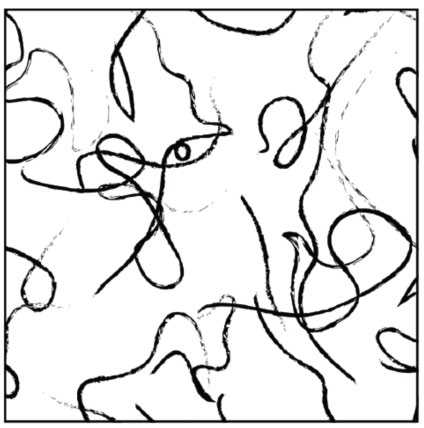
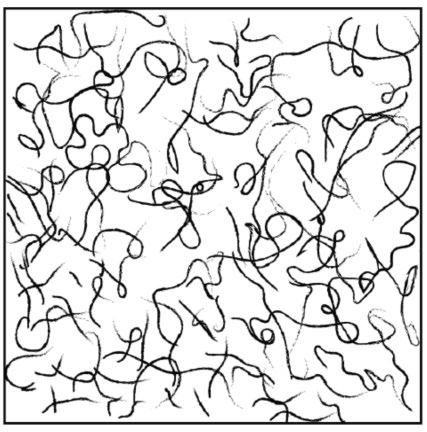
Figure 4: Schematic picture of structures at different times after a sudden isotropic-nematic phase transition, which are commonly characterised by the characteristic linear domain lengthξ_d. The lines indicate positions of line TDs. Such structure are typically visible using optical microscopy. With time ξ_d grows towards infinity in bulk samples without pinning impurities. A possible orientational order of the final structure is shown in Figure 1a.
However, there exist different mechanisms using which diverse patterns of TDs could be stabilized in a LC confined within a simple planar cell. One of them is to use chiral LCs or chiral dopants [10]. Strong enough chirality and appropriate LC elasticity could stabilize the so-called double twist local structures, whose existence topologically requires a lattice of line defects, which are locally characterized by the winding number k=-1/2. Note that this mechanism works also in bulk samples. Furthermore, diverse configurations of TDs could be stabilized via appropriate patterning of LC confining plates [11, 12, 13]. Finally, they might be enforced by strong enough curvature (e.g., egg carton-like surface) of confining plates. Namely, recent studies in 2D systems reveal [14, 15] that TDs exhibiting a positive topological charge are attracted to “bumps” and negative charges to “saddle- type” regions between them. Using these techniques one could establish conditions for which diverse competing and switchable defect patterns are possible. These could be robustly mutually reconfigured using, e.g., an appropriate electric field pattern [16, 17, 18, 19].
These patterns of TDs represent attractors for appropriately surface decorated nanoparticles (NPs). Namely, NPs trapped within cores od defects partially replace a relatively energetically expensive core with their volume [20, 21]. If a dense enough concentration of NPs is assembled within a line defect [22], it effectively acts as a conducting wire. Therefore, via line defect manipulation one could indirectly orientationally reconfigure the [7, 9], which is enabled by the annihilation of defects. Typical patterns are schematically shown in Figure 4. In bulk, all defects would eventually mutually annihilate, and the system would terminate in a defectless homogeneous nematic order, shown in Figure 1A.
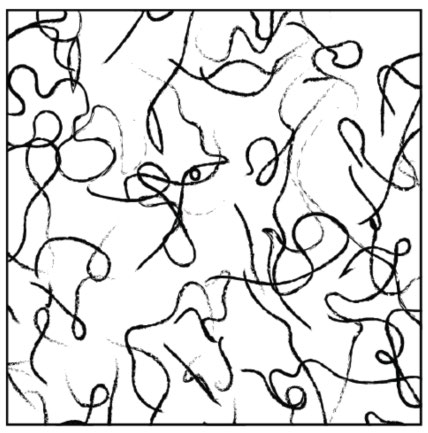
effectively linear assembly of trapped NPs. This could lead to the technology of rewirable micron-sized conducting wires. Chirality and different surface imposed methods of stabilization of diverse organized patterns of TDs and trapping of appropriately surface decorated NPs within them are relatively well understood and experimentally proven in different LC systems. The next step is to master defect- driven reassembling of NPs, which is at the moment in the pioneering stage.
References
-
Kleman M, Lavrentovich OD (2004) Soft Matter Physics: An Introduction.
-
Lavrentovich OD (1998) Topological defects in dispersed words and worlds around liquid crystals, or liquid crystal drops. Liq Cryst 24(1): 117-126.
-
Mermin ND (1979) The topological theory of defects in ordered media. Rev Mod Phys 51: 591.
-
Zurek WH (1985) Cosmological experiments in superfluid helium? Nature 317: 505-508.
-
Skyrme THR (1962) A unified field theory of mesons and baryons. Nucl Phys 31: 556-569.
-
Hobson A (2013) There are no particles, there are only fields. Am J Phys 81: 211-223.
-
Chuang I, Durrer R, Turok N, Yurke B (1991) Cosmology in the Laboratory: Defect Dynamics in Liquid Crystals. Science 251(4999): 1336-1342.
-
Kibble TWB (1976) Topology of cosmic domains and strings. J Phys A Math Gen 9(8): 1387.
-
Bradač Z, Kralj S, Žumer S (2002) Molecular dynamics study of isotropic-nematic quench. Phys Rev E 65: 021705.
-
Meiboom S, Sethna JP, Anderson PW, Brinkman WF (1981) Theory of the blue phase of cholesteric liquid crystals. Phys Rev Lett 46: 1216.
-
Murray BS, Pelcovits RA, Rosenblatt C (2014) Creating Arbitrary Arrays of Two-Dimensional Topological Defects. Phys Rev E 90: 052501.
-
Yoshida H, Asakura K, Fukuda J, Ozaki M (2015) Three- Dimensional Positioning and Control of Colloidal Objects Utilizing Engineered Liquid Crystalline Networks. Nat Commun 6: 7180.
-
Guo Y, Jiang M, Peng C, Sun K, Yaroshchuk O, et al. (2016) High-Resolution and High-Throughput Plasmonic Photopatterning of Complex Molecular Orientations in Liquid Crystals Adv Mater 28: 2353.
-
Bowick M, Nelson DR, Travesset A (2004) Curvature- Induced Defect Unbinding in Toroidal Geometries. Phys Rev E 69(4): 041102.
-
Mesarec L, Góźdź W, Iglič A, Kralj S (2016) Effective topological charge cancelation mechanism. Sci Rep 6: 27117.
-
Harka S, Murray BS, Rosenblatt C, Kralj S (2020) Electric field-driven reconfigurable multistable topological defect patterns. Phys Rev Research 2: 013176.
-
Sasaki Y, Jampani VSR, Tanaka C, Sakurai N, Sakane S, et al. (2016) Large-Scale Self-Organization of Reconfigurable Topological Defect Networks in Nematic Liquid Crystals. Nat Commun 7: 13238.
-
Gwag JS, Kim YK, Lee CH, Kim JH (2015) Realization of Multi-Stable Ground States in a Nematic Liquid Crystal by Surface and Electric Field Modification. Sci Rep 5: 11368.
-
Tai JSB, Smalyukh II (2019) Three-Dimensional Crystals of Adaptive Knots. Science 365(6460): 1449-1453.
-
Kikuchi H, Yokota M, Hisakado Y, Yang H, Kajiyama T (2002) Polymer-stabilized liquid-crystals blue phases. Nature Mater 1(1): 64.
-
Karatairi E, Rožič B, Kutnjak Z, Tzitzios V, Nounenis G, et al. (2010) Nanoparticle-Induced Widening of the Temperature Range of Liquid-Crystalline Blue Phases. Phys Rev E 81: 041703.
-
Coursault D, Grand J, Zappone B, Ayeb H, Levi G, et al. (2012) Linear Self‐Assembly of Nanoparticles Within Liquid Crystal Defect Arrays. Adv Mater 24(11): 1461- 1465.
- Solution-Processed Chiral Perovskites for Biomedical Applications
- Nanotechnology in Health Chemistry and Medicine: Current Challenges and Future Directions
- Human Exposure to Micro- and Nanoplastics: Pathways, Toxicity, and Intervention Strategies
- Exosome Nanomedicine for Cancer Therapy
- Micro and Nanoplastics–Plastisphere, Biotoxicity, Impact on Human Health, and Mitigation Strategies
- Process Validation of Cefixime Powder for Suspension Dosage Form, 50 mL