
Impact of COVID -19 on Mental Health of Expectant Mothers and Foetus in India
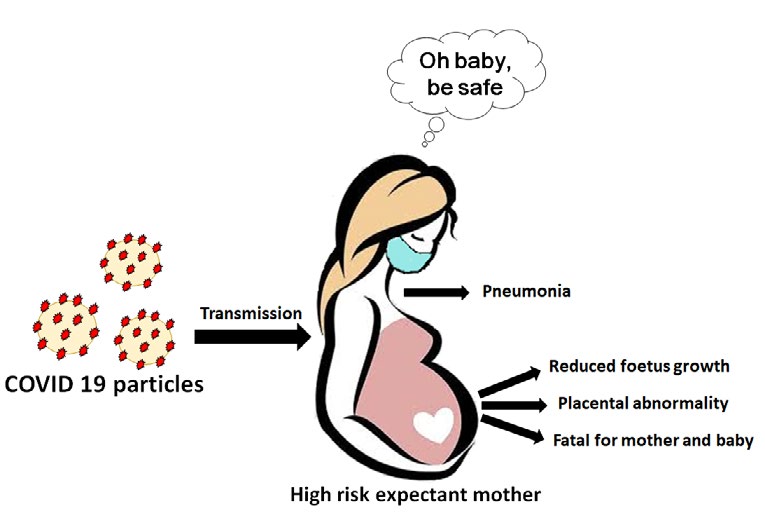
The novel coronavirus emerged in the later 2019 is a global crisis affecting the economy and having serious mental implication on humans. The people falling under younger (0-10 yrs.) and older (>55 yrs.) age group are at increased risk of contracting the disease. Also, the number of COVID- 19 affecting the pregnant women is increasing with having greater morbidity and mortality among them. Therefore, a thorough understanding on effect of coronavirus on foetal development and abnormalities of placenta function and its impact on mental health of expectant mother is reviewed in this communication.
Introduction
Brief Epidemiology of the Outbreak
COVID-19 pandemic is a serious threat to 213 countries throughout the globe having major effect on the economy and mental impact of the humans. The first outbreak was reported in Wuhan city of China towards the end of 2019. In India, the first reported case was in January 30, 2020 in Kerala and since then there is a slow increase of corona affected population in major cities like Mumbai, Chennai and Delhi. The spread of the virus began due to the migrants and tourists from other countries. According to the Ministry of Health and Family Welfare, Government of India (MoHFW) there is 50% recovery rate of total cases and is equal to the active cases at a given time point. It is considered less severe in India compared to other countries like US, Italy, Spain and Russia especially because of higher recovery rate.
As the Covid-19 infection develops severe acute respiratory distress syndrome (SARS) and causes sever pneumonia by binding effectively to the Angiotensin- converting enzyme 2 (ACE 2) receptor of lungs. It is due to structural modification of spike protein when compared to other coronaviruses. The effect of SARS-CoV-2 is generally asymptomatic and develops mild to severe symptoms within 14-20 days of exposure [1]. Recently, pregnant women were also warned of having greater risk for novel corona virus. This is because of the potential of Covid-19 virus to cause abnormalities in the placenta leading to cut in the blood supply to the growing foetus. FDA approved drugs like hydroxychloroquine as emergency medicine to treat corona positive cases but was not proved to be effective on virus in any report [2]. The hunt for vaccine development in still on in almost all countries against the COVID-19 virus. Due to the increases in number of COVID-19 cases in India, the chance of pregnant women exposure to the virus is relatively high. The high risk expectant mothers are urged to take all the necessary precautions to stay away from the infection.
Impact on Growing Foetus
The placenta is an important structure developed during early pregnancy in mammals and maintained until delivery for nourishing the developing foetus. It helps in supplying oxygen, nutrients and also in removing waste from the foetus via an umbilical cord. Any infection causing damage to the placenta deprives the foetus from essential nutrition from mother. This has a serious effect on development and growth of the foetus sometimes resulting in stillbirth. Many corona positive expectant mothers had reduced foetal growth due to unknown reason at the late stage urging for premature delivery or induced delivery [3].
Mental Health of Pregnant Women
According to (MoHFW) the active cases of COVID 19 is around 0.01% of the total population of India. A study carried out in Washington state on COVID-19 impact on health of pregnant women states that 15% showed severe COVID-19 and all were found to be overweight or obese with complication of gestational diabetes and high blood pressure [4]. The pregnant women are usually considered to be immune compromised to avoid the growing foetus from rejection and thus the rates of infection susceptibility are higher.
Conclusion
The reported cases of COVID 19 positive pregnant women in India are probably in their second or third trimester. This has led to an increased fear and stress among the expectant mothers affecting mentally. As several state governments in India announced certain relaxation in the activity during lockdown 5.0. People who were caged at home past 2 months showed up on streets without general precautions like wearing masks and maintaining social distancing announced by the Indian government [5]. All such activities make susceptible age groups of population to be more prone and exposed to the virus which may lead to serious spread in the second wave. Also due to increasing cases of novel corona, many hospitals lack basic isolation ward facility and denies admission to pregnant women for labor. This projected via media increases constant worries in the mind of expectant mothers about the safety of herself and unborn baby. The only way to stay away from contracting the infection is to follow all the necessary precautions recommended by Indian Government and WHO. The precaution include wearing mask, washing hands frequently, avoiding public gatherings, sanitizing all the store brought items, maintaining social distancing even at home and telephonic enquiry to the gynaecologist unless any emergency. By following the above actions, contraction of the virus can be avoided and high risk expectant mothers can still be safe by delivering the baby safely.
References
-
Krishnakumar B. Rana S (2020) COVID 19 in INDIA: Strategies to combat from combination threat of life and livelihood. Journal of Microbiology, Immunology and Infection 53(3): 389-391.
-
Pastick KA, Okafor EC, Wang F, Lofgren SM, Skipper CP, et al. (2020) Hydroxychloroquine and chloroquine for treatment of SARS-CoV-2 (COVID-19). Open Forum Infectious Diseases, 2020. Oxford University Press US 7(4): 130.
-
Dória M, Peixinho C, Laranjo M, Varejão AM, Silva PT (2020) Covid-19 during pregnancy: a case series from an universally tested population from the north of Portugal. European Journal of Obstetrics and Gynecology and Reproductive Biology 250: 261-262.
-
Lokken EM, Walker CL, Delaney S, Kachikis A, Kretzer NM, et al. (2020). Clinical Characteristics of 46 Pregnant Women with a SARS-CoV-2 Infection in Washington State. American Journal of Obstetrics and Gynecology.
-
Singh AK, Misra A (2020) Herd Mentality, Herds of Migrants/people, and COVID-19 in India. Diabetes & Metabolic Syndrome 14(4): 497.
- Solution-Processed Chiral Perovskites for Biomedical Applications
- Nanotechnology in Health Chemistry and Medicine: Current Challenges and Future Directions
- Human Exposure to Micro- and Nanoplastics: Pathways, Toxicity, and Intervention Strategies
- Exosome Nanomedicine for Cancer Therapy
- Micro and Nanoplastics–Plastisphere, Biotoxicity, Impact on Human Health, and Mitigation Strategies
- Process Validation of Cefixime Powder for Suspension Dosage Form, 50 mL