
Computational Modelling of Carbon Nanocapsule with Nanotube and Fullerene C60
This work intends to develop procedures for the design of carbon nanocapsule with nanotube and fullerene C60. The simulations take place to show the basic and functional structures of carbon allotropes and its uses. The aim of the investigation is computational modelling of nanocapsule with the nanotube and fullerene C60. The nanocapsule consists of locking chamber and storage area. The computational modelling has done by Atomistix Virtual NanoLab. The step by step procedure is explained and executed. The result revealed that capping of carbon nanotube and carbon nanocapsule are simulated in an effective computational manner using Atomistix Virtual NanoLab.
Introduction
Nanotechnology is defined as the study and use of structures between 1 nanometre and 100 nanometres in size. To give you an idea of how small that is, it would take eight hundred 100 nanometre particles side by side to match the width of a human hair. While this is the most common definition of nanotechnology researchers with various focuses have slightly different definitions [1]. The role of computational nanotechnology has become critically important in nanotechnology development. The length and time scales of nanoscale systems and phenomenon have shrunk to where we can directly address them with computer simulations and theoretical modeling with high accuracy. The rapidly increasing computing power used for large-scale and high-fidelity simulations make it increasingly possible for nanoscale simulations to be also predictive [2]. Computational nanotechnology is emerging as a fundamental engineering analysis tool for novel nanodevice design in the way that continuum finite-element analysis has been used for designing and analyzing most engineering systems [3]. In this paper a computational modelling of carbon nano capsule is simulated using Atomistix Virtual NanoLab trail version. The nano capsule is well known but it’s not visible to our eyes this computational process will be a platform to visualize how Nanotechnology concepts are used in various applications.
Atomistix Virtual NanoLab
With its graphical interface, Virtual NanoLab provides a user-friendly approach to atomic-scale modelling. The software contains a set of interactive instruments that allows the user to design nano systems, to set up and execute numerical calculations, and to visualize the results. Samples such as molecules, nanotubes, crystalline systems, and two- probe systems are built with a few mouse clicks.
Virtual NanoLab contains a 3D visualization tool, the Nanoscope, where atomic geometries and computed results can be viewed and analysed. One can for example plot Bloch functions of nanotubes and crystals, molecular orbitals, electron densities, and effective potentials. The numerical engine that carries out the actual simulations is Atomistix ToolKit, which combines density functional theory and non-equilibrium Green’s functions to ab initio electronic- structure and transport calculations. Atomistix ToolKit is developed from the academic codes TranSIESTA [4] and McDCal [5].
Materials and Methods
Capping a Nanotube
In order to create a nano capsule, as a first step one side of the tube should be caped then the other side. This section elaborates the procedure to cap a nano tube with C60. Procedures to Follow Start virtual Nano lab open the builder. • Go to stash click add from plugins > Nanotube.
• Use Bulk Tools>Repeat to extend the structure 10 times in the C-direction. Press Crtl+R to see the whole structure properly.
• Finally, remove the unit cell by clicking the molecule converter which will convert the structure into a molecule.
• Insert a C60 molecule by clicking Add>Add from Database, and choose Databases>Fullerenes from the menu. Locate C60 in the list and add it to the stash.
• Cut the portion of C60 which matches the tube exactly.
• Select three carbon atoms from the fullerene two from same pair and another one from other pair and convert it into Nitrogen.
• Double click the nanotube in the stash and select three carbon atoms two from same pair and another one from other pair and convert it into oxygen.
• Then drag the C60 to the window, now by clicking the first nitrogen atom and drag it in to the oxygen atom do it for other two also then click fuse in the move tool.
• Open> select click close neighbors, enter the threshold value as 0.7A and click select then delete.
• Change the entire atom to carbon by using the periodic table.
• To optimize the caped tube > select the cap and few more atoms from the tube and click coordinate tools> quick optimizer and change the maximum steps to 100 and click run.
Carbon Nano Capsule
Once the one end of a carbon nano tube is capped, to make it as a capsule other end should also be capped. In order to cap the other end, repeat the step 9 to 12 at the other end of the nano tube to form a capsule.
Results and Discussion
Finally, the simulation results show that the computational modelling has done by Atomistix Virtual NanoLab. The result clearly shows the computational modelling of nanocapsule with the nanotube and fullerene C60 in Figure 1-4.
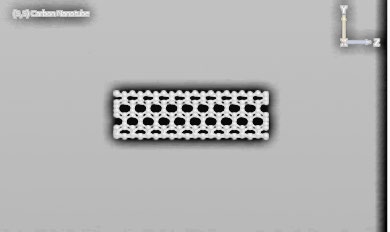
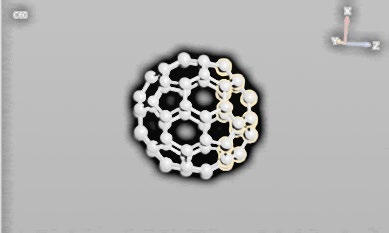
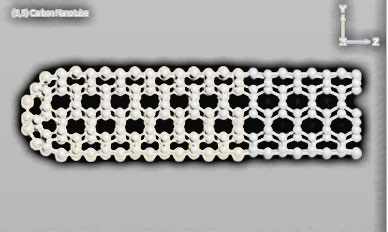
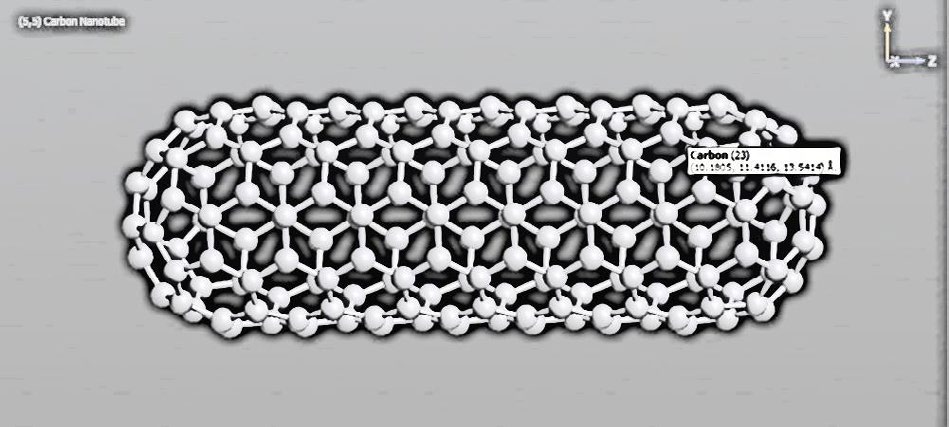
The nanocapsule discussed can retain the nanotube and fullerene C60 under normal conditions and meets the requirements of industrial use.
Conclusion
In this paper Capping of carbon nano tube and carbon nano capsule are simulated and the procedures are well explained. The outputs yielded are very useful for the budding researchers in the field of nanotechnology and its associated computational fields.
Acknowledgments
The authors would like to thank “Atomistix Virtual NanoLab” simulation commercial tool for the allowable free days trail pack to perform this research. This research was supported by various eminent computational scholars.
References
-
Whitesides GM (2005) Nanoscience, nanotechnology, and chemistry. Small 1(2): 172-179.
-
Srivastava D, Menon M, Cho K (2001) Computational nanotechnology with carbon nanotubes and fullerenes. Computing in Science & Engineering 3(4): 42-55.
-
Merkle RC (1991) Computational nanotechnology. Nanotechnology 2(3): 134.
-
Quantum ATK Atomic-Scale Modeling for Semiconductor & Materials.
-
Brandbyge M, Mozos JL, Ordejón P, Taylor J, Stokbro K (2002) Density-functional method for nonequilibrium electron transport. Physical Review B 65(16): 165401.
- Solution-Processed Chiral Perovskites for Biomedical Applications
- Nanotechnology in Health Chemistry and Medicine: Current Challenges and Future Directions
- Human Exposure to Micro- and Nanoplastics: Pathways, Toxicity, and Intervention Strategies
- Exosome Nanomedicine for Cancer Therapy
- Micro and Nanoplastics–Plastisphere, Biotoxicity, Impact on Human Health, and Mitigation Strategies
- Process Validation of Cefixime Powder for Suspension Dosage Form, 50 mL