
Kinetic Monte Carlo Study of Low Pressure Chemical Vapor Deposition SiNx Thin Films Deposit Phase
In the present study, we use a simulation program based on the kinetic Monte Carlo method able to describe the deposition process of nitrogen doped silicon films obtained by low-pressure chemical vapor deposition technique with a mixture of disilane and ammonia. A new pattern describing the ammonia molecules distribution in the simulation matrix allowed us via the kinetic Monte Carlo method to simulate the deposit phase of layers. The obtained results describe well the different stages of the nitrogen doped silicon deposition process. Indeed, an increase in the gas flow ratio leads to the formation of a high density of small amorphous silicon clusters
Introduction
The SiNx thin films are widely used for the production of silicon nanocrystals (Si-nc) [1, 2, 3], because the optical and electrical properties of this material are compatible with complementary metal oxide semiconductor CMOS technology. Indeed, silicon nanocrystals have attracted a great deal of attention owing to its potential nanoelectronic and optoelectronic device applications as well as their interesting physical properties [1]. Various fabrication techniques, such as plasma-enhanced chemical vapor deposition (PECVD) [4, 5], low-pressure chemical vapor deposition (LPCVD) [2, 3] and catalytic chemical vapor deposition (Cat-CVD) [1] have been examined for the fabrication of Si-nc in SiNx thin films. Moreover, the physical properties of these films [1, 2, 4] depend strongly on their deposition parameters (temperature, total pressure, gas flow ratio…). Consequently, the simulation of the deposit step plays an important role in defining the required properties of the obtained films. In this work, we investigate the influence of deposition parameter, namely gas flow ratio on the deposition process of SiNx thin films obtained by LPCVD technique by using a mixture between disilane (Si2H6) and ammonia (NH3) via the kinetic Monte Carlo (kMC) method. To simulate this process, we propose a new pattern for the distribution of the NH3 molecules in the simulation matrix that can model the formation of small amorphous silicon clusters.
Simulation Procedure
The deposition process of SiNx thin films has been simulated in the present work using the kinetic Monte Carlo method via a two-dimensional triangular lattice representing the surface structure of the film, as shown in Figure 1. We suppose that deposited molecules must have discrete positions in the simulation matrix. A fixed number of sites (N = 40,000) is available in the system. The diameter of the silicon atom is around 0.25 nm [6]. In the simulation, empty sites are chosen randomly from the matrix for the deposition of molecules. The deposition rate of each molecule is calculated as follows [7]:
− = T K E V V
a d d exp 0 (1)
B
Where the Vd0 parameter depends only on the deposition total pressure P and on the wafer-to-wafer distance δ, and the deposition activation energy Ea was estimated to be 2.25 eV [8]. KB is the Boltzmann’s constant and T is the deposition temperature.
![Figure 1: We suppose that deposited molecules must have discrete positions in the simulation matrix. A fixed number of sites (N = 40,000) is available in the system. The diameter of the silicon atom is around 0.25 nm [6]. In the simulation, empty sites are chosen randomly from the matrix for the deposition of molecules. The deposition rate of each molecule is calculated as follows [7]:](/fulltextimages/7655/fig_1.png)
The number of nearest neighbors of a deposited particle ranges from zero to six in the triangular lattice. A particle with six nearest neighbors is considered stable. This particle cannot migrate because it is fully surrounded by other particles in all directions. However, a particle having less than six nearest neighbors is considered unstable and it becomes subject to migration. This particle jumps to its most stable neighboring unoccupied site. The expression of the migration rate of the ith particle is defined as follows [6]:
− = T K E n r i i m 0 0 , exp υ (2)
B
Where ʋ0 is a pre-exponential factor, ni the number of the nearest neighbors of the ith particle, and E0 the contribution to the activation energy barrier. In this paper, the pre-exponential factor and the activation energy barrier contribution take the following values ʋ0 = 1013 s-1 and E0 = 0.6 eV [9].
Noticing that deposition and migration events are executed instantaneously upon selection and sites for both events are chosen randomly from the simulation matrix.
The technique of KMC is used to simulate the deposit step of SiNx thin films on a matrix of (200 x 200) sites. All molecules are assumed to occupy discrete lattice sites.
During the simulation, the NH3 molecules distribution in the matrix of simulation does not take a random aspect. In our approach, each of the NH3 molecules must occupy one random nearest neighbor site of each silylene (SiH2) site, as it is illustrated in Figure 1. Thus, two neighbor SiH2 molecules become isolated from each other that allow the SiNx thin film growth. As a result, a nitrogen compound is created with the formation of strong Si-N bonds. Furthermore, by increasing the number of NH3 molecules introduced into the simulation matrix; the SiH2 sites become increasingly isolated from each other preventing the coalescence phenomenon (the NH3 molecules will occupy all the nearest neighbor sites of each SiH2 site). Consequently, the deposition of amorphous silicon clusters with small sizes can be simulated using KMC method. Noticing that, hydrogen atoms are omitted from the matrix during the simulation.
Results and Discussion
We applied our approach to simulate the deposit step of SiNx thin films obtained by LPCVD technique. A mixture between Si2H6 and NH3 was used as the source gas. The films were deposited at low temperature (723 K), while the total pressure P was set constant at 26.66 Pa [2]. The gas flow ratio R (defined as R = f(NH3) / f(Si2H6) where f(NH3) is NH3 flow and f(Si2H6) is Si2H6 flow) was chosen to be the main influent parameter ranging from 0.18 to 4. All films were deposited at total surface coverage.
The evolution of the surface structures of the SiNx thin films prepared at R = 0.18, 1, 2 and 4, respectively, is shown in Figure 2. Thus, an increase in the gas flow ratio values provokes an increase in the amorphous silicon clusters density combined with a decrease in their sizes, as shown in Figure 3, in good agreement with the experimental results [2].
![Figure 2: Thus, an increase in the gas flow ratio values provokes an increase in the amorphous silicon clusters density combined with a decrease in their sizes, as shown in Figure 3, in good agreement with the experimental results [2].](/fulltextimages/7655/fig_2.png)
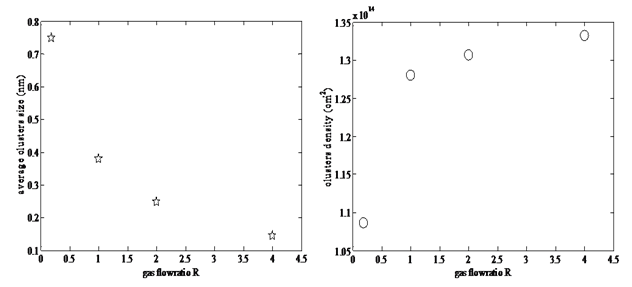
For these results, the corresponding amorphous silicon nanoclusters sizes were calculated to be around 0.7 nm, 0.4 nm, 0.2 nm and 0.1 nm, respectively. Therefore, the KMC simulation results suggest that the control of the source gas composition was effective in changing the amorphous nanoclusters size in the low temperature (723 K) process and that deposition of films characterized by high density of small amorphous silicon nanoclusters was possible using this size control.
During the simulation, each of the NH3 molecules must occupy one random nearest neighbor site of each SiH2 site preventing the coalescence between two neighbor SiH2 molecules. Thus, by increasing the gas flow ratio values (increase in the number of NH3 molecules introduced into the simulation matrix); the SiH2 sites become increasingly isolated from each other leading to a reduction in the size of amorphous silicon clusters.
Noticing that, the size value represents an average size of all amorphous silicon clusters. The average size (or the average radius) is determined by dividing the sum of all amorphous silicon clusters sizes by the total number of clusters existed in the film. The size of each cluster is obtained using the following steps: • First, a silicon site is selected randomly from the simulation matrix.
• Then, the number of its nearest neighbors which are occupied by silicon atoms is calculated (in our approach this number varies between zero and two).
• If this number is zero, a cluster is formed by only one silicon atom and its size is equal to the radius of this silicon atom.
• However, if this number is different to zero, the Monte Carlo algorithm of grain growth is used [10] to verify which sites can ensure the minimization of the energy of the selected site.
• After, we keep only the sites verified the last condition.
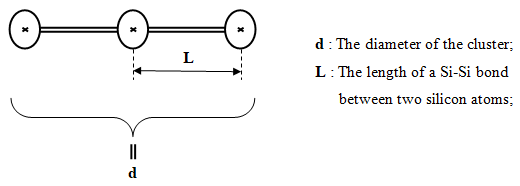
• Furthermore, only sites which are in the same line with the selected site are remained (see Figure. 4).
• Moreover, each cluster is assumed to be uniform.
• Finally, the diameter of each cluster is equal to the sum of the lengths of Si-Si bonds existed in the cluster and the diameter of a silicon atom (the radius = the diameter / 2).
Conclusion
In this study, the deposit step of SiNx thin films obtained by LPCVD technique at a temperature of 723 K using a mixture between disilane and ammonia has been simulated via the kinetic Monte Carlo method. The NH3/Si2H6 gas flow ratio was chosen to be the main influent parameter. The non-coalescence between silylene molecules caused by the presence of Si-N bonds has been modeled by using a new pattern for the distribution of the NH3 molecules in the simulation matrix. The size of the amorphous silicon clusters could be controlled by variation of NH3/Si2H6 mixture ratio in the source gas. Indeed, an increase in the gas flow ratio leads to an increase in the amorphous silicon clusters density combined with a decrease in their sizes.
Conflicts of Interest
The authors declare that they have no known competing financial interests or personal relationships that could have appeared to influence the work reported in this paper.
Credit Authorship Contribution Statement
Adil Bouhadiche: Investigation & Writing. Soulef Benghorieb: Investigation.
References
-
Lee KM, Kim TH, Hwang JD, Jang S, Jeong K, et al. (2009) Size control of silicon nanocrystals in silicon nitride film deposited by catalytic chemical vapor deposition at a low temperature (⩽200 °C). Scripta Mater 60(8): 703-705.
-
Bouridah H, Haoues H, Beghoul MR, Mansour F, Remmouche R, et al. (2012) Study of Silicon Nanocrystals Formation in Annealed Amorphous In Situ Nitrogen Doped Silicon Thin Films Obtained by Low Pressure Chemical Vapor Deposition. Acta Phys Pol A 121: 175- 177.
-
Haoues H, Bouridah H, Beghoul MR, Mansour F, Remmouche R, et al. (2013) Formation of silicon nanocrystals by thermal annealing of low-pressure chemical-vapor deposited amorphous SiNx (x=0.16) thin films. Mat Sci Semicon Proc 16(6): 1849-1852.
-
Zerga A, Carrada M, Amann M, Slaoui A (2007) Si- nanostructures formation in amorphous silicon nitride SiNx:H deposited by remote PECVD. Physica E 38(1): 21- 26.
-
Wang M, Li D, Yuan Z, Yang D, Que D (2007) Photoluminescence of Si-rich silicon nitride: Defect- related states and silicon nanoclusters. Appl Phys Lett 90: 131903.
-
Huang J, Orkoulas G, Christofides PD (2013) Porosity control in thin film solar cells. Chem Eng Sci 94: 44-53.
-
Temple Boyer P, Rousset B, Scheid E (2010) Influences of deposition and crystallization kinetics on the properties of silicon films deposited by low-pressure chemical vapour deposition from silane and disilane. Thin Solid Films 518(23): 6897-6903.
-
Temple Boyer P, Jalabert L, Couderc E, Scheid E, Fadel P, et al. (2002) Properties of nitrogen doped silicon films deposited by low pressure chemical vapour deposition from disilane and ammonia. Thin Solid Films 414(1): 13- 17.
-
Keršulis S, Mitin V (1995) Monte Carlo simulation of growth and recovery of silicon. Mater Sci Eng B 29(1-3): 34-37.
-
Huang CM, Joanne CL, Patnaik BSV, Jayaganthan R (2006) Monte Carlo simulation of grain growth in polycrystalline materials. Appl Surf Sci 252(11): 3997-4002.
- Solution-Processed Chiral Perovskites for Biomedical Applications
- Nanotechnology in Health Chemistry and Medicine: Current Challenges and Future Directions
- Human Exposure to Micro- and Nanoplastics: Pathways, Toxicity, and Intervention Strategies
- Exosome Nanomedicine for Cancer Therapy
- Micro and Nanoplastics–Plastisphere, Biotoxicity, Impact on Human Health, and Mitigation Strategies
- Process Validation of Cefixime Powder for Suspension Dosage Form, 50 mL