
Degradation and Kinetics Study of Enrofloxacin using Diperiodato Cuprate (III) in Alkaline Medium
The antibiotic enrofloxacin is vitiated in an alkaline medium with diperiodatocuprate (III), and the reaction is monitored using an Ultra Violet Spectrophotometer at a wavelength of 415 nm with constant ionic strength and dielectric constant. At room temperature, varying the oxidant concentration while keeping all other variables constant results in pseudo first order kinetics. The sequence of the reaction is determined by altering the concentration of the antibiotic enrofloxacin at four different temperatures and the results are used to compute thermodynamic and activation values. Activation parameter, entropy increases on achieving the transition state and followed dissociative mechanism. Feasible reaction mechanism is proposed based on the probable products of oxidation and the active species of reactants.
Introduction
Enrofloxacin is the medicine used in bacterial infection for the veterinary purpose [1]. It is a broad-spectrum antibiotic that comes under the fluoroquinolones group [1, 2] whereas the effect of this drug on viral infections and fungal infections or other parasites is nil. This drug destroys the bacterial cell by stopping the DNA synthesis process in the cell of bacteria. The infections of the skin, urinary tract, respiratory system, and the infections of wounds are treated by this drug. IUPAC name of this drug is 1-Cyclopropyl- 6-fluoro-7-(4-ethyl-1piperazinyl)-1, 4-dihydro-4-oxo-3- quinoline carboxylic acid [1, 2, 3, 4].
The purpose of selecting this drug is to study the behavior of Enrofloxacin with Diperiodato cuprate(III) a mild oxidizing agent, which was not available in the literature. Very few oxidation reactions have been carried out on this drug. This research aims to shed more insight on Diperiodato cuprate (III) oxidation behavior on Enrofloxacin and to propose a possible redox mechanism.
Diperiodato cuprate (III) is widely used to oxidise a variety of organic molecules, including medicinal products, and has a significant impact in the kinetics of a variety of carbon compounds and physiologically active chemicals [3].
Generally, this is effective oxidizing agent in alkaline medium. It is competent one electron oxidant for several aromatic compounds in basic medium. In aqueous medium the dipriodato cuprate (III) results in to restricted solubility and stability [3]. The applications of this oxidant is listed in the estimation of amino acids more over the reaction with alcohols leads to copper (II) complexes which catalyze the amino acid reactions. The complexes of periodate are trivalent and are extensively used in the degradation kinetics of the biologically active compounds [3].
**Experimental**
**Chemicals**
The chemicals employed in the experiment are of the reagent grade, and solution preparation is done using double distilled water throughout. Diperiodato cuprate (III), the oxidant utilized in the reaction, is produced and standardized according to the literature [2]. The progress of the reaction is monitored using a UV visible absorption spectrophotometer set to 415 nm. The drug stock solution is prepared in the double distilled water in alkaline medium by taking appropriate amount of Enrofloxacin. Sodium hydroxide solution of 1.0 x 10$^{-3}$ M is prepared and standardized.
**Instruments Used in the Experiment**
A CARY 50 Bio UV-Vis Spectrophotometer (Varian BV, The Netherlands) with a temperature regulation unit is used to measure the kinetics. An Elico pH metre type LI 120 is used to monitor pH levels.
**Kinetic Measurements**
The pseudo first order kinetics is used to conduct all experimental kinetic measurements.
To preserve pseudo first order kinetics, the medication concentration is kept ten times higher than the oxidant diperiodato cuprate concentration (III). The constant temperature and constant ionic strength is maintained throughout the experimental process. The reaction is started by mixing thermally stabilised diperiodato cuprate (III) with adequate concentrations of enrofloxacin medicine in an alkaline medium. The spectrophotometric absorption of light at 420 nm wavelength is used to track the reaction’s progress. Figure 4.1 depicts the spectrum shifts that occur during the reaction. Diperiodatocuprate (III) has a computed value of 6253 ±50 dm$^{-3}$ mol$^{-1}$ cm$^{-3}$ as a function of time. Up until 80% of the reaction is completed, kinetic data are taken.
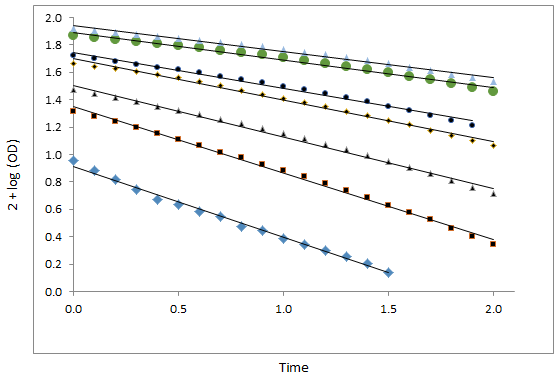
The $k_{obs}$ are noted and rate constant $k$ is calculated for the different readings, from the graph log absorption vs. time is drawn and $k$ calculated is linear which indicates the reaction in relation to diperiodatocuprate (III) is pseudo first order reaction. The numerical quantities which are calculated for $k_{obs}$ were reproducible in the range of ±2 percent error.
**Stoichiometry and Product Analysis**
Varied sets of molar concentrations of reactants in appropriate alkaline condition and ionic strength kept in the beaker for 24 hours in the room temperature in closed container, next day the kinetic readings are calculated and the stoichiometry of the reaction is found that is 1:1, for one mole of drug one mole of oxidant is required to degrade it completely. The stoichiometry of the reaction is explained in the following equation. The primary product created in the breakdown reaction of enrofloxacin is 7-amino-1-cyclopropyl-6-fluoro-4oxo-quinolone-3-carboxylic acid, which is the consequence of dealkalisation of the piperazine moiety, which leads to ring opening of piperazine, and ammonia and aldehyde as end products.
Results
By adjusting the concentrations of enrofloxacin, alkali, and periodate while leaving all other conditions constant, the order of reactions was estimated using the slopes derived from log kobs Vs log (concentration) plots.
**Oxidant Dependency**
Oxidant diperiodatocuprate (III) in the reaction is varied from 1.4 x 10$^{-5}$ to 1.3 x 10$^{-4}$. In other static conditions, the findings of this study and calculations show that the reaction follows a pseudo-first-order reaction with respect to the oxidant at a constant temperature. The linear graph is observed for the determined values.
**Dependency on Enrofloxacin Concentration**
According to scientific analysis and current literature, the rate of reaction increases as the drug concentration in the reaction mixture increases, indicating that the reaction is enrofloxacin-concentration dependent. The rate constant, $k$, of the reaction increases as the amount of the antibiotic enrofloxacin is increased between 1x10$^{-4}$ to 1.4x10$^{-3}$ mol dm$^{-3}$.
This demonstrates the reaction’s drug reliance. The graph of logk observed versus log [enrofloxacin] is plotted and the value of the slope calculated is less than one which determines the reaction is less than unit order dependent on the antibiotic drug enrofloxacin concentration.
Effect of Periodate and Alkali Concentration
By increasing the periodate quantity from 1.0x10-
4 to 1.0x10⁻³ mol dm-3 while retaining all other reactant proportions constant, the impact of periodate concentration was evaluated.
It was concluded that adding periodate hinders the reaction rate (Table 1). In terms of periodate intensity, the order is less than unity. An elevated level of alkali in the reaction mixture was probed, and it was encountered experimentally that an increase in alkali concentration is directly proportional to the rate of reaction, resulting in an increase in the value of k as the concentration of NaOH in the reaction mixture is increased. The order of [OH-] was shown to be less than unity.
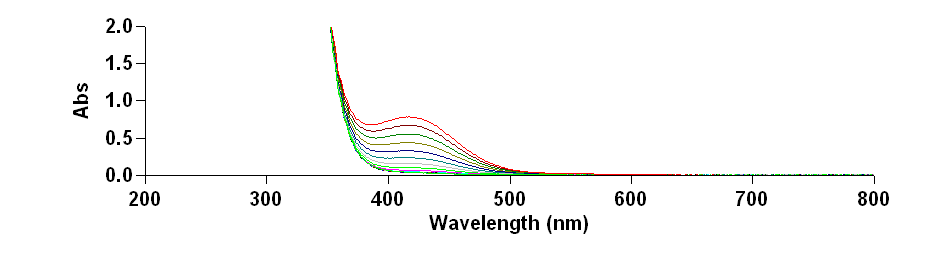
![Figure 2: Spectroscopic changes occurring in the degradation of Enrofloxacin by diperiodato cuprate (III) at 25○C([DPC] =3x10⁻⁵, [ENR] =1x10⁻⁴).](/fulltextimages/8996/fig_2.png)
Effect of Ionic Strength and Solvent Polarity
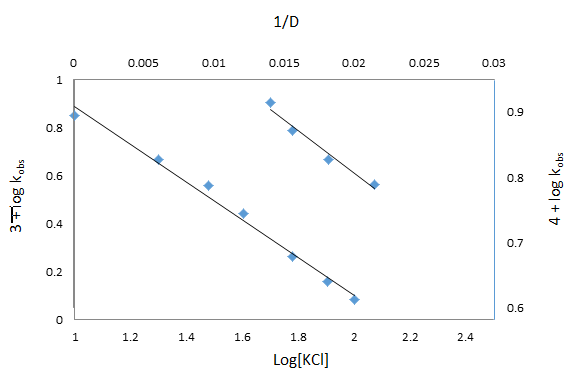
By varying the potassium nitrate solution in the range of 0.02 to 0.20 mol dm-3 while keeping the molar proportions of the other reactant molecules like enrofloxacin and DPC constant, it was discovered that an increase in the molar concentrations of potassium nitrate had no discernible effect on the rate of reaction. The effect of relative permittivity (D) was observed experimentally by varying the concentration of tertiary butanol and water content in the reaction mixture while retaining all other reaction conditions constant. A decrease in the reaction mixture’s dielectric constant had almost no significant effect on the reaction rate.
Effect of Temperature
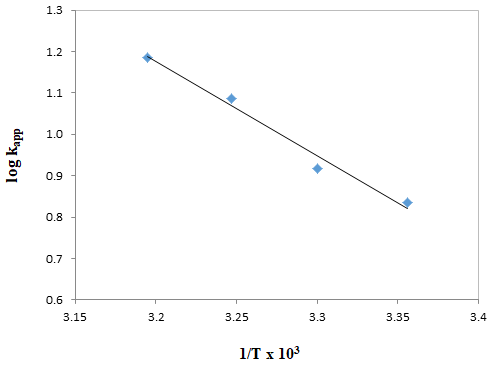
The effect of temperature modification on response rate was investigated by varying the temperature to 25, 30, 35, H4IO6 - + H+ H5IO6 H3IO6 2- + H+ H4IO6 - H2IO6 3- + H+ H3IO6 2- and 40 degrees. The temperature effect on enrofloxacin and alkali was explored by modulating the enrofloxacin and alkali quantities while keeping all other variables held constant.
It has been established that increasing the concentration of the reactant significantly enhances the rate of reaction. The slopes and intercepts of 1/kobs vs 1/[enrofloxacin] and 1/kobs versus 1/[OH-] have been used to calculate the slow step rate constant k1. The graph is designed with four unique temperatures in consideration.
Discussion
The diperiodatocuprate(II) a water soluble complex in alkaline medium at high pH exist in HIO6 4- as present in the complex. This is documented in several studies, which reveals that numerous equilibria emerge depending on the medium pH [3, 4].
(2) (3) (4)
| $[DPC] x 10^{5 Mol dm-3}$ | $[ENR]x10^{4 Mol dm-3}$ | $[OH^{-}]x10^{3 Mol dm-3}$ | $[IO_{4}]x10^{4 (mol dm-3) | $K_{obs x 102 s-1}$ | |
|---|---|---|---|---|---|
| 1.2 | 1 | 1 | 1 | 0.15 | |
| 1.4 | 1 | 1 | 1 | 0.14 | |
| 3.31 | 1 | 1 | 1 | 0.14 | |
| 4.8 | 1 | 1 | 1 | 0.14 | |
| 7.3 | 1 | 1 | 1 | 0.13 | |
| 8.7 | 1 | 1 | 1 | 0.12 | |
| 10.17 | 1 | 1 | 1 | 0.12 | |
| 1.2 | 1 | 1 | 1 | 0.15 | |
| 1.2 | 3 | 1 | 1 | 0.54 | |
| 1.2 | 6 | 1 | 1 | 0.64 | |
| 1.2 | 8 | 1 | 1 | 0.71 | |
| 1.2 | 10 | 1 | 1 | 0.73 | |
| 1.2 | 12 | 1 | 1 | 0.74 | |
| 1.2 | 14 | 1 | 1 | 0.76 | |
| 1.2 | 1 | 1 | 1 | 0.15 | |
| 1.2 | 1 | 2 | 1 | 0.24 | |
| 1.2 | 1 | 4 | 1 | 0.36 | |
| 1.2 | 1 | 6 | 1 | 0.44 | |
| 1.2 | 1 | 8 | 1 | 0.52 | |
| 1.2 | 1 | 10 | 1 | 0.61 | |
| 1.2 | 1 | 12 | 1 | 0.72 | |
| 1.2 | 1 | 1 | 1 | 0.15 | |
| 1.2 | 1 | 1 | 2 | 0.1 | |
| 1.2 | 1 | 1 | 4 | 0.07 | |
| 1.2 | 1 | 1 | 8 | 0.05 | |
| 1.2 | 1 | 1 | 10 | 0.04 |
Table 1: Effect of variation of DPC, enrofloxacin, periodate and alkali concentrations on the oxidation of enroflaxacin by DPC at
Activation Parameters
| PARAMETERS | VALUES |
|---|---|
| $E_{a (kJ mol^{-1}) | 45.86 ± 1 |
| $\Delta H^{\#}$ (kJ mol-1) | -2.51 ± 1 |
| $\Delta S^{\#}$ (kJ mol-1) | 933.1 ± 4 |
| $\ddot{A}G^{\#}$ (kJ mol-1) | -287.58 ± 3 |
Table 2: Activation and thermodynamic parameters of the oxidation of enrofloxacin by diperiodatouprate(III) in aqueous alkaline m
| Temperature(K) | K (dm3 mol-1) 1 | K (dm3 mol-1) 2 |
|---|---|---|
| 298 | 0.92 | 0.22 |
| 303 | 0.95 | 0.23 |
| 308 | 1.63 | 0.4 |
| 313 | 2 | 0.5 |
Table 3: Activation and thermodynamic parameters of the oxidation of enrofloxacin by diperiodatouprate(III) in aqueous alkaline m
Equilibrium Constants K1 and K2 at Different Temperatures
| Quantities | Using K values 1 | Using K values 2 |
|---|---|---|
| ∆H (kJ mol-1) | -2.6 | -2.6 |
| ∆S (JK-1mol-1) | -0.0147 | -4.29 |
| ÄG (kJ mol-1) | -2.5 | -2.5 |
Thermodynamic Quantities using K1 and K2 Values
Near pH 7 the periodic acid exists as H4IO6 -1and as H5IO6 -
1 in the acid medium. Under our experimental conditions, the main expected species are H3IO6 2- and H2IO6 3-. The earlier work shows that the soluble copper (III) periodate complex exists as diperiodatocuprate (III), [Cu(H3IO6)2 (OH)2]3- in little high pH.
In an alkaline medium, the diperiodatocuprate(III) complex and enrofloxacin reaction have the first-order dependency on [DPC], fractional-order on both [ENR] and [alkali], and a negative fractional order dependence on periodate. The simulation and experimental results were used to propose a plausible mechanism that accommodated all of the observed ordering in each reactant, such as [oxidant], [reductant], [OH-], and [H3IO6 2-].
The alkali effect on the reaction is explained by the equilibrium shown below [Cu(OH)2 (H3IO6)2]-3 + OH- k1 (5) [Cu(OH)2 (H3IO6) ( H2IO6)]4-+ H2O The order with respect to [H3IO62-] (Table 1) suggests that the equilibrium of Cu(III) periodate complex to form monoperiodatocuprate(III) (MPC) as given in Eq (6) is established. Such types of equilibria (5) and (6) have been noticed in literature [5].
These equations reveal that monoperiodatocuprate (III) is a key player in this reaction. Before the sluggish step, the reaction starts with the creation of a complex between oxidant species and enrofloxacin. The fractional order of enrofloxacin demonstrates this. The Michaelis-Menten plot, which depicts an intercept in agreement with complex formation, confirms this.
$$\text{Cu(OH)}_2(\text{H}_3\text{IO}_6)_2^+ + \text{HO}_2 + \text{Cu(OH)}_2 + \text{H}_3\text{IO}_6^{-2} + \text{CO}_2 + \text{Other products}$$
(7)
Complex[C]
(8)
Above scheme is used and proposed a following rate law
$$\text{Rate} = \frac{-d[\text{DPC}]}{\text{dt}} = k[\text{Complex(C)}]$$
$$= \frac{k K_1 K_2 K_3 [\text{ENR}][\text{OH}][\text{Cu(OH)}_2(\text{H}_3\text{IO}_6)_2]^{3-}}{[\text{H}_2\text{IO}_6]^{3-}}$$
The total [DPC] can be written as
$$[\text{DPC}]_t = \frac{[\text{H}_2\text{IO}_6]^{3-} + K_1 K_2 K_3 [\text{OH}][\text{ENR}] + K_1 K_2 [\text{OH}] + K_1 [\text{H}_2\text{IO}_6]^{3-}}{[\text{H}_2\text{IO}_6]^{3-}}$$
The free [DPC] is given by,
$$[\text{DPC}]_t = \frac{[\text{DPC}][\text{H}_2\text{IO}_6]^{3-}}{[\text{H}_2\text{IO}_6]^{3-} + K_1 K_2 K_3 [\text{OH}][\text{ENR}] + K_1 K_2 [\text{OH}] + K_1 [\text{H}_2\text{IO}_6]^{3-}}$$
Similarly, total [OH] can be calculated as,
$$[\text{OH}^-]_t = [\text{OH}^-]_t + [\text{Cu(OH)}_2(\text{H}_3\text{IO}_6)_2]^{4-} + [\text{Cu(OH)}_2(\text{H}_3\text{IO}_6)] + \text{Complex(C)}$$
$$= [\text{OH}^-]_t + \frac{K_1 K_2 [\text{OH}^-]_t [\text{Cu(OH)}_2(\text{H}_3\text{IO}_6)_2]^{4-} + K_1 [\text{OH}^-]_t [\text{Cu(OH)}_2(\text{H}_3\text{IO}_6)_2]^{3-}}{[\text{H}_2\text{IO}_6]^{3-}}$$
We can neglect 2nd, 3rd and 4th terms in the above Equation due to low concentration of DPC used. Therefore,
$$[\text{OH}^-]_t = [\text{OH}^-]_t + [\text{Cu(OH)}_2(\text{H}_3\text{IO}_6)_2]^{4-} + [\text{Cu(OH)}_2(\text{H}_3\text{IO}_6)] + \text{Complex(C)}$$
$$= [\text{OH}^-]_t + \frac{K_1 K_2 [\text{OH}^-]_t [\text{Cu(OH)}_2(\text{H}_3\text{IO}_6)_2]^{4-} + K_1 [\text{OH}^-]_t [\text{Cu(OH)}_2(\text{H}_3\text{IO}_6)_2]^{3-}}{[\text{H}_2\text{IO}_6]^{3-}}$$
Due to low concentration of DPC used, the 2nd term in the above Equation is neglected. Therefore,
$$[\text{ENR}]_t = [\text{ENR}]_t$$
In the above equations subscripts T and f refer to total and free concentrations respectively.
Merging equations (9),(10) and (11) in (8) and neglecting T and f we get
$$\text{Rate} = \frac{d[\text{DPC}]}{\text{dt}} = \frac{k K_1 K_2 K_3 [\text{ENR}][\text{DPC}][\text{OH}]}{[\text{H}_2\text{IO}_6]^{3-} + K_1 (\text{H}_3\text{IO}_6)^{2-} [\text{OH}]+ K_1 K_2 [\text{OH}]+ K_1 K_2 K_3 [\text{ENR}][\text{OH}]}$$
The verification and confirmation of the observed order has been done by rearranging the above equation as
$$\frac{1}{k_{\text{obs}}} = \frac{(\text{H}_2\text{IO}_6)^{3-}}{k K_1 K_2 K_3 [\text{ENR}][\text{OH}]} + \frac{(\text{H}_2\text{IO}_6)^{3-}}{k K_2 K_3 [\text{ENR}]} + \frac{1}{k K_3 [\text{ENR}]}$$
The reaction mixture is kept for 24 hours to undergo complete degradation under constant temperature and pressure. The basic medium is maintained throughout the experiment, the Cu$^{4+}$ ion oxidizes the enrofloxacin so as to form products, here intermolecular electron transfer takes place, and oxidation may take place at the piperazine ring [6, 7]. N dealkylation, hydroxylation, and hydrolysis bring the structural change in the piperazine ring [2, 8, 9, 10, 11, 12]. The flouroquinolone may remain structurally intact during the reaction [1, 12, 13, 14] the aromatic amine group can be oxidized to enamine [1, 12, 13, 14, 15, 16]. Formation of phenol and 7- amino-1-cyclopropyl-6- fluoro-4oxo-quinolone-3- carboxylic acid are noticed. 7- amino-1-cyclopropyl-6-fluoro-4oxo- quinolone-3- carboxylic acid is the major product formed in the degradation and ammonia and aldehydes and other products are the byproducts [1, 13, 14, 15, 16, 17]. Fluoroquinolone moiety remains intact in the structure which retains the antibacterial activity of the drug even after oxidation and the changes observed in the structure significantly improve the fluoroquinolone antibacterial activity [17, 18, 19, 20, 21]. The positive value of entropy of activation indicates that the activation complex is loosely formed and about to dissociate. In this case entropy increases on achieving the transition state and follows a dissociative mechanism. Low enthalpy of activation indicates that the reaction is fairly fast.
Conclusion
The drug enrofloxacin oxidizes easily in the alkyl medium and the fluoroquinolone moiety remains intact in the structure which retains the antibacterial activity of the drug even after oxidation. As per the interpretation of the fluoroquinolones –DNA model the cooperative binding of DNA gyrase, quinolone moiety containing carboxyl and keto groups show very important features in retaining antibacterial activity. The changes observed in the structure significantly improve the fluoroquinolone antibacterial activity. The other products formed in the reaction are not harmful to the domestic activities and higher molecules were degraded in to lower masses. And further according to the mechanism observed and the reactivity of the molecules this technique can be utilized for the purification of water resources and also can be applied to treat the industrial waste effluents.
References
-
Xu Y, Liu S, Guo F, Cui F (2015) Oxidation of Enrofloxacin with Permanganate: Kinetics and Multivariate effects, Identification of oxidation products and determination of antibacterial activity. Journal of chemistry.
-
Paul T, Dodd MC, Strathmann TJ (2010) Photolytic and Photocatalytic decomposition of aqueous ciprofloxacin: Transformation products and Residual antibacterial activity. Water research 44(10): 3121-3132.
-
Golet EM, Strehler A, Alder AC, Giger W (2002) Determination of fluoroquinolone antibacterial agents in sewage sludge and sludge-treated soil using accelerated solvent extraction followed by solid-phase extraction. Anal Chem 74(21): 5455-5462.
-
Williams R, Riviere JC (2003) Inside view: Anthrax contamination, response and mitigation. Chemical Health and Safety 10(1): 7-13.
-
Hiremath MI, Nandibewoor ST (2006) Kinetics and mechanism of ruthenium(III) catalyzed oxidation of L-proline by copper(III): A free radical intervention and decarboxylation. Russ J Phys Chem 80: 1029-1033.
-
Murthy CP, Sethuram B, Rao TN (1981) Kinetics of Oxidation of some Alcohols by Diperiodatocuprate(III) in Alkaline Medium. Z Phys Chem 262(2): 336-340.
-
Speltini A, Sturini M, Maraschi F, Profumo A (2010) Fluoroquinolone antibiotics in environmental waters: Sample preparation and determination. Journal of Separation science 33(8): 1115-1131.
-
Speltini A, Sturini M, Maraschi F, Profumo A, Pretali L, et al. (2010) Photochemical degradation of marbofloxacin and enrofloxacin in natural water. Environmental science and technology 44(12): 4564-4569.
-
Lillenberg M, Yurchenko S, Kipper K, Herodes K, Pihl V, et al. (2010) Presence of fluoroquinolones and sulphonamides in urban sewage sludge and their degradation as a result of composting. International journal of environmental science and technology 7(2): 307-312.
-
Wei R, Ge F, Chen M, Wang R (2012) Occurrence of ciprofloxacin, enrofloxacin, and florfenicol in animal waste water and water resources. Journal of Environmental Quality 41(5): 1481-1486.
-
Kassinos DF, Meric S, Nikolaou A (2011) Pharmaceutical residues in environmental waters and wastewater: current state of knowledge and future research. Analytical and bioanalytical chemistry 399(1): 251-275.
-
Thabaj KA, Kulkarni SD, Chimatadar SA, Nandibewoor ST (2007) Oxidative transformation of ciprofloxacin by alkaline permanganate- A Kinetic and mechanistic study. Polyhedron 26(17): 4877-4885.
-
Ebert I, Bachmann J, Kohnen U, Küster A, Kussatz C, et al. (2011) Toxicity of fluoroquinolones antibiotics enrofloxacin and ciprofloxacin to Photoautotrophic aquatic organisms. Environmental toxicology and chemistry 30(12): 2786-2792.
-
Philips G, Johnson BE, Ferguson J (1990) The Loss of antibiotic activity of ciprofloxacin by photodegradation. J Antimicrob Chemother 26(6): 783-789.
-
Sturini M, Speltini A, Maraschi F, Profumo A, Pretali L, et al. (2012) Sun light induced degradation of soil absorbed veterinary antimicrobials Marbofloxacin and Enrofloxacin. Chemosphere 86(2): 130-137.
-
Dodd MC, Shah AD, von Gunten U, Huang CH (2005) Interaction of fluoroquinolone antibacterial agents with aqueous chlorine: reaction kinetics and mechanisms and transformation pathways. Environmental science and Technology 39(18): 7065-7076.
-
Dodd MC, Buffle MO, von Gunten U (2006) Oxidation of antibacterial molecules by aqueos ozone : moiety -specific reaction kinetics and applications to ozone- based water treatment. Environmental science and Technology 40(6): 1969-1977.
-
Zhang H, Huang CH (2005) Oxidative transformation of fluoroquinolone antibacterial agents and structurally related amines by manganese oxide. Environmental science and technology 39(12): 4474-4483.
-
Zhang H, Huang CH (2003) Oxidative transformation of triclosan and chlorophene by manganese dioxide. Environmental science and Technology 37(11): 2421- 2430.
-
Shen LL , Mitscher LA, Sharma PN, O’Donnell TJ, Chu DW, et al. (1989) Mechanism of inhibition of DNA Gyrase by quinolone antibacterials: a cooperative drug – DNA binding model. Biochemistry 28(29): 3886-3894.
-
Hirsch R, Ternes T, Haberer K, Kratz KL (1999) Occurance of antibiotics in the aquatic environment. Science of thy Total environment 225(1-2): 109-118.
- Solution-Processed Chiral Perovskites for Biomedical Applications
- Nanotechnology in Health Chemistry and Medicine: Current Challenges and Future Directions
- Human Exposure to Micro- and Nanoplastics: Pathways, Toxicity, and Intervention Strategies
- Exosome Nanomedicine for Cancer Therapy
- Micro and Nanoplastics–Plastisphere, Biotoxicity, Impact on Human Health, and Mitigation Strategies
- Process Validation of Cefixime Powder for Suspension Dosage Form, 50 mL