
Metallic Nanoparticles Applications in Cosmetology: A Comprehensive Review
Metal nanoparticles have revolutionized the beauty industry by offering antimicrobial properties, enhanced product performance, improved texture, and targeted delivery of active ingredients. These nanoparticles exhibit broad-spectrum antimicrobial activity against bacteria, fungi, and viruses, and offer potential in wound healing, acne treatment, and skin whitening and anti-aging formulations. Gold nanoparticles have gained attention in skin whitening and anti-aging formulations due to their unique optical properties. Metal nanoparticles also provide photoprotection in sunscreens and other photoprotective products by absorbing or scattering harmful UV radiation. However, safety concerns, long-term effects, skin penetration, accumulation, and systemic toxicity require further evaluation. Future research should focus on optimizing formulations, understanding efficacy and mechanisms of action, and addressing safety concerns to unlock the full potential of metal nanoparticles in cosmetology.
Introduction
Nanomaterials (NMs) offer distinct advantages over their larger-scale counterparts in the field of cosmetics. The cosmetic industry employs NMs to achieve prolonged effects and enhanced stability. The expansive surface area of nanomaterials facilitates more efficient transportation of ingredients through the skin. By utilizing nanomaterials in cosmetics, several key objectives can be achieved. These include improved ingredient delivery through efficient skin penetration, the introduction of new color elements (e.g., in lipsticks and nail polishes), enhanced transparency (e.g., in sunscreens), and long-lasting effects (e.g., in makeup). The ultimate aim of incorporating NMs in cosmetic formulations is to ensure precise ingredient delivery to targeted areas of the body while maintaining long-term stability. Presently, NMs find widespread application in skincare products, particularly in sunscreens, where they function as effective UV filters [1]. The incorporation of nanoparticles in cosmetic formulations has revolutionized the beauty industry, offering innovative solutions for enhanced product performance, improved texture, and targeted delivery of active ingredients. These nanoscale particles, with dimensions ranging from 1 to 100 nanometers, exhibit unique properties that enable novel functionalities in cosmetics (Figure 1) However, the use of nanoparticles in cosmetics has also sparked concerns regarding their safety and potential health risks [2]. Among the various types of nanoparticles, metallic nanoparticles have garnered significant attention due to their unique physicochemical properties and diverse applications. This article aims to provide a comprehensive review of the applications of metal nanoparticles in cosmetology, exploring their benefits, challenges, and potential future directions [3]. Among these metals selenium (Se) which is an important trace element as a part of the seleno-proteins, that regulate the oxidative status of the body as antioxidant and is required for the normal physiological reaction [4].
Various methods are employed to synthesize nanoparticles, including chemical, physical, and biological approaches [5]. However, both chemical and physical methods tend to be costly, environmentally unfavorable, and involve the use of toxic chemicals as reductants [6]. These methods also require the addition of stabilizing agents, which can be chemically toxic and impede the suitability of the resulting nanoparticles for biological applications. In contrast, utilizing plant extracts and microorganisms as bio- factories for NPs production presents an eco-friendly and safe alternative [7]. Interestingly, the use of plant extracts proves to be more convenient than microorganisms as it eliminates the need for specialized conditions required for microbial cultivation and maintenance. Plant extracts contain natural agents that act as both reductants and stabilizers, including phenols, alkaloids, tannins, flavonoids, and saponins, among others [8].
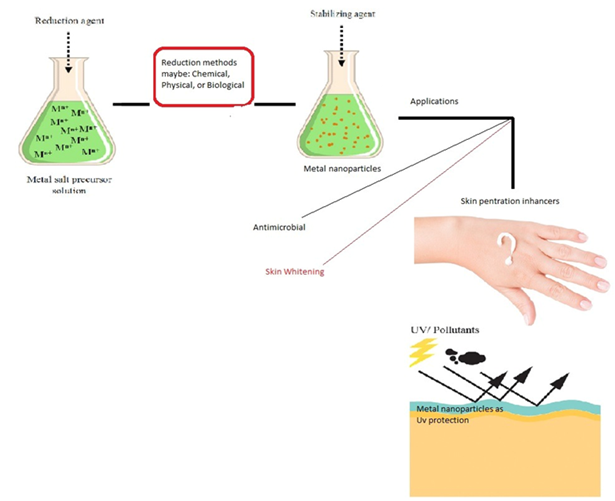
Antimicrobial Properties of Metal Nanoparticles
The incorporation of metal nanoparticles with antimicrobial properties has emerged as a groundbreaking approach in the development of cosmetic products. Metal nanoparticles and some metal-oxide, such as silver (Ag), copper (Cu), and zinc oxide (ZnO), exhibit broad-spectrum antimicrobial activity against various microorganisms, including bacteria, fungi, and viruses. Silver Nanoparticles (AgNPs) have long been recognized for their potent antimicrobial activity. They possess a unique mechanism of action, where the release of silver ions disrupts essential cellular processes in microorganisms, leading to their inactivation or destruction. The small size and large surface area of silver nanoparticles enhance their antimicrobial efficacy by facilitating contact with microbial cells [9]. In cosmetology, silver nanoparticles find applications in various personal care products, including creams, lotions, soaps, and deodorants. Their incorporation helps inhibit the growth of bacteria and fungi, thereby reducing the risk of infections, body odor, and microbial spoilage of cosmetic formulations. Silver nanoparticles have also been studied for their potential in wound healing and acne treatment, owing to their antimicrobial and anti-inflammatory properties [10]. Copper nanoparticles (CuNPs) possess excellent antimicrobial properties, primarily attributed to the release of copper ions. These ions can disrupt microbial cell membranes, interfere with enzyme functions, and induce oxidative stress, leading to the destruction of microorganisms [11]. The antimicrobial activity of copper nanoparticles has been demonstrated against a wide range of pathogens, including bacteria, fungi, and viruses. In cosmetology, copper nanoparticles have been incorporated into various cosmetic products for their antimicrobial and preservative effects. They help prevent microbial contamination and extend the shelf life of formulations, ensuring product safety and integrity. Copper nanoparticles are particularly useful in water-based cosmetic formulations where traditional preservatives may be less effective [12].
Zinc Oxide Nanoparticles (ZnO NPs): Have remarkable antimicrobial properties, mainly attributed to their ability to release zinc ions. These ions interact with microbial cells, disrupt their metabolism, and inhibit their growth and proliferation [13]. Zinc oxide nanoparticles have demonstrated antimicrobial efficacy against bacteria, fungi, and viruses. In cosmetology, zinc oxide nanoparticles are commonly used in sunscreen formulations due to their UV- blocking properties. However, they also contribute to the antimicrobial effects of these products, providing additional protection against microorganisms on the skin’s surface. This dual functionality of zinc oxide nanoparticles enhances the photoprotective and antimicrobial benefits of sunscreens [14]. In general, the main actions of nanoparticles as antibacterial agents and how the bacteria uptake these nanoparticles are demonstrated in (Figure 2).
![Figure 2: The actions of NPs as antibacterial agents and how NPs penetrate the bacterial cell walls [15].](/fulltextimages/10547/fig_2.png)
Skin Whitening and Anti-Aging
Metal nanoparticles, particularly gold (Au) nanoparticles, have garnered significant attention in the field of cosmetology due to their potential applications in skin whitening and anti-aging formulations. The unique properties of gold nanoparticles, including their optical properties and ability to interact with light, make them promising candidates for achieving skin brightening effects and addressing signs of aging. This article explores the skin whitening and anti-aging properties of metal nanoparticles, with a focus on gold nanoparticles, and their implications for cosmetic formulations [16].
Skin Whitening: Gold nanoparticles exhibit remarkable optical properties, including the phenomenon known as localized surface plasmon resonance (LSPR). LSPR refers to a phenomenon that occurs when metallic nanoparticles or nanostructures interact with light, leading to the collective oscillation of conduction electrons on their surfaces. It is a localized version of the more general plasmon resonance phenomenon, where free electrons in a metal collectively oscillate in response to an external electromagnetic field. This localization is achieved through the size, shape, and composition of the nanoparticles [17]. For example LSPR allows gold nanoparticles to interact with light, leading to the scattering and absorption of specific wavelengths [16]. This unique optical behavior enables gold nanoparticles to enhance the appearance of skin brightness and luminosity. In cosmetology, gold nanoparticles have been used in skin whitening products to impart a brightening effect on the skin [18]. These nanoparticles can scatter light, making the skin appear more radiant and reducing the appearance of dullness or uneven skin tone. The incorporation of gold nanoparticles in cosmetic formulations, such as creams or serums, can help achieve a more vibrant and even complexion.
Anti-Aging Effects: Gold nanoparticles also offer potential anti-aging benefits for the skin. Several studies have shown that gold nanoparticles can stimulate collagen synthesis, which plays a crucial role in maintaining skin elasticity and reducing the appearance of wrinkles and fine lines [18]. Collagen is a key structural protein in the skin, and its production tends to decline with age. By promoting collagen synthesis, gold nanoparticles can help improve skin firmness and reduce visible signs of aging. Furthermore, gold nanoparticles possess antioxidant properties, which can help counteract oxidative stress and minimize damage caused by free radicals. Oxidative stress contributes to the aging process by inducing cellular damage and collagen degradation [19]. By neutralizing free radicals, gold nanoparticles help protect the skin from premature aging and maintain its youthful appearance [19].
Delivery Systems and Enhanced Efficacy
Metal nanoparticles have gained significant attention in the field of cosmetics due to their potential as efficient carriers for active ingredients. These nanoparticles, typically in the nanometer size range, offer several advantages over traditional delivery systems, such as improved stability, enhanced penetration into the skin, and controlled release of the active ingredients [20]. Here are some ways metal nanoparticles can serve as efficient carriers in cosmetic formulations:
Enhanced Stability: Metal nanoparticles, such as gold, silver, or titanium dioxide, can provide stability to the active ingredients by protecting them from degradation, oxidation, or evaporation. This ensures that the active ingredients remain potent and effective throughout the product’s shelf life [21].
Improved Penetration: Metal nanoparticles have unique properties, including their small size and large surface area, which enable them to penetrate the skin more effectively. They can overcome the skin’s natural barrier and deliver the active ingredients to the targeted layers, such as the epidermis or dermis, where they can exert their beneficial effects [22].
Controlled Release: Metal nanoparticles can be engineered to release active ingredients in a controlled manner. By modifying the surface of the nanoparticles or encapsulating the active ingredients within them, it is possible to achieve sustained release or triggered release in response to specific stimuli like temperature, pH, or light. This controlled release ensures a prolonged and optimal delivery of the active ingredients, enhancing their efficacy [23].
Increased Bioavailability: Metal nanoparticles can enhance the bioavailability of active ingredients by improving their solubility and dissolution rate. When active ingredients are loaded onto or encapsulated within metal nanoparticles, they can overcome their inherent limitations, such as poor water solubility, and become more readily available for absorption and utilization by the skin [24].
Targeted Delivery: Metal nanoparticles can be functionalized with ligands or antibodies that specifically recognize certain skin receptors or cells. This allows for targeted delivery of active ingredients to specific areas or cell types, increasing their efficacy and reducing potential side effects [25].
Synergistic Effects: In some cases, metal nanoparticles themselves can exhibit beneficial properties for the skin, such as antioxidant or antimicrobial activities. When combined with active ingredients, they can create synergistic effects, amplifying the overall efficacy of the cosmetic formulation [26].Top of Form
Photo-protection
Metal nanoparticles and their oxides can also provide photoprotection in cosmetic formulations. They can act as physical sunscreens, absorbing or scattering harmful UV radiation, thereby reducing its penetration into the skin. Titanium Dioxide (TiO2) Nanoparticles: TiO2 nanoparticles are widely used in sunscreens and cosmetic products due to their excellent UV-blocking properties. They effectively scatter and reflect both UVA and UVB radiation, providing broad-spectrum protection. TiO2 nanoparticles are typically coated or surface-treated to improve their dispersibility and reduce any potential whitening effect on the skin [27]. Zinc Oxide (ZnO) Nanoparticles: ZnO nanoparticles are another commonly used ingredient in sunscreens [28]. Like TiO2, they offer broad-spectrum UV protection by reflecting and scattering both UVA and UVB radiation. ZnO nanoparticles are often preferred for their superior photostability and reduced potential for skin irritation [3]. Iron Oxide (Fe2O3) Nanoparticles: Iron oxide nanoparticles, particularly those in the red and yellow color range, are used in cosmetic products to provide visible light protection. They absorb and reflect visible light, which can contribute to skin aging and hyperpigmentation. By incorporating iron oxide nanoparticles into formulations, the skin is shielded from the harmful effects of visible light. Silver Nanoparticles: Silver nanoparticles possess unique antimicrobial and antioxidant properties, making them attractive for use in sunscreens and other photoprotective products. In addition to UV protection, silver nanoparticles can help mitigate the damage caused by reactive oxygen species generated upon exposure to sunlight, thereby reducing oxidative stress on the skin [5, 21].
Metallic nanoparticles can indeed contribute to the formation of reactive oxygen species (ROS) through different mechanisms.
One primary mechanism by which metallic nanoparticles and their oxides generate ROS is through their ability to undergo redox reactions. Metallic nanoparticles, such as silver or iron oxide nanoparticles, possess a high surface area-to-volume ratio, which allows them to interact with surrounding molecules and catalyze oxidation-reduction reactions. In the presence of oxygen or other electron acceptors, these nanoparticles can act as catalysts and transfer electrons, leading to the production of ROS.
Additionally, some metallic nanoparticles can generate ROS through a phenomenon called localized surface plasmon resonance (LSPR), such as gold or silver nanoparticles, absorb and scatter incident light due to the collective oscillation of their conduction electrons. This energy transfer can promote the generation of ROS, particularly singlet oxygen, through the interaction of the excited nanoparticle with molecular oxygen or other molecules (Figure 3). It is important to note that the ROS generation by metallic nanoparticles is highly dependent on factors such as nanoparticle composition, size, surface properties, and the surrounding environment. The specific mechanisms may vary depending on these factors, and different types of metallic nanoparticles may exhibit varying degrees of ROS generation. The ability of metallic nanoparticles to generate ROS has led to their application in various fields, including medicine, where they can be utilized for targeted cancer therapy, antimicrobial treatments, and imaging techniques [29, 30].
![Figure 3: The internal mechanisms of SeNPs, and their role in generation ROS [31].](/fulltextimages/10547/fig_3.png)
Safety Concerns
While metal nanoparticles offer promising applications in cosmetology, their use also presents certain challenges and necessitates further research. The safety of metal nanoparticles in cosmetic formulations is a primary concern. While many studies have demonstrated their potential benefits, it is crucial to thoroughly evaluate their long-term effects, including potential skin penetration, accumulation, and systemic toxicity. Further research is needed to understand the biological interactions and potential risks associated with the use of metal nanoparticles in cosmetics [32].
Future work
Standardization and Regulation: The standardization of manufacturing processes, characterization techniques, and safety assessment methods for metal nanoparticles in cosmetic products is essential. Establishing guidelines and regulations for their use will help ensure consistent product quality, efficacy, and safety.
Environmental Impact: The potential release of metal nanoparticles from cosmetic products into the environment raises concerns about their impact on ecosystems and organisms. Research should focus on understanding their fate, behavior, and potential ecological effects, as well as developing strategies for their sustainable use and disposal.
Optimization of Formulations: Further research is needed to optimize the formulation of metal nanoparticles in cosmetic products. This includes exploring methods to enhance their stability, control their release kinetics, improve their compatibility with other ingredients, and minimize any potential negative effects on product aesthetics, such as unwanted color changes or texture alterations.
Efficacy and Mechanism of Action: Further studies are needed to explore the efficacy and mechanisms of action of metal nanoparticles in cosmetic applications. This includes understanding their interactions with the skin, their ability to deliver active ingredients effectively, and their impact on various skin conditions or concerns.
Conclusion
The incorporation of metal nanoparticles in cosmetic formulations has brought significant advancements to the beauty industry. The antimicrobial properties of metal nanoparticles, such as silver, copper, and zinc oxide, have revolutionized the field of cosmetology by providing effective solutions for preventing microbial growth, reducing infections, and extending the shelf life of products. These nanoparticles offer unique mechanisms of action, including the release of ions that disrupt essential cellular processes in microorganisms.
Metal nanoparticles, particularly gold nanoparticles, have also shown promise in skin whitening and anti-aging formulations. Their optical properties, such as localized surface plasmon resonance, contribute to skin brightening effects and a more even complexion. Furthermore, gold nanoparticles stimulate collagen synthesis and possess antioxidant properties, which help improve skin firmness, reduce wrinkles and fine lines, and protect against premature aging.
Moreover, metal nanoparticles serve as efficient carriers for active ingredients in cosmetic formulations. They enhance stability, improve penetration into the skin, enable controlled release, increase bioavailability, and allow for targeted delivery. By utilizing metal nanoparticles as delivery systems, cosmetic products can achieve enhanced efficacy and optimize the effects of active ingredients. Metal nanoparticles also contribute to photo-protection in cosmetics, acting as physical sunscreens by absorbing or scattering harmful UV radiation. Titanium dioxide, zinc oxide, and iron oxide nanoparticles offer broad-spectrum UV protection and shield the skin from both UVA and UVB radiation. Additionally, silver nanoparticles provide not only UV protection but also mitigate the damage caused by reactive oxygen species, reducing oxidative stress on the skin.
However, the safety of metal nanoparticles in cosmetic formulations remains a concern. Further research is necessary to thoroughly evaluate their long-term effects, including skin penetration, accumulation, and systemic toxicity. Standardization, regulation, and comprehensive safety assessments are crucial to ensure consistent product quality and safety. Future work should focus on standardizing manufacturing processes, characterizing techniques, and safety assessment methods for metal nanoparticles in cosmetic products. Additionally, understanding the environmental impact and developing sustainable strategies for their use and disposal is important. Optimization of formulations, exploration of efficacy and mechanisms of action, and continued research on their interactions with the skin and impact on various skin conditions will further advance the field.
In summary, metal nanoparticles offer exciting possibilities in cosmetics, providing antimicrobial properties, skin whitening and anti-aging effects, efficient delivery systems, and photo-protection. With ongoing research and development, the incorporation and utilization of metal nanoparticles in cosmetology can be optimized, ensuring their effectiveness, safety, and contribution to innovative cosmetic formulations.
References
-
Ahmad U, Ahmad Z, Khan AA, Akhtar J, Singh SP, et al. (2018) Strategies in Development and Delivery of Nanotechnology Based Cosmetic Products. Drug Res (Stuttg) 68(10): 545-552.
-
Fytianos G, Rahdar A, Kyzas GZ (2020) Nanomaterials in cosmetics: Recent updates. Nanomaterials 10(5): 1-16.
-
Niska K, Zielinska E, Radomski ME, Inkielewicz stepniak I (2017) Metal nanoparticles in dermatology and cosmetology: Interactions with human skin cells. Chem Biol Interact 295: 38-51.
-
Al-qaraleh SS, Al Zereini W (2022) Phyto-Decoration of Selenium Nanoparticles Using Moringa peregrina (Forssk) Fiori Aqueous Extract : Chemical Characterization and Bioactivity Evaluation. Biointerface Res Appl Chem 13(2).
-
Menon S, Shanmugam VK (2020) Cytotoxicity Analysis of Biosynthesized Selenium Nanoparticles Towards A549 Lung Cancer Cell Line. J Inorg Organomet Polym Mater 30(5): 1852-1864.
-
Alam H, Khatoon H, Raza M, Ghosh PC, Sardar M (2019) Synthesis and Characterization of Nano Selenium Using Plant Biomolecules and Their Potential Applications. Bionanoscience 9(1): 96-104.
-
Gunti L, Dass RS, Kalagatur NK (2019) Phytofabrication of selenium nanoparticles from emblica officinalis fruit extract and exploring its biopotential applications: Antioxidant, antimicrobial, and biocompatibility. Front Microbiol 10: 1-17.
-
El Seedi HR (2019) Metal nanoparticles fabricated by green chemistry using natural extracts: Biosynthesis, mechanisms, and applications. RSC Adv 9(42): 24539- 24559.
-
Rai M, Yadav A, Gade A (2009) Silver nanoparticles as a new generation of antimicrobials. Biotechnol. Adv 27(1): 76-83.
-
López Serrano RM, Olivas JS, Landaluze, Cámara C (2014) Nanoparticles: A global vision. Characterization, separation, and quantification methods. Potential environmental and health impact. Anal Methods 6(1): 38-56.
-
Ermini ML (2023) Copper nano-architecture topical cream for the accelerated recovery of burnt skin. Nanoscale Adv 5(4): 1212-1219.
-
Salvioni L (2021) The emerging role of nanotechnology in skincare. Adv Colloid Interface Sci 293: 102437.
-
Gautam R (2021) Prediction of Skin Sensitization Potential of Silver and Zinc Oxide Nanoparticles through the Human Cell Line Activation Test. Front Toxicol 3: 1-11.
-
Carrouel F, Viennot S, Ottolenghi L, Gaillard C, Bourgeois D (2020) Nanoparticles as anti-microbial, anti- inflammatory, and remineralizing agents in oral care cosmetics: A review of the current situation 10(1): 140.
-
Mba IE, Nweze EI (2021) Nanoparticles as therapeutic options for treating multidrug-resistant bacteria: research progress, challenges, and prospects. World J Microbiol Biotechnol 37(6): 1-30.
-
Hu X, Zhang Y, Ding T, Liu J, Zhao H (2020) Multifunctional Gold Nanoparticles: A Novel Nanomaterial for Various Medical Applications and Biological Activities. Front Bioeng Biotechnol 8: 1-17.
-
Endo S, Shimanoe K, Matsuyama T, Wada K, Okamoto K (2022) Deep-ultraviolet localized surface plasmon resonance using Ga nanoparticles. Opt Mater Express 12(7): 2444-2452.
-
Siddiqui MF, Jeon S, Kim MM (2021) Monitoring of whitening agent for skin analysis using tyrosinase gold nanoparticle-based colorimetric assay. Asia-Pacific J Chem Eng 16(2): 2593.
-
Li W, Liu R, Pei Q, Shou T, Zhang W, et al. (2019) Apoptotic effect of green synthesized gold nanoparticles from curcuma wenyujin extract against human renal cell carcinoma a498 cells. Int J Nanomedicine 14: 4091- 4103.
-
Gupta V, Mohapatra S, Mishra H, Farooq U, Kumar K, et al. (2022) Nanotechnology in Cosmetics and Cosmeceuticals — A Review of Latest Advancements. Gels 8(3): 173.
-
Fytianos G, Rahdar A, Kyzas GZ (2020) Nanomaterials in Cosmetics : Recent Updates. 1(5): 979.
-
Grigore E, Grumezescu AM, Holban AM, Mogo GD, Andronescu E (2017) Collagen-Nanoparticles Composites for Wound Healing and Infection Control. 7(12): 516.
-
Al Qaraleh SY, Al Zereini WA, Oran SA, Al Sarayreh AZ, Al Dalain SM (2022) Evaluation of the antioxidant activities of green synthesized selenium nanoparticles and their conjugated polyethylene glycol (PEG) form in vivo. Open Nano 8: 100109.
-
Park Y, Kim JN, Jeong SH, Choi JE, Seung Ho L, et al. (2010) Assessment of dermal toxicity of nanosilica using cultured keratinocytes , a human skin equivalent model and an in vivo model. 267(1-3): 178-181.
-
Gupta S, Bansal R, Gupta S, Jindal N, Jindal A (013) Nanocarriers and nanoparticles for skin care and dermatological treatments. Indian Dermatol Online J 4(4): 267-272.
-
Ribeiro AI, Dias AM, Zille A (2022) Synergistic Effects between Metal Nanoparticles and Commercial Antimicrobial Agents : A Review. American Chemical Society 5(3): 3030-3064.
-
Vaudagna MV, Aiassa V, Marcotti A, María Fernanda PB, María Florencia C, et al. (2023) Titanium Dioxide Nanoparticles in sunscreens and skin photo-damage. Development, synthesis and characterization of a novel biocompatible alternative based on their in vitro and in vivo study. Journal of Photochemistry and Photobiology 15: 100173.
-
Test Guideline No. 442E In Vitro Skin Sensitisation (2022) In Vitro Skin Sensitisation In Vitro Skin Sensitisation assays addressing the Key Event on activation of dendritic cells on the Adverse Outcome Pathway for Skin Sensitisation 442.
-
Kessler A, Hedberg J, Blomberg E, Odnevall I (2022) Reactive Oxygen Species Formed by Metal and Metal Oxide Nanoparticles in Physiological Media—A Review of Reactions of Importance to Nanotoxicity and Proposal for Categorization. Nanomaterials 12(11): 1922.
-
Mammari N, Lamouroux E, Boudier A, Duval RE (2022) Current Knowledge on the Oxidative‐Stress‐Mediated Antimicrobial Properties of Metal‐Based Nanoparticles. Microorganisms 10(2): 437.
-
Khurana A, Tekula S, Saifi MA, Venkatesh P, Godugu C (2019) Therapeutic applications of selenium nanoparticles. Biomed Pharmacother 111: 802-812.
-
Najahi Missaoui W, Arnold RD, Cummings BS (2020) Safe Nanoparticles : Are We There Yet ? Int J Mol Sci 22(1): 385.
- Solution-Processed Chiral Perovskites for Biomedical Applications
- Nanotechnology in Health Chemistry and Medicine: Current Challenges and Future Directions
- Human Exposure to Micro- and Nanoplastics: Pathways, Toxicity, and Intervention Strategies
- Exosome Nanomedicine for Cancer Therapy
- Micro and Nanoplastics–Plastisphere, Biotoxicity, Impact on Human Health, and Mitigation Strategies
- Process Validation of Cefixime Powder for Suspension Dosage Form, 50 mL