
Toxicity of the Quatro Stimuli Nanocontainers in Rats
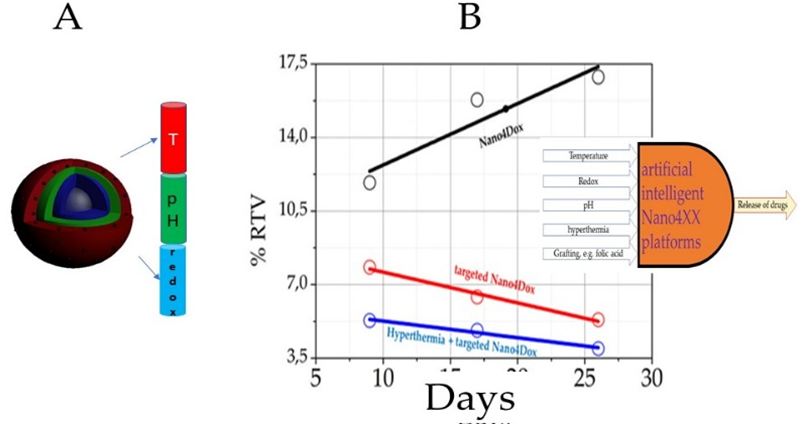
An artificial intelligent drug delivery system (DDS) was produced for cancer treatment, consisting of a shell made of three polymers: the first is sensitive to temperature, the second is sensitive to pH, and the third is sensitive to redox [1]. This innovative DDS called Nano4XX (XX=Dox, Cis) platform was tested on animals, although they were shown to have the potential to cure cancer, as shown in Figure 1 A [2]. When nanocontainers loaded with doxorubicin enter the mice, there is no cure; primary cancer increases with time. The opposite happens when the Nano4Dox platform is enriched with target molecules that detect cancer and are encapsulated in the cancer cell, so they are absorbed and destroyed within the tumor to release the doxorubicin for treatment. In this series of experiments, hyperthermia was applied, and treatment was further improved (Figure 1 B) [1,2].
Editorial
An artificial intelligent drug delivery system (DDS) was produced for cancer treatment, consisting of a shell made of three polymers: the first is sensitive to temperature, the second is sensitive to pH, and the third is sensitive to redox [1]. This innovative DDS called Nano4XX (XX=Dox, Cis) platform was tested on animals, although they were shown to have the potential to cure cancer, as shown in Figure 1 A [2]. When nanocontainers loaded with doxorubicin enter the mice, there is no cure; primary cancer increases with time. The opposite happens when the Nano4Dox platform is enriched with target molecules that detect cancer and are encapsulated in the cancer cell, so they are absorbed and destroyed within the tumor to release the doxorubicin for treatment. In this series of experiments, hyperthermia was applied, and treatment was further improved (Figure 1 B) [1, 2].
and even pregnancy in embryo and offspring development and how these affect the adulthood of the rat model. In detail, the toxicological study was done with four nanoparticle doses in 24 male SCID mice, one aged at 12-14 weeks. One contained 5mg/ml of nanocontainers, dissolved in saline and administered through the tail to the animal every other day for one week totaling three injections. Group (1) 5mg/ ml nanospheres dissolved in saline administered by the tail of animals every other day for one week, a total of 3 injections. Group (2) contained 5 mg/ml, and group (3) 15 mg/ml. Group (4) was administered only with saline and named as a control group. The nanocontainers had a size of 350 nm. All actions were performed intravenously at a dose of 100μl/animal. On the 8th day after introducing these nanocontainers, the animals were even stunned by inhaling isoflurane for blood sampling via cardiac puncture and then underwent anesthesia using cervical dislocation. GGT, SGPT, SGOT, ALP, bilirubin (total and direct), creatinine, urea, and albumin were evaluated. The results showed no difference in the parameters GGT, SGPT, SGOT, and ALP in the four samples, proving that the platform’s administration does not cause alteration of vital organs [1].
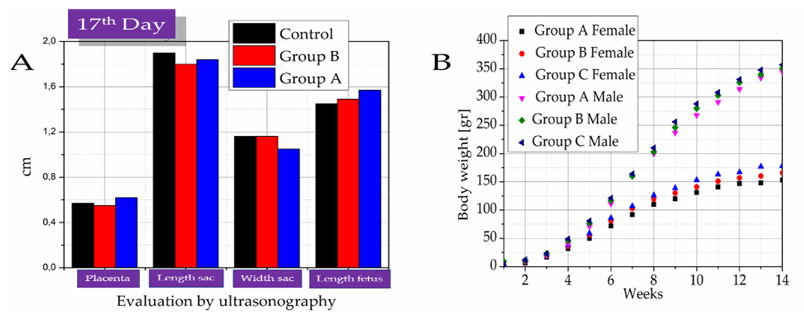
Another study of the behavior of pregnant mothers and newborns was done on toxicity after the delivery of the nano containers. The study was done using three groups with 0 (control group), 5 (1X), and 15 (3X) mg/ml. The results of the work are shown in Figure 2 A. It looks like there is no difference between Group A, B, and the control group, so it was just containers with no adverse effect on your pregnant mother. Figure 2 B shows the development of the earthlings from mothers treated with an injection of Group A and B nano containers. The exact figure shows the newborn born with zero nano containers. The picture shows no difference in newborns’ (male and female) development after having particles in the mother during pregnancy [1].
The present study showed that the new system we developed with quadrupole stimuli responses targeting nanocontainers loaded with doxorubicin is non-toxic and presents targeted cancer therapy with significant efficacy (Figure 1) [4]. The platform was named Nano4XX (XX=Dox), and the treatment performs much better than Doxil©. This platform can accommodate any commercial drug, leading to personalized chemotherapy and reduced toxicity. This platform has better efficacy than commercial liposomal doxorubicin. One can say that this platform revolutionized cancer treatment [5].
Acknowledgments
George Kordas thanks the European Research Council (ERC) under the IDEAS program for funding this work under contracts:
- Advanced Grant: “A Novel Nano container drug carrier for targeted treatment of prostate cancer “Nano therapy” Nos. 232959, and
- Proof of Concept Grant: Nos. 620238.
References
-
Kordas G (2018) Adjustable Quarto Stimuli (T, pH, Redox, Hyperthermia) Targeted Nanocontainers (Nano4Dox and Nano4Cis) for Cancer Therapy Based on Trojan Horse Approach. Archives of Pharmacy & Pharmacology Research 1(1): 1-7.
-
Kordas G (2023) Application of Nanocontainers in Medicine : The Revolution of Nanotechnology. Archives of Pharmacy & Pharmacology Research 8(2): 1-4.
-
Lelovas P, Efthimiadou EK, Mantziaras G, Siskos N, Kordas G, et al. (018) In vivo toxicity study of quatro stimuli nanocontainers in pregnant _rats_: Gestation, parturition, and offspring evaluation. Regulatory Toxicology and Pharmacology 98: 161-167.
-
Kordas G (2022) Quadrupole Stimuli‐Responsive Targeted Polymeric Nanocontainers for Cancer Therapy: Artificial Intelligence in Drug Delivery Systems. Nanoengineering of Biomaterials pp: 505-522.
-
Kordas G (2019) Nanotechnology in Cancer Treatment as a Trojan Horse: From the Bench to Preclinical Studies. Nanostructured Polymer Composites for Biomedical Applications pp: 323-365.
- Solution-Processed Chiral Perovskites for Biomedical Applications
- Nanotechnology in Health Chemistry and Medicine: Current Challenges and Future Directions
- Human Exposure to Micro- and Nanoplastics: Pathways, Toxicity, and Intervention Strategies
- Exosome Nanomedicine for Cancer Therapy
- Micro and Nanoplastics–Plastisphere, Biotoxicity, Impact on Human Health, and Mitigation Strategies
- Process Validation of Cefixime Powder for Suspension Dosage Form, 50 mL