
Nanorobotics as a New Paradigm for the Management of Various Diseases
Nanorobotic is a forthcoming nanodevice in the field of science and medicine. These are the programmable devices designed in nano size to perform multiple function particularly delivering the drug at targetted sites. Using nanotechnology, the drug can be targeted to a precise location which would make the drug much more effective and reduce the chances of possible side effects. These device could be choice for treating cancerous diseases, brain diseases, dentistry ailments. This review focuses on the overview of treating multiple debilitating ailments utilizing nanorobots.
Introduction
A leading-edge electromechanical device entitled nanorobotics has advanced significantly over the years in various fields. The nanorobot (Greek: nano means ‘small’; bot means ‘robot’) is a nanodevice with a size ranging from 1 to 100 nm having a diameter of about 0.5 to 3 microns. They are generally fabricated from elements like carbon, silicon, sulfur, and fluorine, accomplish specific functions within the human body, such as, capable of detecting through sensors, actuation to transform a signal into mechanical motion, information processing, and manipulation, thereby expeditiously curing agonizing diseases. It is a miniature automated dispenser that is programmed to access the diseased area in the human body, thereby, ensuring the availability of the drug in the desired area and also reducing exposure to the peripheral organs [1]. Moreover, they offer various advantages like high accuracy, high efficiency, early disease diagnosis and prevents adverse effect. Nanorobotics are of multiple types such as magnetically driven, self-assembled, bacterial based and bio-nanorobots. These nanorobotics offers various applications including pharmacokinetic monitoring of drug delivery, surgeries, early diagnosis and cellular assistance in inflammatory response [2].
Nanorobotics Role in Treating Diseases
To ameliorate and mitigate undesirable effects by delivering the drug to the intended target region, it is imperative to assemble a robotic system that offers extreme precision in drug delivery & additionally outperforms conventional and nanoscales therapies in terms of benefits. Currently, numerous researchers have used nanorobots to alleviate various chronic ailments like brain aneurysms, glioblastoma, and dentistry problems. Figure 1 illustrates the utilization of nanorobots in targeting various diseased area.
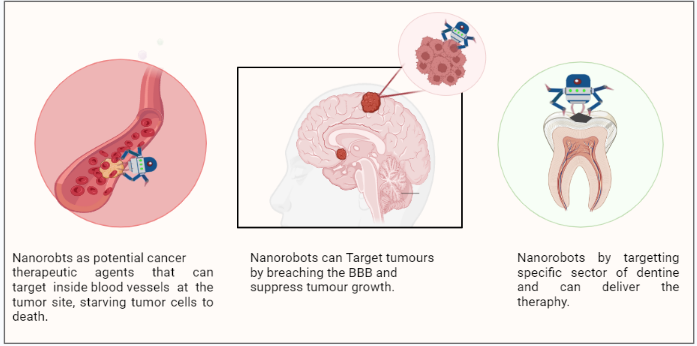
Yoo, et al. [3] employed the “nanorobotics” gadget involving a radar to acquire signals and forward them to computerized means to recognize health complications including a lipid profile, blood glucose levels, and certain allergies [3]. Further, Kalinin et al, devised the beam controlled nanorobots which functions by generating a pixel map of a given atomic object and identifies the parts, thereby, performs a range of scanning profiles using these electron beam [4]. Nanorobots with self-propelling and navigating skills have emerged as interesting new areas of research due to their property of delivering the drug to the targeted part of the body. The self-powered magnetic nanorobot was generated by encapsulating doxorubicin hydrochloride in Fe3O4-conjugated nanoparticles followed by conjugation with an anti-epithelial cell adhesion molecule antibody for deeply targeting the tumor. The potential to impart autonomous acceleration and intracellularly release the loaded drug at specific pH is advantageous in treating the tumor. The propulsion of nanobots in a biological fluid may occur due to the presence of the enzyme ‘serum catalase’ with no external H2O2 indicating the ability of the nanobot to propel in blood and penetrate the tumor by utilizing H2O2 present in the tumor microenvironment [5]. Furthermore, the doxorubicin encapsulated in silica core followed by layering with enzyme ‘urease’ adhered nanoparticles were generated to fabricate the ‘urease nanobots’. They released the drug specifically in presence of urea and displayed an anticancer efficiency toward adenocarcinoma HeLa cells [6]. Consequently, to deliver this anticancer medication doxorubicin into tumors, ‘DNA nanobots’ were created involving aptamers folded into systemic form, and when the aptamer is unfolded, it is recognized followed by attaching to its tumor-specific target molecule, delivering thrombin to the circulation, stimulating coagulation of the local malignant cells, and ultimately causing tumor necrosis and tumor growth inhibition [7].
Since, lactate also plays role in cancerous cell proliferation & growth of tumors. Considering, tumor lactic acidosis can lead to treatment resistance, neutralizing it is essential. Meng et al. devised alkaline nanorobots that respond to ultrasound using PLGA nanoparticles that contain doxorubicin, sodium carbonate, and perfluorocarbon. This suggested that these nanobots prevent the growth of malignancies by rapidly releasing the drug to offset lactic acidosis on the response towards ultrasonic power which has high tissue penetration tendency as well as disrupts the acidic environment to enhance drug uptake in a cancer cell. As a result, it offers a potential strategy for overcoming the means to combat that cancer lactic acidosis causes [8].
Besides this, it is interesting to note that nanorobots have been devised to treat brain-related diseases. Although, numerous strategies have been developed including surgery and chemotherapy. However, the development of a treatment strategy with improved therapeutic efficacy and fewer side effects is absolutely important. Initially, to deliver the drug in brain areas, it is essential that it must be able to cross the blood-brain barrier. Therefore, ‘natural killer cell mimic’ nanorobots were developed, which were having the tendency to target the tumor by breaching the blood-brain barrier. These natural cells were attached with certain integrins on endothelial cells resulting in the activation of the signalling cascade and producing gaps between the tight junctions. Interestingly, when exposed to NIR radiations they could recognize tumour easily [9]. Meanwhile, these nanodevices are additionally utilized to alleviate orthodontic problems. The traditional techniques of managing dentinal difficulties were not much effective, however, research illustrates the immense potential of nanobots in dentistry. The various application of this device in dentistry includes treating tooth hypersensitivity, inducing anesthesia, and repairing major tooth issues [10]. Currently, the magnetically driven nanobots are employed to sanitize dentinal tubules during root canal treatments enabling the subtle insertion of the nanodevice, which are isotopically disseminated throughout the enamel and dentin and can penetrate tubule layers thereby effectively treating the ailment [11].
Future Aspect
The plethora of employing nanorobotics might hopefully escalate in the coming years as it exhibits certain advantages in curing debilitating diseases effectively with localized targeting. Additionally, a better prognosis is also offered by diagnosing the ailment at the initial stages. The authenticity of these miniature devices will allow the physicians to accomplish multiples task at cellular as well as molecular levels to provide better treatment. Furthermore, it is anticipated that nanorobot implementations would evolve in other sectors such as the food industry and environmental impact assessment.
References
-
Sivasankar M, Durairaj R (2012) Brief review on nano robots in bio medical applications. Adv Robot Autom 1(1).
-
Vasile C (2018) Polymeric nanomaterials in nanotherapeutics. 1st (Edn.), Elsevier.
-
Yoo B, Rinaldi V, Kajur HV, Sedlak R (2021) Detecting potential health risks using nanorobotics. AT&T Intellectual Property I LP JUSTIA Patents.
-
Kalinin SV, Jesse S, Dyck OE, Sumpter BG (2020) Beam controlled nano-robotic device. UT Battelle LLC US.
-
Andhari SS, Wavhale RD, Dhobale KD, Tawade BV, Chate GP, et al. (2020) Self-propelling targeted magneto- nanobots for deep tumor penetration and pH-responsive intracellular drug delivery. Sci Rep 10(4703).
-
Hortelão AC, Patiño T, Perez Jiménez A, Blanco A, Sánchez S (2018) Enzyme‐powered nanobots enhance anticancer drug delivery. Adv Funct Mater 28(25): 1705086.
-
Singh R, Deshmukh R (2022) Enzyme‐powered nanobots enhance anticancer drug delivery. Curr Drug Deliv 20(2): 111-126.
-
Meng X, Xu Y, Lu Q, Sun L, An X, et al. (2020) Ultrasound- responsive alkaline nanorobots for the treatment of lactic acidosis-mediated doxorubicin resistance. Nanoscale 12 (25): 13801-13810.
-
Deng G, Peng X, Sun Z, Zheng W, Yu J, et al. (2020) Natural- killer-cell-inspired nanorobots with aggregation- induced emission characteristics for near-infrared-II fluorescence-guided glioma theranostics. ACS nano 14 (19): 11452-11462.
-
Verma SK, Chauhan R (2014) Nanorobotics in dentistry–A review. Indian J Dent 5: 62-70.
-
Dasgupta D, Peddi S, Saini DK, Ghosh A (2022) Mobile nanobots for prevention of root canal treatment failure. Adv Healthcare Mater 11(14): 2200232.
- Solution-Processed Chiral Perovskites for Biomedical Applications
- Nanotechnology in Health Chemistry and Medicine: Current Challenges and Future Directions
- Human Exposure to Micro- and Nanoplastics: Pathways, Toxicity, and Intervention Strategies
- Exosome Nanomedicine for Cancer Therapy
- Micro and Nanoplastics–Plastisphere, Biotoxicity, Impact on Human Health, and Mitigation Strategies
- Process Validation of Cefixime Powder for Suspension Dosage Form, 50 mL