
Approaches to the Stabilization of Titanium-Containing Nanopowder for Biomedical Research
The paper is devoted to the stabilization of nanopowders for use in biomedical research. Conducting biomedical research on nanopowders has a lot of obstacles and complications related to the aggregate state of matter: a significant number of new materials are presented in the form of nanopowders, which actualizes the issue of obtaining stable hydrosols of nanopowders for experimental studies in vitro and in vivo and the choice of stabilizers that do not affect on the toxicity and biological properties of the starting material. The dispersibility of hydrosols of nanopowders of titanium-containing nanomaterials (TiO2, TiO2-Ag (4%) in various environments was analyzed and the feasibility of using certain stabilizers for a series of screening scientific studies was substantiated.
Introduction
The toxicological behavior of nanomaterials in direct contact with cells depends on their chemical composition, concentrations, solubility, shape, area and charge. Effects may depend on how long the nanoparticles remain intact and how they can accumulate in the biosystem. Impurities formed during the production of nanomaterials also can affect their toxicity [1].
At the same time, as at the beginning of the development of nanotechnology, the development and introduction of new materials is significantly ahead of biomedical research on the potential dangerous effects of nanomaterials on living organisms and environmental objects. In turn, conducting these studies has a number of obstacles and complications related to the aggregate state of the substance: a significant number of new materials are presented in the form of nanopowders, which actualizes the issue of obtaining stable hydrosols of nanopowders for experimental studies in vitro methods and the choice of stabilizers that do not affect on the toxicity and biological properties of the starting material.
The toxicity of the composition is determined not only by the toxicity of the active substance (for example, metal nanoparticles), but also by stabilizing or other auxiliary components that can affect the biological activity of the resulting solution, as well as cause an increase in its toxicity. In particular, a method of stabilizing silver nanoparticles with sodium citrate is known, the disadvantage of which is a wide size distribution of the obtained nanoparticles, low stability during storage, as well as contamination of the final sol with citrate anion oxidation products, in particular, acetone dicarboxylic and itaconic acids [2]. There is also a known method of stabilizing nanocrystalline cerium dioxide with citric and polyacrylic acid, which are added directly during synthesis and are adsorbed on the surface of cerium dioxide nanoparticles and prevent their agglomeration during the synthesis process [3]. The disadvantage of this method is its complexity and time-consuming nature.
As is known, applications of nanostructured titanium dioxide (TiO2) can now be found in a wide range of fields, including electronic materials, energy, environment, medicine, catalysts, etc. [4, 5]. Usually, titanium-containing nanomaterials are presented in the form of nanopowders, which actualizes the issue of converting them into stable hydrosols for in vitro and in vivo studies and, accordingly, the search for an adequate stabilizer. To stabilize nanomaterials in solutions, organic and inorganic compounds are used to obtain colloidal solutions of varying degrees of stability (polythiocyanohydroquinone, low molecular weight polyvinylpyrrolidone, human serum albumin, polysaccharides, sodium citrate, etc.) [6].
Therefore, the aim of the work was to analyze the dispersibility of hydrosols of nanopowders of doped titanium-containing nanomaterials in various environments and to justify the feasibility of certain stabilizers for a series of screening studies of potential in vitro hazards.
Materials and Methods
The dispersion of the silver-doped titanium dioxide complex (TiO2-Ag nanocomposite, mass fraction of Ag~4%) and titanium dioxide nanopowder (TiO2) synthesized by the thermal decomposition method in various media/stabilizers was evaluated. The size of the particles was determined by the method of dynamic light scattering using the Analysette 12 DynaSizer device (Fritsch, Germany).
Results and Discussion
The possibility of using nanoparticles of polyhydroxyl compounds (primarily carbohydrates) as a stabilizer has been revealed [7, 8]. Glucose-citrate buffer (glucose (4 g), sodium citrate (1 g) in 100 ml of distilled water) is used in an express method for determining the toxicity of nanomaterials in vitro solutions using bovine spermatozoa as a test object for thawing sperm, and also as a control solution. Therefore, under the conditions of using bovine spermatozoa as a test object, stabilization of metal nanopowders with a glucose- citrate buffer (4:1 ratio of glucose and sodium citrate) is the optimal solution, as it allows obtaining stable hydrosols (Table 1).
| Stabilizer/medium | Time, hours | Hydrodynamic diameter, nm |
|---|---|---|
| Glucose-citrate buffer (glucose : sodium citrate: 4:1) | 1 | 48,65 |
| Glucose-citrate buffer (glucose : sodium citrate: 4:1) | 24 | 53,37 |
| Glucose-citrate buffer (glucose : sodium citrate: 4:1) | 48 | 52,12 |
| Glucose-citrate buffer (glucose : sodium citrate: 4:4) | 1 | 134,93 |
| Glucose-citrate buffer (glucose : sodium citrate: 4:4) | 24 | 195,04 |
| Glucose-citrate buffer (glucose : sodium citrate: 4:4) | 48 | 234,49 |
Table 1: Dispersion of TiO2-Ag(4%) nanocomposite in glucose-citrate buffer over time.
On the other hand, for studies of antibacterial activity and phytotoxicity, bovine spermatozoa cannot be used as a test object. Also, it will obviously be impractical to use glucose-citrate buffer as a stabilizer, which is a favorable environment for spermatozoa, but not for microorganisms and plants.
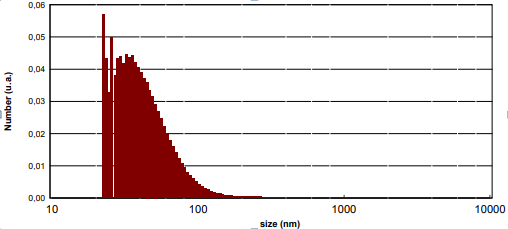
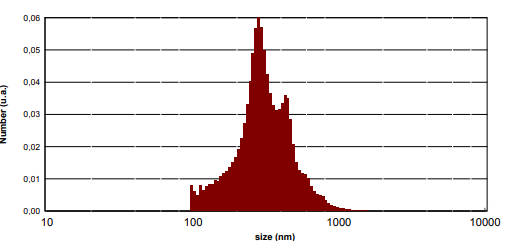
Studies of the dispersion of titanium-containing nanomaterials have shown that the size of particles can vary significantly in different stabilizers (Table 2; Figures 1 & 2).
| Stabilizer | Concentration of nanomaterial, % wt. | Hydrodynamic diameter, nm | |
|---|---|---|---|
| TiO2 | Glucose-citrate buffer (5%) | 0,3 | 46,84 |
| TiO2 | Sodium citrate (0.38%) | 0,3 | 35,3 |
| TiO2 | Polysucrose 400 (5%) | 0,3 | 128,86 |
| TiO2-Ag(4%) | Glucose-citrate buffer (5%) | 0,3 | 43,9 |
| TiO2-Ag(4%) | Physiological solution (0.9%) | 0,25 | 41,01 |
| TiO2-Ag(4%) | Physiological solution (0.9%) | 0,5 | 48,32 |
| TiO2-Ag(4%) | Polysucrose 400 (5%) | 0,3 | 328,8 |
Table 2: Dispersion of titanium-containing nanomaterials in various stabilizers.
The obtained results must be taken into account when planning and conducting biomedical research using certain test objects and model systems.
Conclusions
Stabilization of titanium-containing nanopowders with a glucose-citrate buffer makes it possible to obtain relatively stable hydrosols that can be used in screening studies using bovine spermatozoa as a test object. For studies of phyto- and antibacterial toxicity of nanomaterials, it is advisable to use nanopowders in physiological solution, which can be applied during the first day. The use of a sterile solution of Polysucrose 400 as a stabilizer of powdered titanium- containing nanomaterials is impractical due to rapid agglomeration of nanoparticles.
Conducting further research on acceptable stabilization of nanopowders is necessary.
References
-
Hartwig A, van Thriel C (2023) Risk Assessment of Nanomaterials Toxicity. Nanomaterials (Basel) 13(9): 1512.
-
Cuervo Osorio G, Jiménez Valencia AM, Mosquera Agualimpia C, Escobar Sierra DM (2018) Manufacture of titanium dioxide scaffolds for medical applications. Revista Facultad de Ingeniería 27(48): 17-25.
-
Ju X, Fučíková A, Šmíd B, Nováková J, Matolínová I, Matolín V, et al. (2020) Colloidal stability and catalytic activity of cerium oxide nanoparticles in cell culture media. RSC Advances 10(65): 39373-39384.
-
Ziental D, Czarczynska Goslinska B, Mlynarczyk DT, Glowacka Sobotta A, Stanisz B, et al. (2020) Titanium Dioxide Nanoparticles: Prospects and Applications in Medicine. Nanomaterials (Basel) 10(2): 387.
-
Gopinath KP, Madhav NV, Krishnan A, Malolan R, Rangarajan G (2020) Present applications of titanium dioxide for the photocatalytic removal of pollutants from water: A review. J Environ Manage 270: 110906.
-
Phan HT, Haes AJ (2019) What Does Nanoparticle Stability Mean? Journal of Physical Chemistry C: Nanomaterials and interfaces 123(27):16495-16507.
-
Lokesh S, Chandrakant T (2022) Biosynthesis of polysaccharides-stabilized metal nanoparticles for chemical and biosensing applications. Micro and Nano Technologies Polysaccharide Nanoparticles Elsevier, pp: 553-583.
-
La Spina R, Mehn D, Fumagalli F, Holland M, Reniero F, et al (2020) Synthesis of Citrate-Stabilized Silver Nanoparticles Modified by Thermal and pH Preconditioned Tannic Acid. Nanomaterials (Basel) 10(10): 2031.
-
Gual A, Godard C, Philippot K, Chaudret B, Denicourt Nowicki A, et al. (2009) Carbohydrate-derived 1,3-diphosphite ligands as chiral nanoparticle stabilizers: promising catalytic systems for asymmetric hydrogenation. ChemSusChem 2(8): 769-779.
-
Saha SK, Roy P, Saini P, Mondal MK, Chowdhury P, et al. (2016) Carbohydrate polymer inspired silver nanoparticles for filaricidal and mosquitocidal activities: A comprehensive view. Carbohydrate Polymers 137: 390-401.
-
Górska S, Maksymiuk A, Turło J (2021) Selenium- Containing Polysaccharides—Structural Diversity, Biosynthesis, Chemical Modifications and Biological Activity. Applied Sciences 11(8): 3717.
-
Tamang N, Shrestha P, Khadka B, Mondal MH, Saha B, et al. (2021) A Review of Biopolymers’ Utility as Emulsion Stabilizers. Polymers (Basel) 14(1): 127.
-
Demetska O, Beliuha O, Movchan V, Didenko M, Riabovol V, et al. (2023) Screening Assessment of the Potential Hazard of Nanomaterials using a Bull Sperm. International Journal of Nanoscience and Nanotechnology 19(2): 77-84.
-
Nateq S, Moghaddam G, Alijani S, Behnam M (2020) The effects of different levels of Nano selenium on the quality of frozen-thawed sperm in ram. Journal of Applied Animal Research 48(1) 434-439.
- Solution-Processed Chiral Perovskites for Biomedical Applications
- Nanotechnology in Health Chemistry and Medicine: Current Challenges and Future Directions
- Human Exposure to Micro- and Nanoplastics: Pathways, Toxicity, and Intervention Strategies
- Exosome Nanomedicine for Cancer Therapy
- Micro and Nanoplastics–Plastisphere, Biotoxicity, Impact on Human Health, and Mitigation Strategies
- Process Validation of Cefixime Powder for Suspension Dosage Form, 50 mL