
Synthesis of Silica Nanoparticles Doped with Zinc Cation to Remove Bacteria DNA Harboring Antibiotic Resistance Genes from Aqueous Solution
This study investigated removing bacteria DNA from an aqueous solution using silica oxide nanoparticles doped with zinc cation (SiO2@Zn2+). The authenticity of the adsorbent was confirmed by scanning electron microscopy (SEM) coupled with energy-dispersive x-ray spectroscopy (EDX). Adsorption studies involving two operating conditions (time-concentration profile and adsorbent dose) showed increased removal efficiency during the adsorption of bacteria DNA by SiO2@Zn2 +. Therefore, SiO2@Zn2 + may be a promising adsorbent that can tackle the consequences of ARGs infected water.
Introduction
The gain in the fight against bacterial infection has been short-lived due to the development and subsequent proliferation of antibiotic-resistance genes (ARGs) [1]. ARGs render antibiotics ineffective in the treatment of bacterial infections. Water bodies are one of the most important routes for the spread of ARGs. Thus, abundant ARGs have been detected in freshwater, surface water, drinking water, and wastewater [2]. While the presence of naturally occurring minerals enhances the spread of ARGs in fresh and surface water, the hotspot for the enrichment of ARGs has been wastewater, incredibly wastewater rich in antibiotics [3]. In the quest to combat the proliferation of ARGs in water bodies, adsorption technology has been proposed as a cost-effective technique for the removal of ARGs [4], and the application of metallic oxides has been applied for this purpose [5].
In adsorption technology, the specific surface area and the physical and chemical affinities of the adsorbent towards the adsorbate are essential criteria for an adsorbent [6]. Metal oxide nanoparticles possess a large specific surface area [7]
and have been used as an adsorbent to remove organic and inorganic pollutants [8, 9]. ZnO is a typical adsorbent used to combat the proliferation of antibiotic-resistant bacteria- harboring ARGs due to their bacteriostatic tendencies [10]. In lieu, in this study, mesoporous silica nanoparticles doped with zinc cation (SiO2@Zn2+) were synthesized via the combustion protocol and used to remove bacteria DNA harboring ARGs, free-cell DNA of Listeria monocytogene present in aqueous solution.
Materials and Methods
Synthesis and Characterization of SiO2@Zn2+
Incorporation of Zn2+ cation onto SiO2 was achieved according to the procedure or method described in the literature with slight modifications [11]. 2 g of cetyltrimethylammonium bromide (CTAB) and 4 mL of NaOH were dissolved into 50 mL deionized water. The solution was stirred on the mantle for one hour at 70 ℃. 5 mL of tetraothorsilicate (TEOS) and nitric acid (HNO3) were after a minute. The solution was further stirred for 30 minutes at 60 ℃. Then, 0.02 M of zinc nitrate (N2O6Zn.6H20) was added in the ratio 1:1 of Zn: TEOS. All particles were further stirred for two hours before being separated and centrifuged. Then, the particles were washed three times with distilled water and dried overnight in an oven at 50 ℃. The cation-containing particles were calcined at 550 ℃ for 18 h to remove the remaining CTAB and nitrite. The surface morphology and elemental compositions were achieved using a scanning electron microscope (SEM) coupled with an energy-dispersive x-ray spectroscope (EDX) (JOEL JSM- 6390LVSEM), respectively.
Extraction and Molecular Characterization of Bacterial DNA
The antibiotic-resistant Listeria monocytogene bacteria used in this study were obtained from our laboratory archives isolated from food and vegetables. Before the commencement of genomic DNA extraction, the bacteria isolate was subjected to an antibiotic susceptibility test [12]. The extraction was carried out according to the method described in the literature [13]. The test for antibiotic resistance genes was conducted using the primers and PCR conditions of the targeted resistance gene shown in Table 1.
| Antibiotic Class | PCR primers | Primer sequences | Product size (bp) | PCR protocols | References |
|---|---|---|---|---|---|
| Tetracyclines | tetA | F:GCTACATCCTGCTTGCCTTC R:CATAGATCGCCGTGAAGAGG | 210 | 94 °C – 5 min; 35[94 °C – 1 min; 55 °C – 1 min; 72 °C 1½ min]; 72 °C – 5 min. | [14] |
Table 1: Primer sequence, expected product size, and PCR protocol used for the amplification of resistance genes.
Batch Adsorption Study
Bacterial DNA (2 mL) was used to contaminate nuclease- free water (NFW). 20 mg of SiO2@Zn2+ as adsorbent was weighed and added to the prepared contaminated NFW for the batch adsorption study according to the method described in the literature [15]. The effect of contact time (0-80 mins), initial DNA concentrations (7.28 µg/mL), and adsorbent dose (10-30 mg) on DNA removal were investigated. The optimum parameters were determined and adopted during the experimentation. The percentage removal efficiency (%R) in all the solutions was calculated using Equation 1 described by Panahi AH, et al. [16].
( ) % 100 Ci Cf R Ci
$$ R = \frac {\left(C i - C f\right)}{C i} \times 1 0 0 (1) $$
Ci and Cf are the initial and final concentrations of DNA measured in µg/mL, and % R is the removal efficiency.
Result and Discussion
Antibiotic Susceptibility Test (AST)/Molecular Characterization of Genomic DNA
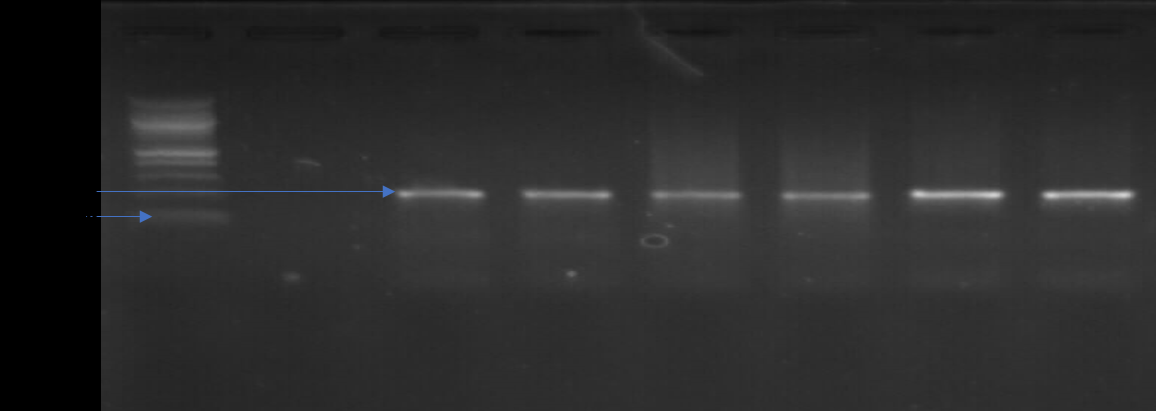
The AST test showed that Listeria monocytogenes (bacteria isolates) were resistant to sulfamethoxazole, erythromycin, streptomycin, amoxicillin, and tetracycline. The determination of resistance genes was achieved by visualizing the PCR product amplifications containing genomic DNA using gel electrophoresis, indicating that bacteria isolates harbor tetA resistance genes at the molecular weight of 210 bp (Figure 1).
Adsorbent Characterization
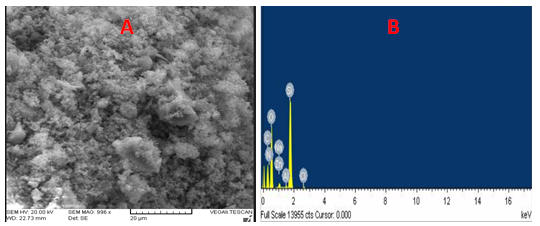
SEM and EDX Analysis: The morphology of the adsorbent (SiO2@Zn2+) was determined using the SEM instrument captured at 20 µm. The material was irregular and formed some slight aggregates (Figure 2A). The elemental composition (Figure 2B) showed a strong signal for silica (Si) at 2Kev and a medium peak representing zinc (Zn) at 0.5 Kev, indicating that this material is pure and its synthesis was successful.
Bacterial DNA Removal Study
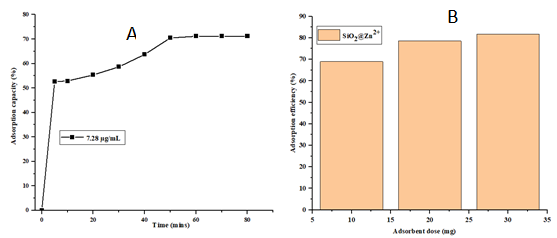
Time-Concentration Profile: The effect of time as a function of initial DNA concentration was conducted at intervals while maintaining the adsorbent dose of 20 mg at pH 7.1. It was observed that when contact time was increased from 0 to 80 minutes, percentage adsorption efficiencies increased from 52.60-71.15% at an initial DNA concentration of 7.28 µg/mL until removal became stable (Figure 3A). This result indicates that increased time increases DNA removal from an aqueous solution. The result is similar to a recently published study Wang Y, et al. [17].
Effect of Adsorbent Dose: The adsorbent dose was studied, and it is illustrated in Figure 3B. As expected, the percentage removal of bacteria DNA rapidly increased with an increase in sorbent mass from 10 to 30 mg. At 30 mg, the optimum removal efficiencies reached 81.73%.
Conclusion
SiO2@Zn2+ was successfully synthesized and employed for bacteria DNA removal from an aqueous solution. This study showed that different operating parameters (time- concentration profile and adsorbent dose) influenced the adsorption process and enhanced the removal of bacterial DNA conveying ARG onto SiO2@Zn2+ from aqueous solution.
Acknowledgments
The authors thank the South Africa Medical Research Council for financial support.
References
-
Le TH, Ng C, Tran NH, Chen H, Gin KYH (2018) Remove antibiotic residues, antibiotic-resistant bacteria, and antibiotic-resistance genes in municipal wastewater by membrane bioreactor systems. Water Research 145: 498-508.
-
Zhang XX, Zhang T, Fang HHP (2009) Antibiotic resistance genes in the water environment. Applied Microbiology and Biotechnology 82(3): 397-414.
-
Ezeuko AS, Ojemaye MO, Okoh OO, Okoh AI (2021) Technological advancement for eliminating antibiotic resistance genes from wastewater: A review of their mechanisms and progress. Journal of Environmental Chemical Engineering 9(5): 106183.
-
Eric AT, Ojemaye MO, Okoh AI, Okoh OO (2021) Potentials of low-cost methods for removing antibiotic-resistant bacteria and their genes in low-budget communities: A review. Journal of Water Process Engineering 40: 101919.
-
Ezeuko AS, Ojemaye MO, Okoh OO, Okoh AI (2021) Journal of Water Process Engineering Potentials of metallic nanoparticles for removing antibiotic- resistant bacteria and antibiotic resistance genes from wastewater: A critical review. Journal of Water Process Engineering 41: 102041.
-
Song HK, Cho WK, Lee KH (1998) Adsorption of carbon dioxide on the chemically modified silica adsorbents. Journal of Non-Crystalline Solids 242(2-3): 69-80.
-
Chew TL, Ahmad AL, Bhatia S (2010) Ordered Mesoporous Silica (OMS) as an adsorbent and membrane to separate carbon dioxide (CO2). Advances in Colloid and Interface Science 153(1-2): 43-57.
-
Ojemaye MO, Okoh OO, Okoh AI (2017) Adsorption of Cu2+ from aqueous solution by a novel material, azomethine functionalized magnetic nanoparticles. Separation and Purification Technology 183: 204-215.
-
Ojemaye MO, Okoh AI (2019) Multiple nitrogens functionalized magnetic nanoparticles as an efficient adsorbent: synthesis, kinetics, isotherm, and thermodynamic studies for removing rhodamine B from aqueous solution. Scientific Reports 9(1): 1-13.
-
Eric AT, Ojemaye MO, Okoh OO, Okoh AI (2022) Influence of different Ag/ ZnO heterostructures on the removal efficiency of multidrug‐resistant Enterococcus faecium harboring multiple resistance genes from tap water. Environmental Progress & Sustainable Energy 41(6): e13925.
-
Chen S, Greasley SL, Ong ZY, Naruphontjirakul P, Page SJ, et al. (2020) Biodegradable zinc-containing mesoporous silica nanoparticles for cancer therapy. Materials Today Advances 6: 100066
-
Humphries R, Bobenchik AM, Hindler JA, Schuetz AN (2021) Overview of Changes to the Clinical and Laboratory Standards Institute Performance Standards for Antimicrobial Susceptibility Testing, M100, 31st Edition. Journal of Clinical Microbiology 59(12): e0021321.
-
Ribeiro JC, Tamanini R, Soares BF, De Oliveira AM, De Godoi Silva F, et al. (2016) The efficiency of boiling and four other methods for genomic DNA extraction of deteriorating spore-forming bacteria from milk. Semina: Ciencias Agrarias 37(5): 3069-3078.
-
Titilawo Y, Obi L, Okoh A (2015) Occurrence of virulence gene signatures associated with diarrhoeagenic and non- diarrhoeagenic pathovars of Escherichia coli isolates from some selected rivers in South-Western Nigeria. BMC Microbiology 15(1): 1-14.
-
Ezeuko AS, Ojemaye MO, Okoh OO, Okoh AI (2022) OpenNano The effectiveness of silver nanoparticles as a clean-up material for water polluted with bacteria DNA conveying antibiotics resistance genes : Effect of different molar concentrations and competing ions. OpenNano 7: 100060.
-
Panahi AH, Ashrafi SD, Kamani H, Khodadadi M, Lima EC, et al. (2019) Removal of cephalexin from artificial wastewater by mesoporous silica materials using Box- Behnken response surface methodology. Desalination and Water Treatment 159: 169-180.
-
Wang Y, Zhou Y, Zhang T, He M, Bu X (2014) Two- dimensional ultrathin nanosheets of Ni-In-layered double hydroxides prepared in water: enhanced performance for DNA adsorption. RSC Advances 4(57): 29968-29974.
- Solution-Processed Chiral Perovskites for Biomedical Applications
- Nanotechnology in Health Chemistry and Medicine: Current Challenges and Future Directions
- Human Exposure to Micro- and Nanoplastics: Pathways, Toxicity, and Intervention Strategies
- Exosome Nanomedicine for Cancer Therapy
- Micro and Nanoplastics–Plastisphere, Biotoxicity, Impact on Human Health, and Mitigation Strategies
- Process Validation of Cefixime Powder for Suspension Dosage Form, 50 mL