
Comparis on of Tinospora cordiofolia and 0.2% Chlorhexidine Mouthrinse for Treatment of Gingivitis
Background: Plaque control has been the key factor in maintenance of oral hygiene. Chlorhexidine (CHX) is considered as gold standard in the treatment of gingivitis, however side effects such as staining of teeth and altered taste sensation, limits its use for longer periods. Ayurvedic drugs, on the other hand, have been proved to be safer for long term usage. Tinospora cardiofolia (T. cardiofolia) also called as guduchi is known to have antibacterial, anti-inflammatory and antioxidant properties. Aim: To evaluate the efficacy of Tinospora cardiofolia (T. cordiofolia) in the treatment of gingivitis and to compare its efficacy with the gold standard chlorhexidine. Materials and Methods: 30 systemically healthy patients with MGI score greater ≥2 were recruited for the study and were randomly assigned into 3 groups; Group A- Herbal mouthrinse: Group B- Placebo: Group C- 0.2% Chlorhexidine. Baseline indices were recorded. Thorough scaling was performed and plaque scores were brought to zero. Patients were instructed to use given mouthrinse 15 ml for 60 sec twice daily. All the indices were repeated at the end of 21 days. Results: Reduction of all indices scores were observed in all the groups at 21st day. Chlorhexidine showed better results when compared to Guduchi.
Introduction
The initiating factor and the main aetiology of gingivitis and its progression to periodontitis is dental plaque thus plaque control has been the key factor in the prevention and treatment of the same. Till date, there have been many mechanical and chemical plaque control methods claiming their efficacy. Chlorhexidine (CHX) is considered the gold standard chemical plaque control method in the treatment of gingivitis however side effects such as staining of teeth and altered taste sensation often deters its use for longer period [1] and opens the gateway for the continuous search and research of a medication with similar or better efficacy and lesser side effects. Lesser side effects of Ayurvedic drugs have led to the extensive research on them in recent times. They have been known for their efficiency to control bleeding and reduce inflammation. One such important medicinal plant is Tinospora cordiofolia (T. cordiofolia), which has proved itself beneficial in medicine to cure respiratory, allergic and inflammatory disorders but its usefulness in the periodontal therapeutics is not much explored [2] Therefore this study was undertaken to evaluate the efficacy of herbal mouth rinse containing Tinospora cordiofolia (T. Cordiofolia) (Guduchi) in the treatment of gingivitis with clinical efficacy, antimicrobial efficacy against gram negative, gram positive.
Materials and Methods
The present randomized clinical trial was conducted at Sri Sai College of Dental surgery Vikarabad, with an objective to asses and compare the efficacy of Guduchi in reducing the plaque scores, bleeding scores and gingival inflammation when compared to gold standard CHX. Ethical clearance was obtained from Institutional Ethics Committee Board (EC Board number: 443/sscds/IRB-E/OS/2015). 30 systemically healthy patients (13 were females and 17 were males) with MGI score greater >2 were selected from the Out Patient Department.
Inclusion Criteria
- Systemically healthy patients within the age group of 20-40 yrs.
- Subjects with MGI score ≥ 2.
- Subjects who had not received any periodontal therapy for past 6 months.
- Subjects willing to participate in the study and willing to give the informed consent.
Exclusion Criteria
• Patients with known history of allergy to any chemical or herbal products.
- Subjects taking antibiotics or any other drugs which can have an effect on periodontium.
- Pregnant and lactating women
- Medically compromised patients
- Subjects who are smokers
- Patients with orthodontic appliances Prior to Scaling, Patients were subjected to the Assessment of Following Clinical Parameters
- Plaque Index (Turesky modification of the Quigley Hein plaque index 1970), for assessing plaque scores [3].
- Modified gingival index by Lobene, et al. [4].
- Saxton Bleeding Index, for assessing bleeding scores [5].
Informed consent was obtained from all the patients. Before commencement of the study, thorough scaling was performed for all the subjects and plaque scores were brought to zero. Further, subjects were randomly assigned into 3 groups: Group A- Herbal mouthrinse; Group B- Placebo; Group C- 0.2% CHX, and were given the respective mouthrinses. They were instructed to use 15 ml of given mouthrinse for 60sec twice daily. Patients were advised not to smoke or chew tobacco and were recalled after 3 weeks for recording the above mentioned clinical parameters.
Statistical Analysis
Statistical analysis was carried out by means of SPSS version 14 software. Paired ‘t’ test was applied for Intragroup comparison. Data is expresses as mean±SD, and comparision of before and after. Unpaired ‘t’ test applied for Intergroup comparison and P value ≤0.05 was considered statistically significant.
Results
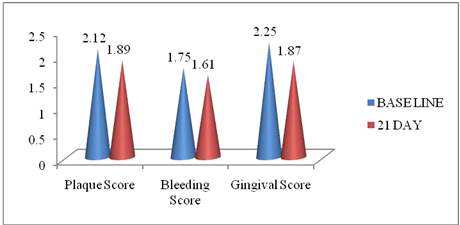
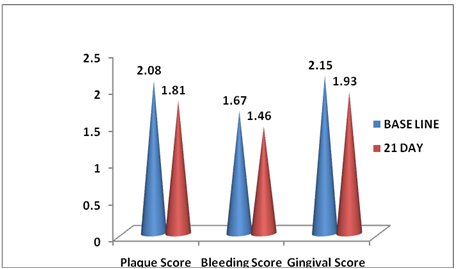
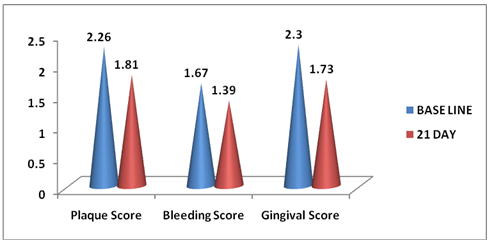
Results are depicted in tables and graphs. Table 1 shows the plaque, bleeding and gingival scores for all the three groups at baseline and 21 days and reduction of plaque scores gingival scores and bleeding scores are observed in all the groups at 21st day. Table 2 shows there was statistically significant difference in all the groups for all the indices at 21st day except for the plaque index in placebo group. Figures 1-3 shows the mean reduction in all the three indices in group A, B and C respectively depicting group C i.e, Chlorhexidine group, showing more affective reduction in scores of all the indices when compared to other groups and group A i.e. guduchi mouthrinse having comparable results with Chlorhexidine. Table 3 shows the difference in efficacy of all the three groups is not significant for any of the indices.
| Group | Base Line | 21 Day’s | |||||
|---|---|---|---|---|---|---|---|
| Plaque Score | Bleeding Score | Gingival Score | Plaque Score | Bleeding Score | Gingival Score | ||
| A | Mean | 2.12 | 1.75 | 2.25 | 1.89 | 1.61 | 1.87 |
| SD | 0.26 | 0.23 | 0.24 | 0.15 | 0.35 | 0.18 | |
| B | Mean | 2.08 | 1.67 | 2.15 | 1.81 | 1.46 | 1.93 |
| SD | 0.39 | 0.23 | 0.23 | 0.19 | 0.26 | 0.24 | |
| C | Mean | 2.26 | 1.67 | 2.3 | 1.81 | 1.39 | 1.73 |
| SD | 0.29 | 0.13 | 0.29 | 0.14 | 0.13 | 0.29 |
Table 1: Mean and Standard Deviation (SD) for Baseline and 21 Day’s.
| Group A | Group B | Group C | |
|---|---|---|---|
| Plaque Score | 0.0161* | 0.1749** | 0.0006* |
| Bleeding Score | 0.0389* | 0.0486* | 0.0282* |
| Gingival Score | 0.0003* | 0.0001* | 0.0003* |
Table 2: P value to compare Plaque Score, Bleeding Score and Gingival Score between base line and 21 day.
| Between | Base Line | 21 Day’s | ||||
|---|---|---|---|---|---|---|
| Plaque Score | Bleeding Score | Gingival Score | Plaque Score | Bleeding Score | Gingival Score | |
| Group A and Group B | 0.3913** | 0.2434** | 0.1874** | 0.1561** | 0.1629** | 0.2404** |
| Group A and Group C | 0.1450** | 0.1952** | 0.3469** | 0.1306** | 0.0513** | 0.1248** |
| Group B and Group C | 0.1306** | 0.4961** | 0.1191** | 0.4764** | 0.2404** | 0.0581** |
Table 3: Comparison of Plaque Score, Bleeding Score and Gingival Score between group.
Discussion
Regardless of one’s good efforts to keep their gums healthy, mechanical therapy is not always sufficient to effectively control plaque. Hence the chemical plaque control is generally considered to be an adjunct to mechanical oral hygiene practices. Albeit Chlorhexidine is measured as a gold standard in the treatment of gingivitis [6], its continuing use is restricted because of displeasing taste, mucositis, staining properties and may cause epithelial desquamation on long term usage [7]. To prevail over these disadvantages by CHX mouth rinse, countless herbal mouthwashes have been tried in the management of gingivitis. Earlier studies showed evidence of using Turmeric, Neem and Triphala in comparison to chlorhexidine and results showed a significant reduction in plaque scores, gingival scores, and bleeding scores [8]. Chief strength of these herbal mouth rinses is that they are economical and are reported with no ill effects6. Aspalli, et al. [9] evaluated the anti-plaque and anti-gingivitis effect of herbal mouth rinse containing Pilu, Bibhitaka, Nagavalli, Gandhapurataila, Ela and Peppermint satva and concluded that herbal mouthrinse is effective in treating plaque induced gingivitis and can be effectively used as an adjunct to mechanical therapy with lesser side‑effects [9]. Kauret, et al. compared the efficacy of green tea catechin with CHX in the treatment of gingivitis. Results showed that green tea catechin was effective in reducing the plaque scores [8].
T. cordiofolia also known as Guduchi in sansrkrit belongs to the family Menispermeacea. This plant possess immumodulatory, antioxidant and anti-inflammatory properties. Various extracts of T. cordiofolia were studied against dental pathogens. Studies reported its effectiveness against the dental pathogens and the reason behind its efficacy was thought to be presence of alkanoids, flavonoids, various amino acids and steroids which gives the plant a good anti-microbial property [10].
The whole plant is used medicinally; however, the stem is approved for use in medicine as listed by the Ayurvedic Pharmacopoeia of India. This is due to higher alkaloid content in the stems than in the leaves [11]. In a clinical study by Sheth, et al. [12], T. cordifolia has been shown to be effective as antibacterial and antifungal agent at a dose of 500 mg/day for a period of 21 days in healthy individuals. It has also been shown not to exert any remarkable adverse effects on the cardiovascular system, renal system, central nervous system and gastrointestinal system [12].
To the best of our knowledge, till date no studies were found related to the use of Guduchi in the treatment of gingivitis. Hence the aim of the present randomized clinical trial was to evaluate the efficacy of T. cordiofolia in the treatment of gingivitis and to compare its efficacy with the gold standard chlorhexidine. The results of the present study demonstrated that the use of herbal mouthrinse containing guduchi was less but comparably effective than CHX in reducing the plaque and gingival bleeding in all the subjects at the end of the study but the difference in the results of two groups were not statistically significant. Guduchi showed reduced inflammation and bleeding when compared to placebo. Possible reason behind superior results with CHX may be because of its high substantivity [6], when substantivity of herbal mouthrinse is unknown. Also, patients were not trained for any particular brushing technique and were advised to brush in their regular way. Different brushing techniques used by patients may also be one of the reason for variability in the results between guduchi and CHX. Another reason for variability in the results may be attributed to Hawthorne effect. T. cordifolia was previously used systemically in a study by Ram S M, et al. [13], where in it was proved to have anti-bacterial and antifungal properties. Also, it was proved to have properties common in amalaki (amla), which is fortified with Vitamin C, a natural, abundantly available powerful antioxidant, anti-inflammatory. This could be one of the reason for it being affective in reducing gingival and bleeding scores [13]. Many studies used the 3-day de novo plaque accumulation and non-brushing model to evaluate the effect of various mouthwashes. The results drawn from such studies indicated that the evaluation was done under experimental conditions and thus cannot to applied to clinical situation. In the current study, mouth wash was used as an adjunct to tooth brushing to assess its efficacy in real clinical scenario. Sample size taken in this study was small and further studies needs to be done on larger sample size for validation of results and subjects needs to be followed up for longer period of time. Also, to claim the anti-microbial properties of guduchi, microbiological tests should be done before bringing it into day to day practice.
Conclusion
Within the limitations of the study, it can be concluded that guduchi is effective in reducing gingival bleeding (0.0513) and inflammation. Further studies needs to be done for the validation of results for its use in day to day practice.
References
-
Kulkarni V, Uttamani J, Shaik I (2014) Efficacy of chlorhexidine and phenol containing antiseptic mouthwash in the treatment of plaque and gingivitis. J Indian Dent Assoc 8(1): 37-44.
-
Vermani A, Navneet, Gautham S (2013) Screening of antibacterial activity of TinosporaCordiofolia against dental pathogens. J Pharmacol Toxicol 8(1): 28-34.
-
Turesky S, Gilmore ND, Glickman I (1970) Reduced plaque formation by the chloromethyl analogue of victamine C. J Periodontol 41(1): 41-43.
-
Lobene RR, Weatherford T, Ross NM, Lamm RA, Menaker L (1986) A modified gingival index for use in clinical trials. Clin Prev Dent 8(1): 3-6.
-
Saxton CA, Vander Ouderaa FJ (1989) The effect of a dentifrice containing zinc citrate and triclosan on developing gingivitis. J Periodontal Res 24(1): 75-80.
-
Jones CG (1997) Chlorhexidine: is it still the gold standard. Periodontol2000 15(1): 55-62.
-
Kaur H, Jain S, Kaur A (2014) Comparative evaluation of the antiplaque effectiveness of green tea catechin mouthwash with chlorhexidine gluconate. J Indian Soc Periodontol 18(2): 178-182.
-
Chatterjee A, Saluja M, Singh N, Kandwal A (2011) To evaluate the antigingivitis and antipalque effect of an Azadirachtaindica (neem) mouthrinse on plaque induced gingivitis: A double-blind, randomized, controlled trial. J Indian SocPeriodontol 15: 398-401.
-
Aspalli S, Shetty VS, Devarathnamma MV, Nagappa G, Archana D, et al. (2014) Evaluation of antiplaque and antigingivitis effect of herbal mouthwash in treatment of plaque induced gingivitis: A randomized, clinical trial. J Indian SocPeriodontol 18(1): 48-52.
-
Peter T, Hegde V, George RM, Alukal E (2014) Effectiveness of Tinospora cordifolia on staphylococcus, streptococcus, klebsiella and candida species among HIV infected children - A Randomised control trial. World JournlPharmac Res 3(5): 105-117
-
Sinha K, Mishra NP, Singh J, Khanuja SP (2004) Tinospora cordifolia (Guduchi): A reservoir plant for therapeutic applications: A review. Indian J Trad Know 3(3): 257- 270.
-
Sheth MD, Rege NN, Dahanukar SA (2001) Effect of Tinosporacordifoliaon gastrointestinal dismotality induced by chronic, unprecdictable wrap-restraint. Indian J Pharmacol 33: 135.
-
Ram MS, Neetu D, Yogesh B, Anju B, Dipti P, et al. (2002) Cytoprotective and immunomodulating properties of Amla (Emblica officinalis) on lymphocytes: an in vitro study. Journal of Ethnopharmacology 81(1): 5-10.
- Solution-Processed Chiral Perovskites for Biomedical Applications
- Nanotechnology in Health Chemistry and Medicine: Current Challenges and Future Directions
- Human Exposure to Micro- and Nanoplastics: Pathways, Toxicity, and Intervention Strategies
- Exosome Nanomedicine for Cancer Therapy
- Micro and Nanoplastics–Plastisphere, Biotoxicity, Impact on Human Health, and Mitigation Strategies
- Process Validation of Cefixime Powder for Suspension Dosage Form, 50 mL