
Different Nanomaterials in Beauty Care Products
The two greatest technology of the twenty-first century, biotechnology and nanotechnology, offer tremendous growth and development potential. The manufacturing of nanoscale biomolecular materials and analytical equipment for cellular damage and macro cell biology research make up both academic and commercial uses of these technologies. Thanks to developments in nanotechnology, the area of aesthetic dermatology will be able To produce unusual, enhanced chemicals, means of delivery, and biocompatible and biodegradable medicines. Skincare are mostly used to keep skin and surroundings healthful while producing a flawless look, shifting appearance, or minimizing foul smells. Cosmetic dermatology must consequently emphasize the functional components of cosmetics by evaluating their efficacy and safety in boosting health, given the ever-changing reality of skin care products.
Introduction
The field of technology known as nanotechnology is concerned with building structures no larger than 100 nm [1]. It involves working with materials on ana minimum of a single dimension on an atomic or molecular scale, with a size range of 1 to 100 nm [2]. Because it encompasses fields like molecular biology, surface science, and organic chemistry, applied science is immensely diverse. At several cellular levels, nanotechnology assists in slowing down the ageing process [3]. To protect the skin from the damaging effects of sunlight, cosmetics are being formulated using nanotechnology. Liposomes, Among the various kinds of nanomaterials/nanocarriers used in cosmetics are niosomes, dendrimers, lipid nanoparticles that are solid (SLN as well), spheres, small particles, golden nanoparticles, and other varieties. Cosmetics are the products used to improve the skin. The external materials applied to the exterior of the body are called cosmetics. Cosmetics are defined by the Food and Drug Administration (FDA) as “elements meant to be injected into human skin or any portion thereof for scrubbing, enhancing appearance, augmenting appearance, or enhancing the look”. FDA (United States of America) (2018). In the current world of CV, cosmetics are considered essential. They not only draw people to them, but they also have physiological effects. It has gotten a lot of attention from both men and women during the previous two to four decades. Creams and powders are the most often used cosmetics [4]. The term “cosmeceutical” refers to a cosmetic item for possible pharmaceutical or drug-like qualities. It might come from a living source or be created biologically. The words “cosmetics” and “pharmaceutics” were absorbed to form an entirely novel word in the 1990s.
Advantages
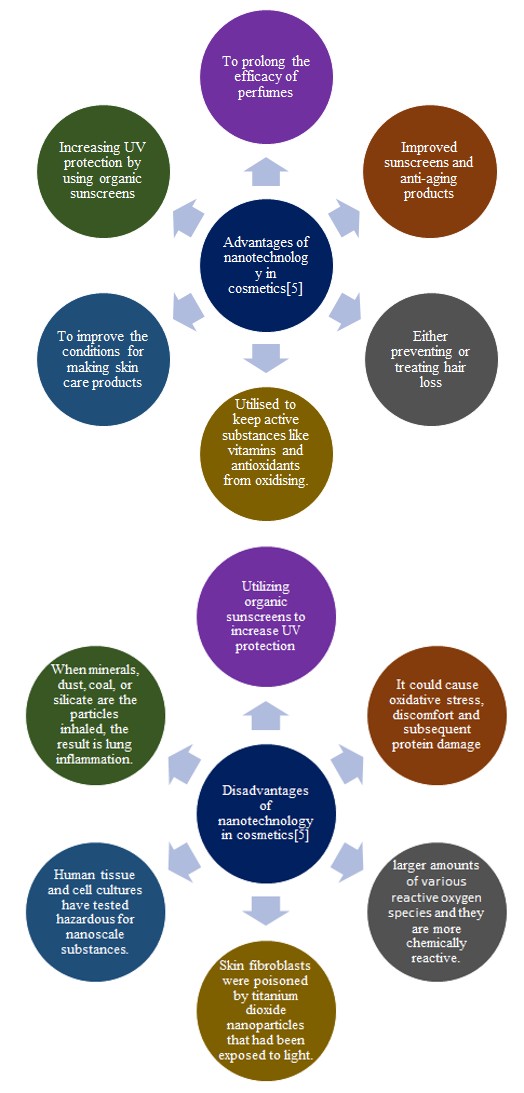
Disadvantages
Nanocarriers that made for Beauty Products
Liposome
- Biodegradable liposomes.
- Natural and non-toxic.
- A sphere made throughout a lipid bilayer that contains an water-filled space is known as a liposome (also known as a lipid body).
- Phospholipid is the lipid that is most frequently employed, while these lipids, glycolipids, and Liposomes have been created using a number of sterols..
- They range in dimensions from 25 to 5000 nm. You can create liposomes by a biological membrane tear (form through sonication ) Niosome
- Niosomes are cholesterol and non-ionic surfactants arranged in tiny lamellar structures.
- With polar portions the niosomes include an amphiphilic bilayer structure that provides non-polar places inside the bilayers where hydrocarbon prescription drugs will be captivated and outside and inside the vesicles where hydrophilic pharmaceuticals will be caught [5].
Dendrimers
- Dendrimers are artificial polymers with branching architecture that are bedded.
- Their name refers to the special arrangement of polymer molecules and stems at the Greek word “dendron,” which indicates “tree.”
- Because of their numerous unique properties, including their nanoscale size, single-dispersity, water solubility, multivalency, and manipulable surface modification, they have mostly worked in drug delivery investigations.
- In 1978, Fritz Vögtle and R.G. Denkewalter of Allied Corporation developed the first dendrimers. When the dendrimer’s core is removed, many comparable splinter named roots are found.
- Higher generation dendrimers are larger, more developing, and consist of higher ending groups at the margins than lower generation dendrimers.
Solid Lipid Nanoparticles (SLN)
- Particles located in micron-sized colloidal carriers, or SLN, distribute themselves in liquid or a water-based chemical solution., with sizes ranging from 50 to 1000 nanometers. The body contains lipids.
- Advantages of SLN
- improved control over the kinetics of chemical release from capsules
- No more solvent is necessary.
- exceptionally great long-term stability.
- Disadvantages of SLN
- Unexpected gelatine trend
- Growth of Particles Gold Nanoparticles
- Colloidal gold is another name for tiny gold particles, also known as gold nanoparticles, that disperse in water and have a diameter of 1 to 100 nm.
- By modifying the The electrical and spectral characteristics of gold nanoparticles can coexist within its dimension, shape, and surface chemistry.
- Gold nanoparticles have developed into a desirable substance in the cosmetic sector due to their potent antifungal and antibacterial capabilities.
Polymersomes Polymersomes are a type of artificial vesicle, which are minuscule hollow spheres that contain solutions. The vesicle membrane of polymersomes is constructed of synthetic block copolymers that are amphiphilic and should have a radius of 50 nm to 5 m or more. Compared to liposomes, they exhibit greater stability due to the hard and thick bilayer. The majority of polymersomes that have been identified have an aqueous solution in the centre, which makes them ideal for encapsulating and protecting delicate compounds including medicines, bytes of DNA and RNA, enzymes, along with peptides and protein fragments, as well as other molecules.
Nanoemulsion
- It usually consists of an aqueous substance scattered in a greasy phase or an oily phase diffused in a water phase, resulting in droplets or oily phases of nanometric size. Two non-miscible fluid propagate isotropically form small particles.
- Whenever it addresses oleophilic chemical substances, nanoemulsions sometimes have a larger loading capacity than microemulsions, which may be helpful in some situations.
- With tiny emulsion certain nanoemulsions need a substantial quantity of energy to produce, which renders them thermodynamically unstable systems.
- The most popular ways to make nanoemulsions are these three:
- high-pressure homogenization,
- micro fluidization, and
- phase-inversion temperature methodology.
Methods of Preparation
There are Several ways to make Nanoparticles, Including [6]:
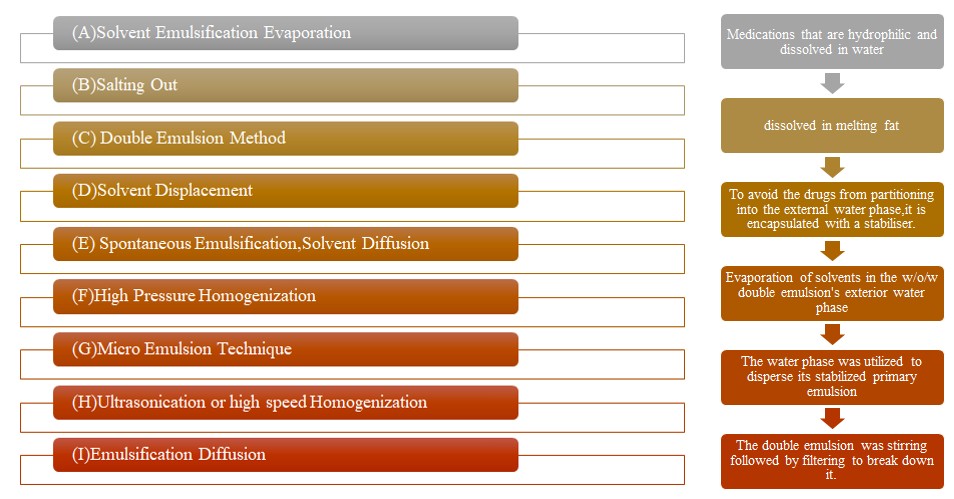
Solvent Emulsification Evaporation
Salting Out
Double Emulsion Technique
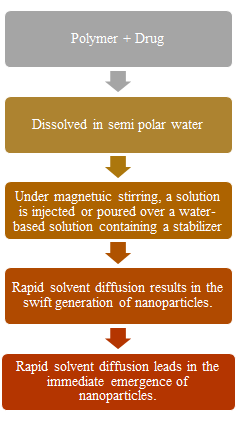
Solvent Displacement
Various Nanomaterials Utilized in the Preparation of Cosmetics and Cosmetic Ingredients [7]
Sunscreen Nanomaterials: Inorganic particles (TiO2, ZnO) Uniqueness: Reflect or absorb UV light Advantage: Biocompatible, stable, and hydrophilic Disadvantage: Respiratory toxicity Commercially Available Product: Lotus Professionals Phytorx UV Defense Sun Block SPF 100 Lipstick Nanomaterials: Silica (SiO2) Uniqueness: Used to fill the majority of the cosmetic formulation as filler Advantage: Hydrophilic, high cost of production Disadvantage: Respiratory toxicity Commercially Available Product: Used to fill the majority of the cosmetic formulation as filler Facemask/Mascara Nanomaterials: Carbon black Uniqueness: A colouring agent Advantage: Low Cost, high stability in terms of chemicals and heat, and lightweight Disadvantage: Cellular damage, which modifies the ability of neutrophils to phagocytose Commercially Available Product:
- Face Masque —Carbon BAE [8]
- Mascara Black—Lakme Sunscreen Nanomaterials: Small-scale organic (tris-biphenyl triazine) Uniqueness: Optimum UVB and UVA 2 filter out Advantage: Strong and stable filter Disadvantage: Potentially harmful to aquatic environments Commercially Available Product: Extra UV Gel—Allie Toothpaste Nanomaterials: Nanohydroxyapatite Uniqueness: Secure in children’s toothpaste Advantage: Dental polish and desensitizers that remineralize teeth Disadvantage: Extreme brittleness Commercially Available Product
- Kinder Karex Hydroxyapatite
- APAGARD M plus—Sang Facemask/Anti-Aging Cream Nanomaterials: Gold and silver nanoparticles Uniqueness: Enhanced Raman scattering on the surface Advantage: Chemical stability, standardised pharmacokinetics and antibacterial as well as antifungal consistent form, measurement, and extend length, and distribution in the environment Disadvantage: High dosages cause DNA and cell damage in humans; lung toxicity Commercially Available Product
- Gold Radiance Peel-Off Mask–VLCC
- Nano Gold Firming Treatment— Chantecaille Face Cream Nanomaterials: Buckyballs (buckminsterfullerene/C60 Uniqueness: Powerful free radical scavenger Demonstrates antioxidant activity, thermostability, and photostability; guards against various oxidative stress- related skin issues Disadvantage: lung toxicity, damage to brain cells, and extreme hydrophobic Commercially Available Product: Brightening Essence— Juva Skincare.
Properties of Nanoparticles
- They serve as a conduit between molecular or chemical structures and bulk materials.
- While at the nanoscale size-dependent features are sometimes observed, a Bulk material require to preserve regular physical attributes. at all sizes.
- The ratio of of atoms at the surface is very small (micron), in contrast with every single atom in bulk materials greater than a micron in size.
- Specifically at high temperatures, the elevated levels given area-to-volume ratio between nanocrystals acts as a potent diffusion driver. Compared to bigger particles, sintering may occur at warmer temperatures and over a shorter amount of space.
- With the particle surface’s strong enough contact with the solvent allows it to conquer differences in density— which would otherwise cause the material to sink or float in a liquid—nanoparticle suspensions are plausible.
- As a result of their capacity to generate quantum effects and confine electrons, nanoparticles often exhibit unexpected optical properties. Gold nanoparticles in solution, for example, appear dark red to black.
- Half hydrophilic and half hydrophobic, Janus particles are a special kind of nanoparticle that works well at stabilising emulsions. At the water/oil interface, they can self-assemble and perform the role of solid surfactants.
- It is essential to confirm that the photocatalytic activity of the nanoparticles does not result in the composite system self-destructing before adding them to a polymer matrix.
Conclusion
Nanotechnology is a rapidly emerging field with many promising applications in business, health, cosmetics, and society. Nanomaterials are included in many skin care products as a way to make use of the unique properties of matter at the nanoscale. Dermatologists who have a close relationshipconcerned the appearance of skin should be aware of this new technology, share it across to their others, and actively participate in its evaluation and the creation of guidelines and policies that will ensure its appropriate and advantageous usage.
Acknowledgement
I am grateful to Prof. Y.P. Sharma for increasing me to learn about scientific data as well as provide inspiration for my research.
References
-
Maynard AD (2006) Nanotechnology: A Research Strategy For Addressing Risk. PEN.
-
Robert FS (2005) EPA ponder voluntary Nanotechnology Regulations. Science 309(5731): 36.
-
William A, Goddard I, Brenner D, Sergey Edward L, Gerald JI (2007) A Handbook on Nanoscience, Engineering and Technology. In: 2nd (Edn.), Taylor and Francis.
-
Morganti P (2010) Use and potential of nanotechnology in cosmetic dermatology. Clinical, cosmetic and investigational dermatology 3: 5-13.
-
Patel A, Prajapati P, Boghra R (2011) Overview on application of nanoparticles in cosmetics. Asian J Pharm Clin Res 1(2): 40-55.
-
Mittapally S, Aziz A, Student A, Afnan AA (2019) A review on nanotechnology in cosmetics. Pharma Innov Int J 8(4): 668-671.
-
Gupta V, Mohapatra S, Mishra H, Farooq U, Kumar K, et al. (2022) Nanotechnology in cosmetics and cosmeceuticals—A review of latest advancements. Gels 8(3): 173.
-
Kushwaha N, Minocha N, Kumar N (2020) Use of nanotechnology in cosmeceuticals: a review. Int J Pharm Sci Invent 9(1): 43-51.
- Solution-Processed Chiral Perovskites for Biomedical Applications
- Nanotechnology in Health Chemistry and Medicine: Current Challenges and Future Directions
- Human Exposure to Micro- and Nanoplastics: Pathways, Toxicity, and Intervention Strategies
- Exosome Nanomedicine for Cancer Therapy
- Micro and Nanoplastics–Plastisphere, Biotoxicity, Impact on Human Health, and Mitigation Strategies
- Process Validation of Cefixime Powder for Suspension Dosage Form, 50 mL