
Experimental Investigation on the Synthesis of Nanostructures Based on Fullerene C70 and Their Stability
Nanostructures based on fullerene C70 are of great interest due to their wide application in modern branches of science and technology. In this work, a method for synthesizing nanostructures of various dimensions (nanoaggregates and nanowhiskers) of fullerene C70, based on the self-organization of C70 molecules during the evaporation of droplets of a solution of fullerene in ethylbenzene on the substrate surface, is proposed and implemented for the first time. It has been established that the onset of C70 nanowhisker synthesis during evaporation of C70 solution droplets on the substrate surface depends on the substrate temperature. Experimental evidence is presented that an increase in both the C70 concentration in the solution and the substrate temperature leads to an increase in the geometric dimensions of C70 nanowhiskers. The stability of the resulting nanostructures to high temperatures has been determined. The results obtained provide the necessary information on the role of solution concentration and substrate temperature in the synthesis of one-dimensional nanomaterials.
Makhmanov UK¹,²*, Aslonov BA¹ and Chuliyev TA¹,³
¹Institute of Ion-Plasma and Laser Technologies, Uzbekistan ²National University of Uzbekistan, Uzbekistan ³Gulistan State University, Uzbekistan
Introduction
Fullerenes continue to hold significant potential as nanoscale raw materials for molecular engineering, novel materials, and supramolecular chemistry [1]. This potential is attributed to their high symmetry, novel π-conjugated systems, and unique chemical and physical properties. Consequently, supramolecular nanostructures based on fullerenes, such as nanowhiskers [2], nanotubes [3, 4, 5], nanorods [6], nanowires [7], and nanolayers [8], are of particular interest.
In modern science, nanowhiskers are defined as thread- like crystals with a cross-section of up to 100 nm and a length significantly exceeding the cross-section [9]. Currently, metallic, inorganic, and carbon nanowhiskers are of particular interest; they can be obtained naturally or through synthetic methods. Nanowhisker synthesis is achieved using various techniques, including molecular beam epitaxy, vapor deposition, laser ablation, magnetron deposition, and chemical epitaxy in high vacuum, among others [10, 11]. Nanowhiskers exhibit several times greater strength than conventional crystals, along with high conductivity, flexibility, water-repellent properties, and corrosion resistance [12]. Semiconductor nanowhiskers are widely employed in the development of device elements across fields such as microelectronics, optoelectronics, nanoengineering, solar energy, biomedicine, nanoelectromechanics, and gas sensors [13, 14, 15, 16].
Light fullerenes (C60/C70) are hollow, spherical or ellipsoidal carbon molecules with diameters of less than 1 nm, composed of sp2 carbon atoms arranged in truncated icosahedral structures. A notable property of fullerene molecules is their ability to self-assemble in pure solvents over time, leading to the formation of nanoclusters with various shapes and sizes [17]. The solvent’s nature plays a crucial role in this self-assembly process. The molecular self- assembly, reactivity, and electron-acceptor characteristics of fullerenes offer unparalleled advantages in applications such as electrocatalysts and supercapacitors [18]. Furthermore, fullerenes possess high photosensitivity, electron mobility, antioxidant activity, and radical scavenging capabilities [19]. These properties make them highly attractive for a wide range of applications, including photodetectors, sensors, solar cells, LEDs, biomedicine, and drug delivery systems [20, 21, 22].
Since the discovery of C60 fullerene nanowhiskers (C60NWs) by Miyazawa KI, et al. [23], these structures have found applications across various fields. The synthesis method involves adding a poor solvent to a saturated solution of C60, which leads to the formation of a liquid-liquid interface. This results in a supersaturated solution where C60 crystal nuclei form at the interface, leading to the synthesis of elongated C60NWs. Although this method was initially “static” (without external influence), later developments introduced “dynamic” approaches (such as ultrasound and manual mixing) and other modified techniques [24]. Similarly, C70 fullerene nanowhiskers (C70NWs) were synthesized using the same methods based on C70 fullerenes [25].
The formation of nanowhiskers from nanoscale fullerenes relies on bottom-up technology, where precise regulation and control of NWs size and structure are crucial. Notably, when fullerene NWs synthesized in solution are transferred to a solid substrate, their morphology undergoes significant changes [26]. This change is caused by the self- assembly of fullerene nanoparticles during the evaporation of drops of a colloidal solution (containing nanostructures) of fullerene on the substrate surface. In our opinion, if one- dimensional nanostructures are synthesized using molecular solutions of fullerene on the surface of a solid substrate, it is possible to control their morphology. In addition, the stability of fullerene nanostructures synthesized on the substrate surface is considered very important and is currently poorly studied. Therefore, it is very important to study the processes that occur during the evaporation of fullerene molecular solution droplets on the surface of a solid substrate, control the size and morphology of synthesized nanostructures, as well as their stability.
In this work, scientific results on the synthesis of C70 fullerene nanostructures (nanoaggregates and nanowhiskers) on the substrate surface by evaporation of a microdroplet of C70 molecular solution and their structural stability characteristics are described.
Materials and Methods
In the experiments, fullerene C70 powders with high purity of ~99.8% (Sigma-Aldrich, USA) were used, and dichlorobenzene (C6H4Cl2, Sigma-Aldrich) was used as an organic solvent. The solubility of C70 powders in dichlorobenzene at room temperature is approximately 18.5 mg/mL. The mixture of dichlorobenzene and C70 powders, contained within a hermetically sealed glass vessel, was subjected to continuous mechanical stirring for 1 hour at a frequency of approximately 2.0 Hz, using a MS-11H programmed laboratory magnetic stirrer (WIGO, Poland). The magnetic stirrer is used for mixing low-viscosity liquid (dichlorobenzene) and soluble substances (C70) at different frequencies (0÷40 Hz) at the room temperature. Subsequently, the C70 solution was sonicated for 20 minutes using a DC-120H ultrasonic bath. The DC-120H ultrasonic bath is made of stainless steel with wire basket and lid. Its temperature range is from Ambient to 70°C, it can affect the solution at 40 KHz frequency.
A thermostatically controlled table with an accuracy of ±1°C was employed for heat treatment experiments utilizing the Peltier effect. The temperature of the glass substrate was monitored with an accuracy of ±2% using a thermocouple connected to an MS8217 digital multimeter.
Droplets of C70 solution were applied to the substrate surfaces using a VITLAB pipette dispenser (VITLAB GmbH, Germany) under controlled laboratory conditions. The solution and ambient temperature were approximately ~23±1°C, and the droplets were protected from convective air currents until complete evaporation.
In the experiments, a “Motic B1-220A” optical binocular microscope with a digital camera was used to record continuous images of dispersed phase rings. The maximum possible magnification in the Motic B1-220A microscope is 1000x.
We employed a JSM-IT200 high-resolution scanning electron microscope (JEOL, Tokyo, Japan) to investigate the morphological features and accurately measure the geometrical dimensions of one-dimensional C70 nanowhiskers (C70NWs) and nanoaggregates. In the electron microscope, control functions such as switching the cathode to the operating mode, focusing the image, eliminating astigmatism, adjusting brightness and contrast are automated. The JSM- IT200 microscope implements the mode of studying samples even under controlled low vacuum conditions. The pressure in the sample chamber studied under the microscope can vary from 10 to 100 Pa.
Experimental Results and Their Discussion
The shape of a droplet of fullerene solution with a volume of V ≈ 40÷50 μL on a flat surface resembles the shape of a segment of a sphere. It is noteworthy that the base area of the droplet remains constant throughout the thermal evaporation process. However, the contact angle (α) of the droplet gradually decreases until it reaches zero degrees. This behavior is attributed to strong capillary flows induced by the Marangoni effect along the droplet-air interface and the Rayleigh-Bénard effect within the evaporating droplet volume (Figure 1). These effects lead to significant capillary flows, facilitating the assembly of fullerene nanoparticles and the subsequent synthesis of various nanostructures.
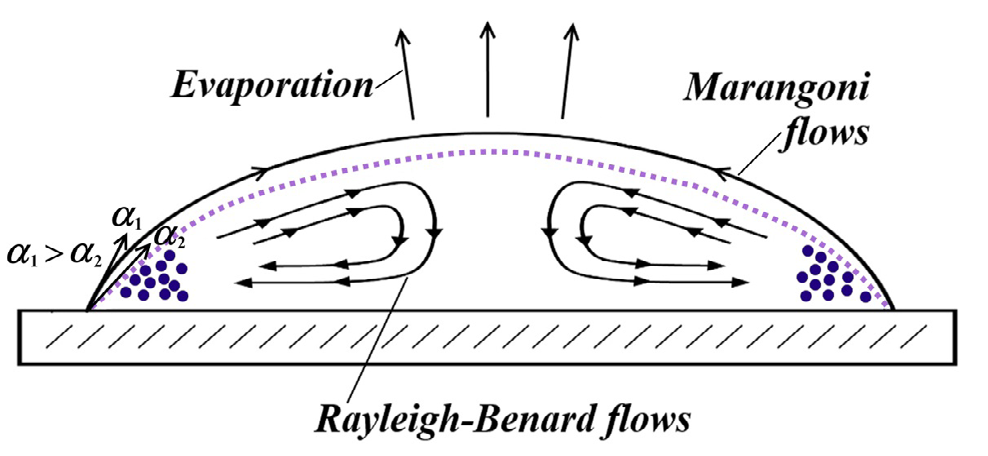
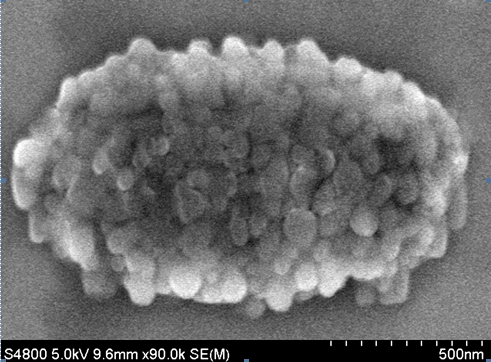
Figure 2 shows an SEM image of the structures formed by the evaporation of droplets of C70 solution in dichlorobenzene at room temperature (~24 ± 1°C) on a base surface. Due to the constant base area of the microdroplet, the residue left after complete solvent evaporation resembles a coffee ring, indicating a trace of nanostructures. The temperature gradient, resulting from the rapid cooling of the surface and near-surface layers of the droplet, plays a crucial role in this process. Upon complete solvent evaporation, ellipsoidal C70 aggregates were observed on the substrate surface (Figure 2). The average polar and equatorial diameters of these C70 aggregates were ~1500 nm and ~900 nm, respectively. The resulting C70 aggregates are porous and consist of discrete intermediate nanoaggregates with an average diameter of ~50÷60 nm.
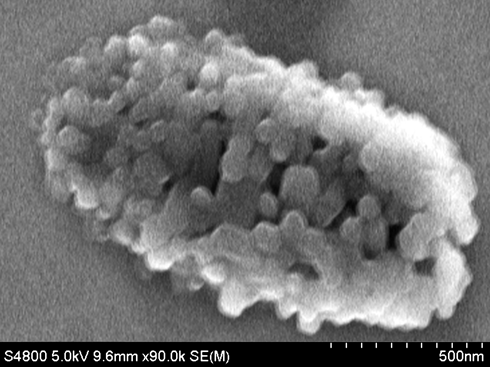
Figure 3 presents an SEM image of C70 nanoaggregates synthesized at ~24±1°C after heating to ~185°C on the substrate surface. The image reveals that the overall appearance and dimensions of the nanoaggregates, which exhibit a porous and fractal structure, were maintained during the synthesis. However, several porous cracks were observed in the nanoaggregates, which we attribute to the complete evaporation of solvent molecules throughout the volume of the nanoaggregates at this elevated temperature.
To synthesize one-dimensional C70 structures, the evaporation process of a C70 solution droplet on a substrate was conducted at various temperatures. When the solid substrate was heated to ~32°C, nanostructured filaments (whiskers) of C70 fullerene with an optimal shape were synthesized on the substrate surface (Figure 4). The concentration of C70 fullerene in the initial droplet of the solution was ~5.6 mg/mL. At 32°C, the intense solvent evaporation from the microdroplet creates a temperature gradient that helps overcome certain energy barriers in the formation of C70 nanowires (C70NWs). In this case, the average geometric dimensions of the C70NWs were ~1.5 µm in width and ~9 µm in length.
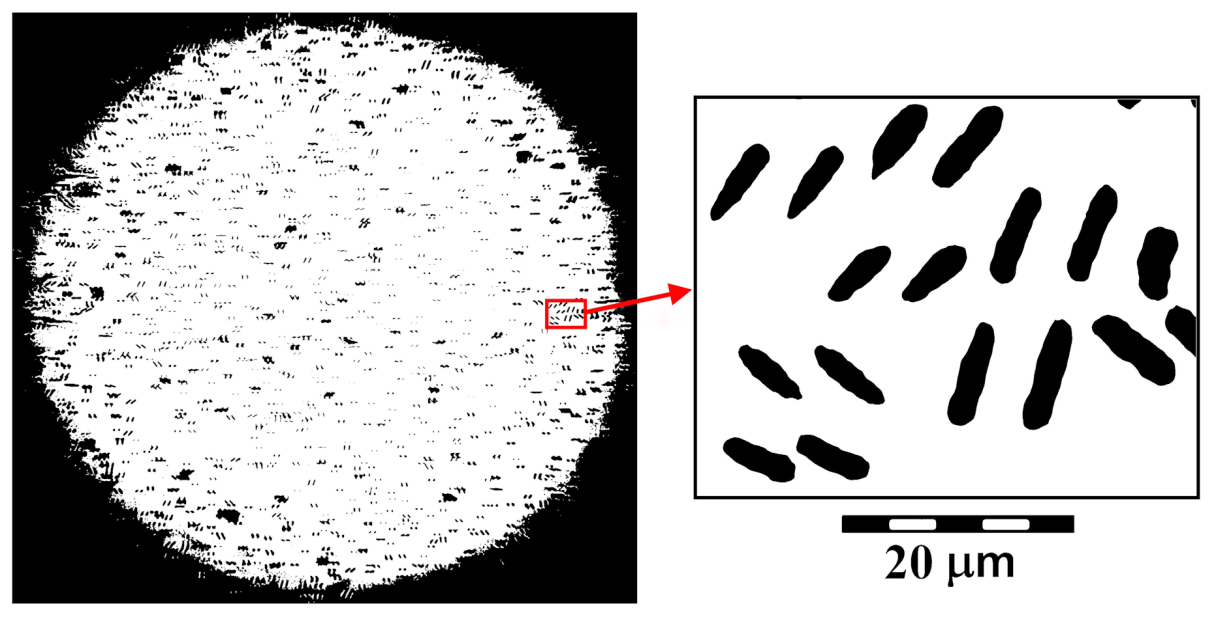
Figure 5 shows an SEM image of C70 nanowires (C70NWs) synthesized on a horizontally oriented substrate heated to 36°C. The initial concentration of C70 in the droplet was ~2.5 mg/mL. During the evaporation of the droplet, strong capillary currents in both the volume and surface layers of the droplet initiate the self-assembly of fullerene particles and the synthesis of C70 filaments. The C70NWs depicted in Figure 5 have a molecularly flat surface. The average geometric dimensions of these NWs were ~1.75 µm in length and ~100 nm in width. These results indicate that the size of the C70 nanowhiskers can be adjusted by varying the initial concentration of fullerene in the solution.
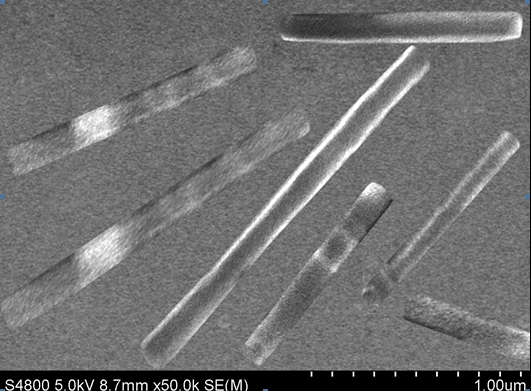
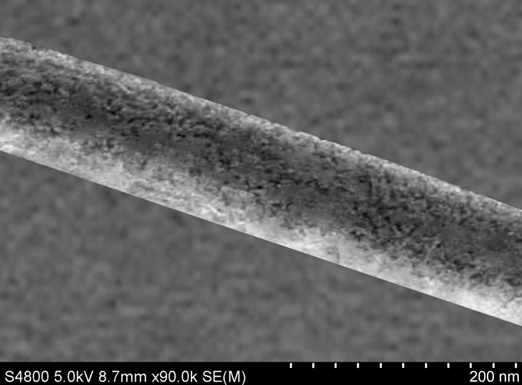
Figure 6 presents an SEM image of C70 nanowhiskers synthesized at ~36°C on the base surface, followed by heating to ~185°C. The image shows that, at this temperature, the overall appearance and dimensions of the C70 nanowhiskers were preserved, although small nanocraters were observed on their surface. This indicates that the C70 nanowhiskers are sufficiently resistant and stable as one-dimensional structures at elevated temperatures.
The experiments revealed that the geometric dimensions of the formed C70 nanowhiskers (C70NWs) can be controlled by varying both the substrate temperature and the concentration of fullerene. Specifically, an increase in substrate temperature accelerates the formation and growth of crystalline nanowhiskers, while also significantly enlarging their geometric dimensions. Table 1 presents the experimental results, illustrating the changes in the geometric dimensions of the synthesized C70NWs. It is easy to see from the table that by increasing the concentration of C70 by 1.2 times, the average length of the synthesized C70NS can be increased to 1.45 times, and the average diameter to 1.12 times.
| T/ (°C)^{b}$ | Average length (µm) | Average width (nm) | |
|---|---|---|---|
| 2.5 | 32 | 1.25 | 85 |
| 2.5 | 36 | 1.75 | 100 |
| 2.5 | 40 | 2.1 | 118 |
| 3 | 32 | 1.48 | 94 |
| 3 | 36 | 1.9 | 122 |
| 3 | 40 | 3.05 | 133 |
Table 1: ** Variation in the Average Size of Synthesized C70 Nanowhiskers (C70nws) as a Function of Substrate Temperature and C70
aConcentration of C70 in solution. bThe substrate temperature (T) is maintained constant until the droplet is completely evaporated. Table 1: Variation in the Average Size of Synthesized C70 Nanowhiskers (C70nws) as a Function of Substrate Temperature and C70 Concentration.
Conclusion
For the first time, as a result of self-organization of С70 fullerene molecules in the volume of evaporation of solution droplets, synthesis of nanostructures of different dimensions (nanoaggregates and nanowhiskers) was carried out. Synthesis of C70 fullerene-based nanostructures using droplet evaporation on the substrate surface is a cost-effective and versatile method. By changing the initial fullerene concentration and substrate temperature, it is possible to adjust the morphology of C70 nanostructures according to desired values, which is one of the main scientific novelties of the research. Electron microscopic measurements confirmed that ellipsoidal nanoaggregates were synthesized during droplet evaporation on the substrate surface at room temperature, while one-dimensional C70 nanowires (C70NWs) were formed during droplet evaporation on a heated substrate surface at 32°C. The average polar and equatorial diameters of C70 nanoaggregates are ~1500 nm and ~900 nm, respectively, and the structure is porous, consisting of discrete intermediate aggregates with an average diameter of ~50÷60 nm. The results of controlling the average geometrical dimensions of C70NWs by changing the experimental conditions are also presented and analyzed. In addition, the structural stability of C70 nanoaggregates and C70NWs after heating to ~185°C on a solid substrate surface was determined. The proposed method has proven effective for synthesizing micro- and nanoscale fullerene- based whiskers, which can be applied in various “bottom-up” technology processes.
Acknowledgements
The present research was supported by a project of the Ministry of Higher Education, Science and Innovation of the Republic of Uzbekistan: FL-8323102108 “Synthesis and modification of carbon-based functional nanomaterials, research of their interactions with atomic particles”.
References
-
Mojica M, Alonso JA, Méndez F (2013) Synthesis of fullerenes. J Phys Org Chem 26(7): 526-539.
-
Bakhramov SA, Makhmanov UK, Aslonov BA (2023) The Synthesis of C70 Fullerene Nanowhiskers Using the Evaporating Drop Method. Condens Matter 8(3): 62.
-
Miyazawa K, Minato J, Fujino M, Suga T (2006) Structural investigation of heat-treated fullerene nanotubes and nanowhiskers Diam Relat Mater 15(4): 4-8.
-
Miyazawa K, Minato J, Yoshii, T Fujino M, Suga T (2005) Structural characterization of the fullerene nanotubes prepared by the liquid–liquid interfacial precipitation method J Mater Res 20(3): 688–695.
-
Makhmanov UK, Kokhkharov AM, Bakhramov SA, Esanov SA (2022) Synthesis of fullerene C60 nanotubes in the volume of an evaporating drop of colloidal solution. Rom J Phys 67: 601-607.
-
Maji S, Shrestha LK, Ariga K (2021) Nanoarchitectonics forHierarchical Fullerene Nanomaterials Nanomaterials 11(8): 2146.
-
Shrestha LK, Shrestha RG, Yamauchi Y, Hill JP, Nishimura T, et al. (2021) Fullerene Nanoarchitectonics: Rich Possibilities in Organized Structures from Zero- Dimensional Angew Chem 21(6): 221-225.
-
Kasálková NS, Slepicka P, Švorcík V (2021) Carbon Nanostructures, Nanolayers, and Their Composites Nanomaterials 11(9): 2368.
-
Maksimovskii SN (2019) Growth of nanowhiskers in laser plasma: nanowhiskerography as a new method for protected printing with employment of scanning laser radiation. J Russian Laser Res 40: 30-34.
-
Zhang X, Dubrovskii VG, Sibirev NV, Cirlin GE, Sartel C, et al. (2010) Growth of Inclined GaAs Nanowires by Molecular Beam Epitaxy: Theory and Experiment. Nanoscale Res Lett 5: 1692-1697.
-
Xia M, Guo HY, Hussain MI (2020) Controllable Combustion Synthesis of SiC Nanowhiskers in a Si–C–N System: The Role of the Catalyst. Appl Sci 10(1): 252.
-
Pian MD, Maggini M, Vancso GJ, Causin V, Benetti EM (2019) Poly(3-hexylthiophene) Nanowhiskers Filler in Poly(ε-caprolactone) Based Nanoblends as Potential Bioactive Material. Eur Polym J 114: 144-150.
-
Yin H, Lin H, Zong Y, Wang XD (2021) The recent advances in C60 micro/nanostructures and their optoelectronic applications. Org Electron 93: 106142.
-
Miyazawa K (2009) Synthesis and properties of fullerene nanowhiskers and fullerene nanotubes. J Nanosci Nanotechnol 9(1): 41-50(10).
-
Kausar A State-of-the-Art of Fullerene-Based Nanocomposite Nanofibers—Enterprise and Technological Amenabilities. Polym Plast Technol Mater 62: 1157-1177.
-
Nikolic MV, Milovanovic V, Vasiljevic ZZ, Stamenkovic Z (2020) Semiconductor Gas Sensors: Materials, Technology, Design, and Application. Sensors 20(22): 6694.
-
Makhmanov UK, Kokhkharov AM, Bakhramov SA, Erts D (2020) The formation of self-assembled structures of C60 in solution and in the volume of an evaporating drop of a colloidal solution. Lith J Phys 60(3): 194-204.
-
Xu T, Shen W, Huang W, Lu X (2020) Fullerene micro/ nanostructures: Controlled synthesis and energy applications. Mater Today Nano 11: 100081.
-
Itaka K, Yamashiro M, Yamaguchi J, Haemori M, Yaginuma S, et al. (2006) High-Mobility C60 Field-Effect Transistors Fabricated on Molecular-Wetting Controlled Substrates. Adv Mater 18(13): 1713-1716.
-
Su M, Hu Y, Yu A, Peng, Z Long W, et al. (2021) Molecular engineering for high-performance fullerene broadband photodetectors. Nanoscale Adv 3(4): 1096-1105.
-
Paukov M, Kramberger C, Begichev I, Kharlamova M, Burdanova M (2023) Functionalized Fullerenes and Their Applications in Electrochemistry, Solar Cells, and Nanoelectronics. 16(3): 1276.
-
Minami K, Song J, Shrestha LK, Ariga K (2021) Nanoarchitectonics for fullerene biology. Appl Mater Today 23: 100989.
-
Miyazawa KI, Obayashi A, Kuwabara M (2001) C60 nanowhiskers in a mixture of lead zirconate titanate sol– C60 toluene solution. J Am Ceram Soc 84(12): 3037-3039.
-
Mchedlov-Petrossyan NO, Marfunin MO, Kriklya NN (2024) Colloid Chemistry of Fullerene Solutions: Aggregation and Coagulation. Liquids 4(1): 32-72.
-
Makhmanov UK, Esanov SA, Aslonov BA, Bekmurodov Z, Musurmonov KN, et al. (2023) Controlling the size of C70 fullerene whiskers by evaporation of solution droplets Rom J Phys 68: 616.
-
Bakhramov SA, Makhmanov UK, Kokhkharov AM (2019) Synthesis of Nanoscale Fullerene C60 Filaments in the Volume of an Evaporating Drop of a Molecular Solution and Preparation of Thin Nanostructured Coatings on Their Basis. Appl Sol Energy 55(5): 309-314.
- Solution-Processed Chiral Perovskites for Biomedical Applications
- Nanotechnology in Health Chemistry and Medicine: Current Challenges and Future Directions
- Human Exposure to Micro- and Nanoplastics: Pathways, Toxicity, and Intervention Strategies
- Exosome Nanomedicine for Cancer Therapy
- Micro and Nanoplastics–Plastisphere, Biotoxicity, Impact on Human Health, and Mitigation Strategies
- Process Validation of Cefixime Powder for Suspension Dosage Form, 50 mL