
The Influence of Aberrations on the Accuracy of Astrometry and Photometry
Aberrations in optical systems pose critical challenges to the precision of astrometric and photometric measurements, directly impacting our ability to accurately determine the positions and brightness of celestial objects. There are different aberration types including spherical aberration, coma, diffraction rays, motion blur, astigmatism, flare light, field curvature, vignetting, and chromatic aberration. They cause distortions in the recorded images, affecting the accuracy and reliability of measurements in both astrometry and photometry. This review aims to offer insights into both the theoretical and practical aspects of aberration control, providing a foundation for future advancements in precision astrometry and photometry, essential for understanding the Universe with unprecedented accuracy.
Abbreviations
PSF: Point Spread Function; CCD: Charge-Coupled Device; SNR: Signal-to-Noise Ratio; AI: Artificial Intelligence; VLT: Very Large Telescope.
Introduction
Astrometry and photometry are foundational techniques in observational astronomy, critical for precisely determining the positions, movements, and brightness (light curves) of celestial objects [1, 2, 3, 4, 5, 6, 7]. As astronomical instrumentation advances, the demand for higher accuracy in these measurements has grown, particularly for fields such as exoplanet detection, catalogs cross-matching, galaxy mapping, and high-precision stellar and satellites tracking [8].
However, optical aberrations like deviations from the ideal behavior of optical systems pose significant challenges to this pursuit. Aberrations, such as spherical, diffraction rays, coma, astigmatism, motion blur, flare light, vignetting, field curvature, and chromatic effects, distort incoming light, resulting in errors in recorded positions and intensity measurements. When observing faint, distant objects, even minor inaccuracies can hinder data reliability, leading to compromised results.
This review explores the types of optical aberrations that impact astrometric and photometric accuracy and examines recent advancements in aberration correction. Listed above distortions and aberrations alter the point spread function (PSF), leading to inaccuracies in position measurements and affecting flux measurements, which, in turn, impedes the analysis of stellar brightness and faint object detection [9].
The goal is to provide an overview of the mechanisms by which these aberrations arise, their specific effects on image fidelity, and the methods currently employed to minimize their impact. This review will also discuss ongoing developments in aberration mitigation, emphasizing the significance of improved imaging accuracy in advancing astronomical research and precision observation [10].
Causes of Aberrations
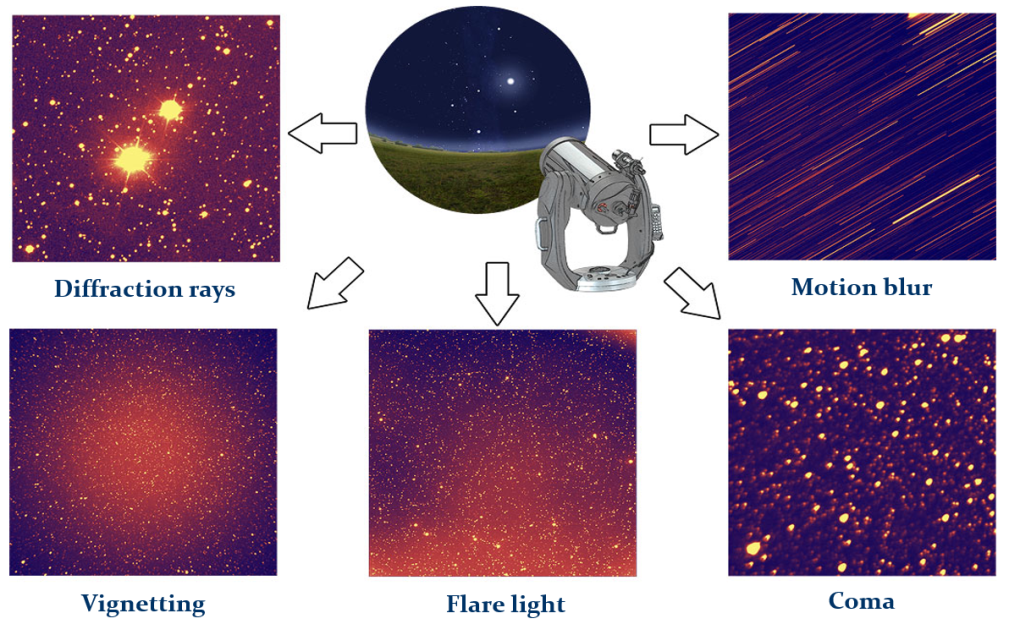
Aberrations in optical systems arise due to imperfections in the design, fabrication, or alignment of optical components, as well as external factors influencing light propagation (Figure 1). Here are the primary reasons behind their occurrence [11]:
- Spherical aberration occurs because spherical lenses or mirrors fail to focus all incoming parallel light rays to the same point. This arises from the geometry of the spherical surface, which introduces variations in focal length for rays hitting different parts of the lens or mirror. It leads to a blurred or distorted image, particularly when observing bright or sharp-edged objects [12].
- Coma is a result from off-axis light rays passing through a lens or mirror. These rays focus at different points, creating an asymmetrical, comet-shaped distortion. Such effect is a common in wide-field imaging, where objects near the edges of the field of view appear stretched or smeared.
- Astigmatism arises when an optical system has different focal lengths for rays in perpendicular planes. This is often due to lens or mirror misalignment or imperfections in their surface curvature. Such effect produces images that are sharp in one direction but blurred in the perpendicular direction.
- Field curvature is a result from the natural tendency of lenses and mirrors to focus light onto a curved surface rather than a flat image plane. This causes parts of the image (center or edges) to be out of focus unless corrected.
- Distortion (pincushion and barrel) occurs due to non- uniform magnification across the field of view, often from improperly shaped or spaced lens elements. It alters the shape of objects, causing them to appear stretched (pincushion) or compressed (barrel).
- Chromatic aberration happens because lenses have different refractive indices for different wavelengths of light. This disperses light into its constituent colors, with each color focusing at a slightly different point. Such effect results in colored fringes around objects, especially at high-contrast edges.
- Atmospheric aberrations occur due to atmospheric turbulence, temperature gradients, and varying refractive indices in the Earth’s atmosphere. These distortions primarily affect ground-based telescopes and causes scintillation (twinkling) and blurring of celestial objects, limiting resolution [13].
- Diffraction rays occurs when light waves encounter an obstacle, such as the edges of an aperture, support structures (spider vanes), or imperfections in the optical system. The wave nature of light causes it to bend and interfere, forming patterns such as diffraction spikes. Such effect produces star-like spikes around bright point sources, common in images captured by telescopes with secondary mirror supports. Diffraction limits the resolving power of an optical system, setting a fundamental limit on the smallest angular detail observable.
- Motion blur arises from the relative movement between the charge-coupled devices (CCD), camera or telescope and the observed object during the exposure time. This can result from telescope vibrations, tracking errors, or the movement of celestial objects. Such effect causes streaking or smearing of the image, reducing positional accuracy in astrometry and making flux measurements in photometry unreliable [14].
- Flare light results from internal reflections or scattering within an optical system due to bright light sources in or near the field of view. Poor lens coatings, scratches, or contamination on optical elements exacerbate the problem. Flare light creates halos, streaks, or ghost images, reducing image contrast and affecting brightness measurements in photometry [15].
- Vignetting occurs when light rays from the edges of the field of view are partially obstructed by the lens barrel, aperture edges, or other structural components of the optical system. This is often a design or alignment issue. Vignetting leads to a gradual darkening of the image toward the edges, impacting uniformity in photometric data. In extreme cases, faint objects at the edges of the field of view may become undetectable.
- Mechanical or manufacturing defects arise from imperfections in the production process, such as surface roughness, misalignment of optical components, or material inhomogeneity. Such effect introduces additional, unpredictable distortions to the image.
All mentioned factors collectively influence the precision of observational data. Diffraction limits spatial resolution, motion blur causes positional inaccuracies (astrometry), and flare light can obscure faint stars. Vignetting reduces photometric uniformity, and flare light distorts brightness measurements [16].
By understanding these causes, optical systems can be designed and optimized to minimize aberrations, using advanced materials, corrective elements, and calibration techniques. Mitigating these effects involves using strategies such as precision tracking systems, baffling to reduce flare light, improved optical coatings, careful telescope alignment, and software corrections during image processing [17, 18].
Aberration Resolving
Numerous studies have addressed the influence of optical aberrations on astrometric and photometric measurements, underscoring their detrimental effects on the reliability of astronomical data.
Optical Aberration Mitigation
Early work by Born M, et al. [19] laid the theoretical foundation for understanding optical aberrations and their impact on imaging quality. Spherical aberration, for example, causes rays from a single point source to spread out rather than converge, which reduces image sharpness and alters the PSF. Subsequent research expanded this understanding, with Smith WJ [20] detailing how coma and astigmatism distort images asymmetrically, further affecting the precision of position measurements.
With the development of adaptive optics in the late 20th century, researchers made significant progress in correcting aberrations caused by atmospheric turbulence in ground- based telescopes. Beckers JM [21] pioneered adaptive optics techniques, using deformable mirrors to counteract wavefront distortions in real-time, greatly enhancing the resolution of ground-based imaging. Today, adaptive optics remains essential for mitigating aberrations in many large telescopes, including the Keck Observatory and the Very Large Telescope (VLT) [22, 23]. Study by Tyson RK, et al. [24] emphasizes the impact of such technologies on high- precision observations, particularly for faint object detection and deep-sky surveys.
Optic Calibration
Optic calibration refers to the process of adjusting and aligning optical systems to ensure their performance meets desired specifications. It is critical for improving the accuracy of measurements in various applications, including astronomy, microscopy, imaging systems, and sensors [25]. Calibration compensates for systematic errors and optimizes system performance by addressing optical aberrations, misalignments, or environmental influences.
The main purposes of the optic calibration are to perform telescope alignment, photometric standardization and distortion mapping as well as to minimize errors, enhance accuracy and optimize performance. Telescope alignment ensures that mirrors and lenses are precisely aligned for optimal focusing and minimal aberrations. Photometric standardization establishes baseline measurements for celestial brightness using reference stars. Distortion mapping corrects field distortions in wide-field surveys for accurate astrometric data. Errors minimization reduces distortions, aberrations, and other deviations in the optical system. Accuracy enhancing ensures that measurements, such as angular positions (astrometry) or light intensity (photometry), are as precise as possible. Performance optimization aligns the optical path for maximum efficiency in focusing and image quality [1, 6].
The Main Steps in the Optic Calibration are the Following: Baseline measurement (initial testing of the system to identify deviations or errors) -> identification of defects (detecting issues like misalignments, aberrations, or uneven illumination) -> adjustment (correcting errors through hardware such as realigning lenses or mirrors and software such as image processing algorithms) -> validation (rechecking performance post-calibration to ensure the system meets specifications).
There are a Lot of Different Parameters, which are used for Calibration: Geometric, focus, spectral, photometric, and polarization [26]. Geometric calibration corrects image distortions, such as barrel or pincushion distortion, ensuring spatial accuracy. Focus calibration adjusts the focal plane to optimize resolution and minimize blurring [27]. Spectral calibration ensures wavelength accuracy, crucial for spectroscopic applications and chromatic aberration corrections. Photometric calibration standardizes intensity measurements for accurate brightness determination. Polarization calibration compensates for polarization effects introduced by optical components, critical for some specialized observations.
To Perform the Optic Calibration the Several Techniques are used: Wavefront sensing, star tests, artificial targets, ray-tracing simulations and master frames calibration. Wavefront sensing detects and analyzes distortions in the wavefront of light to correct aberrations in real-time (e.g., Shack-Hartmann sensor, interferometry) [28]. Star test is a defocusing images of stars and analysis to detect and adjust optical misalignments. Artificial targets use precisely designed patterns (e.g., calibration grids or checkerboards) to measure distortion and misalignment. Ray-tracing simulations use the different models of the optical system to predict and correct aberrations or other imperfections. Flat-field calibration corrects uneven illumination across the sensor or detector by imaging a uniformly illuminated surface.
Optic calibration is an iterative and essential process, ensuring that optical systems deliver high-precision results across various scientific and industrial domains. So, there are some challenges appear for the optic calibration, like environmental factors (temperature changes, vibrations, and humidity can alter the performance of calibrated systems), aging components (wear and tear, such as coating degradation or lens misalignment, require recalibration over time), complex optical designs (multi-element systems with tight tolerances demand advanced calibration methods), etc.
Calibration Master Frames
Calibration master frames are essential components of image preprocessing in optical systems, particularly in astronomy and other imaging applications. They are used to correct systematic errors and imperfections in raw data captured by cameras or detectors, ensuring accurate measurements of celestial objects or other observed phenomena. Master frames are created by combining multiple calibration images taken under controlled conditions to improve signal-to-noise ratio (SNR) and ensure consistency [29].
There are different types of Calibration Master Frames:
- Bias frame captures the inherent electronic noise of the detector when no light is present. To create it a series of images is taken with zero exposure time (shutter closed), and the average is used to produce the master bias frame. It is used for subtracting from all raw images to remove the detector’s electronic offset.
- Dark frame measures the thermal noise generated by the detector during an exposure. To create it a series of images with the same exposure time and temperature as the observation images is taken with the shutter closed. These are averaged to create the master dark frame. It is used for subtracting from raw images to account for thermal noise and hot pixels.
- Flat-field frame corrects for pixel-to-pixel sensitivity variations and uneven illumination across the detector. To create it images are taken of a uniformly illuminated source (e.g., twilight sky, dome screen, or flat-field panel). Multiple flat frames are averaged to produce the master flat frame. It is used for dividing raw images to normalize pixel responses and eliminate vignetting or dust shadows.
- Sky flat or twilight flat frame is similar to flat-field frame but specifically accounts for sky brightness variations. To create it images are captured during twilight when the sky has a relatively uniform brightness, then combined into a master frame. It is used for correction the additional gradients introduced by the observing setup.
- Illumination correction frame corrects for non-uniform illumination due to optical or environmental factors. It is obtained by analyzing the system’s illumination profile, often in conjunction with flat-field frames. It is used for applying to adjust for uneven brightness levels.
- Defect map identifies and masks out permanently defective pixels (hot, cold, or dead pixels) on the detector. It is generated from dark frames, flat-field frames, or long-exposure observations. It is used for applying during preprocessing to ignore or interpolate over defective areas.
By applying these master frames, astronomers and scientists ensure that raw data is converted into scientifically meaningful, high-quality images ready for analysis [2]. Master frames correct systematic errors introduced by the detector, ensuring uniformity across multiple observations. They improve signal quality by removing noise and artifacts that could otherwise obscure faint signals or distort measurements. Also, the master frames enhance the accuracy of astrometric and photometric data, critical for scientific studies.
Post-processing Methods
Post-processing methods after optic calibration are essential for enhancing the quality of astronomical images. These methods aim to remove residual noise, correct artifacts, and extract meaningful data, such as the precise positions (astrometry) and brightness (photometry) of celestial objects [30]. Post-processing is typically performed after initial calibration steps like bias, dark, and flat-field corrections.
The key Post-Processing Methods are the Following:
- Cosmic ray removal eliminates bright streaks or spots caused by high-energy particles striking the detector and reduces non-astronomical noise, improving data fidelity. Techniques like median filtering or sigma-clipping are used when combining multiple exposures. Also, the algorithms that detect and replace outlier pixels in single exposures can be used as well.
- Image stacking (co-adding) enhances SNR by combining multiple frames of the same field and improves the detection of faint objects with reducing random noise. Techniques like weighted averaging, median stacking, or sigma-clipping are used to suppress noise and transient artifacts. Also, alignment of frames uses star positions for the image registration.
- Background subtraction removes uneven sky brightness caused by light pollution, moonlight, or instrumental glow and produces a uniform background, enhancing the visibility of faint structures. Techniques like polynomial fitting or spline interpolation are used to model the background gradient. Also, masking of the bright stars and objects is performed before fitting the background.
- Deblending separates overlapping sources, such as stars or galaxies, in crowded fields and provides accurate photometric and positional data for each source. Techniques like profile fitting uses PSF and morphological methods to distinguish adjacent sources.
- Deconvolution restores image sharpness by correcting for the blurring introduced by the telescope’s optics or the atmosphere as well as enhances resolution and recovers finer details. Techniques like iterative methods, such as Richardson-Lucy deconvolution and regularization techniques are used to prevent noise amplification.
- Noise reduction suppresses residual noise while preserving signal details and improves image clarity without significant loss of detail. Techniques like Gaussian or median filters are used to smooth out noise. Also, the Wavelet transform is used to selectively suppress noise at different spatial scales.
- Artifact removal eliminates residual artifacts such as halos, diffraction spikes, or ghosts and improves image aesthetics and measurement reliability. Techniques like masking bright objects and interpolating surrounding areas are used for this. Also, modeling and subtracting known artifacts is performed based on optical characteristics.
- Color calibration (for multiband imaging) ensures accurate representation of object colors across different filters and produces scientifically accurate color information. Techniques like normalizing color channels is used based on standard stars as well as correcting the atmospheric dispersion in ground-based observations.
- Contrast and stretching enhances the visibility of faint features without saturating bright areas and makes faint objects more prominent while preserving overall image balance. Techniques like histogram equalization or logarithmic scaling are used for dynamic range adjustment. Also, the adaptive stretching is used to emphasize specific intensity ranges.
Post-processing is a crucial step in ensuring high-quality, scientifically valuable astronomical data, allowing faint and subtle features to be detected and analyzed with confidence. Such careful astronomical big data preparation will be used for the main processing methods, algorithms, tools and software.
Main Processing Methods
The main processing methods are the following: astrometry, photometry, object detection, object cataloging, moving object detection and tracking. More details about the main processing methods are provided below:
- Astrometric Calibration aligns images with celestial coordinate systems to provide accurate positions for objects and ensures precise localization of celestial objects. Techniques like plate-solving with matching the observed stars with cataloged positions as well as correcting the distortions in wide-field images are used [31].
- Photometric calibration converts raw brightness values into standardized flux or magnitude units and provides consistent brightness measurements for scientific analysis (light curve creation). Techniques like applying color corrections for atmospheric extinction and filter characteristics as well as comparing observed stars with known standards (reference stars) from astronomical photometric catalogs are used for this [32].
- Object detection involves identifying and isolating celestial objects, such as stars, galaxies, and nebulae, in observational data. It is a critical step in analyzing astronomical images, enabling researchers to study the properties, positions, and distributions of these objects. Detection methods vary in complexity, depending on the data quality and scientific goals: thresholding, source extraction, matched filtering, Wavelet transform techniques, machine learning and artificial intelligence (AI) based methods [33].
- Object cataloging is the process of systematically identifying, classifying, and recording celestial objects in databases for scientific study. These astronomical astrometric and photometric catalogs serve as reference tools, providing essential information about the positions, brightness, motions, and other properties of stars, galaxies, planets, and other astronomical phenomena. Cataloging is a cornerstone of observational astronomy, enabling researchers to analyze trends, test theories, and plan future observations.
- Moving object detection and tracking in astronomy focuses on identifying and monitoring celestial objects that change position relative to the background stars over time [34]. These include asteroids, comets, meteors, satellites, and even distant planets. Accurate detection and tracking are critical for studying the dynamics of such objects, predicting their trajectories, and assessing potential impacts on Earth [35].
The Main Processing Methods are Commonly Implemented in the Different Software and tools. Some of them are: IRAF (Image Reduction and Analysis Facility) (https:// iraf-community.github.io): A versatile software suite for reducing and analyzing astronomical data, widely used for spectroscopy and imaging tasks [36]. MaxIm DL (https://diffractionlimited.com/product/ maxim-dl): A comprehensive tool for astronomical imaging, offering camera control, calibration, and image processing in a single platform [37]. CoLiTec (Collection Light Technology) (https://colitec. space): Specializes in automated detection and astrometric processing of moving objects, such as asteroids and comets, in astronomical surveys [38]. Astrometrica (http://astrometrica.at): A software package designed for astrometric measurements, particularly effective in detecting and tracking minor planets [39]. Astrometry.net (https://astrometry.net): An online and offline tool for solving astrometric problems, converting images into celestial coordinates by matching stars with catalogs [40]. Astropy (https://www.astropy.org): A Python-based library providing tools and frameworks for a wide range of astronomical computations, including data analysis and visualization. Astro Image J (https://www.astro.louisville.edu/ software/astroimagej): A powerful software tailored for precision photometry, time-series analysis, and exoplanet light curve extraction. SAOImageDS9 (https://sites.google.com/cfa.harvard. edu/saoimageds9): A widely used visualization tool for astronomical images, offering features for analysis, alignment, and overlays. PixInsight (https://pixinsight.com): A professional- grade software for advanced image processing, focusing on noise reduction, calibration, and aesthetic enhancement of astronomical data. SExtractor (Source Extractor) (https://www.astromatic. net/software/sextractor): An algorithm for detecting and cataloging astronomical sources from imaging data, widely used for creating object catalogs.
Conclusion
This review provides a comprehensive examination of the origins and specific impacts of each aberration type on astrometric and photometric accuracy. By focusing on how these aberrations affect imaging systems using CCD matrixes, particularly in ground-based telescopes, space observatories, and survey telescopes, we identified key challenges in data precision. We also analyzed the role of atmospheric turbulence in introducing additional aberrations, compounding errors in ground-based observations.
To address these issues, advanced correction techniques, such as adaptive optics, wavefront sensing, high-frequency filtration, inverse median filtration, matched filtration and various pre- and post-processing algorithms, tools and software have been developed to mitigate aberrations’ impact on measurement quality. These technologies, along with improved optical designs and calibration techniques, are instrumental in refining the precision of astronomical measurements in astrometry and photometry. In addition, we highlighted the significance of aberration correction in large-scale astronomical surveys and upcoming missions, which demand ever-higher levels of precision for deep space exploration, exoplanet and Universe studies [41].
References
-
Akhmetov V, Khlamov S, Khramtsov V, Dmytrenko A (2020) Astrometric reduction of the wide-field images. Advances in Intelligent Systems and Computing 1080: 896-909.
-
Kudzej I, Savanevych VE, Briukhovetskyi OB, Khlamov SV, Pohorelov AV, et al. (2019) CoLiTecVS – A new tool for the automated reduction of photometric observations. Astronomische Nachrichten 340 (1-3): 68-70.
-
Troianskyi V, Godunova V, Serebryanskiy A, Aimanova G, Franco L, et al. (2024) Optical observations of the potentially hazardous asteroid (4660) Nereus at opposition 2021. Icarus 420: 116146.
-
Mykhailova L, Savanevich VE, Sokovikova NS, Bezkrovny MM, Khlamov SV, et al. (2014) Method of maximum likelihood estimation of compact group objects location on CCD-frame. Eastern-European Journal of Enterprise Technologies 5(4): 16-22.
-
Khlamov S, Savanevych V, Briukhovetskyi O, Oryshych S (2016) Development of computational method for detection of the object’s near-zero apparent motion on the series of CCD–frames. Eastern-European Journal of Enterprise Technologies 2(9): 41-48.
-
Parimucha Š, Savanevych VE, Briukhovetskyi OB, Khlamov SV, Pohorelov AV, et al. (2019) CoLiTecVS – A new tool for an automated reduction of photometric observations. Contributions of the Astronomical Observatory Skalnate Pleso 49(2): 151-153.
-
Khlamov S, Savanevych V (2020) Big astronomical datasets and discovery of new celestial bodies in the Solar System in automated mode by the CoLiTec software. Knowledge Discovery in Big Data from Astronomy and Earth Observation, Astrogeoinformatics: Elsevier, pp: 331-345.
-
Akhmetov V, Khlamov S, Dmytrenko A (2019) Fast coordinate cross-match tool for large astronomical catalogue. Advances in Intelligent Systems and Computing 871: 3-16.
-
Burger W, Burge M (2009) Principles of digital image processing. Fundamental Techniques: Springer, pp: 29.
-
Faaique M (2023) Overview of Big Data Analytics in Modern Astronomy. Int Journal of Mathematics Statistics and Computer Science 2: 96-113.
-
Bellanger M, Engel BA (2024) Digital Signal Processing: Theory and Practice. In: (10th Edn.), Signal Processing, Wiley, pp: 400.
-
Khlamov S, Vlasenko V, Savanevych V, Briukhovetskyi O, Trunova T, et al. (2022) Development of computational method for matched filtration with analytic profile of the blurred digital image. Eastern-European Journal of Enterprise Technologies 5(4-119): 24-32.
-
Oszkiewicz D, Troianskyi V, Galád A, Hanuš J, Durech J, et al. (2023) Spins and shapes of basaltic asteroids and the missing mantle problem. Icarus 397: 115520.
-
Chierchie F, Moroni GF, Simbeni PQ, Stefanazzi L, Paolini E, et al. (2020) Detailed modeling of the video signal and optimal readout of charge-coupled devices. Eastern- International Journal of Circuit Theory and Applications 48(7): 1001-1016.
-
Savanevych V, Khlamov SV, Akhmetov VS, Briukhovetskyi AB, Vlasenko VP, et al. (2022) CoLiTecVS software for the automated reduction of photometric observations in CCD-frames. Astronomy and Computing 40(100605): 15.
-
Savanevych V, Khlamov SV, Briukhovetskyi O, Trunova T, Tabakova I (2023) Mathematical methods for an accurate navigation of the robotic telescopes. Mathematics 11 (10): 2246.
-
Akhmetov V, Khlamov SV, Tabakova I, Hernandez W, Hipolito JIN (2019) New approach for pixelization of big astronomical data for machine vision purpose. IEEE, pp: 1706-1710.
-
Khlamov S, Savanevych V, Briukhovetskyi O, Pohorelov V, Vlasenko V, et al. (2018). CoLiTec software for the astronomical data sets processing. Proceedings of the International Conference on Data Stream Mining & Processing: 227-230.
-
Born M, Wolf E (1959) Principles of Optics: Electromagnetic Theory of Propagation, Interference and Diffraction of Light. Pergamon Press, pp: 988.
-
Smith WJ (2000) Modern Optical Engineering. In: The Design of Optical Systems (3rd Edn.), McGraw-Hill, pp: 641.
-
Beckers JM (1993) Adaptive Optics for Astronomy: Principles, Performance, and Applications. Annual Review of Astronomy and Astrophysics 31: 13-62.
-
Wizinowich P, Acton DS, Shelton C, Stomski PJ, Gathright J (2006) Adaptive Optics Developments at the Keck Observatory. Publications of the Astronomical Society of the Pacific 118(845): 297-309.
-
Beuzit JL, Vigan A, Mouillet D, Dohlen, Gratton R, et al. (2019) Sphere: the exoplanet imager for the Very Large Telescope. Astronomy & Astrophysics 631: A155.
-
Tyson RK, Frazier BC, Zhao Y (2002) Principles of Adaptive Optics. Academic Press.
-
Adam G, Kontaxis P, Doulos L, Madias END, Bouroussis CA, et al. (2019) Embedded microcontroller with a CCD camera as a digital lighting control system. Electronics 8(1): 33.
-
Burger W, Burge M (2022) Digital image processing: an algorithmic introduction: Springer Nature, pp: 945.
-
Khlamov S, Savanevych V, Vlasenko V, Briukhovetskyi O, Trunova T, et al. (2023) Development of the matched filtration of a blurred digital image using its typical form. Eastern-European Journal of Enterprise Technologies 1(9-121): 62-71.
-
Nishizaki Y, Valdivia M, Horisaki R, Kitaguchi K, Saito M, et al. (2019) Deep learning wavefront sensing. Optics express 27(1): 240-251.
-
Gonzalez R, Woods R (2018) Digital image processing. In: 4th (Edn.), Pearson, pp: 1168.
-
Troianskyi V, Kashuba V, Bazyey O, Okhotko H, Savanevych V, et al. (2023) First reported observation of asteroids 2017 AB8, 2017 QX33, and 2017 RV12. Contributions of the Astronomical Observatory Skalnaté Pleso 53(2): 5-15.
-
Savanevych V, Briukhovetskyi O, Sokovikova NS, Bezkrovny MM, Vavilova IB, et al. (2015) A new method based on the subpixel Gaussian model for accurate estimation of asteroid coordinates. Monthly Notices of the Royal Astronomical Society 451(3): 3287-3298.
-
Savanevych V, Akhmetov V, Khlamov S, Dikov E, Briukhovetskyi A, et al. (2020) Selection of the reference stars for astrometric reduction of CCD-frames. Advances in Intelligent Systems and Computing IV: Springer Nature Switzerland 1080: 881-895.
-
Sen S, Agarwal S, Chakraborty P, Singh KP (2022) Astronomical big data processing using machine learning: A comprehensive review. Experimental Astronomy 53(1): 1-43.
-
Savanevych V, Vavilova IB, Khlamov S, Briukhovetskyi AB, Pohorelov AB, et al. (2018) A method of immediate detection of objects with a near-zero apparent motion in series of CCD-frames. Astronomy & Astrophysics 609: 11.
-
Akhmetov V, Savanevych V, Khlamov S, Dikov E, et al. (2019) Cloud computing analysis of Indian ASAT test on March 27, 2019. IEEE International Scientific-Practical Conference Problems of Infocommunications Science and Technology, pp: 315-318.
-
Tody D (1993) IRAF in the Nineties. In: Astronomical Data Analysis Software and Systems II, Hanisch RJ, Brissenden RJV (Eds.), NASA Astrophysics Data System (ADS), 52: 173.
-
Burxonov O, Nurmamatov S (2022) Express astrometry of images obtained during astronomical observations using “MAXIM DL”. Science and Innovation 1(8): 863- 870.
-
Khlamov S, Savanevych V, Tabakova I, Kartashov V, Trunova T, et al. (2024) Machine vision for astronomical images using the modern image processing algorithms implemented in the CoLiTec software. In: Measurements and Instrumentation for Machine Vision, 1st (Edn.), CRC Press, Taylor & Francis Group 1: 269-310.
-
Raab H (2012) Astrometrica: Astrometric data reduction of CCD images. Astrophysics Source Code Library. Record 1203.012.
-
Xing L, Dong X, Maoyuan L (2023) Application Research for Astrometry.net and SCAMP in Astrometric Calibration. Astronomical Techniques and Instruments 20(4): 310-322.
-
Bennett J, Shostak S, Schneider N, MacGregor M (2022) Life in the Universe: Princeton University Press, pp: 544.
- Asymmetry Irreversible Heterogeneity Quantum Cosmology Grand Mathematical PHYSICS
- Early Universe: Hadronic Crystals Coherent Micro Gravitational Wave Emitters PHYSICS Part II
- The Solar System Constraint Maze: A Scientific Dead-End Revealing the Interuniversal Machine
- Assessment of Radiofrequency Radiation from 2G and 3G Mobile Phone Handsets
- Early Universe Magneto-Gravitational Coupling Genesis Physics: Part I
- Falsifiability of the Classical Law of Gravitation and Unveiling the Time-temperature Entanglement of the Universe