
Albert Einstein and the Quantum Physicists-Investigations with an AI
The fluctuations of the planetary gravitational field not only influence the triggering of earthquakes, but can also influence structure formation at the atomic level. An AI pattern, constructed from a list of 17 quantum physicists, fails to recognize Einstein and Feynman. The research suggests that these two physicists do not fit the quantum physicist mold. This research is a continuation to the study of IQ stimulation during birth by the fluctuations of the planetary gravitational field.
Abbreviations
QED: Quantum Electrodynamics; AI: Artificial Intelligence.
Introduction
As previously studied Nitsche ME [1, 2], there is a correlation between the dynamics of the planetary gravitational field and the stimulation of IQ at birth. The influence on character has also already been shown. The study here relates to the characteristics of a group of people who are referred to as pioneers of quantum physics.
It is not a characteristic in the sense of a psychological classification. Rather, an aspect of the intelligence of the group of people is considered here. The result suggests the hypothesis that certain planetary constellations and their dynamics influence the probability of structural formation of the human brain at birth. In addition to intelligence and the character trait "willingness to take risks" [1, 2], a further influence of the fluctuations of the planetary gravitational field on the structural formation of the human brain during the time of birth is established here. This makes another aspect of the effect of gravity on human evolution probable.
In a list from Wikipedia, Albert Einstein (*1879-03-14-11-30) is listed as a pioneer of quantum physics. Einstein was awarded the Nobel Prize for his explanation of the external photoelectric effect: "Albert Einstein provided the explanation of the effect in 1905 in §8 of his work Ueber einen die Erzeugung und Verwandlung des Lichtes betreffenden heuristischen Gesichtspunkt, for which he received the Nobel Prize in Physics of 1921." (Wikipedia)
The Correlation Function
The basis of the investigations is the correlation function $H_{i,j}$ (for the function's derivation, see [1]). It is a Fourier expansion of a periodic process and can be optimized for the respective problem both in its order and in its frequencies. It has the function of a high-pass filter.
$$H_{i,j} = \sum_{k=1}^{N-12-1} a_k \cos(s \cdot \alpha); \text{mit} (k = s \text{ mod } 12)$$
(1)
{ }
0,1, 2,3, 5,0,3,0, 5,3, 2,1
$$ a _ {k} = \{0, 1, - 2, 3, - 5, 0, 3, 0, - 5, 3, - 2, 1 \} \tag {2} $$ Hi,j is the correlation between two celestial bodies; alpha: α is the angle between two celestial bodies; ak are the 12 coefficients of the Fourier series, which repeat N times; N is the order of the correlation function. The coefficients ak were obtained from a Fourier transform, which describes the change in probability for stable and unstable processes.
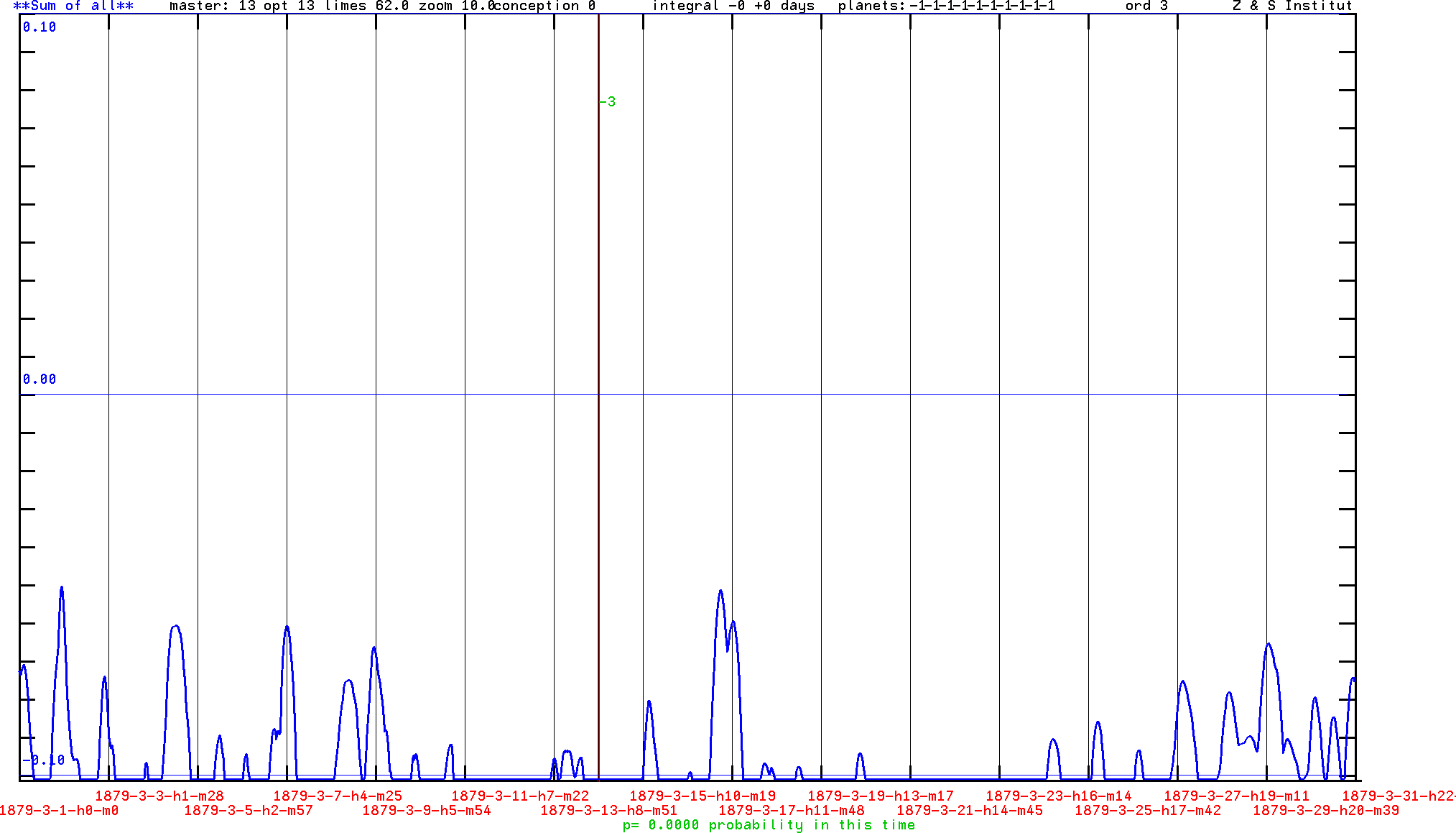
Let us first look at the time quality of his birth on March 14, 1879 at 11:30 a.m in Figure 1:
![Figure 1: The harmony H of the quality of time 1879-03 (Einstein’s birth month). The vertical line marks the time of Albert Einstein’s birth. The correlation function Hi,j (for the derivation of the function, see [1]) is a Fourier expansion of a periodic process and can be optimized both in its order and in its frequencies for the respective problem. It has the function of a high- pass filter.](/fulltextimages/13854/fig_1.png)
Figure 1: The harmony H of the quality of time 1879-03 (Einstein’s birth month). The vertical line marks the time of Albert Einstein’s birth. The correlation function Hi,j (for the derivation of the function, see [1]) is a Fourier expansion of a periodic process and can be optimized both in its order and in its frequencies for the respective problem. It has the function of a high- pass filter.
The time of birth is at the beginning of a local maximum formed by Pluto, the moon and the sun. Intelligent people are born above average at harmonious times (red area of the curves). This also applies to Einstein.
If we compare Einstein’s quality of time with 100,000 randomly selected points in time between 1800 and 2100, the following probabilities for the correlations of the planets with the other celestial bodies emerge: Statistics 4: Probability of events: Correlation matrix H Order of the correlation: 3 ; time shift d: 0 h: 0; Group- Members: 1 ; Number of the Groups: 100000 Julian-date-start: 2378495.458333 Julian-date-end: 2488068.458345 Accidental selection; TEST: Number of accidental selection >= correlation Matrix H of the probability of error:
| 1 | 2 | 3 | 4 | 5 | 6 | 7 | 8 | 9 | 10 | ||
|---|---|---|---|---|---|---|---|---|---|---|---|
| 1 | $\cdot$ | 23.63 | 42.53 | 90.82 | 15.06 | 35.58 | 58.76 | 78.63 | 54.36 | 4.89 | PR 21.61 |
| 2 | 23.63 | $\cdot$ | 17.61 | 2.83 | 55.54 | 25.96 | 31.39 | 82.92 | 15.55 | 47.19 | PR 9.34 |
| 3 | 42.53 | 17.61 | $\cdot$ | 75.09 | 81.41 | 54.02 | 91.31 | 90.67 | 45.86 | 64.94 | PR 77.25 |
| 4 | 90.82 | 2.83 | 75.09 | $\cdot$ | 47.36 | 44.33 | 65.17 | 29.46 | 58.27 | 53.77 | PR 15.89 |
| 5 | 15.06 | 55.54 | 81.41 | 47.36 | $\cdot$ | 19.74 | 80.88 | 69.18 | 71.26 | 2.62 | PR 17.64 |
| 6 | 35.58 | 25.96 | 54.02 | 44.33 | 19.74 | $\cdot$ | 57.56 | 95.67 | 51.63 | 94.15 | PR 76.9 |
| 7 | 58.76 | 31.39 | 91.31 | 65.17 | 80.88 | 57.56 | $\cdot$ | 89.33 | 38.69 | 57.92 | PR 76.57 |
| 8 | 78.63 | 82.92 | 90.67 | 29.46 | 69.18 | 95.67 | 89.33 | $\cdot$ | 90.16 | 10.74 | PR 90.35 |
| 9 | 54.36 | 15.55 | 45.86 | 58.27 | 71.26 | 51.63 | 38.69 | 90.16 | $\cdot$ | 42.43 | PR 58.01 |
| 10 | 4.89 | 47.19 | 64.94 | 53.77 | 2.62 | 94.15 | 57.92 | 10.74 | 42.43 | $\cdot$ | PR 12.66 |
| bigger are: | 39.02% |
Table 1: Probabilities of Albert Einstein’s Pluto harmony (bottom row of the matrix). (Significant are the border areas <5% and >
1=Sun; 2=Moon; 3=Mercury; 4=Venus; 5=Mars; 6=Jupiter; 7=Saturn; 8=Uranus; 9=Neptun; 10=Pluto; 11=IC; Begin: year: 1800 month: 1 day: 1 hour: 0 END: year: 2100 month: 1 day: 1 hour: 0 Three significant correlations (Moon-Venus, Sun-Pluto, Mars-Pluto) out of 48 are quite expected. However, 2 of these only relate to Pluto. This occurs in only 7% of all cases (Table 1).
| Sun | Moon | Mercury | Venus | Mars | Jupiter | Saturn | Uranus | Neptune | Total |
|---|---|---|---|---|---|---|---|---|---|
| 4.89 | 47.19 | 64.94 | 53.77 | 2.62 | 94.15 | 57.92 | 10.74 | 42.43 | 12.66 |
Table 2: Probabilities of Albert Einstein’s Pluto harmony (bottom row of the matrix). (Significant are the border areas <5% and >
Table 1: Probabilities of Albert Einstein’s Pluto harmony (bottom row of the matrix). (Significant are the border areas <5% and >95%) Pluto is the largest and second most massive known dwarf planet in the solar system and the longest known object in the Kuiper belt. It moves in an even more eccentric orbit around the sun than the planet Mercury. Its volume corresponds to about one third of the Earth’s moon.” (Wikipedia) The gravitational force of Pluto is extremely weak, it corresponds to the gravitational pull of a lead ball weighing 50 grams and with a diameter of approx. 2 cm at a distance of 10 meters.
Due to these small physical quantities, one is always inclined to regard Pluto as marginal and to concede that it has no influence. This makes it all the more surprising when its influence cannot be eliminated in statistical studies, as the example of Einstein’s birth shows.
The Question Immediately Arises: Is this just a special status of Einstein’s birth time? For comparison, following a list from Wikipedia, another 16 physicists who had worked on quantum theory were examined. These are:
- Max Planck 23. 4. 1858 Kiel
- Arnold Sommerfeld 5.12. 1868 Königsberg
- Albert Einstein 14. 3. 1879 Ulm
- Ernest Rutherford 30. 8. 1871 Spring Grove
- Max Born 11 12. 1882 Breslau
- James Franck 26. 8. 1882 Hamburg
- Niels Bohr 7. 10. 1885 Kopenhagen
- Erwin Schrödinger 12. 8. 1887 Wien
- Wolfgang Pauli 25. 4. 1900 Wien
- Werner Heisenberg 5.12. 1901 Würzburg
- Enrico Fermi 29. 9. 1901 Rom
- Paul Dirac 8. 8. 1902 Bristol
- Pascual Jordan 18. 10. 1902 Hannover
- Lew Landau 22. 1. 1908 Baku
- John Archibald Wheeler 9. 7. 1911 Florida
- Richard Feynman 11. 5. 1918 Queens, New York
- Julian Schwinger 12. 2. 1918 New York City
| Einstein | Sun | Moon | Mercury | Venus | Mars | Jupiter | Saturn | Uranus | Neptune | SUMME |
|---|---|---|---|---|---|---|---|---|---|---|
| 4.89 | 47.2 | 64.94 | 53.8 | 2.62 | 94.15 | 57.92 | 10.74 | 42.43 | 12.66 | |
| 17 Quantum physicists | 25.4 | 0.46 | 64.58 | 71.03 | 25.9 | 36.7 | 88.02 | 99.67 | 72.99 | 63.47 |
Table 3: Probabilities of Albert Einstein’s Pluto harmony for comparison with 17 quantum physicists including Einstein. (Signific
It can already be seen here that Einstein’s correlation pattern does not fit into the group of 17 quantum physicists (Table 2).
The group of 17 quantum physicists (including Einstein) shows a highly significant harmonic correlation between the Moon and Pluto and a highly significant disharmony between Uranus and Pluto.
Further investigation has also shown that Richard Feynman does not fit the characteristics of the other 15 quantum physicists.
Optimization of an AI-pattern The function for the change in probability W is set up: W= a1*Hi,j + a2*Ii,j + a3*Di,j + a4*DAi,j Only the coefficients ai are variable. • Hi,j- for the harmony and disharmony • Ii,j- for the absolute value (energy) of the superimposed waves • Di,j- for the speed of the change in the oscillation state (1st derivative) • DAi,j- for the acceleration (force) of the change in velocity An AI master constructed from the 17 quantum physicists clearly shows this. It finds all 15 quantum physicists from the list, but not Einstein and Feynman.
If the two physicists are now removed from the list, the significance of the group increases. The pattern recognizes 15 people from the list of 17 quantum physicists (88.2 %) and from a random list of 1000 events 1.9 % in the period 1800 - 2100. The difference of 86.3 % is the criterion for the optimization.
Only 15 quantum physicists (excluding Einstein and Feynman) are considered for the further investigations. The characteristic significances increase, as the following tables (Table 3 & 4) show.
| Planets/events | Sun | Moon | Mercury | Venus | Mars | Jupiter | Saturn | Uranus | Neptune | Total |
|---|---|---|---|---|---|---|---|---|---|---|
| 17 | 25.9 | 0.47 | 64.75 | 71.17 | 27.3 | 36.54 | 87.83 | 99.63 | 72.54 | 63.4 |
| 15 | 36.2 | 0.34 | 69.78 | 47.38 | 56.2 | 25.9 | 89.03 | 99.71 | 76.94 | 68.1 |
Table 4: Probability of Pluto harmony of 17 quantum physicists from the above list compared to the 15 without Einstein and Feynma
As a control, even 100,000 control groups of 17 events each were calculated here.
This is remarkable because, except for Einstein, the exact time of birth was not available for the 16 quantum physicists and therefore the time quality was calculated for 12 o’clock.
The probability of error for the 0.47% (Pluto-Moon correlation) is 4%. The Pluto-Uranus correlation (99.63%) is extremely disharmonious with an error probability of 3%.
The probabilities of error for the 0.34% (15 quantum physicists) are now reduced to: 3% (Pluto- Moon correlation). The Pluto-Uranus correlation (99.71%) now has a probability of error of 2.6%. If both highly significant events are assumed to have a probability of 0.34, the probability of error for 2 to 9 matches is only 0.04%.
The energy of the quantum physicists is even more characteristic than the harmony. Here too, the high significances for Moon-Pluto, Uranus-Pluto and Neptune- Pluto improve.
| Planets/event | Sun | Moon | Mercury | Venus | Mars | Jupiter | Saturn | Uranus | Neptune | TOTAL |
|---|---|---|---|---|---|---|---|---|---|---|
| 17 | 80.29 | 2.03 | 83.14 | 62.31 | 45.6 | 73.3 | 90.69 | 0,04 | 99.95 | 40.35 |
| 15 | 84.34 | 0.9 | 80.51 | 77.91 | 67.67 | 76.76 | 83.35 | 0 | 99.94 | 42.49 |
Table 5: Probability of Pluto energy of 17 and 15 quantum physicists in the above list. (The borderline ranges <1% and >99% are h
If a new AI pattern is created and optimized from these 15 people, all 15 quantum physicists are recognized (100%) and from the list of randomly selected 1000 events, 1.5% are recognized as “quantum physicists”, i.e. 15. The difference is 98.5%.
The events for comparison were selected in the period
1800 to 2100. It is not to be expected that the 15 quantum physicists were actually chosen at random. The birth period of the quantum physicists is from 1858 to 1918.
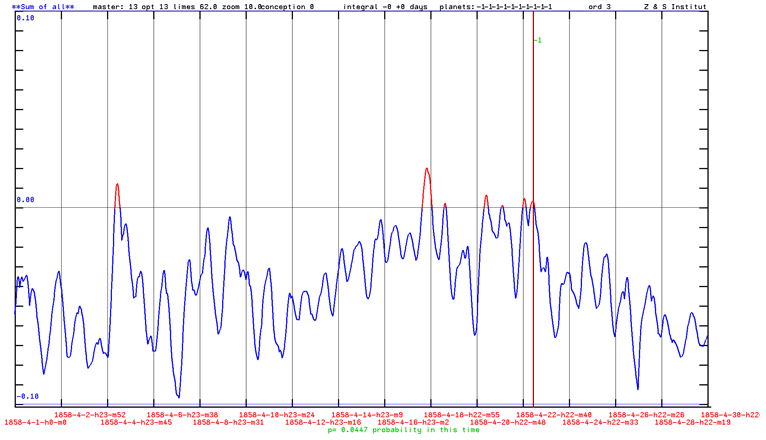
If the month in which a quantum physicist was born is scanned, the curves look as follows (Figure 2 & 3):
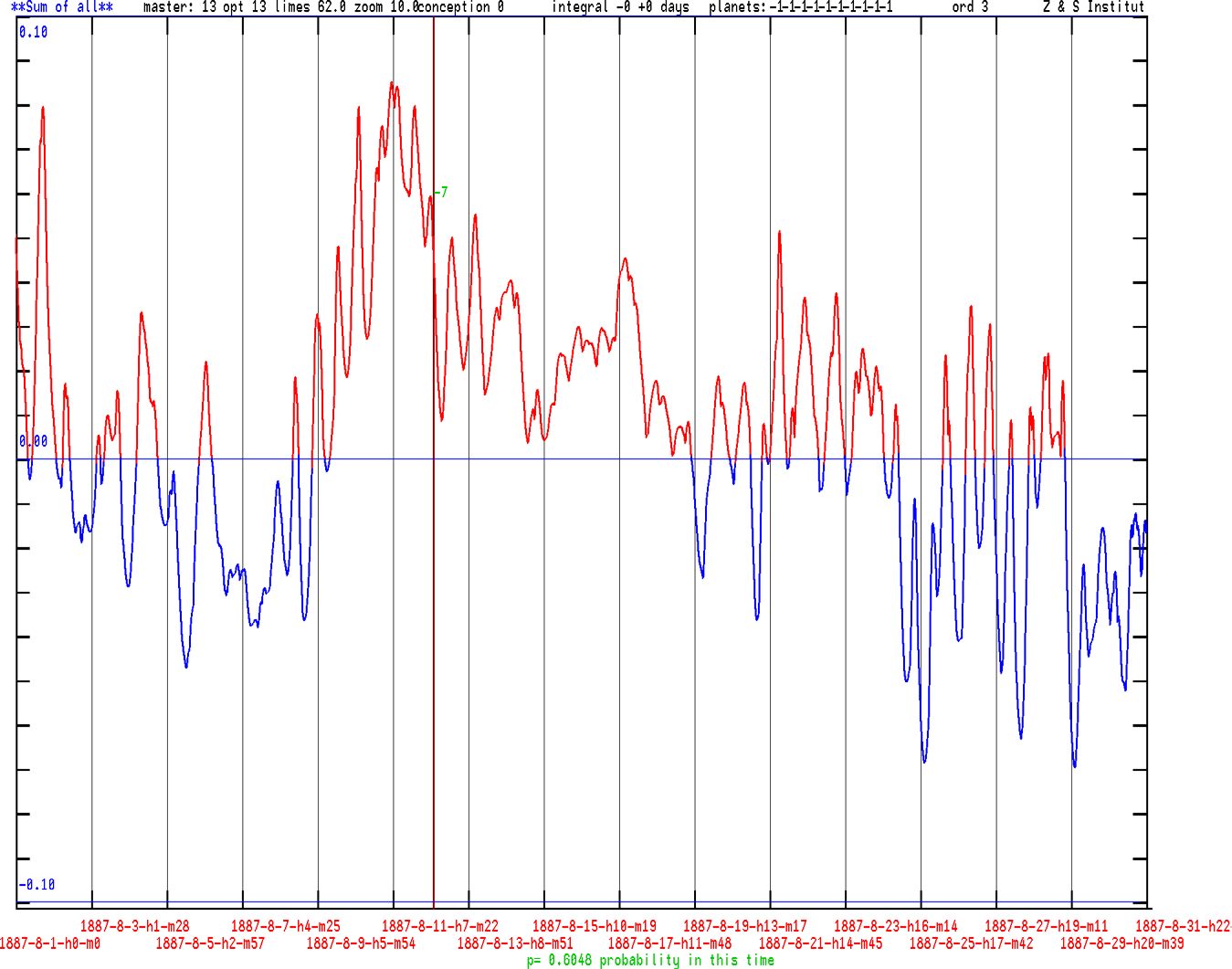
Erwin Schrödinger’s birth month shows very large areas that the AI pattern identifies as favorable birth times for quantum physicists. What does the quality of time look like? (Figure 4).
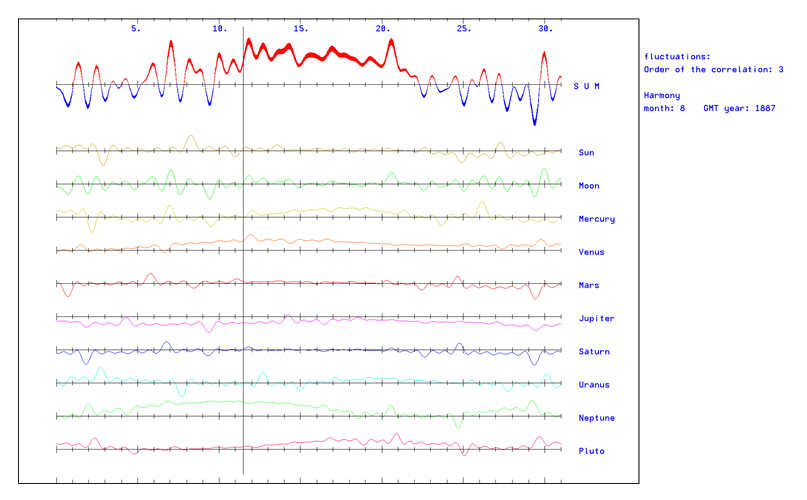
The comparison shows that for Erwin Schrödinger’s birth Neptune and Venus go through a longer harmonic period. Pluto and Mercury also begin a longer harmonic phase. It cannot (!) be deduced from this that it is primarily quantum physicists who are born during this period. Of course, genes also play a role that should not be neglected.
Let us now look (Figure 5) at the month of birth of the two physicists who do not fall into the AI pattern of quantum physicists.
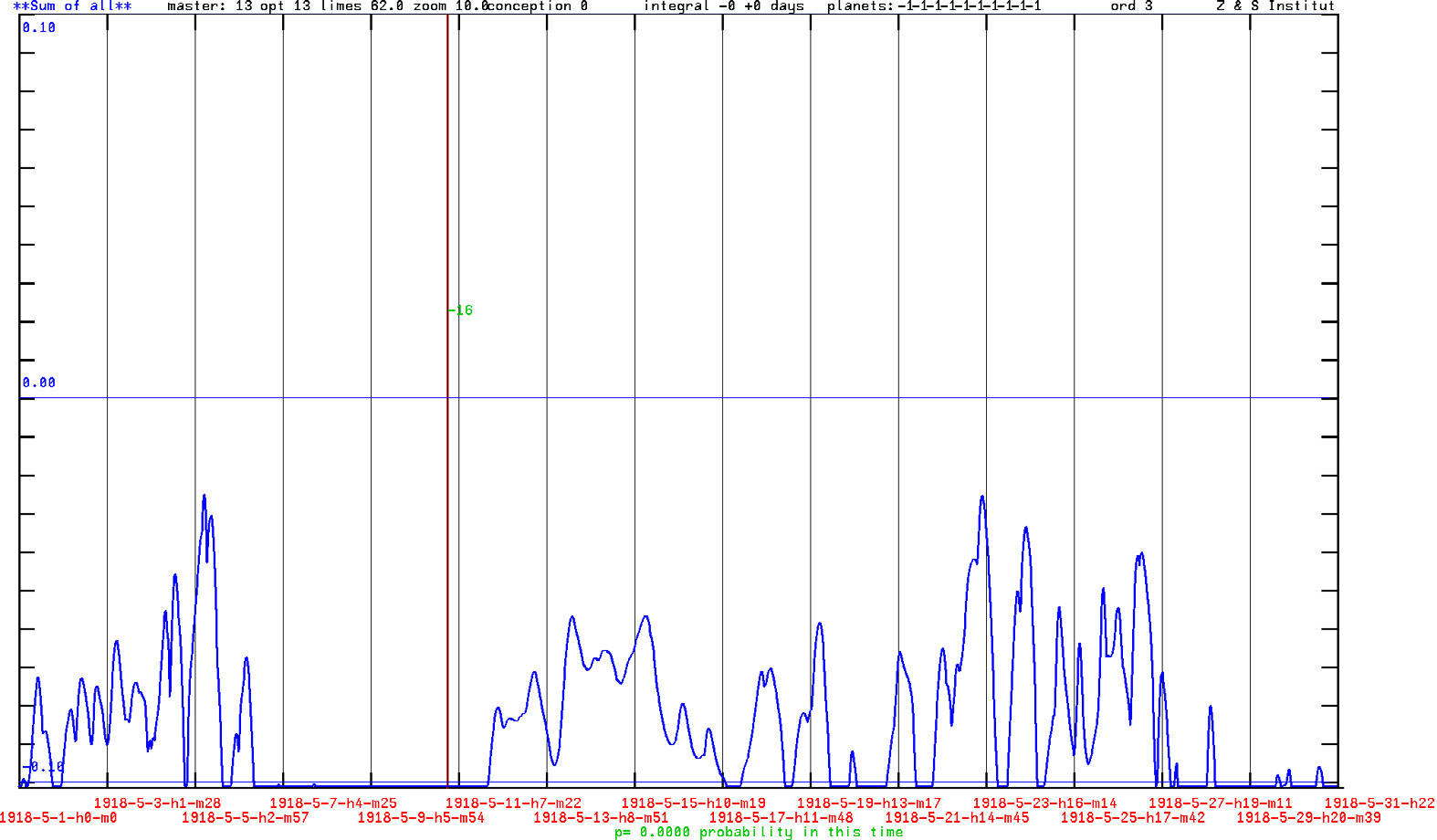
Richard Feynman is not recognized
“Feynman is considered one of the great physicists of the 20th century who made significant contributions to the understanding of quantum field theories. Together with Shin’ichir? Tomonaga and Julian Schwinger, he was awarded the Nobel Prize in 1965 for his work on quantum electrodynamics (QED). His clear presentation of quantum field theory elementary interactions using Feynman diagrams is a de facto standard today.
For Feynman, it was always important to explain and make understandable the obscure laws of quantum physics to laymen and students. His lecture series (The Feynman Lectures on Physics) is widely used at universities. In books such as QED: The Strange Theory of Light and Matter [3] and Character of Physical Law, he addressed a wider audience. His charisma and ability to relate to his audience made his lectures and talks legendary. His unconventional and non- conformist style was also evident in his autobiographical books...” (Wikipedia) Feynman was obviously not the typical quantum physicist; he had other talents, which included popularizing theories that were difficult to understand.
Albert Einstein is not Recognized
“Einstein’s relationship to another pillar of modern physics, quantum physics, is remarkable: on the one hand, because some of his work, such as the explanation of the photoelectric effect, formed its basis; on the other hand, because he later rejected many ideas and interpretations of quantum mechanics...Einstein believed that the random elements of quantum theory could later be proven not to be truly random. This attitude prompted him, first in a dispute with Max Born, to make the famous statement that the old man (or Lord God) does not play dice.
“Quantum mechanics is very respectful. But an inner voice tells me that this is not yet the real deal. The theory delivers a lot, but it hardly brings us any closer to the secret of the old man. In any case, I am convinced that the old man does not play dice.” In the discourse, however, Bohr and his followers remained mostly victorious; even from today’s perspective, the experimental evidence speaks against Einstein’s point of view... “(Wikipedia) Einstein was not the typical quantum physicist, his physical talents were more focused on space and time.
Important: The studies refer only to the quantum physicists listed above. Drawing conclusions about other quantum physicists from this can only be regarded as a hypothesis. In any case, it is a mystery that encourages further investigation.
Notes on the Computer Program
The program calculates the gravitational interactions (not the actual forces) of the sun, moon and the planets up to Pluto according to [Jean Meeus (1992) Astronomische Algorithmen. Barth, Johann Ambrosius, Germany pp. 464.]. Asteroids are not calculated. The calculated correlation function H can be interpreted as an oscillating vector field with higher harmonics [4, 5]. It includes the calculation of probabilities with comparison events. An optimization pass allows the optimization of an AI pattern. The manual can be viewed here [6]. The program can be purchased here [7].
Conclusion
The investigations clearly show that the harmonics of the planetary gravitational field cannot only act via gravity. It can be assumed that, in addition to energy and matter, information plays a significant role. Thus, it is not the mass of Pluto alone, but also its orbit that causes the complex interaction as an oscillator in the planetary system. Further investigations are necessary. The investigations to date even suggest that evolution has another factor in addition to selection and mutation, namely planetary constellations. This assumption should be investigated further.
Conflicts of interest
The author declares that there are no conflicts of interest in connection with the publication of this article.
References
-
Nitsche ME (2023) Fluktuations of the Planetary Gravitational Field and Nonlinear Interactions with Matter. Cuvillier Verlag, Göttingen.
-
Nitsche ME (2022) IQ Stimulation During the Period of Birth. International Journal of Clinical & Medical Informatics 5(1).
-
Nitsche ME (2024) The Formation of Oscillation Patterns Based on the Planetary Gravitational Field and Their Suitability for Earthquake Prediction. Journal of High Energy Physics, Gravitation and Cosmology 10: 149-157.
-
Brack T, Zybach B, Balabdaoui F (2022) Dynamic measurement of gravitational coupling between resonating beams in the hertz regime. Nat Phys 18: 952– 957.
-
Nitsche ME (2025) The use of artificial intelligence on the planetary gravitational field for earthquake forecasting. JHEPGC 11(2).
-
Nitsche ME (2012) Manual Computer program. Planetary correlations.
-
Nitsche ME (2012) Computer program. Planetary correlations.
- Asymmetry Irreversible Heterogeneity Quantum Cosmology Grand Mathematical PHYSICS
- Early Universe: Hadronic Crystals Coherent Micro Gravitational Wave Emitters PHYSICS Part II
- The Solar System Constraint Maze: A Scientific Dead-End Revealing the Interuniversal Machine
- Assessment of Radiofrequency Radiation from 2G and 3G Mobile Phone Handsets
- Early Universe Magneto-Gravitational Coupling Genesis Physics: Part I
- Falsifiability of the Classical Law of Gravitation and Unveiling the Time-temperature Entanglement of the Universe