
Immediate Implant Post-Extraction of Impacted Maxillary Canine: Systematic Review
Introduction: When impacted maxillary canines are not amenable to orthodontic traction or reimplantation, extraction is the only option available, followed by implant placement; this is a challenge due to the bone resorption frequently associated with complex tooth extraction that often necessitates bone grafting. Immediate dental implant placement appears to be the adequate strategy to replace missing teeth. Objective: The aim of this systematic review was the evaluation of implant placement immediately after removal of maxillary canine impacted. Methods: Detailed search in PubMed and Cochrane databases to obtain information on all reported cases and postoperative outcomes. There were no restrictions with regard to publication status or language of publication. Selection criteria: Only included all clinical reports of at least 1-year follow up and that treated by immediate implant in maxillary canine impacted extraction. Results: The initial database search produced 135 titles, after careful examination only 11 reports considered to be met the criteria for inclusion. The remaining reports were to be no met the criteria for inclusion. The results indicated a success rate significant for the procedure of immediate implant placement into impacted maxillary canine extraction socket accompanied by guided bone regeneration (GBR). This procedure allowing implant anchorage and primary stability to achieved. Conclusion: Our review suggest that this treatment is viable and with a good outcome, although more works is needed to determine adequate the results and thus determine the potential impact of this treatment alternative.
Introduction
Impaction is defined as the failed eruption of a permanent tooth with a completely developed root; maxillary canines are the second most frequently impacted teeth after the third molars, with a prevalence ranging from 0.9 to 5 per cent [1], and the palatal displacement is more frequent than the buccal one [2]. The management of impacted canines is one of the most complicated aspects of dento-alveolar surgery. Impacted canines are problems frequently encountered by the orthodontist, general dentist and oral and maxillofacial surgeon [3]. Have proposed different treatment strategies for impacted maxillary canines, ranging from interceptive approaches to guided forced eruption or extraction and orthodontic space closure [1, 2]; however, if traction is not feasible or the patient refuses orthodontic treatment, an alternative solution is to remove the impacted tooth and immediately place an implant [4]. Currently is a common procedure during the same surgery, the placement of an implant immediately after tooth extraction [5, 6]. Some recent clinical systematic reviews have indicated it as a very promising approach in selected cases [7, 8], including immediate loading of post-extraction implants placed in infected sites [9]. The main advantage being the reduction in surgery and treatment time [8]. In the case of a impacted maxillary canine tooth, the possibility of immediate implant placement after extraction depends on the presence of adequate residual apical bone; this is necessary to allow the implant to be positioned and anchored bicortically with good primary stability [10]. Within the literature have reported cases of implants installed after the removal of a retained canine with 1- to 8-year follow-up [11]. However, there are no studies of systematic reviews or similar.
Objective
The present review sought to synthesize the most up-to-date publications to evaluate the effectiveness of immediate implant placement into impacted maxillary canine extraction socket.
Methods
Search Strategy
Searched the PubMed and Cochrane databases from 1990 to the present (January 2017). The research complemented with a manual search of the reference lists of each selected article.
Search terms: The following search terms (keywords) were selected: - Immediate [All Fields] AND implant [All Fields] AND placement [All Fields] AND Extraction [All Fields] AND removal [All Fields] AND ("maxilla" [MeSH Terms] OR "maxilla" [All Fields] OR "maxillary" [All Fields]) AND ("tooth, impacted" [MeSH Terms] OR ("tooth" [All Fields] AND "impacted" [All Fields]) OR "impacted tooth" [All Fields] OR "impacted" [All Fields]) OR "canine" [All Fields]) unconventional [All Fields].
Inclusion / Exclusion criteria: Inclusion criteria included case reports and clinical studies that had:
- Maxillary canine impacted with implant immediate.
- With Guided bone regeneration (GBR).
- Minimum, one year follow-up.
- Exclusion criteria for reports or studies included:
- Procedures that do not include the implant immediately after the removal of the maxillary canine retained.
- Results of the removal technique with a short follow-up period (less than 1 year of control).
Selection Process
The researcher select in 3 stages. First, 135 articles (PubMed, Cochrane) were found in the search, all titles were selected and then the non-relevant publications deleted. During the second stage, all the publications they analyzed through their summaries removing the duplicates. Independently selecting each of the abstracts to obtain articles that met the inclusion criteria. Finally, after this search, the relevant articles and reference lists analyzed to add more articles that met the criteria. The quality of the studies evaluate according to the classification of the levels of scientific evidence in medicine posed by the Oxford Center Study Analysis.
- For the study and a summary of each publication included, the following aspects followed:
- Immediate implant.
- Removal of maxillary canine impacted.
Results
Data Extraction
The selection process of the articles summarized in the Figure 1. Our search strategy permitted to identify 135 articles related to the research topic found.109 articles were excluded when evaluating the titles and did not meet the inclusion criteria. 12 articles were excluded because they were repeated in the results of the search, leaving 14 articles to be analyzed in their totality, of which 2 items was excluded for installing the Implant without doing the extraction of the impacted canine and 1 article for being a poster. Being 11 articles that met the inclusion criteria.
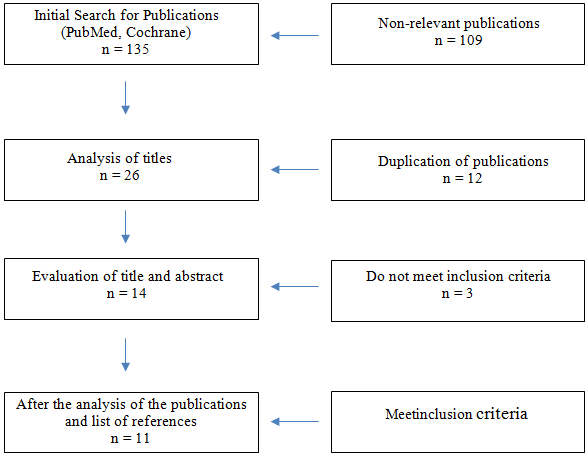
The degree of intra observer concordance Kappa was 0.92 for the selection of each report. Obtaining a measure of the consistency, according to the criteria of Landis and Koch, almost perfect. The clinical study reports evaluated according to their methodology and cataloged as individual case studies, case series and case reports.
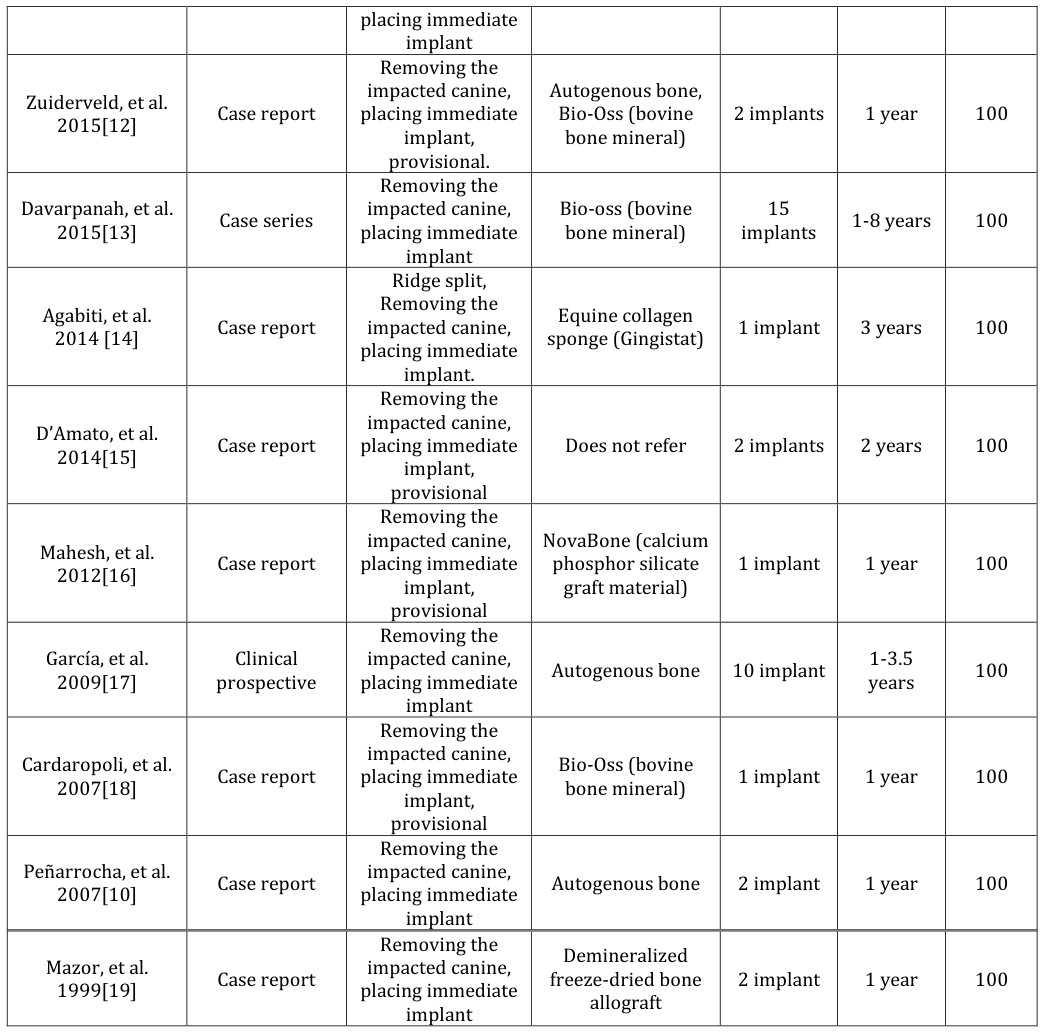
Evaluation of implant placement immediately after removal of maxillary canine impacted: Analyzed 11 publications on the treatment of placing an immediate implant after performing the extraction of an impacted maxillary canine, with a minimum control of 1 year to evaluate the postoperative results (Table 1). Of all the publications analyzed, 1 prospective study was obtained [12], 3 case series [4, 10, 11, 13]and 7 case reports [14, 15, 16, 17, 18, 19]. The impacted canines extracted through a buccal or palatal total flap and osteotomy. Ending with Guided bone regeneration (GBR)-(Alloplastic graft material, autologous bone or the combination of both) [4, 10, 11, 12, 13, 14, 16, 17, 18, 19], only one publication does not report whether or not I use GBR [15]. All publications report a success of 100% of the cases presented, with a follow-up ranging from 1 to 8 years [4, 10, 11, 12, 13, 14, 15, 16, 17, 18, 19], and 5 of them reported that they installed a provisional crown during the same surgery [4, 12, 15, 16, 18].
| Type of Study | Treatment | GBR | Sample | Follow-Up | Success % | |
|---|---|---|---|---|---|---|
| Demarosi, et al. 2016[4] | Case series | Removing the impacted canine, placing immediate implant, provisional. | Bio-oss (bovine bone mineral), physiograft gel, autogenous bone. | 12 implants | 5 years | 100 |
| Mithridade, et al. 2015[11] | Case series | Removing the impacted canine, | Bio-oss (bovine bone mineral) | 5 implants | 5-8 years | 100 |
Table 1: Studies evaluating the placement of immediate implants from the extraction of an impacted maxillary canine with a minimu
The clinical management of impacted canine can be challenging and frustrating [3]. When patients are unwilling to accept orthodontic treatment and/or the impacted canines are in a high position precluding orthodontic traction, the treatment of choice is extraction [18]. In this situation, Mazor, et al. [19], proposes the alternative of installing an implant immediately after the removal of the impacted maxillary canine. The procedure based on the application of the immediate post-extraction implants, which is a procedure that has been widely
- implant
- Removing the impacted canine, placing immediate
- Autogenous bone,
- Zuiderveld, et al.
- 2015[12]
- Case report
- Bio-Oss (bovine
- 2 implants
- 1 year
- 100 implant, provisional. bone mineral)
- Removing the impacted canine, placing immediate
- Davarpanah, et al.
- Bio-oss (bovine
- 15 implants
- 1-8 years
- 100
- 2015[13]
- Case series bone mineral) implant
- Ridge split,
- Removing the impacted canine, placing immediate
- Agabiti, et al.
- Equine collagen sponge (Gingistat)
- 1 implant
- 3 years
- 100
- 2014 [14]
- Case report implant.
- Removing the impacted canine, placing immediate
- D’Amato, et al.
- 2014[15]
- Case report
- Does not refer
- 2 implants
- 2 years
- 100 implant, provisional
- Removing the impacted canine, placing immediate
- NovaBone (calcium
- Mahesh, et al.
- 2012[16]
- Case report phosphor silicate
- 1 implant
- 1 year
- 100 implant, provisional graft material)
- Removing the impacted canine, placing immediate
- García, et al.
- Clinical prospective
- Autogenous bone
- 10 implant
- 1-3.5 years
- 100
- 2009[17] implant
- Removing the impacted canine, placing immediate
- Cardaropoli, et al.
- Bio-Oss (bovine
- 2007[18]
- Case report bone mineral)
- 1 implant
- 1 year
- 100 implant, provisional
- Removing the impacted canine, placing immediate
- Peñarrocha, et al.
- 2007[10]
- Case report
- Autogenous bone
- 2 implant
- 1 year
- 100 implant
- Removing the impacted canine, placing immediate
- Demineralized freeze-dried bone
- Mazor, et al.
- 1999[19]
- Case report
- 2 implant
- 1 year
- 100 allograft implant
Table 2: Studies evaluating the placement of immediate implants from the extraction of an impacted maxillary canine
documented and has a success rate similar to implants in healed site's placement [5, 6, 7, 8, 9]. Anitua, et al. [9], recently reported that it can be performed Immediate implant placement into infected sockets in association with immediate loading, With an average follow-up of 6 years (range 1 to 8 years) and 65% of the implants had a follow- up time > 5 years. No implant failure occurred and the implant success rate was 93%. In the same way, Lang, et al. [20], report to the mean survival of the post-extraction implants with immediate loading has been 98.4% (after 2 years of follow-up) and has decreased to 97.5% with a range of 95.2 to 98.8% (after ≥ 3 years follow-up). The publications analyzed in this review are prospective studies, case series and case report, which result in 100% success in all treated cases (53 implants). These installed immediately after the removal of the impacted maxillary canine, both palatal and labial. In addition, 5 reports made immediate provisionalization, provided there is a good primary stability of the implant installed [4, 12, 15, 16, 18], obtaining in some cases an implant stability of > 45 Ncm and a good aesthetic result after the provisionalization [12]. This insertion torque is ideal, because, Benic, et al. [21] and Gallucci, et al. [22] mention that to make immediate loading the implants must be inserted with a torque ≥ 20 to 45 NcmOr an Implant Stability Quotient (ISQ) ≥ 60 a 65. Coinciding with Morton, et al. [23], who also mentions, that primary stability is an important parameter to yield proper survival of implants for all placement protocols. Qabbani et al [24], concludes that, the insertion of immediate implants in fresh extraction sockets together with grafting the circumferential gap between the bony socket wall and the implant surface with bovine bone granules was able to preserve a greater amount of alveolar ridge volume when compared with an extraction socket that left to heal in a conventional way. Only one publication does not report the use of GBR [15]. All the others, indicated to perform GBR in the area of the osteotomy of the impacted canine, to improve the stability of the implant and not to leave exposed the apical third of the same, in cavity of the osteotomy. Nevertheless, Mazor, et al. [25], reported an alternative, where with the help of a computerized surgical guide performs the installation of 2 implants without need to remove impacted canines. Mentions that this is especially possible in cases where the canines have a labial position, because there is a good amount of remaining bone tissue. Being very important the selection of the case. Providing a relatively short treatment time, a less invasive procedure, and fewer potential complications compared to the extraction of an impacted canine, massive bone grafting, and implant placement; although they do not refer to the follow-up time of the 2 implants installed. Likewise, Davarpahah, et al. [26] described several cases of implants that placed through the impacted teeth, to avoid invasive surgical removal. Of the seven implants placed into four impacted teeth, all healed uneventfully except a short (8.5-mm) implant that became mobile after 4 months. Nevertheless, the canines impacted were removed finally after 6 months the osseointegration. They suggested that implant placement through an impacted tooth might not interfere with implant integration or harm occlusal function, at least in the short term. The small number of publications found in literature may be a good precedent for considering the success of this treatment alternative. Although the outcome characteristic of all publications is a 100 % of successful in cases with at least 1 year of follow-up, more study warranted before this unconventional procedure might be considered as a possible clinical option when we are facing an impacted tooth.
Conclusion
Our review suggest that this treatment is viable and with a good outcome, although more works is needed to determine adequate the results and thus determine the potential impact of this treatment alternative.
References
-
Dalessandri D, Parrini S, Rubiano R, Gallone D, Migliorati M (2016) Impacted and transmigrant mandibular canines incidence, aetiology, and treatment: a systematic review. Eur J Orthod 1-9.
-
Silva AC, Capistrano A, Almeida-pedrin RR, Cardoso MA, Conti AC, et al. (2017) Root length and alveolar bone level of impacted canines and adjacent teeth after orthodontic traction: a long-term evaluation. J Appl Oral Sci 25(1): 75-81. **3.** Alberto PL (2007) Management of the impacted canine and second molar. Oral Maxillofac Surg Clin North Am 19(1): 59-68.
-
Demarosi F, Varoni E, Rimondini L, Carrassi A, Leghissa GC (2016) Immediate implant placement after removal of maxillary impacted canine teeth: A technical note. Int J Oral Maxillofac Implants 31(1): 191-194.
-
Al-Sabbagh M, Kutkut A (2015) Immediate implant placement: surgical techniques for prevention and management of complications. Dent Clin North Am 59(1): 73-95.
-
Falcón GBE (2015) Carga inmediata funcional en la zona estética sobre un implante post extracción. Rev Mex Periodontol 6(1): 5-9.
-
Atieh MA, Duncan WJ, Faggion CM (2016) Quality assessment of systematic reviews on oral implants placed immediately into fresh extraction sockets. Int J Oral Maxillofac Implants 31(2): 338-351.
-
Chrcanovic BR, Albrektsson T, Wennerberg A (2015) Dental implants inserted in fresh extraction sockets versus healed sites: a systematic review and meta- analysis. J Dent 43(1): 16-41.
-
Anitua E, Piñas L, Alkhraisat MH (2016) Long-Term outcomes of immediate implant placement into infected sockets in association with immediate loading: A Retrospective cohort study. J Periodontol 87(10):1135-1140.
-
Peñarrocha M, Peñarrocha M, García-Mira B, Larrazabal C (2007) Extraction of impacted maxillary canine with simultaneous implant placement. J Oral Maxillofac Surg 65(11): 2336-2339.
-
Mithridade D, Serge SM, Keyvan D, Nedjoua CO, Georgy D, et al. (2015) Unconventional implant placement IV. Implant placement through impacted teeth to avoid invasive surgery. Long-term results of 3 Cases. Open Dent J 9: 15-20.
-
Zuiderveld EG, Meijer HJA, Vissink A, Raghoebar GM (2015) Immediate placement and provisionalization of an implant after removal of an impacted maxillary canine: two case reports. Int J Implant Dent 1(1): 13.
-
Davarpanah M, Szmukler MS, Rajzbaum P, Davarpanah K, Capelle ON, et al. (2015) Unconventional implant placement V: Implant placement through impacted teeth; results from 10 cases with an 8- to 1-year follow-up. Int Orthod 13(2): 164-180.
-
Agabiti I, Bernardello F, Nevins M, Wang HL (2014) Impacted canine extraction by ridge expansion using Air scaler surgical instruments: A case report. Int J Periodontics Restorative Dent 34(5): 681-687.
-
D'Amato S, Redemagni M (2014) Immediate Postextraction implantation with provisionalization of two primary canines and related impacted permanent canines: A case report. Int J Periodontics Restorative Dent 34(2): 251-256.
-
Mahesh L, Salama M, Kurtzman GM (2012) Extraction of an impacted maxillary canine with immediate implant placement. Inside dentistry 8(3): 2-4.
-
García B, Boronat A, Larrazabal C, Peñarrocha M, Peñarrocha M (2009) Immediate implants after the removal of maxillary impacted canines: a clinical series of nine patients. Int J Oral Maxillofac Implants 24(2): 348-352.
-
Cardaropoli D, Debernardi C, Cardaropoli G (2007) Immediate placement of implant into impacted maxillary canine extraction socket. Int J Periodont Restorat Dent 27(1): 71-77.
-
Mazor Z, Peleg M, Redlich M (1999) Immediate placement of implants in extraction sites of maxillary impacted canines. J Am Dent Assoc 130(12): 1767- 1770.
-
Lang NP, Pun L, Lau KY, Li KY, Wong MC (2012) A systematic review on survival and success rates of implants placed immediately into fresh extraction sockets after at least 1 year. Clin Oral Implants Res 5: 39-66.
-
Benic GI, Mir-Mari J, Hämmerle CH (2014) Loading protocols for single-implant crowns: a systematic review and meta-analysis. Int J Oral Maxillofac Implants 29: 222-238.
-
Gallucci GO, Benic GI, Eckert SE, Papaspyridakos P, Schimmel M, et al. (2014) Consensus statements and clinical recommendations for implant loading protocols. Int J Oral Maxillofac Implants 29: 287-290.
-
Morton D, Pollini A (2017) Evolution of loading protocols in implant dentistry for partially dentate arches. Periodontol 2000 73(1): 152-177.
-
Qabbani AA, Razak NH, Kawas SA, Sheikh AHS, Wahbi S, et al. (2017) The efficacy of immediate implant placement in extraction sockets for alveolar bone preservation: A clinical evaluation using three- dimensional Cone Beam Computerized Tomography and Resonance Frequency Analysis value. J Craniofac Surg.
-
Mazor Z, Segal P, Levin L (2015) Computer-guided implant placement for rehabilitation of the edentulous maxilla with two impacted canines: an approach without extraction of the impacted teeth. Int J Periodontics Restorative Dent 35(1): 93-97.
-
Davarpahah M, Szmukler MS (2009) Unconventional implant placement. 2: Placement of implants through impacted teeth. Three case reports. Int J Periodontics Restorative Dent 29(4): 405-413.
- Diagnosis and Management of Mental Nerve Paresthesia Secondary to Apical Periodontitis of Mandibular Second Premolar: A CBCT Based Case Report
- A Randomized, Double Blinded Clinical Trial to Compare the Effect of Oral Premedication (Diclofenac Potassium or Dexamethasone) on Post-Operative Pain Following Pulpectomy
- Modified Lip Repositioning Technique for the Management of Excessive Gingival Display
- Integral Role of Non-Dental Providers and Fluoride Dissemination
- Root Canal Treatment Rate in Deciduous Teeth Among 6-Year- Olds in the Era of Discontinuing Water Fluoridation - Historical Cohort Study
- The Impact of the Notch1 on the Migratory Capacity and the Expression of E-Cadherin and CyclinD1 in Ameloblastoma Cells