
Ectopic Eruption of Mandibular Canine- A Report and Review
Tooth eruption is a process whereby the forming tooth migrates from its intraosseous location in the jaw to its functional position within the oral cavity. A variety of eruption problems arise during the transitional dentition period and one such problem is ectopic eruption. Early diagnosis and treatment can prevent a more complicated malocclusion.
Roopashri RK and Gowri B
Oral Medicine and Radiology, AJ Institute of Dental Sciences, Kuntikana, NH-
Keywords: Ectopic eruption; Mandibular canine; Oral periapical
Introduction
Tooth eruption is a process whereby the forming tooth migrates from its intraosseous location in the jaw to its functional position within the oral cavity. A variety of eruption problems arise during the transitional dentition period and one such problem is ectopic eruption. Early diagnosis and treatment can prevent a more complicated malocclusion [1]. Guidance of eruption and development of the primary, mixed and permanent dentitions is an integral component of comprehensive oral healthcare for all dental patients. Such guidance should contribute to the development of a permanent dentition, i.e. in a stable, functional and esthetically acceptable occlusion [2]. Here we report a case of ectopic eruption on right mandibular canine.
Case Report
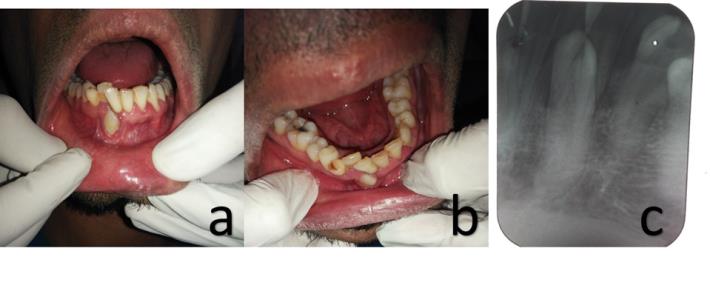
A 27-year-old male patient reported to the department ailing to irregular placement of lower front teeth and presence of extra erupting teeth in the lower jaw. His medical and dental histories were non-contributory. Intraoral examination revealed a retained right mandibular deciduous canine and also revealedan ectopic eruption of right mandibular canine on the attached gingiva of mandibular right central incisor (Figure 1a). There was evident crowding of the lower anterior teeth with slight lingual displacement of the right mandibular lateral incisor and a minimal distal tilt of the right mandibular central incisor (Figure 1b). Intraoral periapical radiograph (Figure 1c) reveals the complete tooth formation with apexification in right mandibular canine. A provisional diagnosis of ectopic eruption of Right mandibular canine was considered due to retained deciduous right mandibular canine.
Discussion
Ectopic eruption is a very rare entity when it comes to the canine. In 1923 Chapman described four cases of ectopic eruption of the maxillary first permanent molars in which he listed four possible causes:
- Small arches
- Deviant paths of eruption of the permanent molar
- Lack of forward movement of all primary teeth, and
- Early eruption of the maxillary first permanent molars [3].
Young found that ectopic eruption was approximately present 3% of the time. There was little difference in the involvement of the right or left side [4]. Nikiforuk classified ectopic eruptions, defined them as “A condition in which the permanent teeth, because of deficiency of growth in the jaw or segment of jaw, assume a path of eruption that intercepts a primary tooth, causes its premature loss and produces a consequent malposition of the permanent tooth. Failure to treat ectopic eruption can result in loss of arch length, inadequate space for the succedaneous premolar, and malocclusion [5]. In the above reported case deciduous mandibular canine has caused the ectopic eruption of mandibular canine. There are several treatment and management options for ectopically erupting tooth which include interproximal wedging and distal tipping, both of which cause incremental distocclusal movement via various orthodontic treatments [6]. In our reported case, extraction of the deciduous tooth and right mandibular lateral incisor was planned and orthodontic bracket placement was advised, post which reshaping of right mandibular canine and right mandibular first premolar was planned.
Conclusion
Aesthetics has always been the primary concern of the generation and smile adds-on value to it. Monitoring the eruption pattern of the teeth should be the concern of both parents and dentists, so that occlusion and smile of the patient is physiologically maintained, because aesthetic imbalance can not only cause physiological but psychological disharmony to the patients.
References
-
Yaseen SM, Naik S, Uloopi KS (2011) Ectopic Eruption: a review and case report. Contemp Clin Dent 2(1): 3-7.
-
Bradley EJ, Bell RA (1990) Eruptive malpositioning of the mandibular permanent lateral incisors: three case reports. Pediatr Dent 12(6): 380-387.
-
Chapman H (1923) First upper permanent molar partially impacted against second deciduous molar. Int J ortho oral surg and Radio 9(5): 339-345.
-
Young DH (1957) Ectopic eruption of permanent first molar. J Dent Child 24: 153-162.
-
Nikiforuk G (1948) Ectopic Eruption: Discussion and clinical report. J Ont Dent Assoc 25: 243-256.
-
McDonald R, Avery D, Dean J (2004) Dentistry for the Child and Adolescent. 8th (Edn.), Mosby pp: 659-660.
- Diagnosis and Management of Mental Nerve Paresthesia Secondary to Apical Periodontitis of Mandibular Second Premolar: A CBCT Based Case Report
- A Randomized, Double Blinded Clinical Trial to Compare the Effect of Oral Premedication (Diclofenac Potassium or Dexamethasone) on Post-Operative Pain Following Pulpectomy
- Modified Lip Repositioning Technique for the Management of Excessive Gingival Display
- Integral Role of Non-Dental Providers and Fluoride Dissemination
- Root Canal Treatment Rate in Deciduous Teeth Among 6-Year- Olds in the Era of Discontinuing Water Fluoridation - Historical Cohort Study
- The Impact of the Notch1 on the Migratory Capacity and the Expression of E-Cadherin and CyclinD1 in Ameloblastoma Cells