
Shade-Matching Capacity of Omnichroma in Anterior Restorations
Objective: To evaluate if there is evidence of shade matching and color change over a month, with OMNICHROMA (Tokuyama) composite restorations, after bleaching with Opalescence™ Boost™ (Ultradent). Methods: Ten extracted teeth with varying shades A1-D4 were randomly chosen, n=10. Samples were restored with an OMNICHROMA shade matching composite. Class V preparations (approximately 6mm x 2 mm x 1.5 mm) were acid etched with Ultra-Etch® (Ultradent, 40% Phosphoric Acid) for 30 seconds, rinsed and air dried. Teeth were bonded with Tokuyama Universal Bond® (8th-generation bonding agent), filled and finished/polished with Super Snap and OneGloss (Shofu). The teeth were stored in distilled water at 37̊C for 24 hours. Shades were evaluated by 2 blinded calibrated clinicians using the VITA Classic shade guide and given an overall matching score between the restoration and the tooth, using a scale of matches, somewhat matches, and does not match. Additionally, on the Crystaleye Spectrophotometer (Olympus) shade evaluations were recorded at a total of 5 locations, 4 sites around the restoration, and the 5th site directly over the restoration. Samples were completely covered in bleach with Opalescence Boost (Ultradent, 40% Hydrogen Peroxide) for 20 minutes according to manufacturer’s instructions, two consecutive times, rinsed and placed in distilled water for 24 hours. L*a*b*, ∆E and Vita shades were recorded at 24 hours, 1 week, 2 weeks, 4 weeks post bleaching using the Crystaleye Spectrophotometer (Olympus). Each sample was evaluated under the Olympus stereomicroscope (SZX16). L*a*b* values of the 4 sites around the restoration were averaged and compared to the L*a*b* values of the restoration. Stata 15 was used, and significant level was set at 0.01. Results: Average color change after bleaching was 3 shades. Shade matching scores by the clinicians showed the composite matched 100%, for all teeth at all time intervals. There was no significant difference in the L*a*b* values between the restoration and tooth at each time interval. Conclusion: The shade of the filling matched that of the adjacent enamel pre- and post-bleaching
Introduction
Dental composite materials have been used in dentistry for a very long time. They can be placed in posterior or anterior teeth alike. Patients prefer composites because it gives more of a natural and esthetic look. When restoring teeth using composites, a clinician typically would be using a handheld shade guide and depending on their own visual skills try and select a shade that would match as closely as possible to the shade of the adjacent tooth structure. After a tooth is filled there is no reason to remove or replace the filling material if there is no recurrent decay or damage. Otherwise it would subject the tooth to more damaging iatrogenic forces. However, when the teeth filled are in the anterior or smile region, it becomes more of an esthetic concern. Studies show that composite suffers from extrinsic or intrinsic staining over time bought on by pigments in food or drinks or habits such as smoking [1, 2, 3]. Whitening techniques for bleaching teeth served as solution for the modification of natural tooth color towards a desired aesthetic appearance whether being done at home or in office [4]. Bleaching can sometimes remove acquired stains on composites and return them to their original shade. However, bleaching will not change the shade of composite restorations to a lighter color as it would on natural tooth structure [5]. It is in fact detrimental to surface finish and polish of composite restorations to undergo multiple consecutive bleaching sessions to try and make them lighter. The surface roughness of these restorations increases and becomes more susceptible to acquiring more stains [4, 5, 6]. Due to the fact that composites don’t change to a lighter shade, bleaching is usually recommended prior to receiving an anterior composite filling, so that the restoration is matched to the new, lighter tooth shade. The problem with that technique as previously mentioned, is when patients already have an existing asymptomatic restoration that will have to be replaced just to match the new shade.
To solve this problem, Tokuyama created a composite called OMNICHROMA. It is a shade matching composite that has gained a lot of popularity recently. According to the manufacturer, OMNICHROMA utilizes “smart chromatic technology” it is able to capture the structural color of its surroundings while conventional composites contain dyes or pigments [7]. This is achieved by controlling the size of its filler particles [7]. In one study conducted by The University of Texas School of Dentistry at Houston the Visual Color Adjustment Potential (CAP-V) of resin composites was analyzed through visual evaluation [8]. Among five test shades, OMNICHROMA exhibited the highest CAP-V, which showed smaller color difference between tooth surface and OMNICHROMA, thus a better match on artificial denture teeth A1-D4. Another study conducted by Nihon University School of Dentistry examined the color-matching ability of OMNICHROMA and other resin composites. OMNICHROMA showed lower ΔE results signifying better color match than the other composites as well as clinically acceptable results for all specimens filled with OMNICHROMA [8]. In a study conducted by Tokyo Medical and Dental University OMNICHROMA demonstrated significantly lower ΔE than the control composite, suggesting its superior ability in matching a patient’s original tooth color [8]. Using a shade matching composite like OMNICHROMA, dentists will be able to save time and money when restoring teeth, especially when in the esthetic zone where these restorations are subject to a lot of attention from the public and require high skill and training in shade matching and composite layering when using conventional composites [7].
Removing old composite and replacing it to match a bleached tooth surface could be a thing of the past. Modern technologies in dentistry and dental materials aim towards less damaging approaches to conserve and preserve as much tooth structure as possible without harming the health or esthetics of the patient. Thus, the aim of this study is to investigate if Omnichroma shade matching composite will modify its shade to match the new bleached surface it was cemented on prior to the bleaching.
Materials and Methods
Sample Preparation
Ten extracted human teeth were held by hand and a Class V preparation outline was traced using an indelible marker. Following manufacturer’s instructions, the outline was located on the junction of the middle and cervical thirds of each tooth. Using a high-speed handpiece and a 330 bur, a class V slot prep was drilled approximately 6mm wide 2mm high and 1.5mm deep. A 45-degree bevel was placed on the incisal and cervical outline of the prep. The enamel was etched using UltraEtch (Ultradent, 40% phosphoric acid) for 30 seconds. After rinsing with water and air drying, Tokuyama universal bond was applied. The bond comes in 2 separate bottles labelled A and B, using a micro brush, a drop of bond A mixed with B was applied in the cavity preparation and air dried for 3 seconds and was left without curing. The Omnichroma was delivered in bulk using a composite gun into the preparation and packed with a plastic instrument. Then it was light cured for 20 seconds using DEMI™, Kerr LED light cure. The samples were finished and polished using Super snap (Shofu) sequentially from black to green to white, then using the Shofu (OneGloss) rubber cup followed by SuperBuff. The samples were stored in numbered test tubes in distilled water and placed in a water bath at 37°C for 24 hours.
Shade Matching
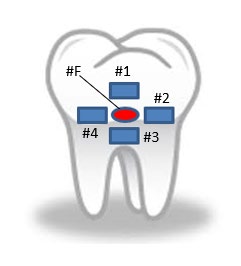
Twenty-four hours post-operative, the samples were gently airdried and placed on sticky transparent wax on a black matte surface. Using the Crystaleye Spectrophotometer (Olympus) the shade and L*a*b* scores were captured along with a picture for every sample using the Olympus stereomicroscope (SZX16). The L*a*b* and shade of 5 different sites on the buccal/labial surface of the teeth were recorded (Figure 1). Four of the sites are on the enamel (#1, #2, #3, #4) surrounding the filling and the 5th site is directly on the filling (#F) that’s in the middle. The readings are captured on those sites (#1, #2, #3, #4) and are then compared to the filling (#F) usually being 1 mm apart.
Two blinded clinicians evaluated the samples’ shade at each time point using the Vita Classical handheld shade guide and gave the samples a numerical score and an alphabetical shade (A1-D4). After recording the shade and pictures 24 hours post-operative, the samples were placed in separate small cups, where Opalescence Boost (Ultradent, 40% Hydrogen Peroxide) was applied on each tooth for 20 minutes, two consecutive times. The entire coronal portion of the tooth was immersed in the bleaching agent. The teeth were then rinsed and placed again in distilled water at 37°C in a dark chamber for another 24 hours. The same process was repeated using the Crystaleye Spectrophotometer (Olympus), the Olympus stereomicroscope (SZX16) and the clinician’s evaluation for the following time points: 24 hours post bleaching, 1-week post bleaching, 2-weeks post bleaching, and 4-weeks post bleaching. The Clinicians’ shade matching criteria were scored as follows: matching completely, somewhat matches and does not match.
Data Analysis
Descriptive statistics (Means ± SD) were calculated for L*a*b* values; percentages were calculated for the matching score. L*a*b* values of the 4 sites around the restoration were averaged and compared to the L*a*b* values of the restoration for each time period using the Student’s t-test. Additionally, a subgroup analysis was conducted. The teeth were divided into 2 separate groups. Group 1 included the teeth that showed a major shade change in enamel after bleaching and Group 2 that showed no significant change. Group1 included teeth #1,3,4,8,10 (Table 2). Group 2 included teeth #2,5,6,7,9 (Table 3). The l*a*b* values of Sites #1,#F, #3 (figure 1) were broken down for each time period. Stata version 15 were used for analysis and significant level was set at 0.01 to account for multiple comparisons.
Results
The average color change after bleaching was 3 shades. Shade matching scores by the clinicians showed the composite matched 100%, for all teeth at all-time intervals. There was no significant difference in the L*a*b* values between the restoration and tooth at each time interval (Table 1).
Regarding the subgroup analysis, for the teeth that showed a major shade change in enamel after bleaching, L values of site#3 and #1 increased after bleaching and decreased after storage. L value of site-F (restored with OMNICHROMA) also increased after bleaching and decreased after storage. On Group 2 where there was no major change in shade of the enamel, site #F did not change accordingly, thus matching the unchanged shade of sites #1 and #3.
| Post Op | 24 Hours | 1 Week | 2 Weeks | 4 Weeks | |
|---|---|---|---|---|---|
| LR | 73 ± 4.7 | 72.7 ± 4 | 72.3 ± 4.5 | 72 ± 4.5 | 72 ± 4.3 |
| LE | 69 ± 4 | 70.5 ± 4 | 69.2 ± 4.5 | 68 ± 4 | 69 ± 4.2 |
| p value | 0.04 | 0.2 | 0.1 | 0.05 | 0.2 |
| aR | 0.5 ± 0.5 | 0.3 ± 1.9 | 0.4 ± 1.4 | -0.2 ± 1.6 | 0.2 ± 1.4 |
| aE | 0.9 ± 0.5 | 0.4 ± 1.9 | 0.5 ± 1.6 | 0.2 ± 1.6 | 0.2 ± 1.5 |
| p value | 0.5 | 0.9 | 0.8 | 0.5 | 1.0 |
| bR | 19.4 ± 4.2 | 21.5 ± 4.1 | 19.7 ± 4 | 19.2 ± 2.8 | 19 ± 4 |
| bE | 18.5 ± 3.6 | 18.1 ± 2.8 | 17.4 ± 3 | 18.4 ± 3.6 | 17.8 ± 4 |
| p value | 0.6 | 0.04 | 0.2 | 0.5 | 0.5 |
Table 1: Comparing L*a*b* values over time between filling and adjacent enamel.
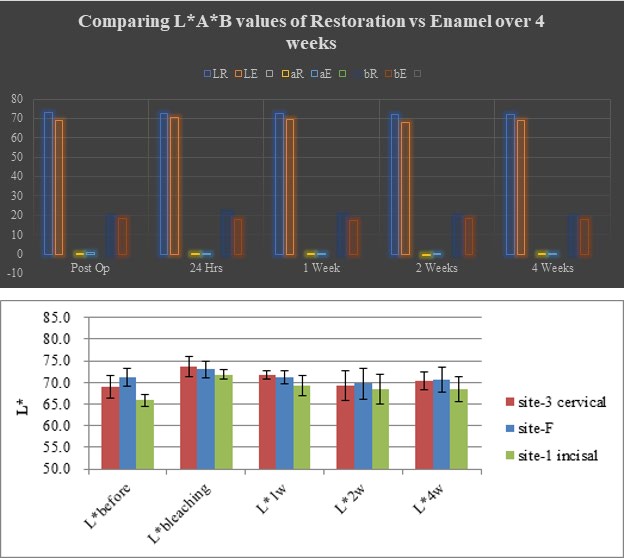
Graph 1: Comparing L*a*b* values over time between filling and adjacent enamel.
Comparing L*a*b* values over time between filling and adjacent enamel LR, aR, bR : L*a*b* values of the restoration. LE , aE, bE : average L*a*b* values of the 4 sites on adjacent enamel. Values are the L,a,b scores ± standard deviation.
Discussion
Overall, OMNICHROMA showed a clinical and statistical shade match to surrounding tooth structure. Clinically, since the beginning of the study the calibrated blinded clinicians gave a matching score of 100% and that result did not change over the entire month. When bleached, the shade of the filling conformed to the shade of the tooth in a manner that cannot be detected clinically. Statistically, the study shows that almost all of the compared points showed a close match to the restoration. The l* values of the restoration (#F) in group 1 (Table 2) showed a change to a lighter color when the tooth enamel (sites #1,#3) changed to a lighter shade after bleaching. Similarly, group 2 (Table 3) showed no change in (#F) when compared to enamel (#1,#3) that did not change shade after being bleached. The l* value is responsible for the lightness or darkness of a color, which is important when comparing shade changes in teeth.
| Post Op | 24 hours | 1 week | 2 weeks | 4 weeks | |
|---|---|---|---|---|---|
| L site#3 | 69.0±2.6 | 73.6±2.4 | 71.7±0.9 | 69.2±3.4 | 70.3±2.2 |
| L site F | 71.2±2.2 | 73±2.0 | 71.2±1.5 | 69.7±3.5 | 70.7±2.9 |
| L site#1 | 65.8±1.3 | 71.9±1.1 | 69.2±2.3 | 69.7±3.4 | 68.4±2.8 |
Table 2: L* values of sites # 1, F, and # 3 of teeth that showed a major shade change in enamel after bleaching.
Graph 2: L* values of sites # 1, F, and # 3 of teeth that showed a major shade change in enamel after bleaching.
| Post Op | 24 hours | 1 week | 2 weeks | 4 weeks | |
|---|---|---|---|---|---|
| L site#3 | 75.2±6.17 | 73.4±6.06 | 74.5±7.18 | 73.3±4.74 | 73.9±5.54 |
| L site-F | 74.8±6.16 | 72.3±5.72 | 73.4±6.40 | 74.2±4.39 | 73.0±5.56 |
| L site#1 | 68.7±4.32 | 70.9±5.58 | 71.1±6.55 | 70.4±5.31 | 70.2±4.57 |
Table 3: L* values of sites # 1, F, and # 3 of teeth that did not show a major shade change in enamel after bleaching.
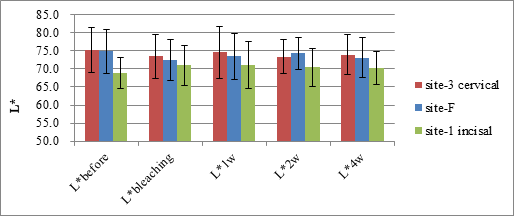
Graph 3: L* values of sites # 1, F, and # 3 of teeth that did not show a major shade change in enamel after bleaching.
As the demand for better esthetics and function increases, the future of resin composites is shifting towards an all in one technology. Clinicians are looking for materials that are more user friendly, could save time and are appealing to the patient’s high expectations [9]. While no one material has all the required qualities, OMNICHROMA is working towards a sustainable future where the clinician or the patient don’t have to worry about shade selection, bleaching over restorations or replacing the filling if it gets stained.
OMNICHROMA is a single shade composite that uses “smart chromatic technology” that can match teeth colors A1-D4 [7]. Whereas traditional composites achieve their color chemically by adding colors into the material, OMNICHROMA achieves its color by generating structural color. Structural color is expressed only by the physical properties of light and not by pigments or dyes [7]. This is done by controlling the morphology of the filler particles so that they reflect color in the red-yellow spectrum [7, 8]. Once it’s cured, it will combine with the reflection of light from the surrounding tooth structure to achieve superior shade matching [7]. This is different from the blending effect where the translucency of the material allows the filling to “blend” with the surrounding structures. As Paravina et al describes it, it is when materials show less difference in color match when placed next to each other rather than in isolation and is also influenced by the thickness and translucency of the used materials [9, 10].
Bleaching of composite restored teeth has been a controversial topic due to the many different types of resin restorative materials as well the types of bleaching agents used. Clinical results depend on a multitude of factors like diet, oral hygiene habits and materials being used. When compared to other studies, with OMNICHROMA, we are evaluating the shade change compared to tooth structure versus using composite discs alone. Rather than proving if bleaching works on the discoloration of composite, we are evaluating if the composite would modify its shade to match a surrounding tooth structure.
In this study two blinded, calibrated clinicians gave a matching score of completely matches to all the specimens evaluated. Comparing it to OMNICHROMA’s technical report, 841 restorative cases were evaluated amongst 25 doctors. The majority of the doctors provided ratings of excellent or good for OMNICHROMA’s color-matching ability with 60.8% ranking it as excellent [8]. Another study conducted by the Tokyo Medical and Dental University found that the ΔE values of OMNICHROMA restorations were lower in the cervical regions compared to the coronal regions, which illustrated a better color match [8].
In our study comparing L*a*b* values (Table 1) the mean values of the restoration, which were also in the cervical area, showed close numbers to the mean values of the surrounding enamel at 4 different points. Thus, supporting the color matching adaptation of OMNICHROMA. In a study by Rasha, et al. [9], the examiners mentioned the use of bulk fill universal shade composite had a high Blending Effect (BE). This Blending effect was better in the bulk fill composites due to a higher translucency of the bulk fill material [9, 11]. The study was performed on clinical patients, extracted teeth and composite like teeth with varying shapes and sizes. The study however did not involve bleaching the surfaces to see if the composite adapted and changed color to match the new shade post bleaching. The authors also mentioned that the bulk fill composite was recommended for classes I and II cavities and not classes III and IV. With OMNICHROMA the shade change was evaluated after the filled teeth are subject to a shade change post bleaching using Opalescence Boost (Ultradent 40%, Hydrogen peroxide). Omnichroma recommends using their bulk fill shade changing composite in anterior region where esthetics is of high concern.
Conclusion
Within the limitations of this in-vitro study, it was concluded that OMNICHROMA shade matching composite matches the shades of enamel for class V restorations. When bleached, the shade of the filling conformed to the shade of the tooth in a manner that cannot be detected clinically. OMNICHROMA changed to a lighter shade with the enamel that responded to bleaching and did not show a change when the enamel remained under the same shade Statistically when looking at the Table 1, the average scores of the L*a*b* of the restoration are very close to that of the enamel and shows that shades of the enamel and the restoration matched pre and post bleaching.
References
-
Perdigão J (Eds.), (2016) Tooth whitening: An evidence- based perspective. Springer.
-
Halacoglu DM, Yamanel K, Basaran S, Tuncer D, Celik C (2016) Effects of Staining and Bleaching on a Nanohybrid Composite with or without Surface Sealant. Eur J Dent 10(3): 361-365.
-
Mourouzis P, Koulaouzidou EA, Helvatjoglu-Antoniades M (2013) Effect of In-office Bleaching Agents on Physical Properties of Dental Composite Resins. Quintessence Int 44(4): 295-302.
-
Augusto B, Bittencourt D , Eugênio MB, Rafaela VB, Tatiana Z, et al. (2011) Surface Modifications on Aesthetically Restored Teeth following Home Bleaching with 16% Peroxide Carbamide. Eur J Dent 5(2): 157-162.
-
Hafez RM, Ahmed D, Yousry M, El Badrawy W, Omar El Mowafy (2010) Effect of In-Office Bleaching on Color and Surface Roughness of Composite Restoratives. Scinapse 4(2): 118-127.
-
Olga P, Scheitza S, Spraul M, Vach K, Hellwig E (2018) The Effect of Long- term Use of Tooth Bleaching Products on the Human Enamel Surface. Odontology 106(1): 64-72.
-
Kevin B (2019) How to match any composite restoration shade: Tokuyama’s OMNICHROMA Uses Smart Chromatic Technology to Match a Wider Range of Natural Teeth Colors. Dental Products Report 53(3): 36.
-
TOKUYAMA, Omnichroma.
-
Abdelraouf RM, Habib NA (2016) Color-Matching and Blending-Effect of Universal Shade Bulk-Fill-Resin- Composite in Resin-Composite-Models and Natural Teeth. BioMed Res Int 2016: 4183432.
-
Paravina RD, Westland S, Kimura M, Powers JM, Imai FH (2006) Color Interaction of Dental Materials: Blending Effect of Layered Composites. Dent Mater 22(10): 903- 908.
-
Fugolin APP, Pfeifer CS (2017) New Resins for Dental Composites. J Dent Res 96(10): 1085-1091.
- Diagnosis and Management of Mental Nerve Paresthesia Secondary to Apical Periodontitis of Mandibular Second Premolar: A CBCT Based Case Report
- A Randomized, Double Blinded Clinical Trial to Compare the Effect of Oral Premedication (Diclofenac Potassium or Dexamethasone) on Post-Operative Pain Following Pulpectomy
- Modified Lip Repositioning Technique for the Management of Excessive Gingival Display
- Integral Role of Non-Dental Providers and Fluoride Dissemination
- Root Canal Treatment Rate in Deciduous Teeth Among 6-Year- Olds in the Era of Discontinuing Water Fluoridation - Historical Cohort Study
- The Impact of the Notch1 on the Migratory Capacity and the Expression of E-Cadherin and CyclinD1 in Ameloblastoma Cells