
Knowledge and Patient Expectations on Dental Implants
Introduction: The oral rehabilitation through implantologyBecome already has an unquestionable reality daily in the clinic in the world’s Brazilian and odontology. It’s an essential driving sections When the dentist himself towards the clientele more and more demanding in terms of functional and recovering high aesthetic patterns. That being said, the knowledge of the perspective which led the patients to choose this kind of treatment is essential for the dentist to Improve his capability of helping Patients in the adaptation on the new situation and in the proper planning of the treatment contributing to Improve the trusting bond with the patient and for the success of the treatment. Objective: Evaluate the knowledge and the expectation of the dental implant toward Patients, as well as identify data related to rehabilitation such as self knowledge, satisfaction and objectives, fouled his or her social and economical conditions. Methods: This has been an observational study and cross, where the Patients under treatment in the course of implantology Specialization answered the validated quiz about the proposed topic. Results: In the present study Patients participated 58, 39 from the female genre from the 52.1 and 19 years old. The patients Seemed to be well informed about the topic. Among These 48% of Them about Claimed to search dental implant straight to the dentist and 89% Told they’d like to Obtain additional information with the same professional. 90% of the people chose the implant interviewed the first treatment option to replace the teeth. Conclusion: Patients The preferred to Obtain information directly with the dentist, even with the growth of other media, and already rehabbed Those with implants, Demonstrated to be satisfied with the masticatory function and aesthetics of the implants.
Introduction
The use of Implant-supported were viable and the osseointegration reality was a significant positive impact magnitude of psychosocial aspect of the patient, as demonstrated by a study by Adell, et al. [1]. Low self-esteem, social interaction difficulties, decreased quality of life, among other issues, are problems that can be related with tooth loss, as well as losses in the masticatory function and consequently the stomatognathic system of the patient [2].
Despite that, still exists a large number of people who don’t have enough knowledge about the possibilities of replacement of the lost tooth. Such information would be valuable in making decisions about the choice of a removable prosthesis or implant-supported [3]. Like most of the important decisions, the choice of way of treatment increases expectations that generally aren’t linear with reality and can’t be mitigated by any known treatment. These high expectations are direct connected to poor quality of information obtained from sources without scientific relevance. Most part of patients hope the dental implants last at least twenty years or for hole life, and some still expect a good implant has the appearance of a natural tooth, and apply the same chewing [4, 5, 6].
In a study by Pommer, et al. [7] which they used a questionnaire to assess the knowledge and expectations of patients regarding dental implants in Austria. 1000 respondents, 79% cited implants as first choice when asked about the replacement of missing teeth. This study pointed a significant increase level of knowledge in the population regarding the research conducted by Tepper et al. [8] and also demonstrated that most of the knowledge obtained is provided by the dental surgeon. However, it is necessary the improvement of communication strategies between dentist- patient so that the information that the professional pass to the patient become more understandable.
The correct professional approach, good understanding of the patient and the expectations created by both before procedures are extremely important conditions to conquer the patient’s awareness and thus be able to overcome psychological and social problems that can impacts negatively the terapêutic success [9]. Many patients feel well informed about dental implants, but few feel comfortable about this kind of treatment. The dental surgeon is considered most reliable source [9, 10, 11].
It is noticeable that dental implants are increasingly accepted by society, although there is little dissemination of specialized information regarding treatment. The high figure for this treatment is an important factor that sometimes makes the patient decline in such a therapeutic modality, as they aren’t oriented reliably relative to the cost of the material used and all professional fees which will be dedicated to carrying out the necessary procedures. However, when patients are informed about these process, they understand that the cost-benefit of such therapeutic modality is excellent and feel able to choose it [12, 13, 14, 15, 16, 17]. Therefore, knowledge of perspective that led patients to choose this kind of treatment is essential for the dental surgeon enhance the ability to assist the patient in adapting to a new situation and the correct treatment planning, helping to improve bond of trust with the patient and the treatment success.
Methods
This was an observational cross-sectional study. For this process, was selected 70 patients who underwent rehabilitation treatment through dental implants in a specialization course in implantology in the city of Juiz de Fora/MG. First of all it was filled out a health record containing identification data and patient age. Then a modified questionnaire was filled proposed by Pommer et al. [7, 11], containing data involving socioeconomic status and monthly income, as well as rehabilitation-related data with dental implants such as self-awareness, goals and expectations.
The inclusion criteria were selected patients who are in process of treatment for rehabilitation with implants and dentures on implants in the arch top and/or bottom, unitary or multiple. Patients who didn’t consent to participate in the study were excluded by not signing the free and informed consent. This study was approved by the Research Ethics Committee of the Faculdade de Ciências Médicas e da Saúde de Juiz de Fora (SUPREMA/JF - report number 1.867.336).
Results
Initially were interviewed 70 patients, 58 were selected as met the inclusion and exclusion criteria. A total of 12 were excluded as they didn’t fill the data correctly and/or didn’t agree with the Informed Consent Form. 39 (67.24%) were female and 19 (32.75%) were male (Chart 1). The mean age was 52.1 years, ranging from 23 to 79 years, and most patients (38 / 65.51%) were in the age group 50-69 years (Chart 2).
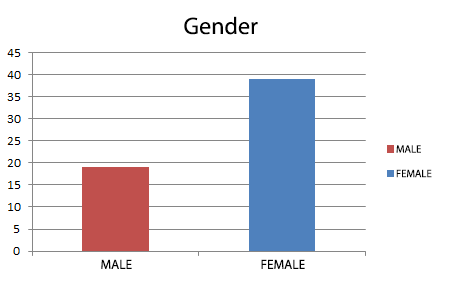
Chart 1: Division of patients by gender.
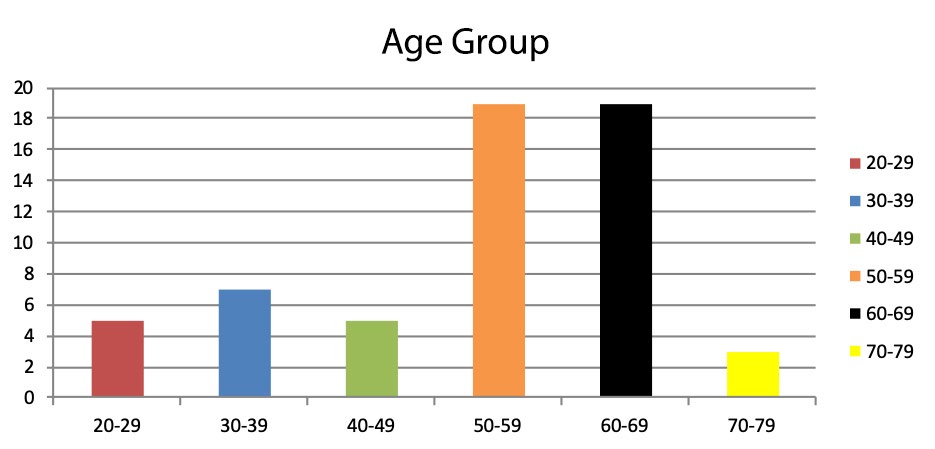
Chart 2: Division of patients by age.
Answers about dental evaluation
In the point of view of interviewed patients dentures have few advantages over dentures supported by implants and fixed dentures are the most advantageous when it becomes necessary to replace an element. However also cited the high cost of implants as the main disadvantage. When questioned about the location of implant fixation, 45 (78%) of the research volunteers opted for jawbone as a response and only 9 (16%) of patients reported not knowing (Table 1).
| Do you have any implants? | |
| Yes | 33 (57%) |
| No | 25 (43%) |
| Have you undergone any dental treatment? | |
| Yes | 57 (98%) |
| No | 1 (2%) |
| What alternatives for dental replacement you know? | |
| Implant-supported prostheses (“implant”) | 27 (47%) |
| Removable partial dentures (“roach”) | 7 (12%) |
| Removable dentures (“teeth”) | 5 (9%) |
| Fixed partial prostheses (“bridges”) | (5%) |
| No answers | 16 (27%) |
| How well informed do you feel about the implants? | |
| Very well informed. | 17 (29%) |
| Well informed. | 22 (38%) |
| Moderately well informed. | 14 (24%) |
| Uninformed. | 4 (7%) |
| No information. | 1 (2%) |
| How well informed do you feel about the other tooth replacement alternatives? | |
| Very well informed. | 9 (16%) |
| Well informed. | 24 (41%) |
| Moderately well informed. | 15 (26%) |
| Uninformed. | 10 (17%) |
| No information. | 0 (0%) |
| Would you be satisfied with a removable prosthesis? | |
| Yes. | 9 (16%) |
| No. | 49 (84%) |
| In your opinion, what are the advantages of removable dentures compared to implants? | |
| Cause less nuisance. | 7 (21%) |
| Better aesthetics. | 5 (15%) |
| As good as own teeth. | 2 (6%) |
| I don’t feel like something strange in my mouth. | 8 (24%) |
| None of the above. | 33 (34%) |
| What type of dental replacement is most advantageous in your opinion? | |
| Removable prosthesis | 3 (5%) |
| Non-removable prosthesis | 53 (91%) |
| No answers | 2 (4%) |
| What are the disadvantages of implant-supported prostheses? | |
| High costs. | 29 (50%) |
| Needs surgery. | 4 (8%) |
| Long treatment time. | 16 (28%) |
| No answers. | 9 (16%) |
| Where do you think the implants are fixed in the jaw? | |
| Jawbone. | 45 (78%) |
| Gum. | 3 (5%) |
| Neighboring teeth. | 0 (0%) |
| Don’t know. | 9 (16%) |
| No answers. | 1 (1%) |
Table 1: Dental evaluation answers.
Answers About Dental Implants
Regarding the source of information about implants, 24 (48%) had the dentist. Regarding the sources of information about tooth replacement alternatives, 33 (62%) is based on the dentist to seek information. However, 48 (89%) of respondents would like to get more information about implants directly with the dentist himself (Chart 3).
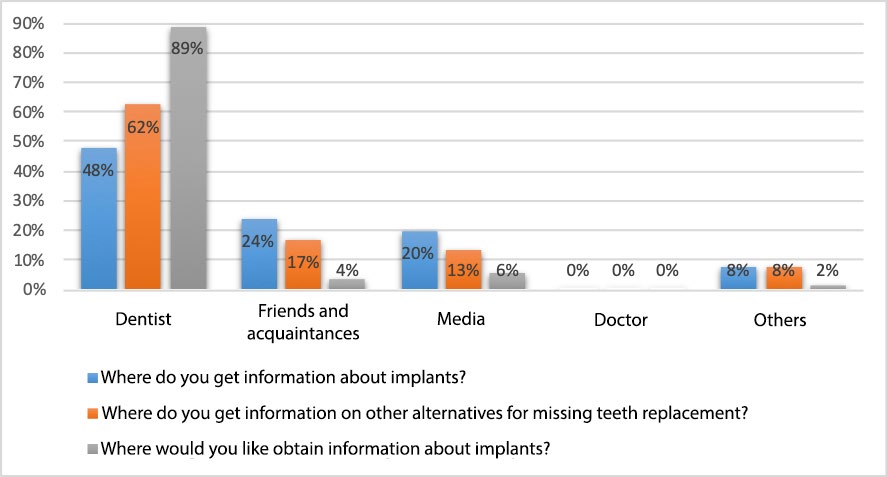
Chart 3: Answers about dental implant.
Answers about the Need for Patient Information Regarding Dental Implants
Of the participants who answered the questionnaire, 49 (84%) would like more information about implants. Most respondents, 31 (53%), is convinced that dental implants last hole life and 22 (38%) were associated with the possible loss of the implant to poor oral hygiene. Much, 43 (74%) believes Would you like to know more about implants?
How long do you think an implant can last?
Up to 5 years. Up to 10 years. Up to 20 years. Throughout life. No answers.
Who / What do you blame for the loss of an implant?
Dentist. Patient. Poor oral hygiene. Inflammation / incompatibilities. No answers.
Do you think implants need special care and hygiene?
No, they are clean as natural teeth. No, they need more care than natural teeth. Yes, they need more care than natural teeth. No answers.
that hygiene should be more rigorous in relation to natural teeth. Of the patients respondents, 45 (78%) reported that the missing tooth must be replaced, with the most frequently found in tooth loss was cited from one to three teeth. When asked if they had replaced the missing teeth, 36 (62%) responded yes and 22 (38%) had not. The vast majority (90%) said they would opt for implant-supported prostheses as election option.
Yes. No. 49 (84%) 9 (16%)
4 (7%) 11 (19%) 10 (17%) 31 (53%) 2 (4%)
7 (12%) 7 (12%) 22 (38%) 15 (26%) 7 (12%)
10 (17%) 3 (5%) 43 (74%) 2 (4%)
Do you know if your dental surgeon (who last treated your teeth) performs implant treatment?
Yes, he works with implants. No, he doesn’t offer implants. Don’t know. No answers.
34 (59%) 17 (29%) 6 (10%) 1 (2%)
Do you think that your dentist uses updated techniques to implant?
Yes. Don’t. No answers.
I would like your dentist perform implant treatment?
Yes. No, only specialists should make this type of treatment. 33 (57%) 25 (43%)
34 (59%) 8 (14%) 16 (28%)
You generally think a dentist that provides implant treatment is more qualified than dentists who don’t?
What do you think about implants?
Yes. No. 43 (74%) 15 (26%)
Would if necessary. Would’t. The implants are not good for everyone. The implants are good for everyone. The implants are expensive, only for the rich. Everyone can afford implants. No answers.
Do you think missing teeth should be replaced?
Yes, definitely. Yes, if the missing tooth is visible. Don’t. No answers.
You have lost one or more teeth in the past?
No. 1-3 teeth. 4-5 teeth. 6-10 teeth. More than 10 teeth. Almost all teeth. All teeth.
21 (36%) 0 (0%) 5 (9%) 8 (14%) 5 (9%) 8 (14%) 11 (18%)
45 (78%) 12 (21%) 0 (0%) 1 (1%)
1 (2%) 22 (38%) 12 (21%) 9 (16%) 6 (10%) 5 (9%) 3 (5%)
- Have you had your missing teeth replaced?
- Yes.
- No.
- 36 (62%)
- 22 (38%)
- If you had lost teeth which would like to use?
- Implant-supported prostheses ( “implant”)
- Removable partial dentures ( “roach”)
- Removable dentures ( “teeth”)
- Fixed partial prostheses ( “bridges”)
- 52 (90%)
- 3 (5%)
- 1 (2%)
- 2 (3%)
- Do you have implants or know someone who has?
- Yes I have.
- Yes, I know someone who has implants.
- No.
- No answers.
- 31 (53%)
- 19 (33%)
- 5 (9%)
- 3 (5%)
- Before you have your implants placed, have you had removable dentures?
- Yes.
- No.
- No answers.
- 34 (59%)
- 23 (40%)
- 1 (1%)
Table 2: Answers about the need for patient information regarding dental implants.
Answers about the Cost of Treatment with Implant and the Patient’s Satisfaction with Treatment
Patients who already have implants placed, 33 (57%), discoursed as follows when asked about the current replacement of teeth, aesthetics and function of own implants: 25 (43%) reported being satisfied and only three (5%) said be totally dissatisfied with the replacement of missing teeth; of these, 14 (24%) are fully satisfied with the aesthetic and 17 (29%) are also satisfied with the function of the present implants. Of the respondents, 26 (45%) know someone who has implants and says is fully satisfied with this kind of substitution, and no research participant reported knowing someone dissatisfied with dental implants (Table 3).
How much do you think a patient has to pay for an implant in Brazil, without a crown, that is, just the pin?
To R$ 1000. To R$ 1500. To R$ 2000. To R$ 2500. Over up to R$ 2500. No answers.
Do you think it is ...
Little. Fair. Too much. No answers.
40 (68%) 11 (18%) 2 (4%) (2%) 2 (4%) 2 (4%)
4 (7%) 43 (74%) 10 (17%) 1 (2%)
How much do you think a dentist has to pay for the purchase of an implant manufacturer / dealer?
To R$ 300. To R$ 500. To R$ 750. To R$ 1000. To R$ 1500. Over up to R$ 1500 No answers.
Who / what is the main responsible for the final price of the implant?
Dentist. Laboratory technician. Manufacturer. Dealer. Taxes. No answers.
Who should pay for the implant?
Patient. Social Security (Government) Private health plan. No answers.
How satisfied are you with the current replacement of your teeth?
Very satisfied. Pleased. Not so satisfied. Dissatisfied. No answers.
23 (40%) 18 (31%) 5 (9%) 4 (7%) 2 (3%) 3 (5%) 3 (5%)
18 (31%) 2 (3%) 12 (21%) 7 (12%) 14 (24%) 5 (9%)
19 (33%) 24 (41%) 6 (10%) 9 (16%)
19 (33%) 25 (43%) 6 (10%) 3 (5%) 5 (9%)
How satisfied are you with the aesthetics of your implant(s)?
Very satisfied. Pleased. Not so satisfied. Dissatisfied. No answers.
14 (24%) 15 (26%) 3 (5%) 0 (0%) 26 (45%)
How satisfied are you with the function of your implant (s)?
Very satisfied. Pleased. Not so satisfied. Dissatisfied. No answers.
13 (22%) 17 (29%) 1 (2%) 1 (2%) 26 (45%)
If you know someone with implants, how satisfied is the person with the implant (s)?
Discussion
Nowadays it’s estimated that about one million dental implants are performed worldwide, making Implantology an important rehabilitation treatment in dentistry [8]. There are several possibilities to obtain information on dental implants. The rise of digital media worldwide has their broader dissemination, performing an important role in raising awareness of the general population and demonstrating the importance of replacing the lost tooth. Especially good communication between the dentist and the patient is very important not only for quality information, but also to the success of treatment, and the professional analyze the motivations and expectations of those who seek this treatment, thus increasing the possibility of patient satisfaction [18, 19, 20].
In this study the mean age of the patients interviewed was 52 years, the majority of females (67.24%). Among the respondents, 53 (91%) also reported that fixed prostheses are most advantageous for the replacement tooth compared with removable, according to a survey by Tomruk O, et al. [3]. However they indicated that the major disadvantages of implant-supported prosthesis are high aggregate cost to the treatment and also the need for surgery, increasing numbers of 29 (50%) and 16 (28%) of the analyzed questionnaires. These results differ from those reported in other research20, where intercurrences were cited but the overall experience was positive. In a survey conducted by Pommer, et al. [7], Austria, in this study, 22 (38%) of the patients felt well informed therapy implants. In the research conducted by Simensen et al. [21] reported that only 6.0% of respondents said they had much prior knowledge of the treatment and 64.1% thought they had little knowledge of implant treatment. As applied in the evaluation by Yao et al. [10] the number of subjects who reported to be well informed reached 17.7% on this treatment modality.
The results of this research demonstrate the need for increased communication between the dentist and patient since about nine (16%) of the respondents reported not know where the implants are anchored in the oral cavity, a result similar to that found in research conducted by Tepper, et al. [8], where 29% reported not knowing where the implants are anchored. When asked where obtains information about implants, 24 (48%) of patients reported inquire directly with the dentist, followed by information through friends and acquaintances. In addition, 48 (89%) of respondents said they would like to have the dentist as the main source, corroborating the results found in other studies, where 62% said they seek information to dentists and 84% would like information with a dentist [7, 21].
In studies by Pommer, et al. [11, 17] 60% couldn’t report whether the last dentist with whom they performed any treatment performed implants, demonstrating an improvement when compared to a survey by Tepper, et al. [8], where it was found that 70% didn’t know how to answer. Despite the progress in obtaining this information, it is clear a failed professional-patient communication. Our study has also applied the same question, where it was found a quantity of 10% of respondents held no knowledge of this data. In the present research, 59% of the interviewees reported that their surgeons are updated, corroborating previous research [8, 11, 17].
In this study, 45 (78%) of respondents said they should replace lost teeth. Regarding the number of teeth lost by respondents, 22 (38%) reported having lost up to three teeth, and research conducted in other countries have found less impressive results, 26% 17 and 27% 8, compared to the same degree of loss. Among the means for substitution and
| Very satisfied. | 26 (45%) |
| Pleased. | 23 (40%) |
| Not so satisfied. | 1 (2%) |
| Dissatisfied. | 0 (0%) |
| Don't know. | 3 (5%) |
| No answers. | 5 (8%) |
Table 3: Answers about the cost of treatment with implant and on patient satisfaction with treatment.
presented to the participants, the large majority indicated that opt to use implants and more than half of respondents have or know someone who has implants.
In this study, 63% of respondents said they received between 880 and 1760 reais. In another research performed5 this percentage remained similar, where 61% said receiving between 685 and 1148 reais, taking into account the conversion of the local currency (Jordanian dinar) for the Brazilian currency. Research by Pommer, et al. [7] depicts another reality, where participants have minimum income up to 900 euros (US $ 3,274).
Of the 58 patients interviewed, 33 (57%) had already installed prosthetic implants and responded to about masticatory function and aesthetics. 30 (94%) proved to be satisfied with the functionality obtained and 29 (91%) say they are satisfied or very satisfied with the result after the implant aesthetic installation. When asked how satisfied they were with the current replacement teeth, we come up with a result of 80% approval, corroborating with results found in other similar studies [17, 22, 23].
Conclusion
a) With the results obtained in this study we suggest that: b) Even with the rising of digital media, patients would like to get further information and other knowledge of the rehabilitation with dental implants directly with the dentist; c) The expectation of patients in the choice of implant treatment is the recovery of masticatory function and esthetics compared to other therapeutic possibilities. In the present study, patients with implants showed been rehabilitated be satisfied with the masticatory function and the aesthetic obtained;
The information to patients on dental implants can help in eliminating any negative image of the procedure which may have been caused due to lack of adequate information.
References
-
Adell R, Lekholm U, Rockler B, Branemark PI (1981) A 15-year study of osseointegrated implants in the treatment of the edentulous jaw. Int J Oral Surg 10(6): 387-416.
-
Saintrain MV, de Souza EH (2012) Impact of tooth loss on the quality of life. Gerodontology 29(2): 632-636.
-
Özçakır Tomruk C, Ozkurt Kayahan Z, Şençift K (2014) Patients’ knowledge and awareness of dental implants in a Turkish subpopulation. J Adv Prosthodont 6(2): 133- 137.
-
Hof M, Tepper L, Semo B, Arnhart C, Watzek G, et al. (2014) Patients’ Perspectives on dental implant and bone graft surgery: Questionnaire: based Interview Survey. Clin Oral Implants Res 25(1): 42-45.
-
AL Dwairi ZN, El Masoud BM, AL Afifi SA, Borzabadi FA, Lynch E (2014) Awareness, attitude, and expectations toward removable dental prostheses implants among wearers. Int J Prosthodont 23(3): 192-197.
-
Nickenig HJ, Wichmann M, Andreas SK, Eitner S (2008) Oral health-related quality of life in partially edentulous Patients: Assessments implant before and after therapy. Craniomaxillofac J Surg 36(8): 477-480.
-
Pommer B, Zechner W, Watzak L, Ulm C, Watzek G, et al. (2011) Progress and Trends in Patients’ mindset on dental implants. I: level of information, sources of information and need for patient information. Clin Oral Implants Res 22(2): 223-239.
-
Tepper G, Haas R, Mailath G, Teller C, Zechner W, et al. (2003) Representative study marketing-oriented on implants in the Austrian population. I. Level of information, sources of information and need for patient information. Clin Oral Implants Res 14(5): 621-633.
-
Cunha MC, Santos JF, Santos MB, Marchini L (2015) Patient’s expectation before and after satisfaction full- arch implant-fixed prosthesis rehabilitation. J Oral Implantol 41(3): 235-239.
-
Yao J, Li M, Tang H, Wang PL, Zhao YX, et al. (2016) What do patients expect from treatment with Dental Implants? Perceptions, expectations and misconceptions: a multicenter study. Clin Oral Implants Res 28(3): 1-11.
-
Saha A, S Dutta, Vijaya V, Rajnikant N (2013) Awareness among Patients Regarding Implants as a treatment option for replacement of missing teeth in Chattisgarh. Int J Dent Oral Health 5(5): 48-52.
-
Johannsen A, Westergren A, Johannsen G (2012) Dental implants from the Patients perspective: Transition from tooth loss, through amputation to implants-negative and positive trajectories. J Clin Periodontol 39(7): 681-687.
-
Rustemeyer J, Bremerich A (2007) Patients’ knowledge and expectations regarding dental implants: assessment by questionnaire. Craniomaxillofac J Surg 36(9): 814- 817.
-
Bra P (1977) Osseointegrated implants in the treatment of edentulous jaw, Experience from a 10-year period. Scand J Plast Reconstr Surg 16: 1-132.
-
Brånemark PI, Adell R, Breine U, Hansson BO, Lindström J, et al. (1969) Intra-osseous anchorage of dental prostheses: I. Experimental studies. Scandinavian Journal of Plastic and Reconstructive Surgery 3(2): 81- 100.
-
Senra H, Oliveira RA, Leal R, Vieira C (2012) Beyond the body image: a qualitative study on how adults experience lower limb amputation. Clin Rehabil 26(2): 180-191.
-
Pommer B, Zechner W, Watzak G, Ulm C, Watzek G, et al. (2011) Progress and Trends in Patients’ mindset on dental implants. II: implant acceptance, patient- perceived costs and patient satisfaction. Clin Oral Implants Res 22(1): 106-112.
-
Johany Al-O, Al Zoman HA, Juhaini M Al, Al Refeai M (2010) Dental Patients’ awareness and knowledge in using the dental implants an option in replacing missing teeth: A Survey in Riyadh, Saudi Arabia. Saudi Dent J 22(4): 183-188.
-
Walia K, Belludi SA, Kulkarni P, Darak P, Swamy S (2016) A comparative and a qualitative analysis of patient’s motivations, expectations and satisfaction with dental implants. J Clin Diagn Res 10(4): 23-26.
-
Atieh MA, Morgaine KC, Duncan WJ (2016) A qualitative analysis on participants’ perspectives on oral implants. Clin Oral Implants Res 27(3): 383-391.
-
Simensen AN, Bøe OE, Berg E, Leknes KN (2015) Patient knowledge expectations and prior to receiving the implant-supported restorations. Int J Oral Maxillofac Implants 30(1): 41-47.
-
Simonis P, Dufour T, Tenenbaum H (2010) Long-term implant survival and success: the 10-16-year follow-up of non-submerged dental implants. Clin Oral Implants Res 21(7): 772-777.
-
Derks J, Håkansson J, Wennström JL, Klinge B, Berglundh T (2015) Patient Reported Outcomes of dental implant therapy in a large randomly selected sample. Clin Oral Implants Res 26(5): 586-591.
- Diagnosis and Management of Mental Nerve Paresthesia Secondary to Apical Periodontitis of Mandibular Second Premolar: A CBCT Based Case Report
- A Randomized, Double Blinded Clinical Trial to Compare the Effect of Oral Premedication (Diclofenac Potassium or Dexamethasone) on Post-Operative Pain Following Pulpectomy
- Modified Lip Repositioning Technique for the Management of Excessive Gingival Display
- Integral Role of Non-Dental Providers and Fluoride Dissemination
- Root Canal Treatment Rate in Deciduous Teeth Among 6-Year- Olds in the Era of Discontinuing Water Fluoridation - Historical Cohort Study
- The Impact of the Notch1 on the Migratory Capacity and the Expression of E-Cadherin and CyclinD1 in Ameloblastoma Cells