
The Influence of COVID-19 Perceptions and COVID-19 Worries on Individuals' Intentions to Postpone Dental Visits
This study examines the influence of COVID-19 perceptions and COVID-19 worries on individuals’ intentions to postpone dental visits among dental patients in Thailand. The self-administered online questionnaire was developed based on reliable and valid sources. The quantitative approach employed convenience sampling to collect data from respondents (n=308) in Thailand. PLS-SEM results show the significant influence of COVID-19 perceptions and COVID-19 worries on individuals’ intentions to postpone dental visits among Thai dental patients both in the private and public sectors. Dental healthcare providers and strategic planners should consider appropriate strategic management due to changing consumer behavior during the COVID-19 pandemic. The recommendation is to do further research expanding sampling in other countries. Also, qualitative research could give more insight to explain the psychological factors and consumer behavioral changes among dental patients. The results could apply in both public and private sectors to encourage the knowledge, perceptions, and attitude among patients in any country. The hard work of healthcare providers regarding COVID-19 pandemic severity could be decreased. The cost-saving and healthy population worldwide will incur soon.
Introduction
The rapid spread of the COVID-19 has been declared a global public health emergency by the WHO. It is a contagious disease spreading worldwide, posing a significant public health threat with far-reaching consequences [1, 2]. Fear and worries of becoming infected have spread and grown in tandem with the COVID-19 pandemic, as the disease is human-to-human transmissible, associated with high morbidity, and potentially fatal, heightening the perception of personal danger [3]. The COVID-19 prevention protocols, such as handwashing, social distancing, and mask-wearing, are critical for preventing the spread of the disease [4]. Furthermore, during the COVID-19 pandemic, people with a higher perception of personal and social responsibility were more compliant with health protocols than those with a lower perception [5]. The COVID-19 pandemic is also an ongoing public health challenge for dentistry. The healthcare-related to COVID-19 in the dental community is critical to research [6]. Therefore, the influence of COVID-19 perceptions and COVID-19 worries among dental patients on individuals’ intentions to postpone dental visits are essential in studying the psychological factors and the outcome of individuals’ intentions to postpone dental visits in the dental healthcare sector. The findings could be practical strategies for dental practitioners and healthcare providers in Thailand and other countries worldwide.
COVID-19 Perceptions
The perception was defined as the process of becoming aware of something through the senses. COVID-19 perceptions are used to assess the individuals’ perceptions of their response to the COVID-19 disease [7, 8]. Besides, several studies investigated individuals’ perceptions of COVID-19, including perceived severity of catching COVID-19 and perceived trust in government [9], and perceived risk and perceived fear [10]. Thus, COVID-19 perceptions were used to assess the individuals’ perceptions of their response to the COVID-19 disease among dental patients.
COVID-19 Worries
An increased worry of contracting COVID-19 was related to a higher perceived risk of contracting the virus [11]. COVID-19 worries reflect the extent to which participants were concerned about the impact of COVID-19, such as contracting the disease, dying because of the disease, lifestyle disruptions, the economy entering a recession, and family income declining [8]. Therefore, COVID-19 worries were the worries of dental patients related to COVID-19.
Intention to Postpone Dental Visits
The COVID-19 pandemic has had an impact on medical service utilization [12]. During the COVID-19 pandemic, how people perceive COVID-19 or illness presentations may influence their decision to visit hospitals for follow- up consultations [13]. Therefore, the intention to postpone dental visits could be related to COVID-19 perceptions and COVID-19 worries among dental patients.
Research Question, Objective, and Hypotheses
Do COVID-19 perceptions and COVID-19 worries influence individuals’ intentions to postpone dental visits among dental patients in Thailand?.
Thus, this study examines the influence of COVID-19 perceptions and COVID-19 worries on individuals’ intentions to postpone dental visits. The research hypotheses are as follows.
- H1: COVID-19 perceptions significantly influence individuals’ intentions to postpone dental visits.
- H2: COVID-19 worries significantly influence individuals’ intentions to postpone dental visits.
Research Methodology
The population was dental patients in Thailand both from the private and public sectors. The sample was from convenience sampling of Thai dental patients over 18 years old (online survey using five Likert’s scale). The sample size determination for an infinite population was over a minimum of 100 as required for inferential statistics following the recommendation of Kock & Hadaya [14]. The questionnaire items in COVID-19 perceptions, COVID-19 worries, and the intention to postpone dental visits were based on Barber & Kim [7]. The hypotheses were tested using PLS-SEM from 308 completed data (n=308).
Results
The respondents represented Thai dental patients from five regions of Thailand who were students (38.6%) and private company employees (38%). Most respondents were female (51.3%), single (76%), held a bachelor’s degree (67.2%) and earned a monthly income of 10,001 - 20,000 THB (40.6%). The age was between 18 - 25 years old (40.6%) and 25-30 years old (41.2%). The demographic profile corresponds to the dental patients for orthodontic treatment in Thailand Tables 1-5 & Figure 1.
| Demographics | Frequency | Percentage | |
|---|---|---|---|
| Gender | Male | 150 | 48.70% |
| Gender | Female | 158 | 51.30% |
| Region | Northern | 39 | 12.70% |
| Region | Eastern | 56 | 18.20% |
| Region | Northeastern | 64 | 20.80% |
| Region | Central | 71 | 23.10% |
| Region | Southern-Western | 78 | 25.30% |
| Age | 18 - 25 years old | 125 | 40.60% |
| Age | 25 - 30 years old | 127 | 41.20% |
| Age | 31 - 35 years old | 20 | 6.50% |
| Age | 36 - 40 years old | 8 | 2.60% |
| Age | 41 - 45 years old | 9 | 2.90% |
| Age | 46 - 50 years old | 12 | 3.90% |
| Age | 51 years old or over | 7 | 2.30% |
| Status | Single | 234 | 76.00% |
| Status | Married | 74 | 24.00% |
| Education | Associated Degree | 51 | 16.60% |
| Education | Bachelor’s Degree | 207 | 67.20% |
| Education | Master’s Degree | 42 | 13.60% |
| Education | Doctorate Degree or Higher | 8 | 2.60% |
| Occupation | Student | 119 | 38.60% |
| Occupation | Civil Servant | 34 | 11.10% |
| Occupation | Private Company Employee | 117 | 38.00% |
| Occupation | Personal Business | 26 | 8.40% |
| Occupation | Househusband or Housewife | 5 | 1.60% |
| Occupation | Unemployed | 3 | 1.00% |
| Occupation | Others | 4 | 1.30% |
| Monthly Income | Less than 10,000 THB | 102 | 33.10% |
| Monthly Income | 10,001 - 20,000 THB | 125 | 40.60% |
| Monthly Income | 20,001 - 30,000 THB | 32 | 10.40% |
| Monthly Income | 30,001 - 40,000 THB | 9 | 2.90% |
| Monthly Income | 40,0001 - 50,000 THB | 13 | 4.20% |
| Monthly Income | More than 50,000 THB | 27 | 8.80% |
| Total | 308 | 100% |
Table 1: Demographic Characteristics of the Respondents (n=308).
| Items | Mean | SD. | Factor Loadings |
|---|---|---|---|
| COVID-19 Perceptions (COP) | |||
| Cronbach’s Alpha = 0.827, AVE = 0.663 | |||
| COP1: I follow the updated news about COVID-19 every day. | 4.851 | 0.14 | 0.923 |
| COP2: COVID-19 preventive protocols are necessary for everyone. | 4.831 | 0.16 | 0.738 |
| COP3: COVID-19 is more dangerous than flu. | 4.792 | 0.224 | 0.861 |
| COP4: Everyone needs the COVID-19 vaccination. | 4.799 | 0.226 | 0.716 |
| COVID-19 Worries (COW) | |||
| Cronbach’s Alpha = 0.885, AVE = 0.637 | |||
| COW1: I am afraid to have COVID-19 if I go outside. | 4.682 | 0.413 | 0.869 |
| COW2: I worry that my family could have COVID-19 from outside. | 4.753 | 0.297 | 0.811 |
| COW3: COVID-19 has disrupted my life and activities. | 4.834 | 0.23 | 0.781 |
| COW4: COVID-19 situation declines my family’s income. | 4.714 | 0.524 | 0.678 |
| COW5: I worry about food safety outside my house. | 4.666 | 0.484 | 0.815 |
| COW6: I worry about the COVID-19 vaccination’s side effects. | 4.692 | 0.449 | 0.825 |
| Intention to Postpone Dental Visits (INP) | |||
| Cronbach’s Alpha = 0.856, AVE = 0.778 | |||
| INP1: I will postpone my dental visit due to the perception | 4.75 | 0.266 | 0.915 |
| of the situation of the COVID-19 outbreak | |||
| INP2: I will postpone my dental visit due to the worries | 4.744 | 0.296 | 0.895 |
| about the situation of the COVID-19 outbreak | |||
| INP3: During the COVID-19 pandemic, I will go to the | 4.802 | 0.257 | 0.833 |
| dental clinic or hospital as necessary. |
Table 2: Mean, SD., Factor Loadings, Cronbach’s Alpha, and Average Variance Extracted (n=308).
| The goodness of Model Fit | SRMR Value |
|---|---|
| Saturated Model | 0.0865 |
| Estimated Model | 0.0865 |
Table 3: The Goodness of Model Fit (n=308).
| Effect | Original Coefficient | Standard Bootstrap Results | Percentile Bootstrap Quantiles | ||||||
|---|---|---|---|---|---|---|---|---|---|
| Mean Value | Standard Error | T-Value | P-Value | P-Value | 0.50% | 2.50% | 97.50% | ||
| (2-Sided) | (1-Sided) | ||||||||
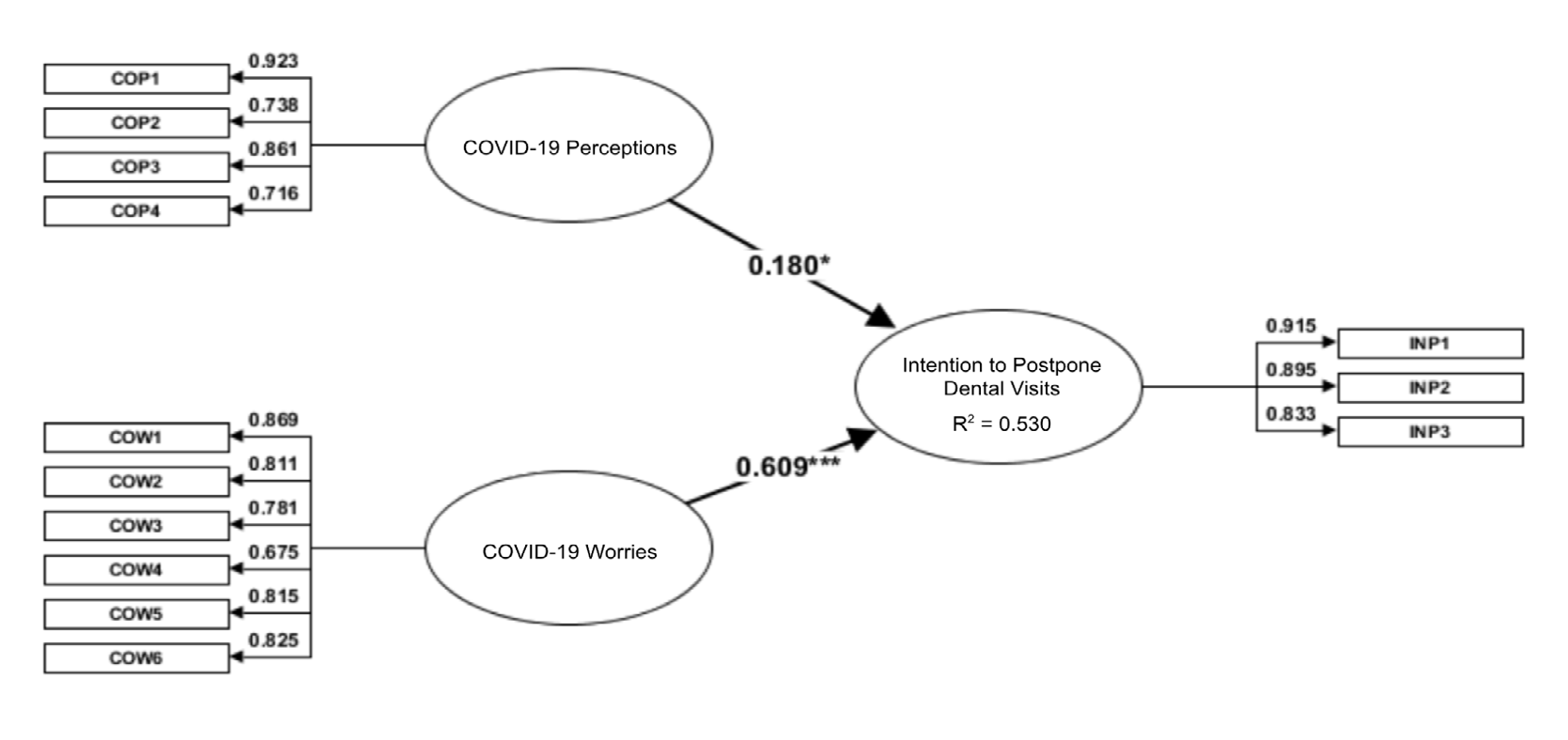
| COP → INP | 0.18 | 0.1733 | 0.0909 | 1.981 | 0.0479 | 0.0239 | -0.0632 | -0.0163 | 0.3321 |
| COW → INP | 0.6091 | 0.6212 | 0.0769 | 7.9255 | 0 | 0 | 0.4337 | 0.4846 | 0.7886 |
| COP: COVID-19 Perceptions; COW: COVID-19 Worries; INP: Intention to Postpone Dental Visits |
Table 4: Total Effects Inference (n=308).
COP: COVID-19 Perceptions; COW: COVID-19 Worries; INP: Intention to Postpone Dental Visits Table 4: Total Effects Inference (n=308).
According to Ahmad, et al. [15], SRMR was set at 0.087, AVE was set at 0.5, Cronbach’s Alpha was set at 0.7 and Factor Loading was set at 0.6.
| Results | Actions | |
|---|---|---|
| H1: COVID-19 perceptions significantly influence individuals' intentions to postpone dental visits. | β=0.180, p<0.05 | Supported |
| H2: COVID-19 worries significantly influence individuals' intentions to postpone dental visits. | β=0.609, p<0.001 | Supported |
Table 5: Summary of Hypothesis Testing.
The individuals’ intention to postpone dental visits can be explained by COVID-19 perceptions and COVID-19 worries by about 53% (R2=0.530).
Discussion
The current global situation is preoccupied with the fight against the new coronavirus concerns about physical health care and psychological suffering among the general population and health professionals [16]. This study confirmed the theoretical framework based on the study of Barber & Kim [7] and Limna, et al. [17]. It reveals that COVID-19 perceptions and COVID worries influence individuals’ intention to postpone dental visits among dental patients in Thailand during the COVID-19 pandemic. However, the demographics were not included in this study. According to Barber & Kim [7], men are more likely than women to die from coronavirus disease 2019 (COVID-19), with a higher case fatality rate in older adults. Older persons and men are less likely than younger adults and women to experience concern, which is a primary motivator of behavioral health improvements. Further, the older persons (especially men) would report the slightest COVID-19 worries and fewer COVID-19 behavior changes. Therefore, the demographics could be the determinants of behavioral changes among dental patients in Thailand and it is an interesting topic in further study [18].
Conclusion
COVID-19 perceptions and COVID-19 worries are the main antecedents of individuals’ intention to postpone dental visits in this study. Moreover, COVID-19 worries can explain behavioral changes among dental patients better than COVID-19 perceptions. However, this study could be explained by other factors such as individual economic factors. Dental patients perceived the COVID-19 pandemic by following the updated news about COVID-19 every day. Most of them know that COVID-19 preventive protocols are necessary for everyone. It is more dangerous than the flu. Thus, everyone needs COVID-19 vaccination. Dental patients worry about COVID-19 because it has disrupted their life and activities. Moreover, COVID-19 declines their family’s income. They worry and fear that their family could have COVID-19 from outside. They also worry about food safety outside. Somebody worries about the COVID-19 vaccination’s side effects and may hard in decisions to get the vaccination. Consequently, the perceptions about COVID-19 and their worries influence individuals’ intention to postpone dental visits. Finally, they will go to hospitals and dental clinics as necessary.
Research Implication
The study’s findings may assist the strategic planners of hospitals and dental clinics in developing and implementing a strategy to respond to the behavioral changes of individuals’ intention to postpone dental visits. Also, it could be applied the results to explain in other sectors. According to Katewongsa, et al. [18]. it is crucial to note that the COVID-19 pandemic is one of many public health threats, and it takes an unpredictable path. Although the current trend is toward a continuous decline in new cases in Thailand, there is always the possibility of subsequent transmission waves, especially as the country enters the annual flu season in October. The pandemic has also placed the population at a double risk because physical inactivity and lifestyles may worsen the impact of future epidemics or exacerbate non-communicable disease threats (e.g., obesity, hypertension, and diabetes), which are also risk factors for complications of COVID-19 infection. Thus, the decreasing prevalence among Thai adults should concern the government and policymakers as they consider strategies for protecting the population’s health in the months and years ahead.
Limitations and Recommendations
Self-administered questionnaires were used in this study. To gain a better understanding of what needs to be studied, qualitative methods like interviews, observations, and focus groups may be used. Participants from Thailand were only included in the study. It may not explain the relationship in other countries. Therefore, the researcher recommended expanding more sampling in other countries.
Acknowledgment
The author acknowledges Mr. Pongsakorn Limna and Mr. Pichakoon Auttawechasakoon who assisted during online survey distribution.
References
-
Dryhurst S, Schneider CR, Kerr J, Freeman AL, Recchia G, et al. (2020) Risk Perceptions of COVID-19 around the World. Journal of Risk Research 23(7-8): 994-1006.
-
Okereke M, Ukor NA, Adebisi YA, Ogunkola IO, Favour Iyagbaye E, et al. (2021) Impact of COVID‐19 on Access to Healthcare in Low‐and Middle‐Income Countries: Current Evidence and Future Recommendations. The International Journal of Health Planning and Management 36(1): 13-17.
-
Shahin MAH, Hussien RM (2020) Risk Perception Regarding the COVID-19 Outbreak among the General Population: A Comparative Middle East Survey. Middle East Current Psychiatry 27(1): 1-19.
-
Cirrincione L, Plescia F, Ledda C, Rapisarda V, Martorana D, et al. (2020) COVID-19 Pandemic: Prevention and Protection Measures to be Adopted at the Workplace. Sustainability 12(9): 3603.
-
Oosterhoff B, Palmer CA, Wilson J, Shook N (2020) Adolescents’ Motivations to Engage in Social Distancing During the COVID-19 Pandemic: Associations with Mental and Social Health. J Adolesc Health 67(2): 179- 185.
-
Chamorro Petronacci C, Martin Carreras Presas C, Sanz Marchena A, Rodríguez Fernández MA, María Suárez Quintanilla J, et al. (2020) Assessment of the Economic and Health-Care Impact of COVID-19 (SARS-CoV-2) on Public and Private Dental Surgeries in Spain: A Pilot Study. Int J Environ Res Public Health 17(14): 5139.
-
Barber SJ, Kim H (2021) COVID-19 Worries and Behavior Changes in Older and Younger Men and Women. J Gerontol B Psychol Sci Soc Sci 76(2): 17-23.
-
Given LM (2008) Perception. The SAGE Encyclopedia of Qualitative Research Methods. Thousand Oaks, CA: SAGE Publications, Inc.
-
Clark C, Davila A, Regis M, Kraus S (2020) Predictors of COVID-19 voluntary compliance behaviors: An international investigation. Glob Transit 2: 76-82.
-
Rather RA (2021) Demystifying the effects of perceived risk and fear on customer engagement, co-creation, and revisit intention during COVID-19: A protection motivation theory approach. Journal of Destination Marketing Management 20: 100564.
-
Wilson JM, Lee J, Shook NJ (2021) COVID-19 Worries and Mental health: The Moderating Effect of Age. Aging Ment Health 25(7): 1289-1296.
-
Thornton J (2020) Covid-19: A&E Visits in England Fall by 25% in Week after Lockdown. BMJ 369: 1401.
-
She R, Luo S, Lau MM, Lau JTF (2021) The mechanisms between illness representations of COVID-19 and behavioral intention to visit hospitals for scheduled medical consultations in a Chinese general population. J Health Psychol.
-
Kock N, Hadaya P (2018) Minimum Sample Size Estimation in PLS‐SEM: The Inverse Square Root and Gamma ‐ Exponential Methods. Information Systems Journal 28(1): 227-261.
-
Ahmad US, Nawab S, Shafi K (2021) The Role of Islamic Work Ethics in Spiritual Leadership and Inclusion Practices Relationship During COVID-19. The Journal of Asian Finance, Economics and Business 8(3): 943-952.
-
Araújo RV (2021) Covid-19 and Anxiety Disorders. Psychology and Psychological Research International Journal 6(4): 1-7.
-
Limna P, Siripipatthanakul S, Woodeson K, Chuaykam S, Siripipattanakul S, et al. (2022) The Relationship Between COVID-19 Perceptions, COVID-19 Worries and Behavioural Changes Among the Students of Ammartpanichnukul School in Krabi, Thailand. Asia- Pacific Review of Research in Education 1(1): 1–14.
-
Katewongsa P, Widyastari DA, Saonuam P, Haemathulin N, Wongsingha N (2021) The effects of the COVID-19 pandemic on the physical activity of the Thai population: Evidence from Thailand’s Surveillance on Physical Activity 2020. Journal of sport and health science 10(3): 341-348.
- Diagnosis and Management of Mental Nerve Paresthesia Secondary to Apical Periodontitis of Mandibular Second Premolar: A CBCT Based Case Report
- A Randomized, Double Blinded Clinical Trial to Compare the Effect of Oral Premedication (Diclofenac Potassium or Dexamethasone) on Post-Operative Pain Following Pulpectomy
- Modified Lip Repositioning Technique for the Management of Excessive Gingival Display
- Integral Role of Non-Dental Providers and Fluoride Dissemination
- Root Canal Treatment Rate in Deciduous Teeth Among 6-Year- Olds in the Era of Discontinuing Water Fluoridation - Historical Cohort Study
- The Impact of the Notch1 on the Migratory Capacity and the Expression of E-Cadherin and CyclinD1 in Ameloblastoma Cells