
Inverted Maxillary Third Molar Impaction: Exploring Capabilities of Artificial Intelligence (AI) Versus Human Intelligence (HI) Expertise in Diagnosis and Treatment Planning
Introduction: The third molar is frequently affected in the oral cavity, with rare cases of inverted impaction in the maxillary region. This rarity poses unique challenges in diagnosis, treatment planning, and surgical procedures, with potential complications like sinusitis or infection. Current literature highlights a divide between conservative and surgical management, lacking comprehensive guidelines and exploring the role of AI-assisted tools. This study addresses this gap by evaluating the diagnostic accuracy of AI tools, particularly ChatGPT, against human specialists in Oral and Maxillofacial Surgery. Considering the growing role of AI in medicine, this research aims to provide insights into the potential of AI in enhancing diagnosis and treatment planning for rare cases, emphasizing collaboration between AI systems and medical professionals. Objectives: • Evaluate the diagnostic accuracy of AI tools (ChatGPT) compared to human-generated (specialist OMFS) diagnoses in dental cases. • Assess the efficiency and reliability of AI-assisted treatment plans in contrast to those generated by dental professionals. • Compare the performance and features of paid and non-paid versions of the AI programs utilized. Materials and Methods: This study centered on the unique case of a 59-year-old woman at Thumbay Dental Hospital, presenting issues related to a faulty dental bridge and a history of managed hypertension. An orthopantomogram showed the inverted impacted maxillary third molar Figure 1. The patient exhibited no direct symptoms from this impaction. A cone computed tomography was performed for a detailed analysis of the patient for complete prosthetic rehabilitation and academic purposes Figure 2. All the available data, including the history, clinical examination, and radiographic findings, were provided to a specialist and AI tools (ChatGPT version 3 and ChatGPT version 4) to get a diagnosis and treatment plan for this unusual case of an impacted third molar. Data collection comprised clinical examinations, imaging, and AI outputs, focusing on the accuracy of diagnostic and treatment plans. The study also assessed AI’s adaptability, cultural sensitivity, and practicality in clinical settings, aiming to gauge AI tools’ potential in enhancing dental diagnostics and treatment planning alongside human expertise. AI tools, including ChatGPT and its advanced versions, were employed to generate and compare diagnostic assessments and treatment plans against those created by dental professionals. Results: In a rare dental case involving a 59-year-old woman with a faulty dental bridge and managed hypertension, specialists at Thumbay Dental Hospital identified functional issues and an inverted impacted maxillary third molar using orthopantomogram and Cone Beam Computed Tomography. Collaborating with oral and maxillofacial surgeons, a comprehensive treatment plan for complete oral rehabilitation was formulated, considering age, anatomical complexity, and medical history, offering two options for the impacted third molar. The AI-generated diagnosis and treatment plans from ChatGPT versions 3 and 4 were explored. ChatGPT-3 provided a detailed plan for bridge replacement, including a specialized segment for managing the impacted third molar. ChatGPT-4 crafted a comprehensive plan starting with an initial consultation, encompassing diagnostic procedures, discussions on bridge replacement options, preparation, fabrication, fitting, and post-procedure care. The plan addressed missing teeth and the impacted tooth, highlighting adaptability to individual needs. However, ChatGPT-4 emphasized its inability to provide medical diagnoses, stressing the importance of professional evaluation. In summary, the study compares human-generated and AI-generated diagnosis and treatment plans. The human-generated plan prioritizes collaboration and comprehensive care, while AI-generated plans from ChatGPT versions 3 and 4 demonstrate detailed and adaptable approaches. ChatGPT-4 underscores the need for professional evaluation. The research sheds light on the potential roles of human and AI expertise in dental diagnostics and treatment planning, emphasizing the importance of collaboration for optimal patient care. Conclusion: This study highlights the collaborative potential of AI and human intelligence in handling intricate dental cases, such as Inverted Maxillary Third Molar Impaction. While AI tools like ChatGPT showcase the ability to create detailed treatment plans, their incapacity to replicate nuanced clinical judgment underscores the vital role of human oversight, particularly in specialized fields like Oral and Maxillofacial Surgery. The results are consistent with existing research, emphasizing AI as a supplement to, rather than a substitute for, human expertise in healthcare. The ongoing integration of AI with human medical practice shows promise in improving diagnostic accuracy and treatment effectiveness in dental healthcare.
Abbreviations
CBCT: Cone Beam Computed Tomography; OPG: Orthopantomogram; AI: Artificial Intelligence; HI: Human Intelligence.
Introduction
The third molar is a commonly affected tooth in the oral cavity, and rare cases involve its inversion during impaction, presenting unique challenges in diagnosis, treatment planning, and surgery. In particular, inverted impaction of maxillary third molars is exceptionally rare, with limited reported instances in dental literature, intensifying the clinical significance of such cases [1, 2, 3]. The implications of an inverted molar within the maxillary sinus can lead to complications like sinusitis, infection, and, in rare instances, the development of cysts or tumors around the impacted tooth. The management of these cases requires careful consideration, especially when the impaction is asymptomatic [1, 2, 3, 4].
The dilemma in treatment planning arises, with literature indicating a divide between conservative and surgical management approaches, guided by patient symptoms, clinical findings, and associated pathologies [5]. However, the existing literature lacks comprehensive guidelines for treatment decision-making and long-term outcomes for both management strategies, leaving a gap in understanding their impact on oral health and quality of life. Additionally, the role of advanced diagnostic techniques, particularly AI-assisted tools, in enhancing diagnosis accuracy and treatment planning for rare cases is underexplored [6, 7].
The integration of AI in the medical field has surged since 2022, with FDA-approved products indicating a shift towards AI utilization in diagnostics and treatment planning. However, challenges in clinical adoption persist due to factors like patient consent, internet connectivity, and environmental variables. Understanding AI’s capabilities and limitations is crucial, considering its multifaceted value in improving clinical efficacy and operational efficiency, alongside concerns about equitable access [8].
Recent studies on Chat-GPT reveal a partial consensus between Chat-GPT and experts, with a moderate level of agreement compared to super-experts. Notably, Chat-GPT’s performance is slightly lower than that of human experts, emphasizing its potential as a valuable resource in diagnoses, especially where access to specialized medical professionals is limited. The paper aims to evaluate ChatGPT’s diagnostic accuracy against human specialists in Oral and Maxillofacial Surgery (OMFS), comparing features of both paid and non- paid versions of the AI programs used in the processes [9].
Material and Methods
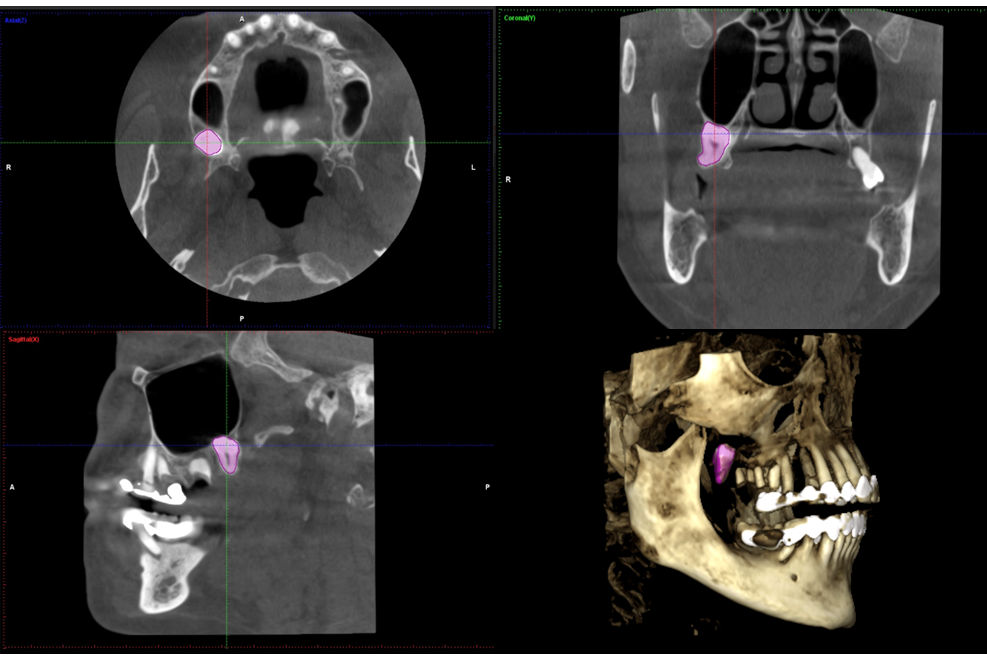
This study investigated a unique case involving a 59-year- old woman with dental issues at Thumbay Dental Hospital, including a faulty bridge and managed hypertension. An orthopantomogram revealed an inverted impacted maxillary third molar, with the patient displaying no direct symptoms Figure 1. A Cone Beam Computed Tomography provided a detailed analysis Figure 2. The specialist and AI tools (ChatGPT versions 3 and 4) were given all available data, including history, clinical examination, and radiographic findings, to formulate a diagnosis and treatment plan for this unusual case of an impacted third molar [10].
Data collection encompassed clinical examinations, imaging, and AI outputs, focusing on diagnostic and treatment plan accuracy. The study evaluated AI’s adaptability, cultural sensitivity, and practicality in clinical settings, assessing its potential alongside human expertise in enhancing dental diagnostics and treatment planning. ChatGPT and its advanced versions were utilized to generate and compare diagnostic assessments and treatment plans with those created by dental professionals. The research aimed to provide insights into the collaborative potential of AI and human intelligence in dental healthcare, emphasizing their complementary roles in optimizing patient care.
Results
Human-Generated Diagnosis and Treatment Plan
Considering the patient’s age, anatomical complexity, asymptomatic presentation, and hypertension history, the plan aimed at complete oral rehabilitation, offering two primary options for addressing the inverted impacted third molar (Table 1).
- Conservative Management
- Surgical Intervention
- This primary approach was advised due to the asymptomatic nature of the case, the patient’s medical history, and the potential risks associated with surgical intervention. A follow-up CBCT was scheduled to monitor the case and the status of the impacted tooth every 6 months to 1 year.
Table 1: Human-generated treatment plan.
![Figure 1: A Cone Beam Computed Tomography provided a detailed analysis Figure 2. The specialist and AI tools (ChatGPT versions 3 and 4) were given all available data, including history, clinical examination, and radiographic findings, to formulate a diagnosis and treatment plan for this unusual case of an impacted third molar [10].](/fulltextimages/13054/fig_1.png)
AI- Generated Diagnosis and Treatment Plan
ChatGPT-3: The clinical scenario provided to ChatGPT involved a detailed dental treatment plan for a hypothetical 59-year-old female patient seeking to change her existing dental bridge. The result was a comprehensive and meticulously structured treatment plan encompassing various stages of care. It was initiated with an extensive initial consultation and examination, proceeding to diagnostic procedures, discussions on bridge replacement options, preparations, fabrication, fitting of the new bridge, and post- procedure care. This structured plan aimed to address the patient’s dental concerns methodically and comprehensively. The comprehensive treatment plan spans from the initial consultation and examination, through diagnostic procedures and discussions on bridge replacement options, to the preparation, fabrication, fitting of the new bridge, and post-procedure care (Table 2).
| Step | Description | Details |
|---|---|---|
| Initial Consultation and Examination | Assess the condition of the existing bridge, abutment teeth, and surrounding structures. | - Examine the integrity of the existing bridge. <br>- Check the health of abutment teeth (especially #16 and #21). <br>- the gum and bone structure around the bridge. |
| Diagnostic Procedures | Perform necessary diagnostic evaluations. | - Digital X-rays to assess underlying bone and root structures.<br>- Dental impressions for bridge design and occlusion study. |
| Treatment Options for Bridge Replacement | Discuss replacement materials and types. | - Materials: Porcelain or zirconia.<br>- Types: Traditional, cantilever, Maryland.<br>- Pros and Cons: Durability, aesthetics, cost, treatment complexity. |
| Preparation for New Bridge | Prepare the mouth for the new bridge. | - Adjustments to abutment teeth, if needed.<br>- Gum shaping for optimal bridge fit. |
| Bridge Fabrication and Fitting | Fabricate and fit the new bridge. | - Lab work for bridge construction.<br>- Trial fittings for comfort and function.<br>- Final adjustments for perfect occlusion and aesthetics. |
| Post-Procedure Care and Maintenance | Guide for caring for the new bridge. | - Cleaning techniques (special brushes, flossers).<br>- Dietary recommendations.<br>- Regular dental check-ups. |
| Potential Risks and Complications | Discuss risks associated with bridge replacement. | - Risk of abutment tooth damage.<br>- Potential for gum disease or decay under the bridge.<br>- Mitigation strategies. |
| Estimated Timeline and Cost | Provide an estimated timeline and cost range. | - Timeline: Initial consultation to final fitting.<br>- Cost: Varies based on bridge type and material. |
Table 2: ChatGpt-3 generated treatment plan.
Additional Treatment Plan A specialized section addressing the management of the impacted and inverted third molar (tooth #18) has been added to the treatment plan, reflecting a holistic approach to oral health. The initial plan lacked details on managing the impacted inverted tooth, prompting a supplementary input to ChatGPT. This led to the formulation of an additional treatment plan, offering a detailed assessment of the tooth’s position, potential complications, treatment options based on the patient’s health, potential surgical procedures, post-surgical care instructions, and discussions on risks. This integration ensures a comprehensive approach to the patient’s oral health, providing a more thorough plan for overall care (Table 3).
- Step
- Description
- Details
- Determine the best approach for the impacted and inverted third molar.
- Management of
- Impacted Inverted
- Tooth #18
Table 3: ChatGpt-3 generated additional treatment plan.
ChatGPT - 4
In response to the complex dental treatment plan for the hypothetical 59-year-old female patient seeking to replace her existing dental bridge, ChatGPT-4 meticulously crafted a comprehensive plan.
It initiated with a thorough consultation, including medical and dental history, oral examination, periodontal assessment, and occlusal analysis. Diagnostic procedures encompassed radiographic examinations, impressions, and photographs for precise treatment planning. The plan addressed bridge replacement options, materials, and types, along with meticulous preparation, including removing the existing bridge, tooth preparation, caries management, and potential gum shaping. Precision in bridge fabrication, fitting, and detailed post-procedure care guidelines were outlined. The plan considered missing teeth and treatment of the impacted tooth (#18), emphasizing adaptability to individual patient needs and the importance of open communication throughout the treatment process (Tables 4-6).
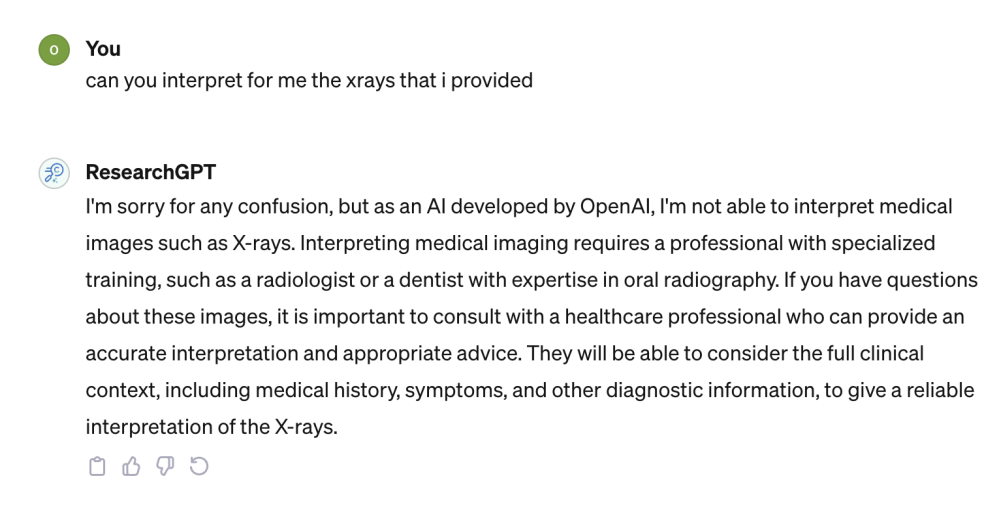
Regarding AI’s limitations, ChatGPT-4, analyzing attached orthopantomogram (OPG) and Cone Beam Computed Tomography (CBCT) images, acknowledged its incapacity to provide medical diagnoses or treatment plans. It recognized the X-ray type but emphasized the necessity for a comprehensive evaluation by a dental or medical professional. Such professionals could correlate radiographic data with a detailed clinical examination and patient history, recommending seeking expertise for an accurate diagnosis and appropriate treatment (Figure 3).
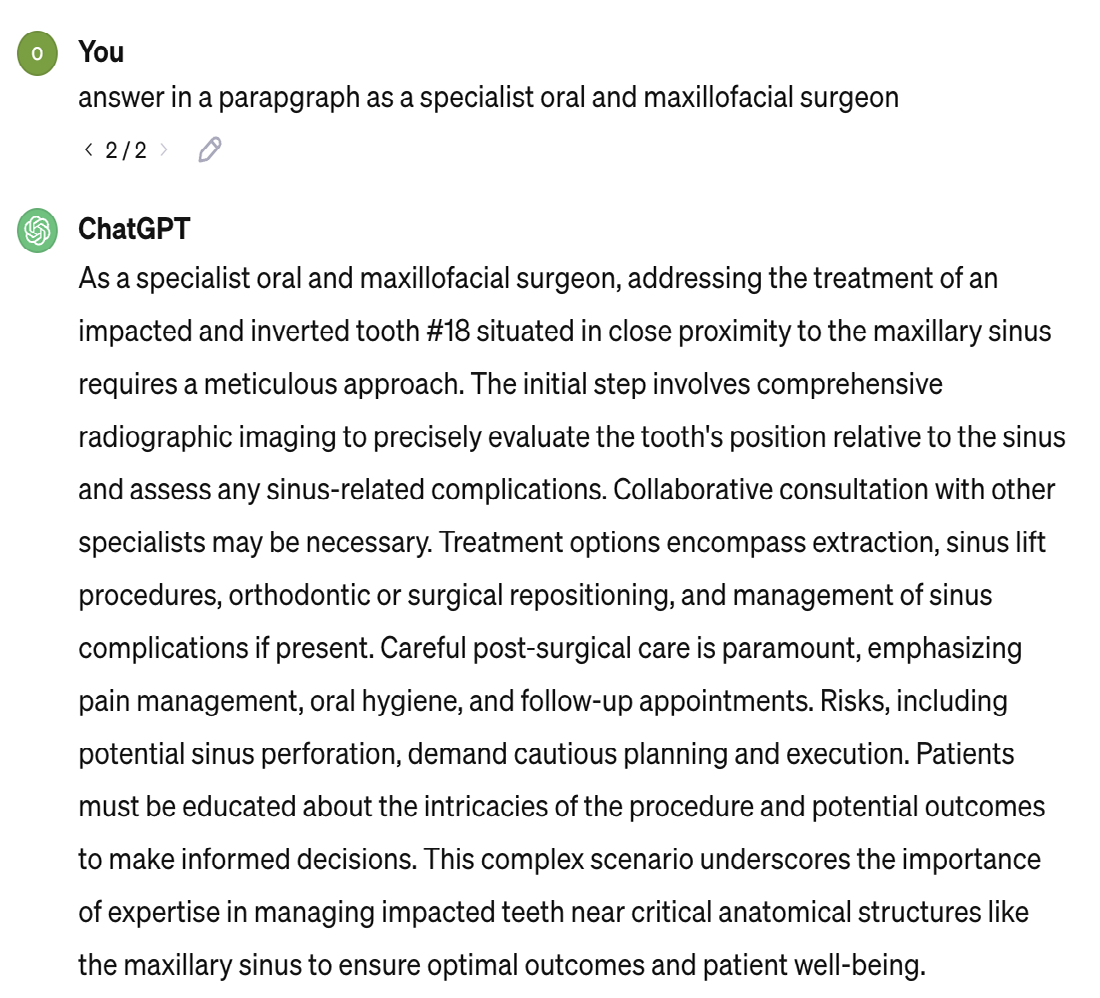
The response provided in Figure 4 pertains to the elaboration on a specific clinical aspect, namely the inverted impacted third molar, in the new input given to ChatGPT-4.
| Aspect | Details | |
|---|---|---|
| Initial Consultation and Examination | - Review Medical and Dental History<br> - Oral Examination<br> - Periodontal Assessment<br> - Occlusal Analysis | |
| Diagnostic Procedures | - Radiographic Examination<br> - Impressions<br> - Photographs | |
| Treatment Options for Bridge Replacement | - Materials (Porcelain, Zirconia)<br> - Types of Bridges (Traditional, Cantilever, Maryland) | |
| Preparation for the New Bridge | - Removal of Existing Bridge<br> - Tooth Preparation<br> - Treating Caries<br> - Gum Shaping | |
| Bridge Fabrication and Fitting | - Lab Work<br> - Trial Fittings<br> - Color Matching<br> - Final Fitting | |
| Post-Procedure Care and Maintenance | - Oral Hygiene Instructions<br> - Dietary Advice<br> - Regular Check-Ups | |
| Potential Risks and Complications | - Bridge Failure<br> - Gum Disease<br> - Tooth Sensitivity or Decay | |
| Estimated Timeline and Cost | - Timeline (2-4 months)<br> - Cost (Varies) | |
| Additional Considerations | - Management of Missing Teeth (#14, #27, #38, #48)<br> - Treatment for Impacted Tooth (#18) | |
| Criteria | Conservative Management | Surgical Intervention |
| Objective | To monitor the impacted tooth for any changes or development of symptoms that may warrant surgical intervention. | To remove the impacted tooth to prevent potential future complications or to address current symptoms or pathology. |
| Diagnostic Imaging | Use existing images to monitor the position and any changes over time. | Preoperative imaging, potentially with additional CBCT to assess the exact position and relation to vital structures. |
| Procedure | Regular dental check-ups, possibly including periodic imaging to track the status of the impacted tooth, | A detailed surgical plan, including an incision, bone removal, tooth sectioning, and careful extraction of the tooth. |
| Risks and Benefits | Benefits: No immediate surgical risks. Risks: Potential for future complications if the tooth becomes symptomatic. | Benefits: It resolves the issue permanently and prevents future complications. Risks: Possible nerve damage, infection, or damage to adjacent teeth. |
| Post-Op Care | Not applicable, as no surgery is performed. | Pain management, antibiotic coverage if needed, and instructions for home care to ensure proper healing. |
| Monitoring | Frequent dental visits to assess for any onset of symptoms or pathology. | Follow-up visits are needed to ensure proper healing and manage any complications. |
| Timeline | Long-term monitoring over the patient’s lifetime. | Short-term, focused on the surgical event and recovery period. |
| Cost | Generally lower, with costs associated with regular dental visits and periodic imaging. | Higher due to the surgical procedure, anesthesia, and follow-up care. |
| Decision Factors | Patient preference for non-invasive management, absence of symptoms, and low risk of future complications | Presence of symptoms, pathology associated with the impacted tooth, or high risk of future complications. |
Table 4: ChatGPT-4 generated treatment plan.
| Capability/Limitation | GPT-3 | GPT-4 |
|---|---|---|
| Medical Diagnosis | Not qualified to diagnose | Not qualified to diagnose |
| Interpretation of Medical Images | Cannot interpret | Cannot interpret |
| Providing Treatment Plans | Cannot provide | Cannot provide |
| Understanding of Medical Imaging | Basic understanding, context- dependent | Advanced understanding, context-dependent |
| Access to Updated Medical Information | Limited to training data up to its last update | Access to information up to its last update in April 2023 |
| Natural Language Understanding | Advanced, but less nuanced than GPT-4 | More advanced and nuanced understanding |
Table 5: Comparative Analysis: GPT-3 vs GPT-4 in the AI Evolution.
Discussion
The rise of AI-powered chatbots spans various sectors, including healthcare. A study comparing AI tools like ChatGPT with human specialists in diagnosing an inverted maxillary third molar found both similarities and differences. Human specialists showcased a patient-centric approach, leveraging clinical intuition and experience. AI-generated plans were initially comprehensive but overlooked the critical aspect of the impacted tooth, later addressed with additional inputs.
The study emphasizes the irreplaceable value of human judgment in healthcare, highlighting AI’s limitations in initial diagnostic accuracy and reliance on specific input for refining recommendations [11].
While AI tools efficiently generate treatment plans, their initial lack of specificity emphasizes the need for human oversight to ensure relevance and personalization to individual patient needs. Florin Eggmann’s study underscores that ChatGPT is not designed for medical guidance, making it unsuitable for clinical decision support. In contrast, human- generated plans exhibit greater reliability, particularly in addressing critical and patient-specific health issues. This highlights the current limitations of AI in healthcare and underscores the essential role of human expertise in providing patient-centered care [12].
Further, the comparison between GPT-3 and GPT- 4 revealed significant advancements in language understanding, problem-solving, and data processing capabilities in the latter. Despite these improvements, both versions consistently acknowledged their limitations in medical diagnostics, underscoring the current boundaries of AI in the domain of healthcare.
This study emphasizes the complementary roles of AI and human expertise in healthcare. While AI, like ChatGPT, excels in structuring plans and processing information, it cannot replicate critical clinical judgment and personalized care inherent to human professionals. The evolution from GPT-3 to GPT-4 showcases AI advancements, but human oversight remains crucial, especially in complex scenarios like dental healthcare. Meredith’s study suggests considering AGI level jointly with Autonomy Level for nuanced insights into AI risks, emphasizing the importance of investing in human-AI interaction research alongside model improvements. The synergy between human expertise and AI is deemed crucial for optimal outcomes in healthcare and complex fields [13].
The integration of AI in healthcare, particularly in dental diagnostics and treatment planning, presents a promising frontier. However, it is obvious that AI works best in conjunction with human medical professionals’ nuanced and patient-specific expertise, rather than as a replacement. This perspective is in alignment with the study by B. Puladi, which acknowledges that while Large Language Models (LLMs) like GPT-4 can provide good suggestions for almost every scenario, their actual added value for Oral and Maxillofacial Surgery (OMS) has not yet been scientifically proven. This emphasizes the need for further research and evaluation to determine the true efficacy and role of AI in specialized medical fields such as OMS [14].
Conclusion
This study highlights the synergistic potential of artificial intelligence (AI) and human intelligence (HI) in managing complex dental cases like Inverted Maxillary Third Molar Impaction. While AI tools, exemplified by ChatGPT versions, show promise in generating detailed treatment plans and processing information, they cannot yet replicate the nuanced clinical judgment and personalized care of human healthcare professionals. The need for human oversight remains crucial, especially in specialized fields like Oral and Maxillofacial Surgery (OMFS). Our findings align with current research, emphasizing that AI should be viewed as an adjunct to, not a replacement for, human expertise in healthcare. As AI continues to advance, its integration with human medical practice offers a promising avenue for enhancing diagnostic accuracy and treatment efficacy in dental healthcare.
Acknowledgments
Special thanks to Dr. Meherban Ali for the radiological support.
References
-
Chhabra S, Chhabra N, Dhillon G (2012) Inverted and Impacted Maxillary Third Molar: Removal by Lateral Transposition Method. International Journal of Experimental Dental Science 1(1): 26-29.
-
Alqutub AW (2023) Inverted Maxillary Third Molar Impaction within the Maxillary Sinus: A Rare Case Report. The American Journal of Case Reports 24: e941859.
-
Abu-Mostafa N, Barakat A, Al-Turkmani T, Al-Yousef A (2015) Bilateral Inverted and Impacted Maxillary Third Molars: A Case Report. Journal of Clinical and Experimental Dentistry 7(3): e441-e443.
-
Peterson LJ (2023) Principles of Management of Impacted Teeth. Chapter 9, Principles of Exodontia, pp: 184-213.
-
Anderson M (1998) Removal of Asymptomatic Third Molars: Indications, Contraindications, Risks and Benefits. Journal of the Indiana Dental Association 77(1): 41-46.
-
Agarwal P, Kumar S, Jain K, Kiran K (2019) Inverted Maxillary Third Molar Impactions. Annals of Maxillofacial Surgery 9(2): 484-488.
-
Held HW (1979) Inverted Maxillary Molar. Dental Radiography and Photography 52(4): 87.
-
Wu K, Wu E, Theodorou B, Liang W, Mack C, et al. (2023) Characterizing the Clinical Adoption of Medical AI through US Insurance Claims. MedRxiv.
-
Mira FA, Favier V, Nunes HSS, Castro JV, Carsuzaa F, et al. (2023) Chat GPT for the Management of Obstructive Sleep Apnea: Do We Have a Polar Star? European Archives of Oto-Rhino-Laryngology 281: 2087-2093.
-
Gaikwad T, Khadse K, Wailthare S, Dubey P (2018) Artificial Intelligence Based Chat-Bot. International Journal for Research in Applied Science and Engineering Technology 6(4): 2305-2306.
-
Horiuchi D, Tatekawa H, Shimono T, Walston SL, Takita H, et al. (2023) Accuracy of ChatGPT Generated Diagnosis from Patient’s Medical History and Imaging Findings in Neuroradiology Cases. Neuroradiology 66: 73-79.
-
Eggmann F, Weiger R, Zitzmann NU, Blatz MB (2023) Implications of Large Language Models Such as Chatgpt for Dental Medicine. Journal of Esthetic and Restorative Dentistry 35(7): 1098-1102.
-
Morris MR, Sohl-dickstein J, Fiedel N, Warkentin T, Dafoe A, et al. (2023) Levels of AGI: Operationalizing Progress on the Path to AGI. Artificial Intelligence.
-
Puladi B, Gsaxner C, Kleesiek J, Holzle F, Rohrig R, et al. (2023) The Impact and Opportunities of Large Language Models Like Chatgpt in Oral and Maxillofacial Surgery: A Narrative Review. International Journal of Oral and Maxillofacial Surgery 53(1): 78-88.
- Diagnosis and Management of Mental Nerve Paresthesia Secondary to Apical Periodontitis of Mandibular Second Premolar: A CBCT Based Case Report
- A Randomized, Double Blinded Clinical Trial to Compare the Effect of Oral Premedication (Diclofenac Potassium or Dexamethasone) on Post-Operative Pain Following Pulpectomy
- Modified Lip Repositioning Technique for the Management of Excessive Gingival Display
- Integral Role of Non-Dental Providers and Fluoride Dissemination
- Root Canal Treatment Rate in Deciduous Teeth Among 6-Year- Olds in the Era of Discontinuing Water Fluoridation - Historical Cohort Study
- The Impact of the Notch1 on the Migratory Capacity and the Expression of E-Cadherin and CyclinD1 in Ameloblastoma Cells