
Prevalence of Sexually Transmitted Infections and Associated Factors among Commercial Sex Workers in Modjo Town East– Shewa, Ethiopia, 2018 G.C: Cross-Sectional Study
Background: Sexually transmitted diseases refer to those conditions caused by pathogens that can be acquired and transmitted through unprotected sexual intercourse. It is known for causing a variety of clinical syndromes, including abnormal genital discharge, genital ulcer/sore, inguinal bubo, and lower abdominal pain in females. Sexually transmitted infections are a major public health concern in developing countries. In a number of countries the prevalence of HIV and sexually transmitted infections are higher among female sex workers than other women. Objective: To determine the prevalence of sexually transmitted Infection and associated factors among commercial sex workers in Modjo town, East shewa, Ethiopia. Methods: Cross sectional study, design was employed to examine prevalence of sexually transmitted infections and associated factors among commercial sex workers in Modjo town. Two hundred fifty commercial sex workers were selected using systematic random sampling procedure and data was collected using pre-tested semi structured questionnaire. Data was entered into Epi Info version 7, checked, coded and analyzed using SPSS version 21 software. The degree of association between outcome and predictors was assessed using Odds ratio with 95% confidence interval. In all cases, P-values less than 0.05 were considered statistically significant Result: The magnitude of sexually transmitted infections among commercial sex workers with at least one syndrome in the study area was 40.7%. Among them, 68(27.6%), 30(12.2%), and 21(8.5%) of the total respondents had experienced vaginal discharge, vaginal ulcer, and inguinal bubo syndromes, respectively. Drug use (AOR=6.95, 95% CI= 1.62-29.72), condom slippage (AOR=3.73, 95% CI=1.79-7.75) and having children (AOR=1.86 95% CI 1.01-3.41) were significantly associated with sexually transmitted infections. Conclusion: A considerable proportion of commercial sex workers were infected by sexually transmitted infections. Had samples for laboratory been collected and examined, the actual prevalence in the study area could even be worse than the current finding.
Background
Sexually transmitted diseases (STDs) refer to those conditions caused by pathogens that can be acquired and transmitted through unprotected sexual intercourse. Bacteria, viruses, protozoa, fungi, and ectoparasites can cause them [1, 2]. It is known for causing a variety of clinical syndromes, including abnormal genital discharge, genital ulcer/sore, inguinal bubo, and lower abdominal pain in females [3].
STDs are global public health problems, which cause acute illness, infertility, long-term disability, and death, with severe medical and psychological consequences in millions of males, females, and infants [4]. Sexually transmitted infections (STIs) are a major public health concern in developing countries. They are increasing with the advent of human immunodeficiency virus (HIV) infection, particularly in sub-Saharan Africa. Sex workers (SWs) are the most vulnerable population [5].
Women sell sex work in a variety of environments. Harcourt and Donovan described „direct‟ sex work as sexual services in which the primary purpose of the interaction is to exchange sex for a fee; women involved in direct sex work typically rely on this as their primary source of income. Working in a brothel is the most common and well known example of involvement in direct sex work. In contrast, women in „indirect‟ sex work often have legitimate occupations providing non-sexual services to patrons in places like bars and massage parlors, and through this occupation they also solicit sex to clients [6].
In low and middle-income countries, symptomatic STIs are treated by syndromic management (presumptive treatment for symptomatic people without the use of laboratory tests), but most STIs are asymptomatic and go unnoticed and untreated. Both symptomatic and asymptomatic STIs can cause serious morbidity, including pregnancy complications, cancer, infertility, and enhanced HIV transmission [7]. Different scholars who are working in the area believe that the magnitude of STDs is considerably increasing from day to day.
In a number of countries the prevalence of HIV and sexually transmitted infections (STIs) are higher among female sex workers than other women [8].
Eighty-six percent of the world‟s burden of STDs occurs in the developing countries having greatest burden in the poorest countries, many of which are in sub-Saharan Africa. In this part of the world, identification and management of STDs are limited and the STDs disproportionately affect females. The morbidity from STDs (excluding HIV) in females aged 15–49 years ranks second next to maternal causes [4].
Female commercial sex workers have been viewed both by laypersons and epidemiologists as one of the high- risk groups for infections and transmission of STDs [5, 9]. Therefore, this study aims to give insight on the prevalence and associated factors with STIs among commercial sex workers in Modjo town.
Methods and Materials
Study Design and Period
Cross-sectional study was conducted among female sex workers in mojo town, East shewa Ethiopia, from July 10-17 in 2018.
Study Area
Modjo is a town located in the East Shewa of oromia regional state about 75 km east of the capital city of Addis Ababa. According to the 2007 Ethiopian census report and based on annual population growth rate, Modjo has estimated a total population of 54,265 and almost half of 27,130 (49.9%) are males. Administratively the town is divided into two sub cities. The Town has one District hospital, one private hospital, one government health centers and 26 Hotels, 22 Bar & restaurants and 60 Groceries. According to Modjo town health office, a total of 952 commercial sex workers were found in the town.
The town been identified by the Government as the key node for the emerging Ethiopian intermodal trade logistics system. Most of medium and large manufacturing firms connected to international markets are located in the surrounding areas of Addis Ababa and the numbers of these firms has been rising every year. It is envisaged that Modjo is playing an increasingly important role as the main port in Ethiopia to facilitate the prompt evacuation of import traffic from Djibouti. The average traffic flows on the Djibouti-Addis Ababa corridor, which passes through Modjo town, is 300-
350 trucks per day.
Source and Study Population
Source population: The source populations for the study were all commercial sex workers in mojo town Study population: The study populations were randomly selected commercial sex workers.
Inclusion and Exclusion Criteria
Inclusion criteria: Commercial sex workers willing to take part on the study were included in the study. Exclusion criteria: Critically ill commercial sex workers, Age less than 18 years old and not voluntary to participate on the study.
Sample Size and Sampling Procedures
Sample size determination: The required sample size for first objective was determined using single population proportion formula by considering the following parameters and assumption.
P= 20.6% proportion of STI from the previous study conducted on the related topic using similar population group) [5].
d= Margin of error 5 % with 95% confidence level. Z α/2 = 1.96 (level of significance) $$ \frac {\mathrm {n} = \mathrm {Z} ^ {2} \alpha / 2 ^ {*} p (1 - \mathrm {p})}{2} = \frac {1 . 9 6 ^ {2} ^ {*}}{2} $$
1.96 *0.206 (1-0.206
$$ \frac {\alpha / 2 ^ {*} p (1 - \mathrm {p})}{W ^ {2}} = \frac {1 . 9 6 ^ {2} * 0 . 2 0 6 (1 - 0 . 2 0 6)}{0 . 0 5 ^ {2}} = 2 5 1 $$
2 2 Considering 10% possible non-response rate, the final sample size was 276 participants.
Sample size for the second objective or factors associated with STI among commercial sex workers [5].
| STI | Proportion | Sample Size | |
|---|---|---|---|
| Sex without | Yes | P1 = 5.1 | 308 |
| condom with | Yes | P2 = 15.4 | 308 |
| paying | NO | Ratio1:1,Power | 308 |
| clients | NO | 80 | 308 |
Table 1: Sample size calculation for the second objectives.
Using EPI INFO stat calculation the sample of association factor for STI using 10 % non-respondent rate is 339.
Which is n = 308+ 10%*308= 339
So the large sample size for both objectives was objective two, which is 339
Since the total number of commercial sex workers in Modjo is 952, we use finite population correction formula to come up with the final sample size. nf= n0 (339/1+339/952)= 250 1+n0/N Therefore, the final sample size was 250 Sampling procedure: Initially, hotel, bars and night clubs where the commercial sex workers had been working was selected randomly. After selection of the hotels, bars and night clubs, the sample size of the study was proportionally allocated to each selected facility. Then, all study participants who fulfilled the inclusion criteria were interviewed.
Variables of the study
- Dependant Variable
- STIs syndrome
- Independent Variables
- Socio-demographic variables (age, educational status, marital status, religion, ethnicity, place where the participant were raised, year of employment, occupation of family)
- Unsafe sex, alcohol use, drug use, forced sex, condom use, year of employment, family occupation, place of growth and others.
- Operational Definitions Syndromic approach:
- Diagnosing using a collection of sign and symptoms
- The occurrence of sexually transmitted infections was identified if commercial sex worker had experienced symptoms of vaginal discharge or genital ulcer or inguinal
- Bubo or more than one of these symptoms in the last 12 months of the survey). Sexual assault:
- Sexual abuse or rape case which occurred on someone Unprotected/Unsafe sex:
- Sexual practice without condom
- Sexual practice with in short period of time of knowing someone and without knowing HIV test result of each other
Data Collection Procedures (Instruments, Personnel, Measurements) & Quality Assurance
Semi structured interview-administered questionnaire was used for data collection, which was adapted from different literature. The questionnaire is initially prepared in English, then translated in to Amharic, and back translated to English to ensure the consistency of two versions by language experts. Pre-test was conducted on 5% of the sample size in Adama town. Necessary corrections were made based on the finding of pre-test before actual data collection.
Three diploma nurses having previous experience of data collection in such study group collected data. Two BSc nurses were recruited to conduct supervision during data collection.
Moreover, two days training were given for data collectors and supervisors on how to maintain confidentiality of the information, methods of obtaining informed consent and the contents of the questionnaire in detail. Before actual data collection, respondents were briefed about the purpose of the study and informed consents were taken. Each filled questionnaire was checked for completeness and consistency.
Data Processing and Analysis
The collected data was entered in to Epi info Version 7 software for data exploration and cleaning then the cleaned data was exported to SPSS version 21 for analysis. Descriptive statistics was used to assess the prevalence of sexually transmitted infections among commercial sex workers. Bivariate and multivariate regression was run to determine the relationship between outcome and predictors. The crude and adjusted odds ratios with the corresponding 95% confidence intervals were computed. A P-value<0.05 was considered statistically significant. Ethical considerations The study was carried out after getting permission from the ethical review board of Arsi University, College of Health science. Informed consent was obtained from each respondent after explanation of the objective of the study. Those who were not participating in the study were not forced. Confidentiality of the information was obtained and assured. The instrument and procedures did not cause any harm to the study subjects and the data collectors.
Result
Socio Demographic Characteristics
Two hundred forty six commercial sex workers were participated in this study giving overall response rate of 98.4%. Nearly half of respondents 116(47.2%) belongs to the age groups of 18-24 years. The mean age was 24.4593+ SD 4.4708. More than half, 128(52%) of the respondents were orthodox Christians. More than one-third, 79(32.1%) of respondent’s belongs to Amhara ethnic groups (Table 2).
| Variables(n=246) | Frequency | Percentage (%) |
|---|---|---|
| Age | ||
| <18 years | 17 | 6.9 |
| 18-24 years | 116 | 47.2 |
| 25-30years | 89 | 36.2 |
| >30 years | 24 | 9.8 |
| Ethnicity | ||
| Oromo | 67 | 27.2 |
| Amhara | 79 | 32.1 |
| Tigrie | 39 | 15.9 |
| Gurage | 35 | 14.2 |
| Others | 26 | 10.6 |
| Religion | ||
| Orthodox | 128 | 52 |
| Muslim | 59 | 24 |
| Protestant | 37 | 15 |
| Catholic | 19 | 7.7 |
| Others | 3 | 1.2 |
| Educational status | ||
| Illiterate | 54 | 22 |
| Able to read and write | 91 | 37 |
| Elementary | 66 | 26.8 |
| High school | 29 | 11.8 |
| College and above | 6 | 2.4 |
| Place of growth | ||
| Urban | 111 | 45.1 |
| Rural | 135 | 54.9 |
| Family occupation | ||
| Farmers | 77 | 31.3 |
| Daily workers | 57 | 23.2 |
| Government employee | 37 | 15 |
| Privet employee | 47 | 19.1 |
| Own business | 28 | 11.4 |
| Raised by | ||
| Mothers only | 37 | 15 |
| Fathers only | 33 | 13.4 |
| Both | 87 | 35.4 |
| Relatives | 66 | 26.8 |
| Non family | 23 | 9.3 |
| Occupation before sex work | ||
| Unemployed | 52 | 21.1 |
| Student | 79 | 32.1 |
| Servant | 76 | 30.9 |
| Tea/coffee service | 31 | 12.6 |
| Others | 8 | 3.3 |
| Married before | ||
| Yes | 118 | 48 |
| No | 128 | 52 |
| Type of sex work | ||
| Home based | 25 | 10.2 |
| Bar based | 121 | 49.2 |
| Street based | 66 | 26.8 |
| Phone based | 34 | 13.8 |
| Years of employment as sex worker | ||
| ≤ 1 | 58 | 23.6 |
| 01-Mar | 146 | 59.3 |
| ≥3 | 42 | 17.1 |
Table 2: Socio demographic characteristics of female commercial sex workers in Modjo town, East Shewa, Ethiopia, 2018 G.C.
Sexual Behavior of Female Commercial Sex Workers
The findings of this study revealed that majority of respondents, 216(87.8%) have had sex before they commenced commercial sex work before the age of 18 years. The mean and standard deviation of age at first sexual initiation was 16.12+SD 2.18 years. It was found that 96 (39%) of the respondents initiated sex through friends.
However, almost quarter of the total respondents 58(23.6%) reported violence as part of their first experiences of sex. Regarding the number of sexual partners, 106 (43.1%), participants reported two sexual clients per day. Moreover, 59(24%) of participants had sex without condom for all sex with non-paying clients during their sexual life. In addition,
89(36.2%) participants had sex without condom with highly paying clients. In relation to substance use, 202(82.1%) of participants had used alcohol and 195(79.3%) of the respondents reported using other drugs prior to sex (Table 3).
| Variables(n=246) | Frequency | Percentage (%) |
|---|---|---|
| Age at first sexual intercourse | ||
| <18 | 216 | 87.8 |
| >18 | 30 | 12.2 |
| Reason for the first sexual intercourse | ||
| Marriage | 49 | 19.9 |
| Friendly | 96 | 39 |
| Gift/money | 43 | 17.5 |
| Violence | 58 | 23.6 |
| Do you have children | ||
| Yes | 134 | 54.5 |
| No | 112 | 45.5 |
| If yes, how many | ||
| One | 66 | 49.2 |
| Two | 48 | 35.8 |
| More than two | 20 | 15 |
| Average number of clients per day | ||
| One | 81 | 32.9 |
| Two | 106 | 43.1 |
| More than two | 59 | 24 |
| Do you have nonpaying client | ||
| Yes | 174 | 70.7 |
| No | 72 | 29.3 |
| Do you use condom with nonpaying client | ||
| Yes | 115 | 46.7 |
| No | 59 | 24 |
| Reason for not using condom with nonpaying | ||
| My boy friend | 29 | 49.1 |
| Regular client | 15 | 25.4 |
| Forced | 10 | 17 |
| Others | 5 | 8.5 |
| Sex without condom with paying clients | ||
| Yes | 157 | 63.8 |
| No | 89 | 36.2 |
| Reason for sex without condom with paying client | ||
| Love | 55 | 22.4 |
| High payment | 74 | 30.1 |
| Intoxicated | 18 | 7.3 |
| Forced | 10 | 4.1 |
| Anal sex practice | ||
| Yes | 24 | 9.8 |
| No | 222 | 90.2 |
| Condom slipped | ||
| Yes | 150 | 61 |
| No | 96 | 39 |
| Condom breakage | ||
| Yes | 189 | 76.8 |
| No | 57 | 23.2 |
| Alcohol use during sexual intercourse | ||
| Yes | 202 | 82.1 |
| No | 44 | 17.9 |
| Drug use prior to sexual intercourse | ||
| Yes | 195 | 79.3 |
| No | 51 | 20.7 |
Table 3: Sexual behavior of female commercial sex workers in Modjo town, East Shewa, Ethiopia, 2018G.C.
Prevalence of STI
Among 246 commercial sex workers, 100 (40.7%) of participants had experienced one or more of the three symptomatic characteristics of STDs in the last 12 months of
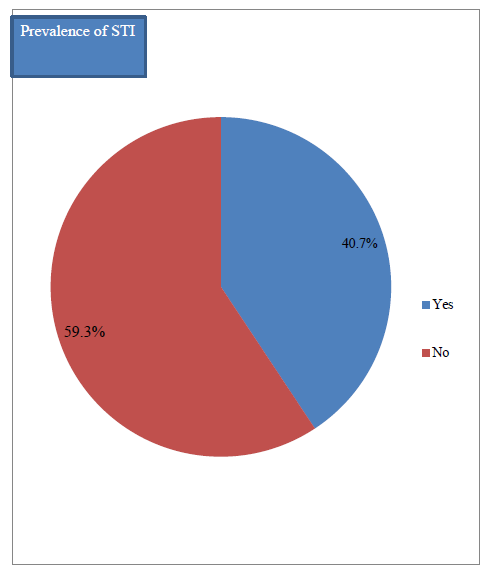
the study period. Among them, 68 (27.6%), 30(12.2%), and 21 (8.5%) of the total respondents had experienced vaginal discharge, vaginal ulcer, and inguinal bubo syndromes, respectively. Therefore, the overall STI prevalence in this study was 40.7 % (Figure 1).
Factors Associated with STI
In multivariable logistic regression, drug use (AOR=6.95, 95% CI= 1.62-29.72), condom slippage (AOR=3.73, 95% CI=1.79-7.75) and having children (AOR=1.86 95% CI 1.01- 3.41) are known to have significant association with sexually transmitted infection among commercial sex workers (Table 4).
| Variables (n=246) | STI | COR (95%CI) | AOR(95%C) | |
|---|---|---|---|---|
| Yes | No | |||
| Year of employment as sex workers | ||||
| ≤1 | 21 | 37 | 1 | 1 |
| 01-Mar | 60 | 86 | 1.229(0.655,2.305) | 0.824(0.378,1.794) |
| ≥3 | 19 | 23 | 1.455(0.648,3.272) | 0.965(0.359,2.598) |
| Sex without condom with paying client | ||||
| Yes | 63 | 94 | 0.942(0.555,1.598) | 0.831(0.441,1.564) |
| No | 37 | 52 | 1 | 1 |
| Alcohol drinking | ||||
| Yes | 97 | 105 | 12.625(3.786,42.099)* | 3.322(0.74,14.912) |
| No | 3 | 41 | 1 | 1 |
| Average number of clients per day | ||||
| One | 31 | 50 | 1 | 1 |
| Two | 49 | 57 | 1.387(0.770,2.498) | 1.268(0.644,2.495) |
| More than two | 20 | 39 | 0.827(0.410,1.667) | 1.115(0.485,2.562) |
| Having children | ||||
| Yes | 43 | 91 | 1 | 1 |
| No | 57 | 55 | 2.913(1.036,3.683)* | 1.861(1.015,3.411)** |
| Condom slipped | ||||
| Yes | 81 | 69 | 4.757(2.622,8.634)* | 3.733(1.797,7.754)** |
| No | 19 | 77 | 1 | 1 |
| Condom breakage | ||||
| Yes | 88 | 101 | 3.267(1.626,6.566)* | 0.796(0.319,1.984) |
| No | 12 | 45 | 1 | 1 |
| Drug use/canabis | ||||
| Yes | 97 | 98 | 115.837(4.771,52.565)* | 6.943(1.622,29.719)** |
| No | 3 | 48 | 1 | 1 |
Table 4: Bivariate and multiple logistic regression analysis of factors associated with STI among commercial sex workers in Modjo
(*show association on bivariate analysis **statistical significant). Table 4: Bivariate and multiple logistic regression analysis of factors associated with STI among commercial sex workers in Modjo town, South East Ethiopia, 2018.
Discussion
Among 246 female commercial sex workers (FCSWs) participated in this study, 40.7% of participants had experienced one or more of the three symptomatic characteristic of STDs in the last 12 months of the study period. Of them, 27.6%, 12.2%, and 8.5% of the respondents had reported vaginal discharge, vaginal ulcer, and inguinal bubo syndromes, respectively. The prevalence of vaginal discharge in this study was higher; however, vaginal ulcer and inguinal bubo syndromes were lower than the study findings in Finoteselam [5].
Shockingly, the prevalence of sexually transmitted
infection among commercial sex workers in the study area was high. This finding was higher than study conducted in Netherlands, 9.5% [10], Malawi, 20 % [11], Nepal,17.5% [12] and Finoteselam northwest Ethiopia, 20.6 % [5]. This variation could be due to the emergence of “hotspots” in the study area such as, dry port, large-scale commercial farms, infrastructure developments (such as express road construction sites from Modjo to Hawasa), factories, trade routes and new industrial zones that attracts mobile groups, which in turn results in high prevalence of STIs among commercial sex workers. Furthermore, low awareness of the study participants could also be the other reason for high prevalence.
Compared to this study, higher prevalence of STIs has been reported in Iran (84.9%) [13] and India (74.6%) [14]. In fact, reported STIs represent only the tip of the iceberg because most infections are entirely asymptomatic, especially for women. In our study, we only took symptomatic cases in the last 12 months. Had samples for laboratory been collected and examined, the actual prevalence in the study area could even be worse than the current finding. This could be the reason for lower prevalence in our study compared with Iran and India.
In the current study, the odd of being infected by STIs is increased by almost sevenfold among commercial sex workers who use illicit drugs (cannabis) as compared with those who did not use. This finding is consistent with a study conducted in India revealing drug-using FSWs more likely to test positive for one or more STIs (59% vs. 33.5%) compared to their non-drug using counterparts [15]. This could be because consumption of drugs is known to affect the decision-making power of the commercial sex workers. This in turn will expose them to experience risky sexual practice that results with high chance of being infected with STIs.
The finding of this study is in line with the studies conducted in Finoteselam and Iran with regard to condom slippage [5, 13]. Commercial sex workers who encountered condom slippage during sexual intercourse in the past 12 months were three times more likely to be infected with STIs compared to their counterparts. This could be because of lack of intervention regarding proper condom usage. Surprisingly, commercial sex workers having no children were almost two times more likely to be infected with STIs compared with those who had children. This could be partly explained by the fact that responsibilities associated with motherhood decreases vulnerability to STIs.
As a limitation, this study dealt with very sensitive and private issues. For that reason, the possibility of underestimation could not be ruled out. Besides, the study did not test for STDs but used self-reported data on syndromes of STDs to determine both the prevalence of STDs and the factors that affect them. This might underestimate the prevalence and is subject to recall bias too.
Declaration
We, authors declare that this article has not been published or submitted anywhere for publication.
Competing Interests: We authors declare that there are no financial and non-financial competing interests.
Funding: It is self-funded research.
Authors Contribution: All the three authors participated in the design and analysis of the study. Firaol Lemessa searched the database, and wrote the first and the second draft of the article. The rest two authors took a part in reviewing the whole components of the research article and approved for the final version.
Acknowledgement
Our deepest gratitude goes to Arsi University, College of Health Sciences for providing us the opportunity to conduct this research. We are also indebted to Modjo town health office and Modjo town children‟s and women affairs for providing us the necessary information.
References
-
Workowski KA, Bolan GA (2015) Sexually transmitted diseases treatment guidelines, 2015. MMWR Recommendations and reports: Morbidity and mortality weekly report Recommendations and reports 64(RR- 03): 1-137.
-
Minichiello V, Rahman S, Hussain R (2013) Epidemiology of sexually transmitted infections in global indigenous populations: data availability and gaps. International journal of STD & AIDS 24(10): 759-768.
-
Wang B, Li X, Stanton B, Zhang L, Fang X (2010) Alcohol use, unprotected sex, and sexually transmitted infections among female sex workers in China. Sexually transmitted diseases 37(10): 629-636.
-
Geremew RA, Agizie BM, Bashaw AA, Seid ME, Yeshanew AG (2017) Prevalence of Selected Sexually Transmitted Infection (STI) and Associated Factors among Symptomatic Patients Attending Gondar Town Hospitals and Health Centers. Ethiopian journal of health sciences 27(6): 589-600.
-
Anteneh ZA, Agumas YA, Tarekegn M (2017) Sexually transmitted diseases among female commercial sex workers in Finote Selam town, northwest Ethiopia: a community-based cross-sectional study. Hiv/Aids 9: 43- 49.
-
Pitpitan EV, Kalichman SC, Eaton LA, Strathdee SA, Patterson TL (2013) HIV/STI risk among venue-based female sex workers across the globe: a look back and the way forward. Current HIV/AIDS reports 10(1): 65-78.
-
Francis SC, Mthiyane TN, Baisley K, McHunu SL, Ferguson JB, et al. (2018) Prevalence of sexually transmitted infections among young people in South Africa: A nested survey in a health and demographic surveillance site. PLoS medicine 15(2): e1002512.
-
Mc Grath-Lone L, Marsh K, Hughes G, Ward H (2014) The sexual health of female sex workers compared with other women in England: analysis of cross-sectional data from genitourinary medicine clinics. Sexually transmitted infections 90(4): 344-350.
-
Cwikel JG, Lazer T, Press F, Lazer S (2008) Sexually transmissible infections among female sex workers: an international review with an emphasis on hard-to- access populations. Sexual health 5(1): 9-16.
-
Verscheijden MMA, Woestenberg PJ, Gotz HM, van Veen MG, Koedijk FDH, et al. (2015) Sexually transmitted infections among female sex workers tested at STI clinics in the Netherlands, 2006-2013. Emerging themes in epidemiology 12: 12.
-
Lancaster KE, Powers KA, Lungu T, Mmodzi P, Hosseinipour MC, et al. (2016) The HIV Care Continuum among Female Sex Workers: A Key Population in Lilongwe, Malawi. PloS one 11(1): e0147662.
-
Shakya S, Thingulstad S, Syversen U, Nordbo SA, Madhup S, et al. (2018) Prevalence of Sexually Transmitted Infections among Married Women in Rural Nepal. Infectious diseases in obstetrics and gynecology 2018: 4980396.
-
Nasirian M, Kianersi S, Hoseini SG, Kassaian N, Yaran M, et al. (2017) Prevalence of Sexually Transmitted Infections and Their Risk Factors among Female Sex Workers in Isfahan, Iran: A Cross-Sectional Study. Journal of the International Association of Providers of AIDS Care 16(6): 608-614.
-
Das A, Prabhakar P, Narayanan P, Neilsen G, Wi T, et al. (2011) Prevalence and assessment of clinical management of sexually transmitted infections among female sex workers in two cities of India. Infectious diseases in obstetrics and gynecology 2011: 494769.
-
Medhi GK, Mahanta J, Kermode M, Paranjape RS, Adhikary R, et al. (2012) Factors associated with history of drug use among female sex workers (FSW) in a high HIV prevalence state of India. BMC public health 12: 273.
- Postpartum Maternal Mental Health - A Narrative Review
- Beta HCG in Cervico-Vaginal Secretion as a Predictor of Preterm Delivery
- Successful Management of Mid Trimester Foetal Death with Major Placenta Previa by Expectant Management Followed by Induction of Labour
- To Evaluate the Expression of Egr2 Gene in Term Low Birth Weight Newborns
- Impact of Maternal Obesity on Maternal and Foetal Outcomes: A Prospective Cohort Study from Northern India
- ‘’Benefit of Pulsatile GnRH Therapy in Treatment of Functional Hypothalamic Amenorrhea (FHA) and Congenital Hypogonadotropic Hypogonadism(CHH) in Infertile Patients Over Canonical Gonadotropins with IVF –A Short Communication’’