
New Location of some Gasteroid Basidiomycetes in Western Kazakhstan
Information about gasteroid basidiomycetes of western Kazakhstan is insufficient or significantly outdated. Therefore, the purpose of our work was to add data on new locations of some gasteroid fungi. The material for the article was the authors’ own collections in 2023; preparation of mushroom preparations, their study and identification were carried out according to standard methods. This article provides data on two species of gasteroid basidiomycetes (Battarrea phalloides (Dicks.) Pers. and Montagnea candollei (Fr.) Fr. (M. arenaria (DC.) Zeller), which were collected from various habitats of Western Kazakhstan. The humic saprotroph Battarrea phalloides, quite widespread throughout the world, was previously noted in dry, sandy locations in the south, southeast and east of Kazakhstan. On the territory of Western Kazakhstan, the fungus was found only in the Aktobe region (the bank of the Itassai River and in the vicinity of Chelkar station) and in the Western Kazakhstan region (the bank of the Ural River). Fruiting bodies of the species are single or in groups of 2-3. The species is a relic of the Cretaceous period. Montagnea candollei is a widespread species, found mainly in dry, open, sandy places, in dunes, deserts, semi-deserts and steppes. The mushroom, found almost throughout the entire territory of Kazakhstan, was found by us in Aktobe, Mangystau and West Kazakhstan regions. Montagnea candollei was first discovered in the territory of the Mangistau region in five points, including both desert and low hills. The fruiting bodies have always been solitary. Data on their habitats (new location) with coordinates and short diagnosis with original dimensions and photographs of the fruit bodies were provided for each taxon.
Introduction
Kazakhstan is a country located in central part of Eurasia. Due to the wide range of habitats, the territory of Kazakhstan (2,724,900 square km) is characterized by a rich diversity of fungi [1].
In recent years, research into the species composition of the mycobiota of Kazakhstan has been carried out most intensively in the southern, southeastern and eastern regions of the republic. Unfortunately, the western regions of the republic, including Aktobe, West Kazakhstan, Atyrau and Mangystau regions, have not yet been studied mycologically. In 2024, a systematic survey of Western Kazakhstan began, thanks to which new localization points of some species of mushrooms were added and their distribution areas were clarified. This is especially important now, when environmental protection and biodiversity conservation are one of the main challenges. The most important and responsible part of preserving biological diversity is the conservation and identification of habitats of rare, relict and endangered species.
The purpose of this study is to add data on new locations of some gasteroid basidiomycetes (Battarrea phalloides and Montagnea candollei) to the Kazakhstan mycobiota.
Materials and Methods
The study was conducted in the western regions of Kazakhstan, including Aktobe, West Kazakhstan (Ural’sk), Atyrau and Mangystau regions. Fungal specimens (gasterocarps) were collected during field trips. The geographic location of the sample collection site was recorded using GPS (Germin). In field studies morphological characteristics of the specimens were recorded and а Canon 600E camera was used for photographing of fruit body.
For light microscopy, small fragments of samples were placed in a drop of distilled water on a microscope slide without any staining [2], examined and photographed using a Levenhuk MED D45T LSD light microscope. Measurements of the gasteroid basidiomycetes structure were made. Specimens were identified with the literature on gasteromycetes [3].
Dried specimens are stored in the herbarium of the Institute of Botany and Phytointroduction, Almaty, Kazakhstan (AA). The systematics and of the names of fungal taxa were given in accordance with MYCOBANK Database [4] and they are listed in alphabetical order.
Results
During the research, two species of gasteroid basidiomycetes were found in the western regions of Kazakhstan. Short descriptions, remarks on the species, photographs of the fruit bodies, and microphotographs were provided. The taxa are listed in alphabetical order. • Basidiomycota Whittaker ex R.T. Moore • Agaricomycotina Doweld • Agaricomycetes Doweld • Agaricomycetidae Parmasto • Agaricales Underw. • Agaricaceae Chevall. • Battarrea phalloides (Dicks.) Pers.
Description – Young fruit body hypogeous, spherical (up to approximately 5 cm in diameter) or ovoid, covered by a two- layered peridium. Mature ones have a well-developed stipe up to 45 cm long. The stipe is hollow, woody, covered with thick, yellowish or brownish narrow and long scales (Figure 1), base include underground membranous volva, made from remains of exoperidium. The head is hemispherical, up to 10 cm in diameter, covered by the endoperidium (Figure 2), strongly depressed at the bottom. The thin, whitish, smooth endoperidium is broken by the equatorial fissure. Gleba is dark brown and powdery, includes capillita and elaters, when mature. Spores are globose, almost elliptcal or slightly angular (Figure 3), 5-7µm in diameter, dark brown with three-layered walls. Elaters are numerous, 30–50(80) µm long, cylindrical, annular to spiral.
Humic saprotroph, growing alone or scatered in dry sandy soil, takyrs, sand dunes, in sandy and clayey deserts, as well as in the mountains.
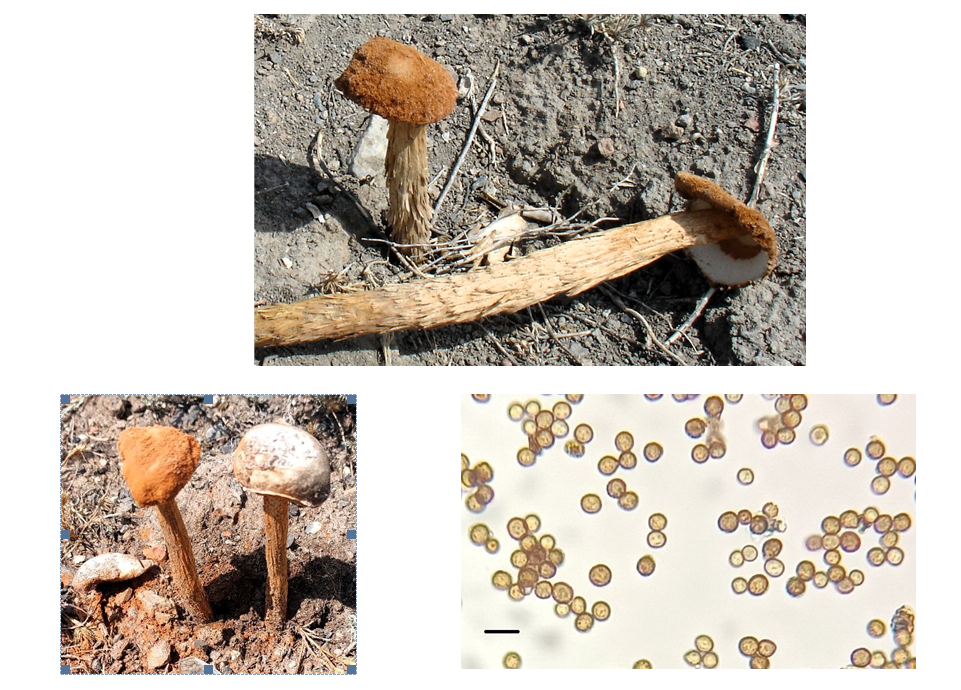
Figures 1-3: Battarrea phalloides. 1 Mature fruit bodies with brownish narrow and long scales on the stipe. 2 Fruit bodies with whitish endoperidium. 3 Spores. – Bar = 13 µm.
Known distribution – Europe, Asia, North and South America, Africa, Australia.
Material examined – Kazakhstan, Western Kazakhstan region, Baiterek district, 72 km northeast of the city of Uralsk, 71 m a.s.l., 51°39ʹ00.6ʺN, 52°14ʹ01.7ʺE, 28 June 2024, SB Nurashov; ibid., Terekty district, 19 km northeast of the village Kyzylzhar, 1 m a.s.l., 51°14ʹ95.7ʺN, 51°55ʹ50.4ʺE, 25 June 2024, AK Dzhiyenbekov.
Note – The species Battarrea phalloides was found in the shrub-forb-steppe and meadow-forest belts of Altai, Tien Shan, Terskei Alatau. Dzungaria and the Caucasus, at altitudes from 900 to 2000-2200 m a. s. l. This phenomenon confirms the opinion of botanists that before the mountains were raised to their present height, there was a real desert on them, and high-mountain deserts developed as a result of the transformation of the original desert formations [5].
Montagnea candollei (Fr.) Fr. (M. arenaria (DC.) Zeller)
Description – Young gasterocarps are spherical or ovoid, soft and surrounded by volva. Mature ones have a well- developed stipe at the top expanded into a cap-shaped disc (Figure 4). The stipe is up to 25 cm, smooth, white, fleshy when young, and then hollow, hard and woody, yellowish, grooved and fibrous small yellow-white scales. The disk is round, with a deepened middle, white or yellow to yellowish brown, with large scales over the entire surface (Figure 5); marginal zone with lamellae. Crescent-shaped, curled, blackish-brown to black, free, not deliquescent lamellae are attached loosely to the inner side and to the edge of the disc. Gleba between lamellae is black. Basidia are oblong, clavate or pyriform, 25–35 × 9–9.5 µm, 4-spored, sterigmata short. Basidiospores are changing in shape, broadly ovoid to oblong or ellipsoid, 12.5–14.5 × 6–7 µm, smooth, thick-walled, dark brown or black with conspicuous germ pore (Figure 6).
Known distribution –Southern and Central Europe, Sardinia, Asia, North and South Africa, Canary Islands, Australia, North, South and Central America.
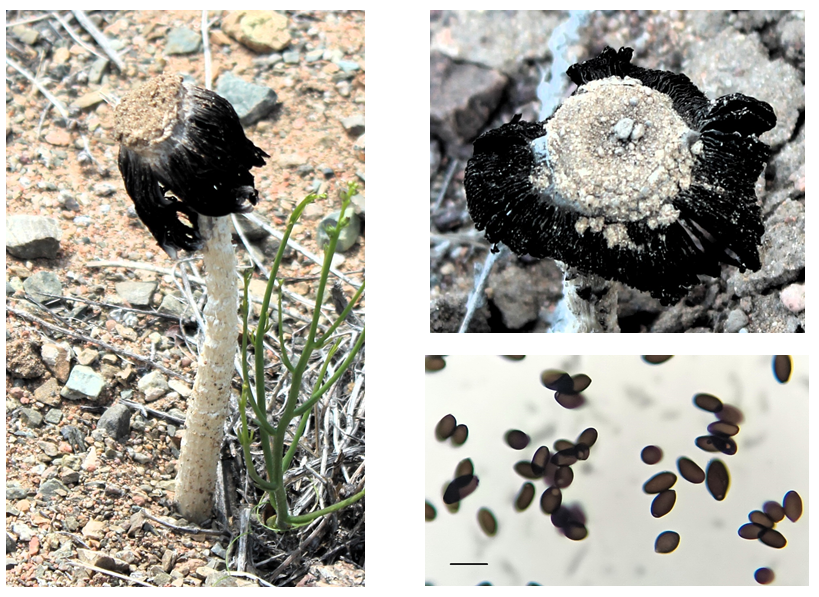
Figures 4-6: Montagnea candollei. 4 Mature fruit body. 5 Disk with large scales over the entire surface. 6 Spores. – Bar = 15 µm.
Material examined – Kazakhstan, Aktobe region, Khobda district, track R-84, feather grass steppe, 194 m a.s.l., 50°19ʹ14.8ʺN, 55°49ʹ38.1ʺE, 9 June 2024, SB Nurashov; ibid., surroundings of the village Khobda, bank of the river Khobda, 141 m a.s.l., 50°09ʹ27.7ʺN, 55°41ʹ33.3ʺE, 9 June 2024, SB Nurashov; ibid., Alga district, north of the village Kyzyltu, smoothed hills with caraganas, 284 m a.s.l., 50°04ʹ38.3ʺN, 57°34ʹ57.7ʺE, 14 June 2024, EV Rakhimova; Mangystau region, Tunkaragai district, 79 km from Aktau, on the road to the Saura tract, next to a stone quarry for construction, a wormwood-shrub community, 276 m a.s.l., 44°09ʹ43.75ʺN, 50°58ʹ59.01ʺЕ, 12 May 2024, LA Kyzmetova; ibid., 53 km from Aktau, on the way to the Saura tract, 266 m a.s.l., 44°06ʹ19.24ʺN, 51°00ʹ39.16ʺЕ, 12 May 2024, LA Kyzmetova; ibid., Karakiya district, territory of the Ustyurt Nature Reserve, dunes, -30 m a.s.l., 42°41ʹ27.89ʺN, 54°07ʹ10.88ʺЕ, 21 May 2024, LA Kyzmetova; ibid., 5 km from the village Shopan Ata, road to the Beket Ata mosque, 162 m a.s.l., 43°32ʹ09.00ʺN, 53°16ʹ36.44ʺЕ, 17 May 2024, LA Kyzmetova; ibid., Mangystau district, Akmyshtau mountain range, valley of castles Airakty,180 m a.s.l., 44°15ʹ04.49ʺN, 52°08ʹ22.51ʺЕ, 16 May 2024, LA Kyzmetova; Western Kazakhstan region, Baiterek district, 72 km northeast of the city of Uralsk, 71 m a.s.l., 51°39ʹ00.6ʺN, 52°14ʹ01.7ʺE, 28 June 2024, SB Nurashov.
Montagnea candollei grows mostly in dry, open, sandy places, in dunes, deserts, semideserts and steppes.
Discussion
Relic of the Cretaceous period, Battarrea phalloides is found in dry, sandy locations throughout the world. Thus, 2,375 occurrences of the fungus are registered in the international network and data “Global Biodiversity Information Facility” (GBIF), the largest number of locations being noted in the United States [6]. However, this species is listed in the Red Book (Red List) of some countries, for example Bulgaria and Dagestan [7, 8].
On the territory of Kazakhstan, Battarrea phalloides was found in the Almaty region (in the desert along the banks of the Ile, Charyn, Taskarasu rivers), Zhambyl region (on the sands along the banks of the Shu river), Turkestan region (sands of Moyun-Kum), Kzyl-Orda region (in saxaul forests and along the banks of the Syr Darya River, in the foothills of the Karatau ridge) [3]. In addition, the fungus was discovered in the East Kazakhstan region in a birch-aspen forest on the banks of the Bukhtarma River and in the gorge of the river Kusty of the Manrak ridge [9]. In recent years, the fungus has been recorded in the Almaty region, in the floodplain of the Charyn River and in the Ulkensay and Chakrambal gorges of the Ketmen ridge [10].
On the territory of Western Kazakhstan, the fungus was found only in the Aktobe region (the bank of the Itassai River and in the vicinity of Chelkar station) [3] and in the Western Kazakhstan region (the bank of the Ural River) [11].
Montagnea candollei (M. arenaria) is a widespread species, found mainly in dry, open, sandy places, in dunes, deserts, semi-deserts and steppes. In the international network and data “Global Biodiversity Information Facility”
[12], the species Montagnea candollei and M. arenaria are considered as two separate species. For the first of them, only 65 occurrences were registered, for the second - 1673. Moreover, the largest number of occurrences was noted in the United States (1014), Mexico (153), Spain (143) and Australia (140). The northernmost location is noted in Poland [13], where the fungus was found only three times. In Mongolia, Montagnea candollei (M. arenaria) is the rarest mushroom, described from two habitats in the north-west of the country [14].
On the territory of Kazakhstan, Montagnea candollei was found in the Karaganda region (sands of Muyun-Kumy, Tabylga, Arys-Kumy, Koksengir mountains,, Betpak-Dala desert), Abay region (Tarbagatai ridge, Rgayty mountains, Barmakum sands), East Kazakhstan region (Manrak, Kurchum and Saur ridges), Almaty region (Ile Alatau ridge, Aidarly sands, valley between the Kungey Alatau and Ketmen ridges), Zhambyl region (banks of the Shu river, Anrakhai mountains, Otar valley), Turkestan region (Southern Kyzyl- Kum sands, Betpak-Dala desert ), Kzyl-Orda region (banks of the Syr Darya river, environs of the city of Kzyl-Orda, sands of Muyun-Kumy).
In Western Kazakhstan, Montagnea candollei is registered in the Aktobe region (Bolshiye Barsuki sands, clay desert in the vicinity of the village of Will) and the Ural region (in the vicinity of the village of Burli) [3]. We noted Montagnea candollei in these same regions and we first discovered the mushroom in the Mangystau region in five locations.
Conclusion
This article provides data on two gasteroid basidiomycetes (Battarrea phalloides (Dicks.) Pers. and Montagnea candollei (Fr.) Fr.) discovered in Western Kazakhstan. Both types are typical for dry, open, sandy places, in dunes, deserts, semideserts and steppes. Data on their habitats (new location) and short diagnosis with original dimensions and photographs of the fruit bodies were provided for each taxon.
Funding
This work was financed by the Committee of Science of the Ministry of Science and Higher Education of the Republic of Kazakhstan within the limits of the research program BR21882122 “Sustainable development of natural-industrial and socio-economic systems of the West Kazakhstan region in the context of the Green growth: a comprehensive analysis, concept, forecast estimates and scenarios”, 2023-2025.
References
-
Nam GA, Rakhimova YV (2017) New location of rare macromycetes in Kazakhstan. Curr Res Environ Appl Mycol 7(1): 1-3.
-
Poliksenova VD, Khramtsov AK, Piskun SG (2004) Guidelines for the special practicum in the section “Mycology. Methods of experimental study of microscopic fungi.” BSU Мinsk Belarus, pp: 36.
-
Schvartzman SR, Filimonova NM (1970) Flora of spore plants in Kazakhstan. Gasteromycetes. Science, Alma- Ata, Kazakhstan 6: 318.
-
MYCOBANK Database. Fungal Databases, Nomenclature & Species Banks.
-
Schvartzman SR (1962) Materials on the history of mycoflora of Kazakhstan. Alma-Ata, Kazakhstan, pp: 183. _6._ _Battarrea phalloides_ (Dicks.) Pers. in GBIF Secretariat (2023). GBIF Backbone Taxonomy.
-
Gyosheva M, Stoichev GT (2006) _Battarrea phalloides_.
-
Volobuev SV, Shakhova NV (2023) First modern findings of red‐listed fungus _Battarrea phalloides_ (Agaricales, Basidiomycota) in the Republic of Dagestan, Russia. South of Russia: ecology development 18(2): 44‐52.
-
Nam GA, Rakhimova EV, Yermekova BD, Abiev SA, Yessengulova BZH, et al. (2011) Fungi of the Kazakh Altai (species summary). Intellect, Almaty, Kazakhstan, pp: 298.
-
Rakhimova YV, Nam GA, Yermekova BD, Jetigenova UK, Kyzmetova LA, et al. (2017) Fungal diversity of desert lowlands of southeast Kazakhstan and the Ketmen ridge. Lux Media, Almaty, pp: 296.
-
Sarsenova AN, Abiev SA, Darbayeva TE (2021) The first find of a Cretaceous relic _Battarrea phalloides_ (Dicks.) Pers. in forest communities in the lower reaches of the Ural River valley. Ex Biology 88(3): 23-32.
-
Montagnea arenaria (DC.) Zeller in GBIF Secretariat (2023) GBIF Backbone Taxonomy.
-
Stasińska M, Prajs B (2002) New record of Montagnea arenaria (Fungi, Agaricales) and its distribution in Poland. Pol Bot Journal 47(2): 211-213.
-
Kherlenchimeg N, Urgamal M (2020) Distribution of Montagnea arenaria (DC.) Zeller mushrooms in Mongolia, some new records from depression of the Great Lakes semi-desert steppe. Problems of botany in Southern Siberia and Mongolia 19(1): 66-68.
- Diversity of Candida sp and Antifungal Susceptibility Patterns in Digestive Candidiasis among People Living with HIV in CHU of Libreville, Gabon
- Vulvovaginal candidiasis: Retrospective study (2019- 2021) at the Centre Hospitalier National de Pikine, Suburban Dakar, Senegal
- Identification of Environmental Fungal Species in Clinical Services of University Hospital of Angre, Abidjan (Cote d’Ivoire)
- Evaluation of Various Extracellular Enzymes of Ectomycorrhizal Mushrooms
- Morphology and Phylogeny of Lactarius Wallichianae sp. nov and Xerula magnispora sp. nov. from India
- Growth of Pleurotus Florida (Oyster Mushroom) on Different Media