
Recombinant Interferon-Alpha 2b for Ocular Surface Squamous Neoplasia (OSSN)
Ocular surface squamous neoplasia (OSSN) is an ambit of ocular surface diseases encompassing dysplasia to different grades of invasive squamous cell carcinoma of the ocular surface. The typical presentation is the leukoplakic appearance with feeder vessels of conjunctiva, limbus, and cornea. Histological confirmation after incisional/excisional biopsy has been considered the gold standard for OSSN. 5-fluorouracil (5-FU) and mitomycin C (MMC) has used as adjuvant topical chemotherapy. Recently, interferon-alpha 2b (INF α2b) is operating as immunotherapy for the treatment of OSSN. Good outcome with fewer side effects than other drugs are reported. An overview on INF α2b for the treatment of OSSN is attempting to analyze mode of action, dose and duration, and treatment modality and outcome of INF α2b.
Introduction
Interferon alpha 2b (INF α2b) is a Type 1 INF consisting of 165 amino acid residues with arginine in position 23. Recombinant DNA technology is producing this type of glycoprotein and resembles INF secreted by leukocytes. It exhibits antineoplastic and antiviral effects [1, 2]. The USA FDA has approved interferon (INF) α2b to treat AIDS- related Kaposi sarcoma, hairy cell leukaemia, malignant melanoma, follicular non-Hodgkin’s lymphoma, chronic hepatitis B and C, and condyloma acuminata. Recently, IFN-α
2b is using for the treatment of anterior segment diseases (conjunctival papilloma, ocular surface squamous neoplasia (OSSN), conjunctival extranodal marginal zone lymphoma (ENMZL), Mooren’s ulcer, and vernal keratoconjunctivitis), and posterior segment disease (serpiginous choroidopathy, posterior uveitis, pseudophakic, diabetic cystoid macular oedema, and proliferative diabetic retinopathy) of the eye [3]. Ocular surface squamous neoplasia (OSSN) commonly encountered ocular tumour with the reported incidence ranging from 0.03 to 1.9/100,000 persons/year. The diagnosis had made by clinical suspicion and confirmed with anterior-segment optical coherence tomography (AS-OCT), cytology, or histology [4]. The most common practised treatment modality in our perspective for Ocular surface squamous neoplasia (OSSN) is surgical excision with 3-4mm free margins with non-touch technique alcohol keratoepitheliectomy followed by double freeze-thaw cryotherapy. Finally, the bare ocular surface is reconstructed by conjunctival autograft or amniotic membrane graft.
Mode of Action
INF α2b has been used off-label in the treatment of OSSN since the first publication in 1994 [5]. The treatment modality has been shifted to topical immunotherapy. The most commonly used topical drugs are interferon-α2b (IFN), mitomycin-C (MMC) and 5-fluorouracil (5FU). IFN has the lowest side effect profile than others. However, Ophthalmologist planning to use IFN-α 2b in their patients must be aware of general and ophthalmological side effects and advise their patients for a systemic evaluation involving physical examination, blood and serological tests, and a chest X-ray before starting the treatment [3].
INF α2b has become an ideal topical immunotherapeutic agent to treat particular cases of OSSN due to its efficacy and low toxicity. OSSN treated as INF α2b monotherapy to achieve complete tumour regression in 75% Tis, 100% T1, and 70% T3 based on the American Joint Committee Classification, 7 edition [6, 7]. INF α2b is using for immunoreduction, immunotherapy, or immunoprevention of OSSN. The tumour involved cornea (30%), conjunctiva-limbal-corneal surface (63%), or bulbar conjunctiva (7%) [6]. INF α2b is the treatment of choice for extensive OSSN as immunoreduction (basal tumour diameter of 20mm or >6 clock hours), as immunotherapy in corneal lesions or smaller conjunctival or conjunctiva-corneal lesions (tumour basal diameter<20mm and <6 clock-hours), and for immunoprevention in patients with histopathology evidence of residual tumour [2, 7, 8, 9, 10].
Dose and duration for the treatment modality: In the patients with Tis (20%), used three cycles of topical INF α2b for immunoprevention. In the patients with T3 (80%), INF α2b was advised for immunoreduction but served as immunotherapy with 100% tumour regression in 92% cases and resulted in 95% immunoreduction in 6%. Complete tumour regression was achieved by immunotherapy with a mean number of three topical INF α2b cycles and two perilesional injections and received three additional topical INF α2b cycles after complete tumour regression. For immunoreduction, six cycles of topical INF α2b and three perilesional INF α2b injections were used [7].
In a study, 18 patients with extensive OSSN, INF α2b served as immunotherapy, achieving complete tumour regression in 72% of patients and achieved immunoreduction in 28% cases by a median duration of 6 months [9]. In a study of five patients, two patients had corneal OSSN, and both showed complete regression of the tumour with topical INF α2b as immunotherapy by a median duration of 2 months [8]. Topical INF α2b is potent at a dose of 1 MIU/cc four to six times/day [8, 9, 10, 11]. The comparison of effectiveness and side effect profile of two amounts of topical INF α2b (1 MIU/cc vs. 3 MIU/cc) in the treatment of OSSN showed not a significant difference between the two doses. However, there is no consensus on the quantity of perilesional INF. The dose and dosage of topical INF α2b was 1 MIU/cc four times a day until clinical resolution, and the amount of perilesional INF α2b was 5 MIU/cc once a month until clinical resolution of the conjunctival component of the tumour. Furthermore, there is a consensus on the duration of topical INF α2b after tumour resolution and ranges from 3 to 4 months (Figures 1 & 2) [6, 7, 8, 10, 12].
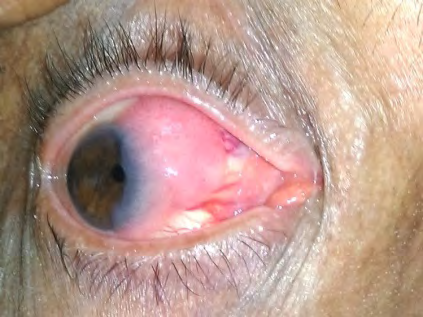
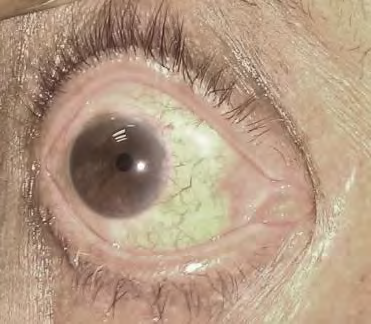
Recurrence Rate
There is no statically significant difference in the recurrence rate of OSSN at 1-year between surgical excision and medical treatment with INF α2b [13, 14]. Recurrence couldn’t found in any patient at a mean follow-up period of 9 months (median: 7 months; range: 3-28 months) [6].
Complications
INF α2b has fewer side effects than other topical agents used in OSSN. Ocular side effects include conjunctival hyperemia (5%), ocular irritation (4%), superficial punctate keratitis (4%), and follicular conjunctivitis (1%). Systemic
side effects include postinjection flu-like syndrome for one day (9%) [6, 7]. No single modality has been shown to superior in the management of OSSN and may need the use of combination therapy to achieve an optimal clinical outcome [15, 16].
References
-
Sepulveda R, Peer J, Midena E, Seregard S, Dua HS, et al. (2010) Topical chemotherapy for ocular surface squamous neoplasia: Current status. Br J Ophthalmol 94(5): 532-535.
-
Lewczuk N, Zdebik A, Bogusławska J (2019) Interferon Alpha 2a and 2b in Ophthalmology: A Review. J Interferon Cytokine Res 39(5): 259-272.
-
Hollhumer R, Williams S, Michelow P (2021) Ocular surface squamous neoplasia: management and outcomes. Eye (Lond).
-
Poothullil AM, Colby KA (2006) Topical medical therapies for ocular surface tumors. Semin Ophthalmol 21(3): 161-169.
-
Maskin SL (1994) Regression of limbal epithelial dysplasia with topical interferon. Arch Ophthalmol 112(9): 1145-1146.
-
Kaliki S, Singh S, Iram S, Tripuraneni D (2016) Recombinant interferon alpha 2b for ocular surface squamous neoplasia: An efficient and cost-effective treatment modality in Asian Indian patients. Indian J Ophthalmol 64(10): 702-709.
-
Shields CL, Kaliki S, Kim HJ, Al Dahmash S, Shah SU, et al. (2013) Interferon for ocular surface squamous neoplasia in 81 cases: Outcomes based on the American Joint Committee on Cancer classification. Cornea 32(3): 248-256.
-
Karp CL, Galor A, Chhabra S, Barnes SD, Alfonso EC (2010) Subconjunctival/perilesional recombinant interferon a2b for ocular surface squamous neoplasia: A 10-year review. Ophthalmology 117(12): 2241-2246.
-
Kim HJ, Shields CL, Shah SU, Kaliki S, Lally SE (2012) Giant ocular surface squamous neoplasia managed with interferon alpha-2b as immunotherapy or immunoreduction. Ophthalmology 119(5): 938-944.
-
Shah SU, Kaliki S, Kim HJ, Lally SE, Shields JA, et al. (2012) Topical interferon alfa-2b for management of ocular surface squamous neoplasia in 23 cases: Outcomes based on American Joint Committee on Cancer classification. Arch Ophthalmol 130(2): 159-164.
-
Shields CL, Kancherla S, Bianciotto CG, Lally SE, Shields JA (2011) Ocular surface squamous neoplasia (squamous cell carcinoma) of the socket: Management of extensive tumors with interferon. Ophthal Plast Reconstr Surg 27(4): 247-250.
-
Schechter BA, Koreishi AF, Karp CL, Feuer W (2008) Long-term follow-up of conjunctival and corneal intraepithelial neoplasia treated with topical interferon alfa-2b. Ophthalmology 115(8): 1291-1296.
-
Galor A, Karp CL, Chhabra S, Barnes S, Alfonso EC (2010) Topical interferon alpha 2b eye-drops for treatment of ocular surface squamous neoplasia: A dose comparison study. Br J Ophthalmol 94(5): 551-514.
-
Moon CS, Nanji AA, Galor A, McCollister KE, Karp CL (2016) Surgical versus medical treatment of ocular surface squamous neoplasia: A cost comparison. Ophthalmology 123(3): 497-504.
-
Nanji AA, Moon CS, Galor A, Sein J, Oellers P, et al. (2014) Surgical versus medical treatment of ocular surface squamous neoplasia: A comparison of recurrences and complications. Ophthalmology 121(5): 994-1000.
-
Venkateswaran N, Mercado C, Galor A, Karp CL (2019) Comparison of Topical 5-Fluorouracil and Interferon Alfa-2b as Primary Treatment Modalities for Ocular Surface Squamous Neoplasia. Am J Ophthalmol 199: 216-222.
- Screening of Hospital Staff During World Glaucoma Week in a Tertiary Eye Care Centre
- Angioid Streaks with Macular Neovascularization: Clinical Insights from Two Cases
- Giant Kissing Naevus: An Oculoplastic Challenge
- Why Freedom of Vision Should Not Cost the Freedom of Feeling - LASIK in the Climate of Change
- Asymmetric Optic Nerve with Small Disc and Large Cup: A Rare and Challenging Case of Unilateral Optic Nerve Hypoplasia
- Large Angle Exotropia in a Child: A Case Report