
Screening of Hospital Staff During World Glaucoma Week in a Tertiary Eye Care Centre
Purpose: To explore the feasibility of Glaucoma screening and prevalence of Glaucoma in hospital staff during world Glaucoma week at a tertiary eye care center. Method: Hospital based Glaucoma screening was conducted in the Glaucoma clinic of Chittagong Eye Infirmary and Training Complex during world Glaucoma week 2025. Participants underwent visual acuity testing, Intra-ocular pressure (IOP) measurement, slit lamp examination, angle evaluation and optic disc evaluation by Ophthalmologists. Results: A total of 40 hospital staff members were screened during world Glaucoma week 2025 (March 9th-15th). Out of these 9 (22.5%) were diagnosed as primary angle closure suspect (PACS), 1 (2.5%) was diagnosed as primary open angle Glaucoma (POAG) and 30 (75%) had refractive error. Of these, 9 (22.5%) consisted of hygiene helpers, 5 (12.5%) were security guards and 4 (10%) were Ophthalmic paramedics. 4 out of 9 cases of PACS underwent Laser Peripheral Iridotomy, 1 case of POAG was prescribed anti-Glaucoma medication. Follow up was available for all cases. Conclusion: Our data suggests that screening is essential for hospital staff. It establishes the feasibility of screening as a method of facilitating access to care and awareness.
Umme Salma Akbar¹*, Musharrat Alam Tarin², Syed Rasal Abdullah Faisal³, Md Raihan Uddin³ and Shally Biswas⁴
¹Consultant, Chittagong Eye Infirmary and Training Complex, Bangladesh ²Assistant Surgeon, Chittagong Eye Infirmary and Training Complex, Bangladesh ³Senior Assistant Surgeon, Chittagong Eye Infirmary and Training Complex, Bangladesh ⁴Associate Consultant, Chittagong Eye Infirmary and Training Complex, Bangladesh Keywords: Screening; Hospital Staff; Glaucoma
Abbreviations
IOP: Intraocular Pressure; PACS: Primary Angle Closure Suspect; POAG: Primary Open Angle Glaucoma; AC: Anterior Chamber; CEITC: Chittagong Eye Infirmary and Training Complex.
Introduction
As the second most common leading cause of irreversible blindness in the world, Glaucoma poses a significant public health problem [1]. It is an ocular disorder with multiple etiologies and can present as optic neuropathy and increased intraocular pressure, but in some cases like normotensive Glaucoma, the IOP may remain normal [2]. There are so many reasons for the increase in IOP, among these most common reasons are: (1) increase rate of formation of aqueous humor, (2) or difficulty in its drainage and (3) rise in episcleral venous pressure. In most cases, the pressure rise is due to increased resistance in the drainage of the aqueous humor through the angle of the anterior chamber and/or due to the circulation of aqueous humor at the pupil. Rapid increase or continuous high IOP leads to damage of the optic nerve, causing irreversible visual field loss [3]. To the best of our knowledge, this is the first article from Bangladesh on screening hospital staff members during World Glaucoma Week.
Method
The screening examinations were performed in the Glaucoma clinic of Chittagong Eye Infirmary and Training complex during “World Glaucoma Week 2025” (March 9th- 15th). Eighty eyes of forty hospital staff over the age of forty years were included in our study. There were no exclusion criteria and we did not turn away any hospital staff above the age of forty years who wished to be screened. Participants were asked to report their age, gender, occupation, family and personal history of Glaucoma, personal history of systemic disease, any history of trauma or steroid use. All participants underwent visual acuity testing, IOP measurement with Goldman applanation tonometer, gonioscopy, slit lamp examination and slit-lamp bio-microscopy for optic nerve evaluation. These evaluations were performed by trained Glaucoma specialists and optometrists. An abnormal screening result of Glaucoma was defined if the subject had any of the following: IOP >21 mm of Hg in either eye, shallow anterior chamber (AC), close angle / open angles or an enlarged vertical cup disc ratio > 0.6 in either eye. Subjects who had a positive Glaucoma screening result were treated accordingly at the Glaucoma clinic of Chittagong Eye Infirmary and Training Complex. They were advised for regular follow up in case of Glaucoma suspects or to have a routine eye examination annually if there were no ocular abnormalities. The study was done after approval from the ethical review board of Chittagong Eye Infirmary and Training Complex (CEITC) and complied with the declaration of Helsinki developed by the world medical association to protect human subjects. Computerized statistical analysis was performed.
Results
A total of 40 subjects were successfully screened. The median age was 48 years. Males were represented in greater numbers than females: 75% to 25%. Most of the subjects (22.5%) were hygiene helpers (Table 1).
| Frequency | Percent (%) | |
|---|---|---|
| Ophthalmic Paramedic | 4 | 10.0 |
| Driver | 3 | 7.5 |
| Assistant Manager | 2 | 5.0 |
| Account & Finance Staff | 1 | 2.5 |
| Technician | 1 | 2.5 |
| Security Guard | 5 | 12.5 |
| Patient Care Attendant | 2 | 5.0 |
| Canteen Helper | 1 | 2.5 |
| Administration officer | 2 | 5.0 |
| OT Staff | 3 | 7.5 |
| Nursing Officer | 1 | 2.5 |
| Counsellor | 2 | 5.0 |
| Maintainace Staff | 1 | 2.5 |
| Hygiene Helper | 9 | 22.5 |
| Imam | 1 | 2.5 |
| Optician | 1 | 2.5 |
| Peon | 1 | 2.5 |
| Total | 40 | 100.0 |
Table 1: Occupations of the Participants.
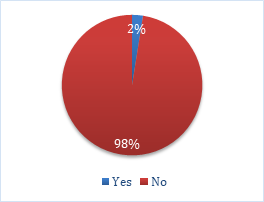
Of the huge portion of the screened population, 39 participants (98%) reported that they never had an eye check-up before (Figure 1).
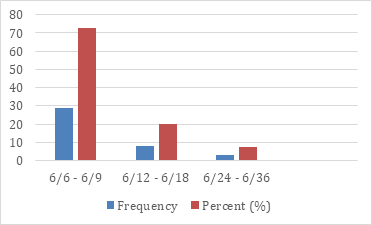
Among them, only 1 participant (2.5%) gave a positive family history of Glaucoma. Visual acuity in both eyes was in the range of 6/6 to 6/9 in 72.5% participants (Figure 2).
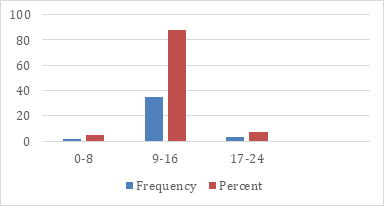
IOP in both eyes were in the range of 9 to 16 mm of Hg in 87.5% (Figure 3).
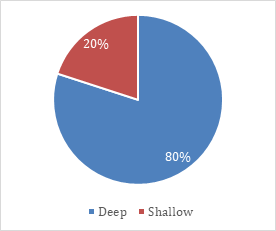
AC depth using the Van Herrick method showed deep AC in 32 (80%) participants and shallow AC in 8 (20%) participants (Figure 4).
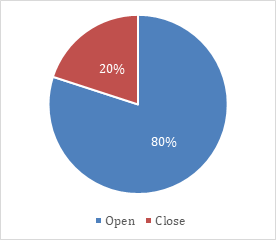
Gonioscopy showed open angle in 32 (80%) participants and angle closure in 8 (20%) participants (Figure 5).
Fundoscopy revealed normal disc in 39 (97.5%) and Glaucomatous disc damage in 1 (2.5%) participant. Of the total participants, 30 (75%) were diagnosed with refractive error, 9 (22.5%) were diagnosed with PACS and 1 (2.5%) was diagnosed as POAG (Table 2).
| Frequency | Percent | |
|---|---|---|
| PACS | 9 | 22.5 |
| POAG | 1 | 2.5 |
| Ref. error | 30 | 75 |
| Total | 40 | 100.0 |
Table 2: Diagnosis.
Discussion
Screening for Glaucoma basically aims at either primary or secondary prevention. Primary prevention targets early detection of the presence of conditions like ocular hypertension and PACS so that they can be managed timely or monitored to prevent Glaucoma. Secondary prevention intends to detect the already established disease so as to prevent or control its rate of progression and lessen the undesirable effects on the quality of life. Screening for Glaucoma is not as easy and straight forward as it is for refractive error or cataracts because of its asymptomatic nature, late presentation and complexity [4, 5, 6, 7, 8, 9]. Our data suggest that our simplified, time-efficient Glaucoma screening program was feasible for use in our setting. Of the total screened, 22.5% were diagnosed as PACS and 2.5% were diagnosed as POAG. Our data also document low levels of ophthalmic care: 98% subjects said they had never shown an eye care provider. No single test or combination of tests has been defined as the gold standard for defining Glaucoma in population-based research. In our study, we limited our examination to visual acuity testing, tonometry with Goldman applanation tonometer, gonioscopy and funduscopy. In BES 5,308 subjects aged 40 years or older underwent a screening examination. The researchers identified 100 cases of POAG (4%) among the 2,395 African-American residents and 32 cases (1%) among the 2,913 Whites. In this study, occupation and history of eye examination, were the factors that significantly affect Glaucoma-related knowledge. This finding was similar to a study in an urban population of Chennai in south India [10]. Age and sex had no significant association with Glaucoma knowledge, and similar results were observed in North India [11] and Ghana [12] studies. Despite working in a hospital with easy access to health care, only 2.3% have undergone screening for Glaucoma. This is low when compared to the study conducted by Icchpujani P (42%) and the study conducted by Adegbehingbe, et al. [11] (59%) [10, 13]. There are barriers to seek medical health care which may be due to the low knowledge and lack of clear understanding about the disease. Even though our Institute is well equipped with diagnostic facilities and human resources for Glaucoma detection and management, the poor or unsatisfactory level of knowledge and awareness about Glaucoma among the general public or community, often limits on timely detection and effective management. Eye centers around the globe have been posting Glaucoma awareness week every year with the key focus on educating Glaucoma patients and spreading awareness among their families as well as the general public about the silent sight threatening disease [5].
Conclusion
Our data suggests that screening is essential for hospital staff. It establishes the feasibility of screening as a method of facilitating access to care and awareness.
It is important to emphasize on intensive eye health education especially among health professionals, continuing medical education about Glaucoma symptoms and subsequent visual impairment must be a priority when designing programs for community outreach.
References
-
Allocco AR, Ponce JA, Riera MJ, Magurno MG (2017) Critical Pathway for Primary Open Angle Glaucoma Diagnosis. Int J Ophthalmol 10(6): 968-972.
-
Moore D, Harris A, WuDunn D, Kheradiya N, Siesky B (2008) Dysfunctional Regulation of Ocular Blood Flow: A Risk Factor for Glaucoma? Clinical ophthalmology 2(4): 849-861.
-
Stein JD, Khawaja AP, Weizer JS (2021) Glaucoma in Adults-Screening, Diagnosis, and Management: A Review. JAMA 325(2): 164-174.
-
Thomas R (2012) Glaucoma in developing countries. Indian J Ophthalmol 60(5): 446-450.
-
Thapa SS, Paudyal I, Joshi PL, Singh K, Parajuli A (2021) Glaucoma in developing countries. Nepalese J Ophthalmol 13(25): 112-121.
-
Tan NYQ, Friedman DS, Stalmans I, Ahmed IIK, Sng CCA (2020) Glaucoma screening: where are we and where do we need to go? Curr Opin Ophthalmol 31(2): 91-100.
-
Fraser S, Bunce C, Wormald R (1999) Risk factors for late presentation in chronic Glaucoma. Invest Ophthalmol Vis Sci 40(10): 2251-2257.
-
Onyia O, Achigbu E, Ejiakor I, Chinemerem U, Ogbonnaya C (2022) Risk factors for late presentation among Glaucoma patients attending three referral hospitals in South-East Nigeria: case–control study. Cogent Public Health 9(1): 2125533.
-
Kastner A, King AJ (2020) Advanced Glaucoma at diagnosis: current perspectives. Eye 34: 116-128.
-
Prabhu M, Patil S, Kangokar PCR (2013) Glaucoma awareness and knowledge in a tertiary care hospital in a tier-2 city in South India. Journal of the Scientific Society 40(1): 3-8.
-
Adegbehingbe BO, Bisiriyu LA (2008) Knowledge, attitudes, and self care practices associated with Glaucoma among hospital workers in Ile-Ife, Osun State, Nigeria. Tanzania journal of health research 10(4): 240- 245.
-
Mahlet T, Abiye M, Abeba TG (2020) Glaucoma awareness and knowledge among adults in woliso town, South West Ethiopia. Journal of Clinical Research and Ophthalmology 7(2): 87-90.
-
Ichhpujani P, Bharatiya S, Kataria M, Topiwala P (2012) Knowledge, attitude and self-care practices associated with Glaucoma among health personnel in tertiary care centre in north India. J Curr Glau Prac 2012 6(3): 108- 112.
- Angioid Streaks with Macular Neovascularization: Clinical Insights from Two Cases
- Giant Kissing Naevus: An Oculoplastic Challenge
- Why Freedom of Vision Should Not Cost the Freedom of Feeling - LASIK in the Climate of Change
- Asymmetric Optic Nerve with Small Disc and Large Cup: A Rare and Challenging Case of Unilateral Optic Nerve Hypoplasia
- Large Angle Exotropia in a Child: A Case Report
- Refractive Status of Retinoblastoma Patients in a Tertiary Eye Care Centre of Bangladesh