
Refractive Error Awareness among School Teachers in Tirukalukundram, Chengalpattu District- A Questionnaire based Study
Aim: To determine Refractive error awareness among School Teachers and to analyse Educational Qualification of School Teachers is in association with Refractive error Awareness. Setting and Design: Cross Sectional Study design with online questionnaire based survey performed from June 2022 to August 2022. Materials and Methods: 460 School Teachers of 22 Schools participated in this study. Validated questionnaire was distributed in English and Tamil Format through WhatsApp as Google Form. Referral letter regarding the project was given to District Educational Officer, Chief Educational Officer, Assistant Educational Officer, and Headmaster. Participant Information sheet and Informed consent was given to School Teachers. Data was calculated based on median score. Normality testing was done. Statistical analysis SPSS and MS EXCEL was used and Chi-square test was done to determine association between Educational qualification and Refractive error awareness. Result: 460 participants responded to the Questionnaire with mean age group (36.76 ± 8.67) years and mean Teaching Experience group (21.70 ± 0.65) years School Teachers participated in this study 387(84%) Female and 73(16%) Male. Chi Square test was done to determine association on Educational qualification with Knowledge (X2=1.981 p value=0.159) and Attitude (X2=1.077, p value=0.299), and also to determine association with Gender on Knowledge (X2=19.769, p value=0.011) and Attitude (X2=9.171, p value=0.328). Conclusion: This present study concludes that awareness does not depend on Educational qualification, since awareness level is less and steps need to be taken to prevent visual impairment.
Introduction
Refractive error is major cause for visual impairment and blindness in school children. Refractive error is a common eye disorder where light is not focussed accurately on the retina. To reduce rate of avoidable blindness, W.H.O made refractive error correction methods as a global initiative in Vision 2020- The Right to Sight 3 School going age is most prominent age where children face difficulties in visual problems [1]. Refractive errors are common among School children, due to change in society with increased and improper usage of audio-visual aids for education, communication and entertainment [2]. Proper eye care is necessary for School Students which helps to avoid visual problems and prevents from affecting their learning skills. Knowledge of Refractive error among School Teachers will determine the treatment options depending on type of Refractive error and power. Awareness of Refractive error helps in preventing the occurrence of visual impairment [3].
Literature Review
Burden of visual impairment due to uncorrected Refractive error is 53.1%⁷. Cross sectional study was conducted for adult population from September 2003 to April 2004 in Riyadh Saudi Arabia. Survey Questionnaire was distributed to 2500 random people. Results of this study depicted that 35% General public was not aware of visual problems. Therefore, on educating Refractive error awareness will help in reducing blindness and improves quality of vision [4].
In 2013 a descriptive survey was conducted using a structured questionnaire on 60 Primary School Teachers in Mysore, for early identification of Refractive error. Results of this study revealed that 80% School Teachers are aware of Refractive error but are not able to identify the visual problems [1].
A population-based study was conducted at Iran and Goa for determining awareness and attitude towards Refractive error correction methods in year of 2013 and 2018. Results reveal that 80% of population in these regions are not aware of Refractive error correction methods and also 25% of population did not know the difference between Ophthalmologist and Optometrist. This was due to lack of eye care services and are not educated by eye care authorities [3, 6]. A study was conducted in year of January 2017 for identifying awareness on healthy vision and eye screening on Private Schools of rural and urban areas of Noida. Workshop was arranged under advice of Department of Community Ophthalmology. Questionnaire was distributed, data was collected and analysed. Results reveal that 47% had no knowledge, 48% had no attitude and are not aware about steps of screening procedures which was due to lack of accessibility of eye care services [5, 6].
A cross sectional study was conducted young- adult population who were attending rural health centre of tertiary hospital age of 15-40. A self-structured questionnaire was distributed for gathering information on awareness on general population for refractive error and its correction methods. Results reveal that 23% are aware about Refractive error. Higher education groups are aware of visual problems so they depicted that education level will determine awareness.
A cross sectional population based survey with multistage cluster random sampling was taken and KAP questionnaire was distributed among adults. Results reveal that 74% are aware of Refractive error; 88% are aware of strabismus, so they depicted that awareness and knowledge of Refractive error and Strabismus was limited.
Methodology
Study Design
Cross sectional study with sample size of 460.22 schools (government and private) were participated. Questionnaire was distributed in English and Tamil format through WhatsApp as Google form Sampling done was Convenient sampling. Referral letter regarding project was given to District Educational Officer. Chief Educational Officer, Assistant Educational Officer, Headmaster/Correspondent. Participant Sheet, Informed consent was given to School Teachers. Data was collected based on responses and median score was done. Inclusion criteria involve School Teachers of Government and Private Schools willing to participate in this study. Institutional Ethical Committee and Institutional Review Board approval was obtained. Declaration of Helsinki was conformed.
Convenience sampling method is used. The sample size was calculated using the below formula n= Z2/2P (1-P)/d2 Where n = required minimum sample size Where Z = Z statistic for level of confidence Where P = estimated prevalence 50% (no prevalence on Refractive error awareness is found) Where = level of significance 0.05 Where d = margin of error 5% n= (1.96)2*0.5(1-0.5) / (0.05)2; n=384 With 20% of non-respondent rate n=384+ (20%of 384) n= 460 Questionnaire comprises of 3 sections with 18 questions in closed ended type. Reliability: Cronbach alpha 0.77 10. Sections are mentioned in Table 1. Questionnaire is closed ended type which involves knowledge and attitude questions with answers given and are mentioned in Annexure 1. The median score is the point at which half the scores are above and half the scores are below. It is described from score of awareness responses.
Annexure 1
Demographic Details
- Age: -----------------
- Gender: -----------------
- Educational Qualification: ----------------------------------
- Teaching Experience: ---------------------------------------
| First Section | Second Section (Knowledge) | Third Section(Attitude) |
|---|---|---|
| Demographic details | 10 multiple choice questions about definition, causes, symptoms and treatment of Refractive error. | 8 multiple choice questions. |
| Every Correct answer will be given 1 point and incorrect answers will be given 0 points. | It will be assessed on 3 points of Likert scale | |
| Sum of score range from 0 to 10 points. Higher the points greater the awareness. Above median score is good knowledge below median score is poor knowledge. | Score points range from 8 to 24. Above median score is good attitude and below median score is poor attitude. | |
| Responses above median score are good knowledge below median score is poor knowledge. | Responses above median score are good attitude and below median score is poor attitude. |
Table 1: Sections of Questionnaire.
Knowledge on Refractive error (Mark only one).
Do you know what Refractive error is? o Yes o No
What are the Symptoms of having Refractive error? o Blurring of vision o Discharge in eyes o Rubbing of eyes o Do not Know Correct answer: Blurring of vision.
What are the factors that cause Refractive error? o Family History o Contact with the patient o Nutritional deficiency o Do not know Correct answer: Family History.
When Refractive error occurs? o When light rays do not focus on the retina o Nutritional deficiency o Contact with the patient o Do not know Correct answer: When light rays do not focus on the retina. What are types of Refractive error? o Short sight o Long Sight o Astigmatism o Do not know Correct answer: Short sight, Long sight, Astigmatism.
Which distance is affected by Refractive error? o Only distance vision o Vision at different distances o Only near vision o Do not know Correct answer: Vision at Different Distances.
What are treatments of Refractive error? o Spectacles o Contact lens o Refractive surgery o Eye medication o Holy water Correct answer: Spectacles, contact lens, refractive surgery.
What is effect of Refractive error on academic performance? o Decrease academic performance o Increase academic performance o No effect on academic performance o Do not know Correct answer: Decrease academic performance.
Is the Refractive error can cause blindness? o Yes o No o Do not know Correct answer: Yes Which is the place to seek help for Refractive error? o Eye hospital o Health centre o Optical shop o Do not know Correct answer: Eye Hospital, Optical shop. Attitude on Refractive error (Mark only one) Can Refractive error cause blindness? o Disagree o Neutral o Agree Correct answer: Agree Wearing Spectacles can correct Refractive error? o Disagree o Neutral
o Agree Correct answer: Agree
Refractive error cannot be cured by all medications? o Disagree o Neutral o Agree Correct answer: Agree Refractive error cannot be cured by eye spectacles? o Disagree o Neutral o Agree Correct answer: Disagree Wearing spectacles can damage the eyes? o Disagree o Neutral o Agree Correct answer: Disagree Wearing spectacle can worsen vision? o Disagree o Neutral o Agree Correct answer: Disagree Wearing spectacle lead to dependency? o Disagree o Neutral o Agree Correct answer: Disagree Young people with Refractive error do not need spectacle correction? o Disagree o Neutral o Agree Correct answer: Disagree
Result
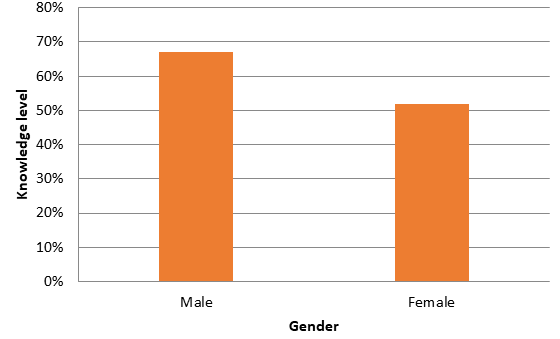
The Present study included 460 (N=460) participants, 383 (84%) were Female and 73 (16%) were Male. As in Figure 1 Educational qualifications, 183 (40%) Undergraduates and 277 (60%) Postgraduates of School Teachers with mean age group (36.76 ± 8.67) years, mean teaching experience (21.70 ± 0.65) years. No Significant statistical association between Educational qualification and Knowledge (X2=1.981, p value=0.159) and Attitude (X2=1.077, p value=0.299) was found. Significant statistical association with gender and knowledge (X2=19.769, p value=0.011) was found, but not associated with attitude (X2=9.171, p value=0.328). Educational qualification was categorised as Undergraduate and Postgraduate. Using Median score cut off value was determined for Knowledge and Attitude using excel sheet and value received was 9 for knowledge and 12 for attitude. In this study both Undergraduates and Postgraduates have more attitudes on Refractive error but they have less knowledge about Refractive error. Values are mentioned in Table 2.
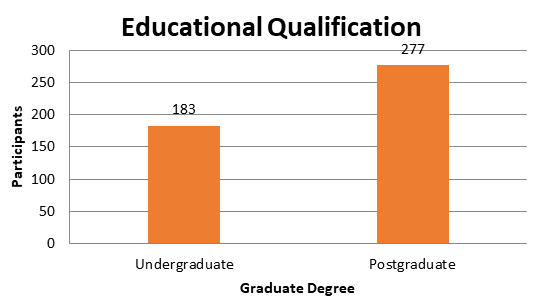
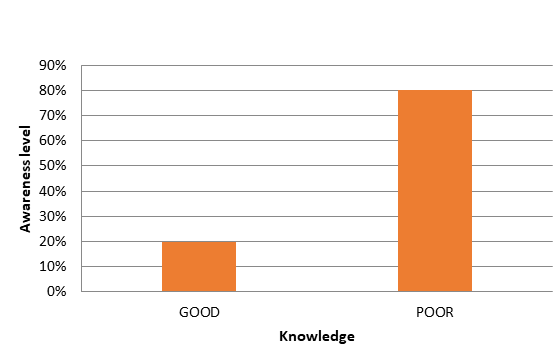
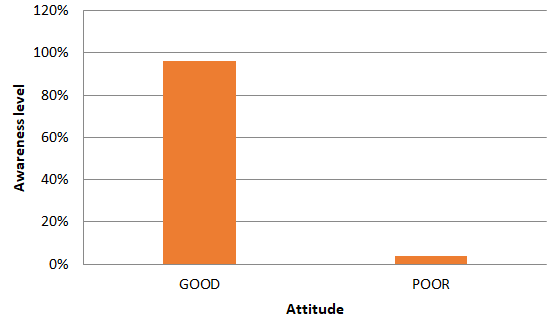
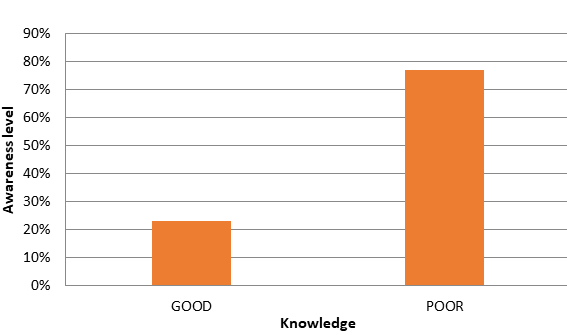
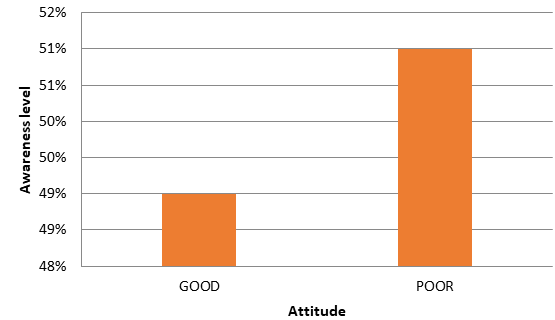
Figure 1: Educational Qualification Participants. 183(40%) undergraduates and 277(60%) postgraduates Median Score was calculated in Figures 2,3 Undergraduates scoring involves (Good Knowledge20%, Poor Knowledge 80%, Good Attitude 96%, Poor Attitude 4%) and in Figures 4,5 Postgraduates scoring involves (Good Knowledge 23%, Poor Knowledge 77%, Good Attitude 49%, Poor Attitude 51%) Undergraduates and Postgraduates had more attitudes on Refractive error but they had less knowledge about Refractive error.
| Knowledge and Attitude | Undergraduate | Postgraduate |
|---|---|---|
| Good knowledge | 36(20%) | 65(23%) |
| Poor Knowledge | 147(80%) | 212(77%) |
| Good attitude | 175(96%) | 136(49%) |
| Poor attitude | 8(4%) | 141(51%) |
Table 2: Scores of Knowledge and Attitude.
| Knowledge level | Males | Females |
|---|---|---|
| Good knowledge | 49(67%) | 204(53%) |
| Poor knowledge | 24(32%) | 183(47%) |
Table 3: Knowledge Level of Gender.
Discussion
This study was cross sectional study to determine refractive error awareness among school teachers. This Prevalent study depicted 43% of school teachers had knowledge on Refractive error. This is lesser as compared to other studies Gondar city 54%10, Mysore 80%2, Andhra Pradesh 74%9, Visakhapatnam district 74%4 had knowledge on Refractive error. This lag in present study due to lack in eye care services, change in lifestyle and vision screening was not followed. Most of studies reveal that greater educational level, greater the awareness; in this present study Postgraduates had lesser knowledge could be due to lack of awareness. Knowledge level was found to be higher in Males and was more aware about Refractive error. This prevalent study depicted that 100% had attitude. It means behaviour towards eye care services on Refractive error. This is greater as compared to other studies North India 23%8, Gondar city 52%10, Vishakhapatnam 72%4. Awareness level of this prevalent study 56% compared to other studies Mysore 80%2, North India 23%8, Andhra Pradesh 74%9.
Conclusion
This present study concludes that awareness does not depend on Educational qualification. Awareness level is poor and steps need to be taken to prevent visual impairment. School Screening Camps needs to be conducted regularly which will improve Refractive error awareness level among School Teachers. Initiatives and recommendation of this study involves conducting School Screening Camps which creates and improves awareness level of School Teachers and provides benefit for Teachers as well as School Students. By taking this initiative majority of School Children will be protected from vision impairment by enhancing knowledge of School Teachers on Refractive error.
Conflict of Interest
No financial or commercial investments included in this study.
Limitations
This study had few limitations. Since it was a cross sectional study; an online based survey, Network accessibility was limited in our area so we had not covered some more interior village schools.
Acknowledgements
We thank to all School Teachers, Principal and Correspondents of Government and Private Schools for participating in this study.
References
-
Ambika K, Nair NP (2013) A study on awareness of primary school teachers regarding refractive errors and its early identification among primary school children. International Journal of Nursing Education 5(1): 6-9.
-
Agrawal D, Tyagi N, Nagesh SR (2018) Awareness levels of school teachers regarding healthy vision and eye screening in Dist Gautam Budh Nagar. UP Natl J Community Med 9(8): 614-627.
-
Alemayehu AM, Belete GT, Adimassu NF (2018) Knowledge, attitude and associated factors among primary school teachers regarding refractive error in school children in Gondar city, Northwest Ethiopia. PloS one 13(2): e0191199.
-
Aldebasi Y (2011) Young public’s awareness to refractive error deficiency. International journal of health sciences 5(1): 9-15.
-
AK SMR (2013) Awareness and attitude toward refractive error correction methods a population based study in Mashhad. Journal of patient safety & quality improvement 1(1): 23-29.
-
Usgaonkar DUP, Tambe DP (2018) Awareness and attitude toward refractive error correction methods, among goan population. IOSR Journal of Dental and Medical Sciences (IOSR-JDMS) e-ISSN 2279-0853.
- Screening of Hospital Staff During World Glaucoma Week in a Tertiary Eye Care Centre
- Angioid Streaks with Macular Neovascularization: Clinical Insights from Two Cases
- Giant Kissing Naevus: An Oculoplastic Challenge
- Why Freedom of Vision Should Not Cost the Freedom of Feeling - LASIK in the Climate of Change
- Asymmetric Optic Nerve with Small Disc and Large Cup: A Rare and Challenging Case of Unilateral Optic Nerve Hypoplasia
- Large Angle Exotropia in a Child: A Case Report