
Revolutionizing Eye Health: AI-Powered Diagnosis and Screening
Artificial intelligence (AI) has contributed to healthcare, particularly in the field of ophthalmology. This article focuses on how AI has improved detection and diagnosis of common eye diseases such as diabetic retinopathy (DR) and age-related macular degeneration (AMD). With AI-based systems, healthcare professionals can now receive more accurate diagnoses faster and create personalized treatment plans. The article also explains how AI is used to detect eye diseases. This includes collecting data, selecting components, preparing data, training models, analyzing data, developing, and refining models, and making diagnoses. It highlights the advantages of using AI to detect subtle changes in retina, such as high accuracy, early detection, predictive abilities, personalised treatment plans, and remote monitoring. However, there are still challenges to employ AI in healthcare. These include ensuring that data utilized is of good quality, refining algorithms, ensuring that the models are easy to understand, and integrating AI with clinical practice. Everyone involved in healthcare must collaborate to ensure that AI can be utilized to help more people with vision problems globally.
Abbreviations
AI: Artificial intelligence; DR: Diabetic Retinopathy; AMD: Age-Related Macular Degeneration; OCT: Optical Coherence Tomography; CKD: Chronic Kidney Disease.
Introduction
The eye is a complex body part that can be affected by several diseases [1]. These conditions can cause vision problems or even blindness if not detected and treated early. Some common eye diseases include diabetic retinopathy, age- related macular degeneration (AMD), glaucoma, cataracts, and retinopathy of prematurity [2]. Detecting these diseases early and getting an accurate diagnosis is important to help protect your vision and maintain your quality of life. AI has transformed healthcare, especially in ophthalmology. With its superior diagnostic accuracy and early disease detection, AI algorithms can analyze medical images like retinal scans or OCT images with exceptional speed and precision [3]. This allows for timely treatment and prevention of vision loss, improving the quality of life and reducing healthcare costs.
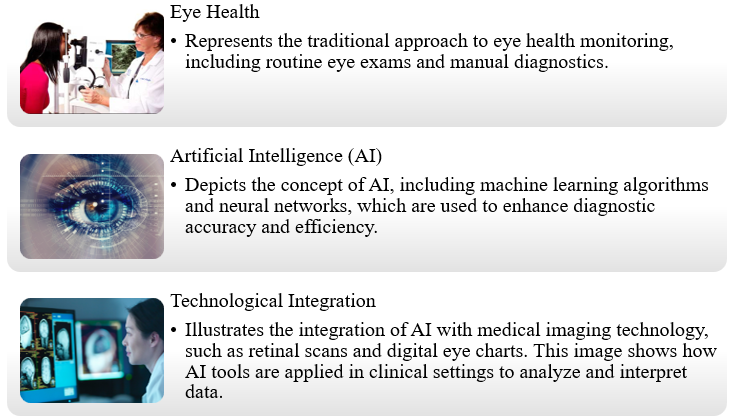
Artificial intelligence (AI) is increasingly being used in the field of healthcare, particularly in ophthalmology, to assist ophthalmologists in providing more accurate and timely diagnoses, which can lead to improved patient outcomes [4]. AI-powered devices can perform automated refraction, analyze structural abnormalities in OCT images, predict disease progression, and even aid in surgical planning and guidance. Additionally, AI tools can offer personalized treatment plans based on an individual’s eye health data, remotely monitor eye health, and cost- effectively facilitate large-scale screening programs for prevalent eye diseases. Detecting and diagnosing vision loss due to diseases like diabetic retinopathy (DR) and age- related macular degeneration (AMD) in its initial stages is crucial. AI-powered screening has proven to be highly effective in identifying these conditions, allowing for timely interventions, and reducing the risk of vision loss [5, 6]. The use of AI algorithms has been greatly beneficial in preventing vision loss and promoting early detection of these illnesses. Figure 1 shows the overview of AI-Powered Eye Health.
Artificial Intelligence (AI) has proven to be a highly efficient and accurate tool for detecting Diabetic Retinopathy
Role of AI in Eye Disease Detection
(DR) and Age-Related Macular Degeneration (AMD) from digital fundus photographs or optical coherence tomography (OCT) images [7]. In the case of DR screening, early identification is crucial, as it is a leading cause of blindness in diabetic patients. Regular screening facilitated by AI models can significantly reduce the risk of visual loss. Furthermore, AI can predict systemic health issues such as chronic kidney disease (CKD) and type 2 diabetes (T2DM) by analyzing fundus images, providing insights into disease progression, and broadening the scope of DR screening [8, 9, 10]. For AMD screening, AI has made significant strides in detecting AMD- related lesions and forecasting disease progression from colour fundus photographs [11, 12]. AI-based segmentation algorithms accurately recognize retinal structures and quantify retinal fluids during follow-up, aiding in treatment assessment and predicting visual outcomes. The application of AI in AMD screening offers substantial benefits for early diagnosis and treatment, enhancing the overall screening and diagnostic process for AMD [13].
AI integration in healthcare and ophthalmology has significantly improved diagnostic accuracy and enabled early disease detection, personalized treatment, remote monitoring, efficient screening, and enhanced diagnostics [14, 15]. AI-powered screening plays a pivotal role in averting vision loss associated with diabetic retinopathy and age- related macular degeneration. These advanced technologies facilitate early detection, precise diagnosis, personalized treatment plans, and efficient disease monitoring, ultimately leading to improved patient outcomes and alleviating the burden of vision impairment and blindness [16, 17].
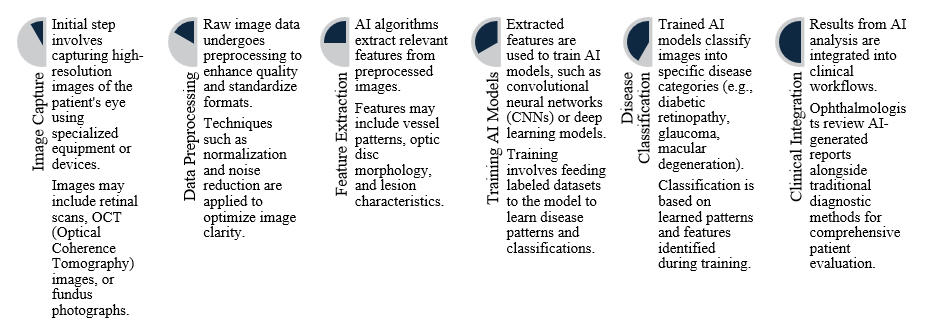
Machine learning and deep learning techniques are used to scan retinas for signs of diabetic retinopathy (DR) and age-related macular degeneration (AMD). These algorithms analyze images for patterns and anomalies to identify these conditions at initial stages [16]. Figure 2 shows AI-based Eye Disease Detection Process.
For DR detection, AI algorithms analyze digital fundus photographs or optical coherence tomography (OCT) images to identify features indicative of DR, such as microaneurysms, haemorrhages, and exudates. These algorithms can classify patients into different risk groups based on the severity of their condition, which can help healthcare professionals make informed decisions about treatment plans and follow-
Advantages of AI in Detecting Subtle Retinal Changes
up care. AI models can also predict systemic health issues like chronic kidney disease (CKD) and type 2 diabetes (T2DM) by analyzing fundus images, expanding the scope of DR screening [18, 19, 20, 21].
In case of AMD, AI-based segmentation algorithms have been developed to accurately recognize retinal structures and detect retinal fluids during follow-up. These algorithms are useful for assessing the integrity of retinal structures, predicting the risk of AMD progression, and assessing treatment responses and factors predicting visual outcomes. AI has facilitated further progress in AMD field by helping to assess treatment responses and factors predicting visual outcomes [21, 22, 23, 24, 25].
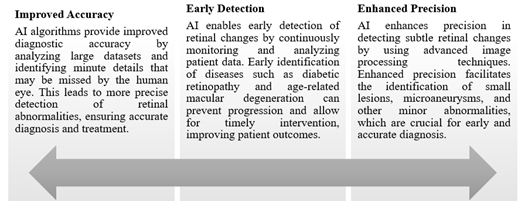
Artificial Intelligence (AI) has transformed the field of ophthalmology by providing high accuracy and efficiency in detecting subtle changes in retinal images that may indicate onset or progression of common eye diseases [26]. Advantages of AI in this field are numerous as shown in Figure 3. Firstly, AI algorithms can analyze retinal scans quickly and accurately, reducing workload of human experts and enabling large-scale screening programs for common eye diseases. Secondly, AI-powered systems can detect subtle changes in eye that may indicate conditions such as diabetic retinopathy or age-related macular degeneration at an early stage, allowing for timely treatment and prevention of vision loss. Thirdly, AI models can predict systemic health issues like chronic kidney disease (CKD) and type 2 diabetes (T2DM) by analyzing fundus images, expanding the scope of DR screening, and providing valuable information for assessing the risk of disease progression. Fourthly, AI-powered devices can create personalized treatment plans based on a patient’s eye health data, improving patient outcomes, and reducing burden of vision impairment and blindness. Lastly, AI tools can enable remote monitoring of eye health, allowing for cost-effective large-scale screening programs for common eye diseases and expanding access to eye care in remote or underserved areas. These benefits of AI in ophthalmology have the potential to alter the way eye health is managed, leading to more personalized care, and improved outcomes for patients [27].
AI technology can detect early signs of diabetic retinopathy (DR) and age-related macular degeneration (AMD) by examining retinal scans. Detecting these conditions early and providing immediate assistance can reduce the risk of losing vision. AI can detect subtle changes in retinal images with high accuracy and efficiency, personalized treatment plans, and remote monitoring. It has several advantages over traditional methods, such as predicting the onset of diseases [28].
Benefits of AI-Powered Screening
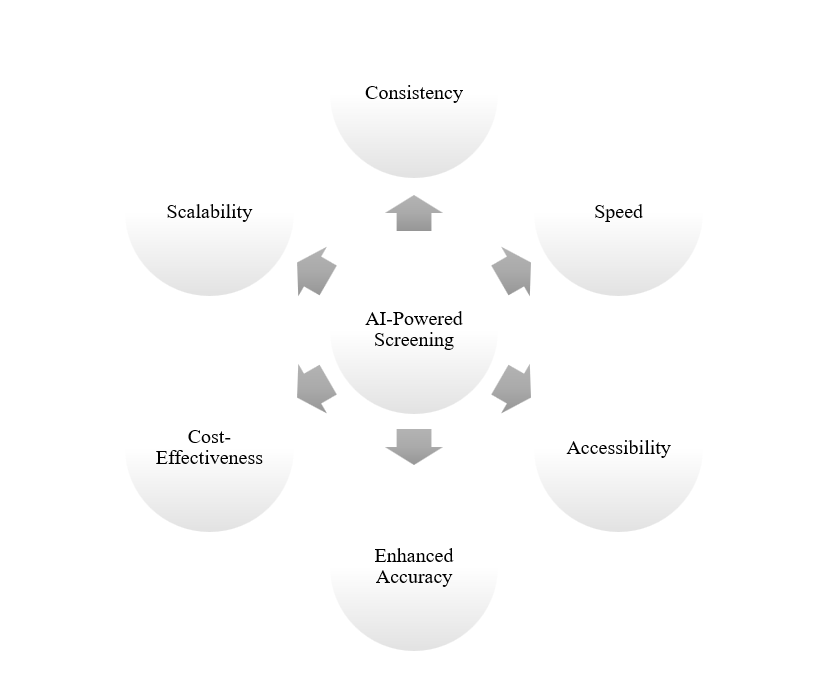
Artificial intelligence (AI) technology can assist in detecting diseases earlier, leading to better patient outcomes, lower healthcare costs, and improved preventive care strategies [29]. In addition, AI algorithms can accurately and quickly examine medical images to identify eye diseases such as diabetic retinopathy (DR) and age-related macular degeneration (AMD). By detecting signs of these diseases at an early stage, healthcare providers can create targeted treatment plans to reduce the likelihood of vision loss and blindness. AI-powered screening can help patients, reduce healthcare costs, and enhance preventive care [30].
Challenges and Future Directions
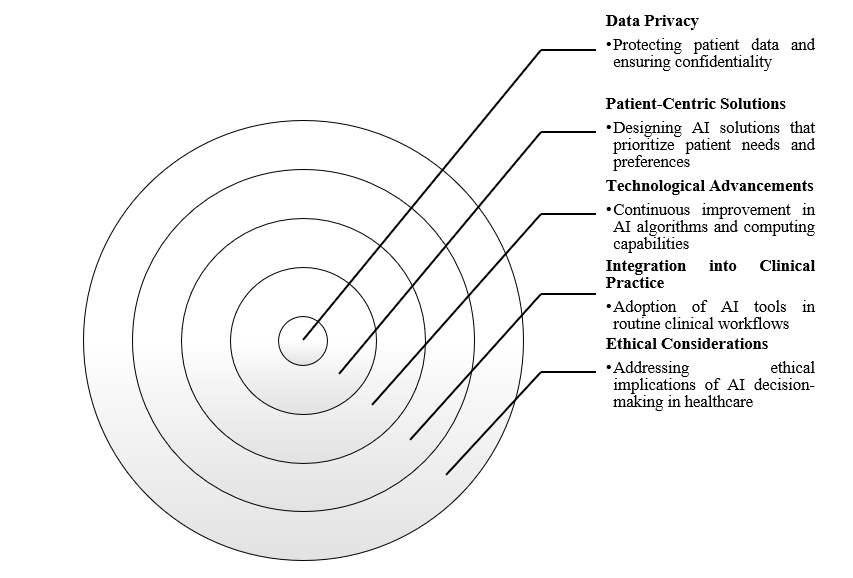
Acknowledging the challenges and limitations of AI in eye disease detection is essential to understand the complexities involved in implementing these technologies effectively.
Some of the key challenges and limitations include: • Data Quality Issues: When using artificial intelligence to detect eye diseases, one of the main challenges is the quality of the data used to train the algorithms. The accuracy and reliability of the AI models depend heavily on the quality, diversity, and quantity of the data available for training. If the datasets used are inadequate or biased, the predictions made by the algorithms may be inaccurate, and this can hinder their performance in detecting eye diseases effectively [31, 32]. • Continuous Algorithm Refinement: AI algorithms need to constantly adapt to new data, changes in disease patterns, and evolving diagnostic criteria. Since eye diseases and the healthcare landscape are constantly changing, AI models need to be updated and improved regularly to ensure they remain effective and relevant. However, this process can be resource-intensive and time-consuming, which makes it challenging to maintain accurate and reliable AI systems for detecting eye diseases [32]. • Interpretability and Transparency: AI can help diagnose eye diseases, but it has limitations. One limitation is that it is hard to understand how the AI makes decisions. Healthcare providers need to trust these technologies and understand how they work. Unfortunately, the lack of transparency in AI algorithms makes it difficult to interpret their decisions. This is a significant challenge for AI-driven healthcare applications, including eye disease detection [33]. • Integration with Clinical Practice: Using AI technologies in clinical practice and workflows has some challenges. These include acceptance, usability, and regulatory compliance. To make the best use of AI tools for patient care, healthcare providers need to be trained in using them effectively. The systems must be seamlessly integrated into the existing healthcare infrastructure. The adoption of AI in eye disease detection requires collaboration between technologists, healthcare professionals, and policymakers [34, 35].
Conclusion
Artificial Intelligence (AI) integration in ophthalmology has significantly improved diagnostic accuracy, enabled early disease detection, personalized treatment plans, remote monitoring capabilities, efficient screening procedures, and enhanced diagnostics. However, challenges such as data quality, continuous refinement, interpretability, and integration with clinical practice must be addressed. Collaboration among technologists, healthcare professionals, and policymakers is imperative to fully realize AI’s potential in eye healthcare, improve patient outcomes, and alleviate the burden of vision impairment and blindness globally.
References
-
Addo E, Bamiro O, Siwale R (2016) Anatomy of the Eye and Common Diseases Affecting the Eye. Ocular Drug Delivery: Advances, Challenges and Applications, pp: 11- 25.
-
Voleti V, Hubschman J (2013) Age-related eye disease. Maturitas 75(1): 29-33.
-
Sait ARW (2023) Artificial Intelligence-Driven Eye Disease Classification Model. Applied Sciences 13(20): 11437.
-
Ting DSW, Pasquale LR, Peng L, Campbell JP, Lee AY, et al. (2018) Artificial intelligence and deep learning in ophthalmology. The British Journal of Ophthalmology 103(2): 167-175.
-
Wang Y, Zhang Y, Yao Z, Zhao R, Zhou F (2016) Machine learning based detection of age-related macular degeneration (AMD) and diabetic macular edema (DME) from optical coherence tomography (OCT) images. Biomedical optics express 7(12): 4928-4940.
-
Skevas C, Weindler H, Levering M, Engelberts J, Grinsven M, et al. (2022) Simultaneous screening and classification of diabetic retinopathy and age-related macular degeneration based on fundus photos-a prospective analysis of the RetCAD system. International journal of ophthalmology 15(12): 1985-1993.
-
Arrigo A, Aragona E, Bandello F (2023) Artificial intelligence for the diagnosis and screening of retinal diseases. Touch reviews in Ophthalmology 17(2): 9-14.
-
Huang X, Wang H, She C, Feng J, Liu X, et al. (2022) Artificial intelligence promotes the diagnosis and screening of diabetic retinopathy. Frontiers in Endocrinology (Lausanne) 13: 946915.
-
Hao S, Liu C, Li N, Wu Y, Li D, et al. (2022) Clinical evaluation of AI-assisted screening for diabetic retinopathy in rural areas of midwest China. PLoS One 17(10): e0275983.
-
Peeters F, Rommes S, Elen B, Gerrits N, Stalmans I, et al. (2023) Artificial intelligence software for diabetic eye screening: Diagnostic performance and impact of stratification. Journal of Clinical Medicine 12(4): 1408.
-
Dong L, Yang Q, Zhang R, Wei W (2021) Artificial intelligence for the detection of age-related macular degeneration in color fundus photographs: A systematic review and meta-analysis. EClinicalMedicine 35: 100875.
-
Bhuiyan A, Wong TY, Ting DSW, Govindaiah A, Souied EH, et al. (2020) Artificial Intelligence to Stratify Severity of Age-Related Macular Degeneration (AMD) and Predict Risk of Progression to Late AMD. Translational Vision Science & Technology 9(2): 25.
-
Dong L, Yang Q, Zhang RH, Wei WB (2021) Artificial intelligence for the detection of age-related macular degeneration in color fundus photographs: A systematic review and meta-analysis. EClinicalMedicine 35: 100875.
-
Huang X, Wang H, She C, Feng J, Liu X, et al. (2022) Artificial intelligence promotes the diagnosis and screening of diabetic retinopathy. Frontiers in Endocrinology 13.
-
Anton N, Doroftei B, Curteanu S, Catãlin L, Ilie OD, et al. (2022) Comprehensive Review on the Use of Artificial Intelligence in Ophthalmology and Future Research Directions. Diagnostics 13(1): 100.
-
Caixinha M, Nunes S (2017) Machine Learning Techniques in Clinical Vision Sciences. Current Eye Research 42(1): 1-15.
-
Balyen L, Peto T (2019) Promising Artificial Intelligence‐ Machine Learning‐Deep Learning Algorithms in Ophthalmology. Asia-Pacific Journal of Ophthalmology 8(3): 264-272.
-
Islam M, Yang H, Poly T, Jian W, Li Y (2020) Deep learning algorithms for detection of diabetic retinopathy in retinal fundus photographs: A systematic review and meta-analysis. Computer methods and programs in biomedicine 191: 105320.
-
Li Y, Yeh N, Chen S, Chung Y (2019) Computer-Assisted Diagnosis for Diabetic Retinopathy Based on Fundus Images Using Deep Convolutional Neural Network. Mob Inf Syst 2019: 1-14.
-
Lakshminarayanan V, Kheradfallah H, Sarkar A, Balaji J (2021) Automated Detection and Diagnosis of Diabetic Retinopathy: A Comprehensive Survey. Journal of Imaging 7(9): 165.
-
Padhy SK, Takkar B, Chawla R, Kumar A (2019) Artificial intelligence in diabetic retinopathy: A natural step to the future. Indian Journal of Ophthalmology 67(7): 1004- 1009.
-
Chen Z, Li D, Shen H, Mo H, Zeng Z, et al. (2020) Automated segmentation of fluid regions in optical coherence tomography B-scan images of age-related macular degeneration. Optics and Laser Technology 122: 105830.
-
Arrigo A, Aragona E, Bandello F (2023) Artificial Intelligence for the Diagnosis and Screening of Retinal Diseases. Touch Reviews in Ophthalmology 17(2): 9-14.
-
Bogunović H, Mares V, Reiter G, Schmidt-Erfurth U (2022) Predicting treat-and-extend outcomes and treatment intervals in neovascular age-related macular degeneration from retinal optical coherence tomography using artificial intelligence. Frontiers in Medicine 9.
-
Schmidt-Erfurth U, Reiter G, Riedl S, Seeböck P, Vogl W, et al. (2021) AI-based monitoring of retinal fluid in disease activity and under therapy. Progress in Retinal and Eye Research 86.
-
Schmidt-Erfurth U, Sadeghipour A, Gerendas B, Waldstein S, Bogunović H (2018) Artificial intelligence in retina. Progress in retinal and eye research 67: 1-29.
-
Anton N, Doroftei B, Curteanu S, Catãlin L, Ilie O, et al. (2022) Comprehensive Review on the Use of Artificial Intelligence in Ophthalmology and Future Research Directions. Diagnostics 13(1): 100.
-
Khan R, Surya J, Roy M, Priya M, Mohan S, et al. (2023) Use of artificial intelligence algorithms to predict systemic diseases from retinal images. Wiley Interdisciplinary Reviews Data Mining and Knowledge Discovery 13(5): e1506.
-
Yu K, Beam A, Kohane I (2019) Artificial Intelligence in Healthcare. Artificial Intelligence and Machine Learning for Business for Non-Engineers. Routledge, UK, pp: 164.
-
Iqbal U, Celi L, Li Y (2020) How Can Artificial Intelligence Make Medicine More Preemptive. Journal of Medical Internet Research 22(8): e17211.
-
Han JH (2022) Artificial Intelligence in Eye Disease: Recent Developments, Applications, and Surveys. Diagnostics (Basel) 12(8): 1927.
-
Nuzzi R, Boscia G, Marolo P, Ricardi F (2021) The Impact of Artificial Intelligence and Deep Learning in Eye Diseases: A Review. Frontiers in Medicine 8: 710329.
-
Dong L, Yang Q, Zhang R, Wei W (2021) Artificial intelligence for the detection of age-related macular degeneration in color fundus photographs: A systematic review and meta-analysis. EClinicalMedicine 35: 100875.
-
Sait ARW (2023) Artificial Intelligence-Driven Eye Disease Classification Model. Applied Sciences 13(20): 11437.
-
Dutt S, Sivaraman A, Savoy F, Rajalakshmi R (2020) Insights into the growing popularity of artificial intelligence in ophthalmology. Indian J Ophthalmol 68(7): 1339-1346.
- Screening of Hospital Staff During World Glaucoma Week in a Tertiary Eye Care Centre
- Angioid Streaks with Macular Neovascularization: Clinical Insights from Two Cases
- Giant Kissing Naevus: An Oculoplastic Challenge
- Why Freedom of Vision Should Not Cost the Freedom of Feeling - LASIK in the Climate of Change
- Asymmetric Optic Nerve with Small Disc and Large Cup: A Rare and Challenging Case of Unilateral Optic Nerve Hypoplasia
- Large Angle Exotropia in a Child: A Case Report