
Post Obstruction Diuresis: A Clinical Diagnosis, you don’t have to Miss it
Post-obstructive diuresis (POD) is a specific entity which may occur post catheterization and is a rare but potentially lifethreatening condition if not recognized and managed appropriately. However, prolonged bilateral ureteral obstruction (BUO) can cause severe structural and functional tubular damage. Complications that may arise: volume depletion, hyponatremia/ hypernatremia, hypokalemia, hypomagnesaemia, metabolic acidosis, hypovolemic shock and death
Introduction
Post-obstructive diuresis (POD), defined as urine output of 200 mL/hr for two consecutive hours or >3L/24hours, is a polyuric response initiated by the kidneys after the relief of a ureteral obstruction to eliminate accumulated solute and volume. POD occurs in 0.5% to 52% of patients with relief of bilateral ureteral obstruction (BUO) and is usually self- limited [1]. There are two types of OPD:
Physiological POD
Temporary and self-limited to 24 hours or less, expected- response diuresis, necessary to normalize fluid volume and excess solutes.
Pathological POD
Dangerous and typically lasts 48 hours or longer, because of obligatory loss of salt and water continues long beyond a homeostatic state.
A 47-year-old man was urgently presented to me in our Emergency department with history of bilateral flank and suprapubic pain for 2 days duration associated with dysuria and difficulty to pass urine. His past medical history was unknown since he just arrived to UAE couple days ago. He denies any symptoms other than passing only 250 mL of urine during the previous 48 hours. On examination, his abdomen was distended, with the top of the bladder palpable midway between the umbilicus and the xiphoid process. Further, an examination of his external genitalia revealed normal.
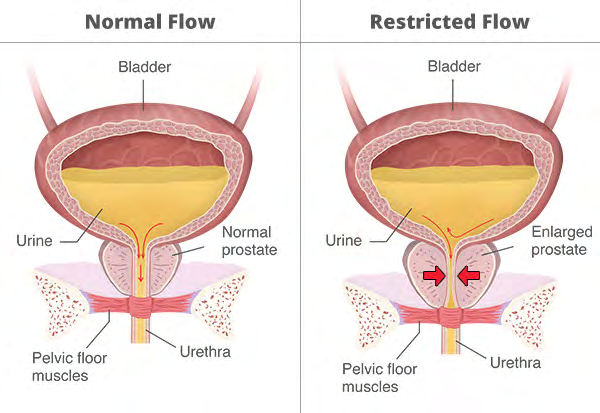
An abdominal CT imaging confirmed acute urinary retention with over distended urinary bladder of average estimated volume (1600ml) with bilateral mild backup pressure changes, prostate is mildly enlarged and homogenous. Immediately a no. 16 French gauge urinary catheter was inserted. The patient drained 4200 mL of urine over 2.5 hours. Arrangements were made to admit the patient to the hospital under the care of urologist on call to further monitor urine output, hydration status, and serum electrolyte levels. On admission, his serum electrolyte and glucose levels were normal, with serum creatinine and urea levels elevated to 133 µmol/L and 85 µmol/L, respectively (Figure 1). The patient’s course in hospital was unremarkable, his urine output remained below 200 mL per hour, and his serum electrolyte levels remained within normal limits (Table 1). The patient was discharged 24 hours later with a catheter in situ with course of antibiotics and tamsulosin tablet for his symptomatic benign prostatic hypertrophy- BPH.. A follow up appointment in Outpatient clinic was given.
Urinary Retention
Acute Urinary Retention (AUR)
Rapid-onset condition associated with suprapubic pain and the inability to urinate.
Chronic Urinary Retention (CUR)
Gradual onset, with no associated pain and the ability to pass only small amounts of urine.
| Category | Common uses of urinary retention |
| Obstructive | Benign prostatic hyperplasia, prostate cancer, gynecological mass, bladder stones, fecal impaction, vaginal prolapse |
| Infection/Inflammation | Urinary tarct infection, prostatic abcess, acute vulvovaginitis |
| Neurologic | Cauda equina syndrome, cord compression transverse myelitis, spinal cord trauma, multiple sclerosis |
| Medications | Tricyclic, antidepressants, antipsychotics(ex. Haldol), opioids, diphenhydramine, ephedrine, NSAIDs, drugs with anticholinergicactivity |
Table 1: Common causes of urinary retention.
The incidence of urinary retention is higher in men than in women and increases with age. It is estimated that 1 in 10 men between the ages of 70 and 79 and 3 in 10 men between the ages of 80 and 89 will have an episode of AUR within their lifespans [2].
There are currently no universally accepted diagnostic values for a normal post void residual volume, but it has been reported that AUR is associated with a residual urine volume of 500 to 600 mL, whereas CUR is associated with a volume of greater than 800 ml. Commonly, patients with CUR present with 1.0 L to 1.5 L of retained urine, with some case reports noting volumes greater than 4 L [3, 4].
Mechanism of POD
Following relief of urinary tract obstruction UTO, there is usually a resultant increase in sodium and water excretion even with the temporary decrease in glomerular filtration rate. This is because the volume expansion that occurs during UTO suppresses antidiuretic hormone (ADH) and aldosterone, leading to minimal reabsorption at the distal and collecting duct level until volume depletion sets in to re-establish reabsorption. It is usually self-limiting and can be a composite of both solute (urea and sodium) and water diuresis. Nevertheless, some patients will continue to eliminate salt and water even after homeostasis has been reached [5], a condition referred to as pathologic post obstructive diuresis (POD). These patients are at risk of severe dehydration, electrolyte imbalances, hypovolemic shock, and even death if not recognized and treated promptly. Patients with pathologic POD require strict monitoring of fluid status and serum electrolyte levels. Intravenous fluid replacement is often warranted and the type and amount of fluids should be tailored to the patient’s serum electrolyte levels and clinical hydration status.
Pathologic POD is estimated to occur in 0.5% to 52% of patients who underwent relief of obstruction [6]. Animal experiments have shown that, in POD, solute and water dynamics alone are inadequate to fully account for the natriuresis and diuresis that follows obstruction relief [7].
Using micro puncture and microinjection methods McDougal, et al. demonstrated that there are defects in both proximal and distal sodium reabsorption that persist for 2-3 days after obstruction relief [8].
In addition, the decrease in water reabsorption in POD has been postulated to be due to a decrease in sodium chloride (NaCl) gradient in the thin ascending loop of Henle. This in turn is brought on by decreased NaCl reabsorption in the medullary ascending limb, caused by increased prostaglandin synthesis. Prostaglandins increase blood flow within the vasa recta, thus facilitating solute washout from the medulla, diluting the countercurrent effect. The increased medullary prostaglandins also antagonize the effect of ADH, thereby reducing the water permeability of the collecting tubule, contributing to the decrease in urine osmolality [9].
Another important cause of morbidity in the patient whose UTO has been relieved is rapid lowering of plasma osmolality, leading to rapid water transfer into the central nervous system, resulting in cerebral edema. Symptoms of this disequilibrium syndrome can range from lethargy, headache, drowsiness, and confusion to serious complications such as seizures, cardiac arrhythmias, coma, and pulmonary edema [10].
Management
Foley’s catheter insertion as first line to complete relief of urinary tract obstruction. There are no studies supporting the practice of gradual emptying of the obstructed bladder. The available published studies support quick, complete emptying for relief of the obstructed urinary bladder [6].
Hospitalization for at least 24 hours for those patients who are at higher risk of developing pathological POD:
- Close monitoring of urine output every 2 hours and electrolytes every 12 hours
- Allow oral access of water for drinking and encourage those patients who are unable to eat and drink on their own as a big challenge.
- Daily weights
- Urine sample for urine osmolality, sodium and potassium
- Intravenous (IV) fluid support should be 0.45% normal saline and limited to no more than 75% of the prior 1 to 2-hour urine production to avoid stimulation of further diuresis [11].
Conclusion
Post obstructive diuresis is a clinical diagnosis based on urine output after decompressing an obstructed bladder or ureter. Normal maximum bladder capacity is about 450 cc to 500 cc. Post obstructive diuresis is not typically an issue unless the residual urine is 1,500 cc or more. Physicians whether in primary care, emergency or inpatient wards aware of POD will be able to identify patients at risk and arrange the appropriate monitoring after relieving a urinary obstruction. Early diagnosis and management of pathologic POD will prevent mortality. Please remember my take home message, especially as you are generally the first to encounter and treat these patients. Don’t miss the guidelines of diagnosis before sending the patient home after relieving any urinary retention.
References
-
Singh A, Dass B, Ejaz A, Atul B (2019) Post-obstructive Diuresis: A Cautionary Tale. Cureus 11(12): e6328.
-
Muhammed A, Abubakar A (2012) Pathophysiology and management of urinary retention in men. Arch Int Surg 2(2): 63-69.
-
Kaplan SA, Wein AJ, Staskin DR, Roehrborn CG, Steers WDJ (2008) Urinary retention and post-void residual urine in men: separating truth from tradition. Urol 180(1): 47-54.
-
Mitchell JP (1984) Management of chronic urinary retention. Br Med J (Clin Res Ed) 289(6444): 515-516.
-
Maher JF, Schreiner GE, Waters TJ (1963) Osmotic diuresis due to retained urea after release of obstructive uropathy . The New England Journal of Medicine 268(20): 1099-1104.
-
Nyman MA, Schwenk NM, Silverstein MD (1997) Management of urinary retention: rapid versus gradual decompression and risk of complications. Mayo Clinic Proceedings 72(10): 951-956.
-
Harris RH, Yarger WE (1975) The pathogenesis of post obstructive diuresis. The role of circulating natriuretic and diuretic factors, including urea. The Journal of Clinical Investigation 56(4): 880-887.
-
McDougal WS, Wright FS (1972) Defect in proximal and distal sodium transport in post-obstructive diuresis. Kidney International 2(6): 304-317.
-
Kinter LB, Dunn MJ, Beck TR, Beeuwkes R, Hassid A (1981) The interactions of prostaglandins and vasopressin in the kidney. Annals of the New York Academy of Sciences 372: 163-179.
-
Rosen SM, O’Connor K, Shaldon S (1964) Haemodialysis disequilibrium. British Medical Journal 2(5410): 672- 675.
-
Leslie SW, Sajjad H, Sharma S (2021) Post obstructive Diuresis, Last Update.
- Results of 6-Month Follow-Up of Patients After B-Turp and Thulep
- The Effect of Drinking Water with a High Content of Antimony and Arsenic on the Dynamics of their Distribution in the Kidneys and the Renal Excretory Function in Rats
- Effectiveness and Safety of Tansurethral Thulium Laser Enucleation of the Prostate in the Treatment of BPH: Review
- A Systematic Review on Molecular Pathophysiology Involved in Chronic Kidney Disease and the Role of Animal Models in Drug Discovery to Manage in Chronic Kidney Disease - An Update
- Functional Development of Kidneys in Human Ontogenesis
- Testicular Metastasis: Uncommon Prostate Cancer Case Report