
Assessment of pH of Fermented Camel and Buffalo Milk by Using Lactobacillus Fermentum and Lactobacillus Helveticus as Starter Culture at Different Time Interval
The aim of this study was to assess the periodical evaluation of pH of fermented camel and buffalo milk collected at weekly interval for period of 2 months from camel dairy maintained at ICAR-NRC on Camel, Bikaner(Rajasthan),India and buffaloes maintained under the project “Establishment of live demonstration models of diversified livestock production systems for motivating adaption to enhancing agricultural income (RKVY-15)” CVAS, RAJUVAS, Bikaner(Rajasthan),India respectively .The samples were inoculated with Lactobacillus fermentum NC DC 214 (L. fermentum) and Lactobacillus helveticus NCDC 288 (L. helveticus) cultures @ 1% in both pasteurized camel and buffalo milk and after proper mixing the samples were drawn at 0, 2, 4, 6, 8, 10, 12 hours and were subjected to analyse, for change in pH. The results of present study revealed a highly significant (P
Introduction
Camel milk is unique in terms of having low fat (1.5- 3%), low protein (2.5%), have longer shelf life, higher ratio of ß-casein to k-casein, absence of Lysozyme-C and ß-lactoglobulin and presence of Whey Acidic Protein and Peptidoglycan Recognition Protein. Fresh and fermented camel milk is an important nutritional and functional source. Normal camel milk has a very white colour and is foamy [1]. The taste of camel milk is usually sweet, when camels are fed on green fodder, but sometimes salty, due to feeding on certain shrubs and herbs in the arid regions [1, 2]. The one-humped camels (Camelus dromedarius) are well-known producers of milk which differs from bovine milk in the composition and structure of its protein content and thus has different functional and medicinal properties. Due to high peroxidase activity, buffalo milk can be preserved naturally for a longer period. Buffalo milk contains more calcium, better calcium: phosphorous ratio and less sodium and potassium than in cow milk which makes it a better nutritional supplement for infants. As the pH is the most common of all analytical measurements in milk processing and since it is a direct measure of acid content [H+] and plays an important Open Access Journal of Veterinary Science & Research
role in milk and milk product processing. Among the reasons for measuring pH include: to produce products with consistent well defined properties, to efficiently produce products at optimal cost ,to avoid causing health problems to consumers, to meet regulatory requirements. Keeping in view the aforesaid facts, the present investigation has been planned to assess the pH of camel and buffalo milk during fermentation by lactic acid bacteria (LAB); Lactobacillus fermentum and Lactobacillus helveticus
Material and Methods
Collection of Samples
About 2 liter of fresh camel milk collected from camel dairy maintained at ICAR-NRC on Camel, Bikaner(Rajasthan) and about 2 liter of fresh buffalo milk collected from buffaloes maintained under the project “Establishment of live demonstration models of diversified livestock production systems for motivating adaption to enhancing agricultural income (RKVY-15)” CVAS, RAJUVAS, Bikaner(Rajasthan) at weekly interval for period of 2 months to perform periodical evaluation of pH of fermented camel and buffalo milk by using Lactobacillus fermentum and Lactobacillus helveticus.
Periodical Evaluation of Fermented Camel and Buffalo Milk
For study of periodical evaluation of pH of fermented camel and buffalo milk, about 2 liter of Fresh camel and 2 liter of fresh buffalo milk were skimmed to bring the fat contents to below 0.5% using cream separator after determination of its physico chemical properties. Camel and buffalo milk were heated to boil at least for 5 min to inactivate/kill the inherent microbial population present in milk, separately for the process of pastuerization. Then after cooling of milk at room temperature, Lactobacillus fermentum NCDC 214 (L. fermentum) and Lactobacillus helveticus NCDC 288 (L. helveticus) cultures were inoculated @ 1% in both pasteurized camel and buffalo milk and after proper mixing the samples were drawn at 0, 2, 4, 6, 8, 10, 12 hours and were inoculated at 37°C for different time intermission and subjected to analysed for change in pH.
pH Measurement
The pH of samples was measured using combined glass electrode of Milkoscan at camel milk research laboratory, ICAR-NRC on Camel, Bikaner (Rajasthan), India.
Results and Discussion
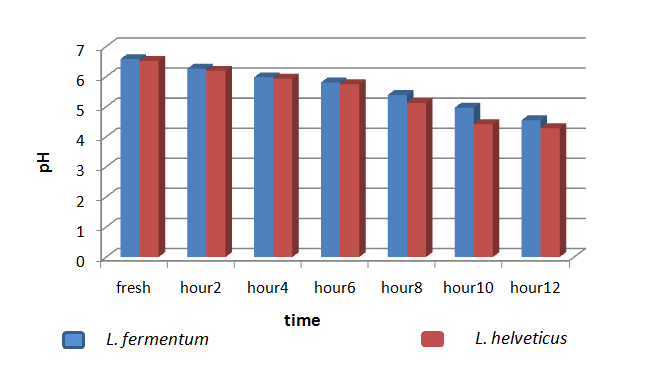
| Treatment | L. fermentum | L. helveticus | Overall | |
| Fresh | 6.58±0.020 | 6.52±0.006 | 6.55g±0.015 | |
| Hour2 | 6.26±0.010 | 6.19±0.002 | 6.22f±0.010 | |
| Hour4 | 5.97±0.006 | 5.93±0.005 | 5.95e±0.008 | |
| Hour6 | 5.80±0.007 | 5.74±0.003 | 5.77d±0.009 | |
| Hour8 | 5.39±0.006 | 5.12±0.003 | 5.25c±0.040 | |
| Hour10 | 4.97±0.005 | 4.42±0.003 | 4.69b±0.080 | |
| Hour12 | 4.55±0.004 | 4.28±0.003 | 4.42a±0.030 | |
| Overall | 5.64b±0.100 | 5.46a±0.120 | 5.55±0.080 | |
| Source of variation | D.F. | Mean Square | Level of sig. | |
| Treated bacteria | 1 | 0.74 | ** | |
| Hour | 6 | 7.55 | ** | |
| Remainder | 76 | 0.0086 |
Table 1: pH (Mean ± SE) of camel milk during fermentation.
Note – Means bearing different superscripts differ significantly. Table 1: pH (Mean ± SE) of camel milk during fermentation.
Bais B, et al. Assessment of pH of Fermented Camel and Buffalo Milk by Using Lactobacillus Fermentum and Lactobacillus Helveticus as Starter Culture at Different Time Interval. J Vet Sci Res 2017, 2(4): 000140.
Copyright© Bais B, et al.
Open Access Journal of Veterinary Science & Research
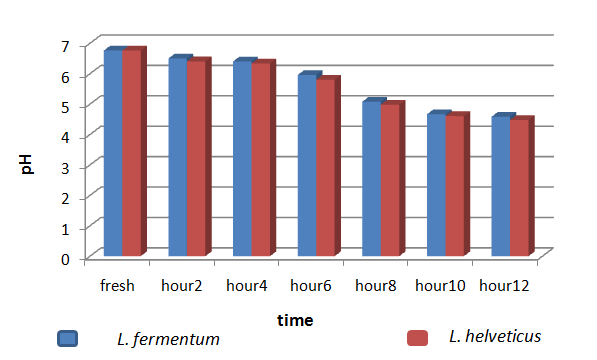
** = Significant at 1% (P<0.01) Table 1(a): Analysis of variance for pH of camel milk during fermentation. The data related to pH of buffalo milk has been presented in Table 2 and depicted in figure 2. The pH of fresh milk has found to be same both for L. fermentum and L. helveticus 6.76 ± 0.007 before inoculation of treated bacteria.
The value of pH was dropped significantly as the fermentation hour were increased and at 12 hour of fermentation it was observed to be 4.58 ± 0.006 and 4.48 ± 0.005 for L. fermentum and L. helveticus respectively whereas the overall pH was 5.70 ± 0.130 and 5.62 ± 0.130 for L. fermentum and L. helveticus respectively. The statistical analysis of data as shown in Table 2a revealed that there was a highly significant (P<0.01) decrease in the pH value of buffalo milk samples with advancement of fermentation hours as well as between the treated bacteria that is L. fermentum and L. helveticus as reported by Karleskind et al. [6].
| Treatment | L. fermentum | L. helveticus | Overall |
| Fresh | 6.76±0.007 | 6.76±0.007 | 6.76g±0.005 |
| Hour2 | 6.50±0.004 | 6.40±0.005 | 6.46f±0.015 |
| Hour4 | 6.40±0.005 | 6.33±0.004 | 6.37e±0.010 |
| Hour6 | 5.95±0.004 | 5.80±0.008 | 5.88d±0.020 |
| Hour8 | 5.08±0.007 | 4.98±0.040 | 5.03c±0.020 |
| Hour10 | 4.66±0.006 | 4.60±0.004 | 4.63b±0.009 |
| Hour12 | 4.58±0.006 | 4.48±0.005 | 4.53a±0.010 |
| Overall | 5.70b±0.130 | 5.62a±0.130 | 5.66±0.090 |
Table 2: pH (Mean ± SE) of buffalo milk during fermentation.
Note – Means bearing different superscripts differ significantly. Table 2: pH (Mean ± SE) of buffalo milk during fermentation.
| Source of variation | D.F. | Mean Square | Level of sig. | ||||||||
|---|---|---|---|---|---|---|---|---|---|---|---|
| Treated bacteria | 1 | 0.14 | ** | ||||||||
| Hour | 6 | 10.21 | ** | ||||||||
| Remainder | 76 | 0.00165 |
** = Significant at 1% (P<0.01) Table2a: Analysis of variance for pH of buffalo milk during fermentation.
Bais B, et al. Assessment of pH of Fermented Camel and Buffalo Milk by Using Lactobacillus Fermentum and Lactobacillus Helveticus as Starter Culture at Different Time Interval. J Vet Sci Res 2017, 2(4): 000140.
Copyright© Bais B, et al.
Open Access Journal of Veterinary Science & Research
Conclusion
From the results of present study it may be concluded that during fermentation process there was a highly significant (P<0.01) decrease in the pH value of camel and buffalo milk samples with advancement of fermentation hours as well as with treated bacteria that is L. fermentum and L. helveticus.
References
-
El-Agamy EI (1983) Studies on camel’s milk. Alexandria University, Egypt: M.Sc Thesis.
-
El-Agamy EI (1994) Camel colostrum. Antimicrobial factors. In Proceedings of the Workshop on Camels and Dromedaries as Dairy Animal, Nouakshott, Mauritania, pp: 24-26. Bais B, et al. Assessment of pH of Fermented Camel and Buffalo Milk by Using Lactobacillus Fermentum and Lactobacillus Helveticus as Starter Culture at Different Time Interval. J Vet Sci Res 2017, 2(4): 000140.
-
Minieri LG, de. Franciscis, Intrieri F (1965) Relationship between pH, acidity and composition of buffalo milk. Dairy Sci Abstr 28: 1676
-
Attia H, Kerouatou N, Dhouib A (2001) Dromedary milk lactic acid fermentation: Microbiological and rheological characteristic. J of Industrial Microbiol and Biotech 26: 263-270.
-
Sulieman AMEH, Ilayan AA, Faki AEAE (2006) Chemical and microbiological quality of Garris, Sudanese fermented camel's milk product. International journal of food sci and tech 41(3): 321-328.
-
Karleskind D, Laye I, Morr FV (1993) Chemical, biological and sensory properties of plain non-fat yoghurt. J Food Sci 58: 991-995. Copyright© Bais B, et al.
- The Digital Stethoscope: Harnessing AI in Veterinary Medicine Without Losing Our Healing Touch
- Meningoencephalomyelitis of Unknown Etiology: Short-Term Effect of Two Treatment Protocols on Cerebrospinal Fluid
- Safety and Efficacy of the HomeoPet Cough in Domestic Pets –A Clinical and Correction Analysis Based Upon User Response Survey
- Non Human Animals Responses to Social Loss
- Owner Reported Clinical Outcomes of a Homeopathic Proprietary Preparation for the Treatment of Upper Respiratory and Nasal Disorders in Companion Animals
- Effects and Diagnostic Approach of Ultrasound in Veterinary Practice: A Systematic Review