
Quantitative Detection of Aflatoxin M1, Ochratoxin and Zearalenone in Fresh Raw Milk of Cow, Buffalo, Sheep and Goat by UPLC XEVO -TQ in Dakahlia Governorate, Egypt
Animals’ derived food as milk is highly nutritive food for human and substitute mother’s milk for children especially after 6 months. To better produce and maintain safe milk and milk product, Ultra Performance Liquid Chromatography XEVOTQ (UPLC) used to monitor mycotoxins as aflatoxin, ochratoxin and zearalenone levels in fresh raw milk of dairy domestic animals. AFL-M1 was detected in all samples in cow, buffalo, sheep and goat milk with different concentration ranged from high, medium and very low with mean 906, 811.1, 1394.86 and 1183.68ng/L respectively. According worldwide standard for aflatoxin M1 level in milk as EC and according US FDA Limit, all samples of raw milk exceed this limit up to 100ng /l while 50%, 80, 90 and 60% exceed US FDA Limit. Notably, the Egyptian raw milk is free from ochratoxin and zearalenone mycotoxin. Taken collectively, strict strategies should be taken to reduce level of aflatoxin in raw milk between producer and consumer and so reduce risk of adverse effect on health.
Rania M Kamal1, Mohamed A Mansour1, Mahmoud M Elalfy2* and Walaa R Galala1
veterinary medicine, Mansoura University, Egypt, Email: dr_melalfym@mans.edu.eg raw milk between producer and consumer and so reduce risk of adverse effect on health.
Keywords: Aflatoxin M1; Ochratoxin; Zearalenone; Fresh Raw Milk
Introduction
Consumption of contaminated food leads to acute or chronic toxicity in animals and human, which accompanied by many adverse effects on the cardiovascular, central nervous, gastrointestinal and pulmonary systems and may be carcinogenic, teratogenic and immunosuppressive effects [1]. There is also an eminent hazard on human health from the ingestion of animal derived foods such as milk which have mycotoxins residues or their metabolites [2]. Aflatoxins are classified as food contaminant and some of their metabolites enhanced genotoxicity and carcinogenic potential. Therefore, understanding the hazardous effect of mycotoxins on human, has led to the necessity of Open Access Journal of Veterinary Science & Research
development of new strategies to reduce the aflatoxins exposure for human [3, 4].
Aflatoxins are exo-secreted metabolites produced by Aspergillus flavus and Aspergillus parasiticus which can be found in a wide range of food and feed. Due to the known harmful potential of these toxins to human and animals, legal limits have been set in many countries. European Commission (EC) has established a maximum acceptable level of aflatoxin M1 (AFM1) in milk to be 50ng/L [5, 6]. The contaminated feed is the main source for mycotoxins infestation of farm animals. Oral intake of fungal metabolites with feed results in a negative impact on all relevant parameters of animal production. Moreover, under experimental conditions, mycotoxins and/or their metabolites can be traced in milk [7]. Additionally, Ellis, et al. [8] estimated that factors such as season, time consumption and improper handling of food can be involved in the presence of AFM1 in milk. In addition, the amount of AFM1 in the rainy season is greater than the dry season. Aflatoxin M1 can be found in animal milk within 12-24h after the first ingestion of aflatoxin B1 (AFB1) and can last up to 3 days after the last ingestion of the mycotoxin. The rate between the amount of AFB1 ingested by the animal and the quanitity excreted in milk is usually 0.2 to 4% (Henry et al., 2001).
Ochratoxin A (OTA) is a secondary metabolite produced by many species of Aspergillus and Penicillium fungi. OTA is also one of the harmful mycotoxins that posed a threat to animal and human health [9, 10, 11]. Notably, dietary exposure to OTA may have association with endemic nephropathy, a chronic progressive hypercreatinemia, uremia, hypertension and oedema and considered carcinogenic to human [12, 13]. Zearalenone (ZEA) is a secondary metabolite secreted by several species of Fusarium fungi, mainly F. graminearum and F. culmorum. These species are known to grow on maize, barley, oats, wheat and sorghum. Both human and animal exposure comes from chronic ingestion of contaminated- food. In addition, human exposure can be direct via cereals or indirect via animal products [14]. ZEA and its metabolites can be excreted into milk, but levels are very low, and often remain below the limit of quantification [15]. ZEA has a pronounced estrogenic action and numbers of animals are susceptible to it. It has been stated that zearalenone may stimulate growth of cells with estrogenic receptors in human mammary gland. It is so supposed that zearalenone may lead to breast cancer in human being.
In the view of aforementioned hazardous effects of these toxins, the current study was planned to evaluate the occurrence and concentration of mycotoxins in fresh raw milk of different species at Dakahlia Governorate, Egypt.
Materials and Methods
Collection of the Samples
A total of 120 raw milk samples, (30 each of cow, buffalo, sheep and goat) were randomly collected from Aga City, Dakahlia Governorate, Egypt at winter season, 2017. Each sample was subjected to aflatoxin, ochratoxin and zearalenone analysis using Ultra Performance Liquid Chromatography XEVO-TQ (UPLC). The collected samples were transferred to laboratory in clean, dryand tightly closed bottles and kept in ice box.
Extraction of Mycotoxins from Raw Milk
All chemicals used were of HPLC grade (Sigma Aldrich, Cairo). Extraction of mycotoxins was done by disposable column c18 which was cleaned firstly by 10 ml of methanol followed by 10 ml of milli-Q water. 20 ml of fresh raw milk diluted with 30 ml of Milli-Q water was loaded into the column. After loading, the column was washed with 10 ml of Milli-Q water and dried by 10 ml hexane. The column c18 was then dried before elution [16]. 8 ml of Acetonitrile (ACN) was added to extract mycotoxins according to the method described by Huang, et al. [17]. The whole mixture was vortexed for 2 min by using Vortex-Genie 2 and then kept in an ultrasonic bath for 30 min. Finally, the mycotoxin extracts were centrifuged with cooling at 4°C, 12,000 RPM for 10 min and the supernatant was separated. The total supernatant was concentrated until 2 ml by evaporation at 50 °C under a nitrogen stream. The concentrated supernatant was mixed with 4 ml of milli-Q water and the pH was adjusted up to 5.0 ± 0.2. Preparations of standard combined stock solution: The standard stock solutions of (300, 500 and 700 ng/L) of each AFM1, OTA and ZEA (Sigma Aldrich-Cairo) were prepared in methanol. The combined standard solution was prepared by taking 1 ml of each stock solution of 300, 500 and 700 ng/L of AFM, OTA and ZEA to 97 ml of methanol/water (50/50 v/v) in a volumetric flask, followed by further dilution with high purity methanol up to a final volume of 100 ml. Each individual mycotoxin stock and the combined mixtures of standard solutions were stored at -20°C before use.
Open Access Journal of Veterinary Science & Research
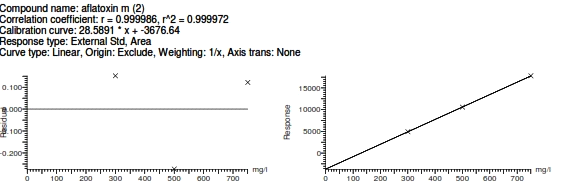
Quantitative Detection of Mycotoxins Level By Ultra Performance Liquid Chromatography (Acquity Uplc - Xevo Tq Ms System)
- Equipment: ACQUITY UPLC - Xevo TQ MS system (MS/MS Detector) (UPLC XEVO apparatus modules):
- Quaternary high-pressure pump with 1500 psi (Waters Company USA).
- Auto sampler, Wither cooling sensor (Waters Company USA).
- Column manger (Waters Company USA).
- Software Math lynx for data analysis (Waters company USA).
- MS/MS XEVO with Photomultiplier detector.
The Mobile Phase was a Mixture of
- 2mm ammonium acetate solution.
- 0.1% formic acid.
- Water.
- Methanol HPLC Grade.
UPLC Columns
- Packed with very fine particles (stationary phase)
- The separation was done hypersil gold™ C18 (1.7µm,
2.1×100mm), HLB Waters company, with mobile phase as described and flow rate was 0.4 ml/min. • Syringe filter: PTF membrane pore size 0.45mm.
Chemicals
- Methanol (HPLC grade, Sigma Aldrich, Cairo).
- Acetonitrile (HPLC grade, Sigma Aldrich, Cairo).
- Formic acid (85%) (Pure reagent for analysis, EL- Nasser Pharmaceutical Chemicals Company prepared as 0.1%.
• Ammonium acetate solution.
Chromatographic Conditions
Mobile phase (A) of 2 mM ammonium acetate with 0.1% formic acid in water. mobile phase (B) of 2 mM ammonium acetate with 0.1% formic acid in methanol with flow rate 0.4 ml/min, injection volume 50µl with mix gradient elution of two mobile phase.
| Time (min) | A | B | ||||||
|---|---|---|---|---|---|---|---|---|
| 0 | 90% | 10% | ||||||
| 3 | 90% | 10% | ||||||
| 10 | 30% | 70% | ||||||
| 10.1 | 10% | 90% | ||||||
| 12 | 10% | 90% | ||||||
| 12.1 | 90% | 10% |
Table 1: Chromatographic Conditions.
Gradient
- Detection was done with Xevo MS/MS with Photomultiplier detector. While, the quantification of residues in sample was obtained and calculated from area under curve, extrapolated automatically by software (math lynx).
- MS Conditions
- MS System: Acquity Xevo Tp
- Ionization mode: ESl+
- Desolvation Temp: 600 °c
- Capillary Voltage: 0.8 KV
Open Access Journal of Veterinary Science & Research
Statistical Analysis
• One-way ANOVA was adopted in this study. Mean ±
standard error of mean (SEM) and descriptive analytical parameters were calculated [18]. Computerized SPSS program version 13 was used in the evaluation of data.
Results and Discussion
Safety of animal derived food as milk should monitor from time to time to ensure freedom form mycotoxins or compliance with the established standard limit in by Egyptian regulations and different organizations and countries.
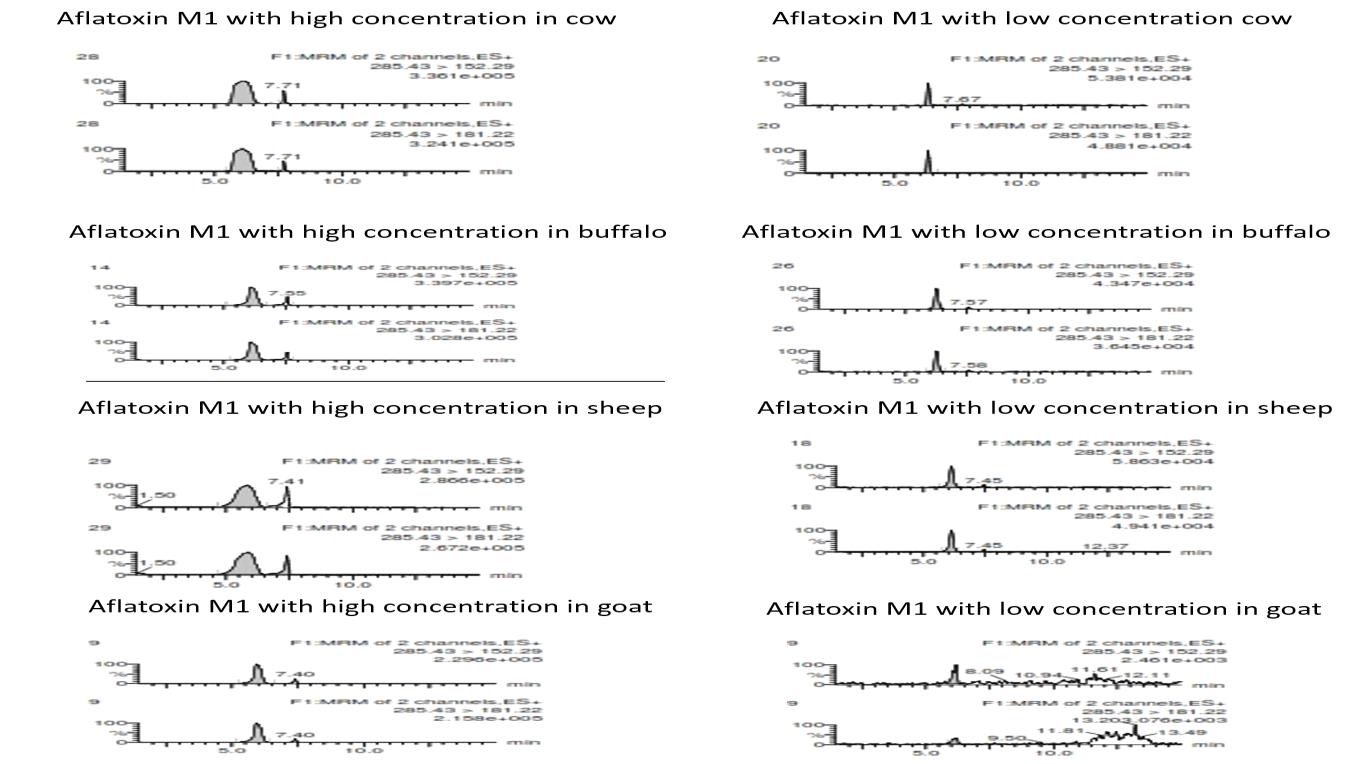
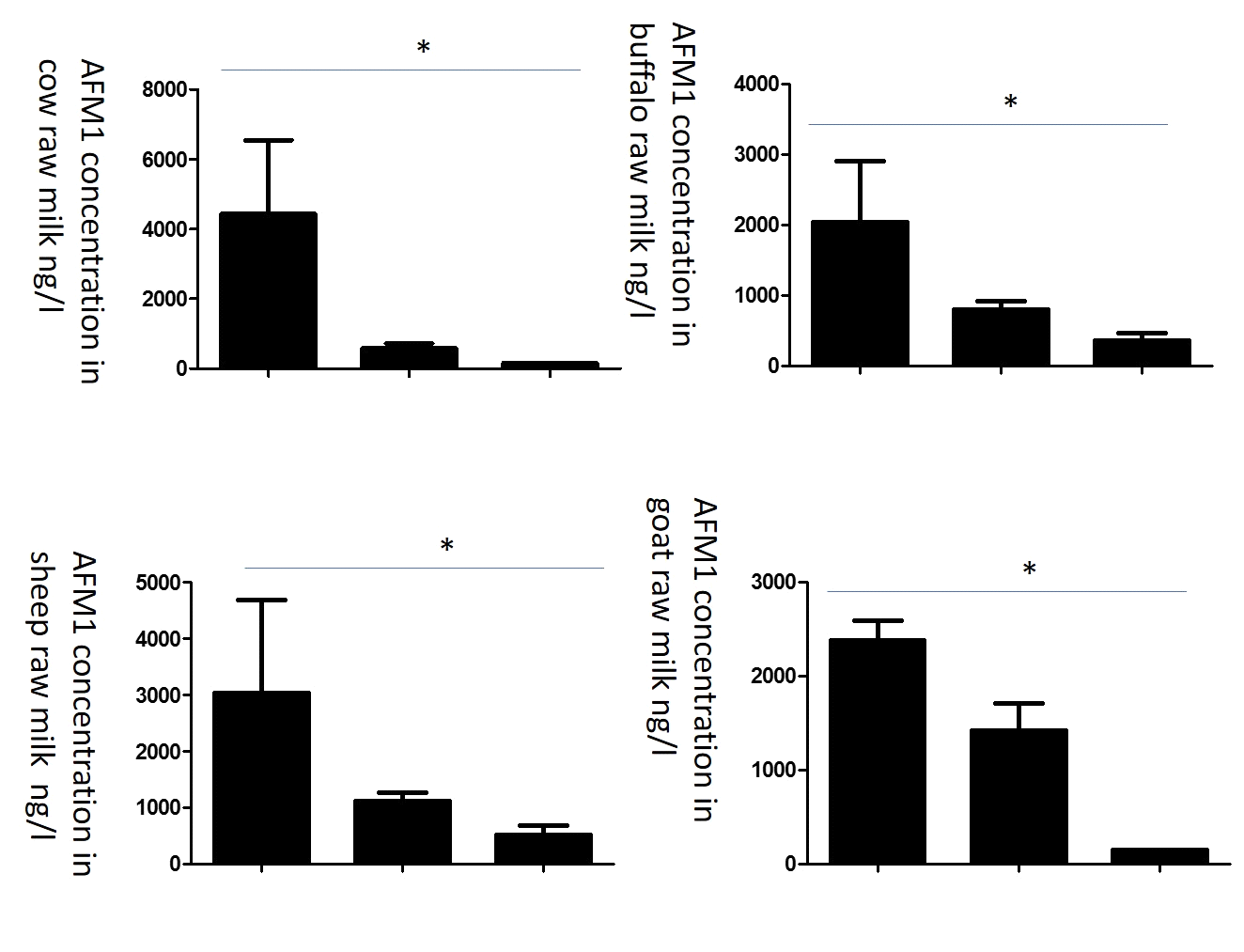
The range and levels of AFM1 concentration in samples were given in table 2 and figure 2 with highest mean concentration of all samples recorded in sheep>goat>cow>buffalo (Table 2). Notably, AFM1 levels were varied from samples from one area to another in same species and also in different dairy animal’s milk (Figure 3).
| P | ositive sample | s | 95 % Confidence | Minimum | Maximum | ||||||||||||||||||||||
|---|---|---|---|---|---|---|---|---|---|---|---|---|---|---|---|---|---|---|---|---|---|---|---|---|---|---|---|
| Dairy species | No. | Mean ± SE | P value | ||||||||||||||||||||||||
| No. | % | Interval | (ng/L) | (ng/L) | |||||||||||||||||||||||
| Cow | 30 | 30 | 100 | 1609.69±460.43 | 668.01 | 2551.37 | 146.1 | 8547.7 | > 0.05NS | ||||||||||||||||||
| Buffalo | 30 | 12 | 40 | 1187.06±360.02 | 394.65 | 1979.47 | 187.3 | 4646.8 | |||||||||||||||||||
| Sheep | 30 | 10 | 33.33 | 2032.63±673.75 | 508.51 | 3556.75 | 531.6 | 7776.1 | |||||||||||||||||||
| Goat | 30 | 8 | 26.67 | 1030.48±364.88 | 167.67 | 1893.28 | 139.5 | 2715.7 |
Table 2: Occurrence of AFM1 in raw cow, buffalo, sheep and goat milk samples (N=30 each). One- way ANOVA was run to determine dif
Table 2: Occurrence of AFM1 in raw cow, buffalo, sheep and goat milk samples (N=30 each). One- way ANOVA was run to determine differences between four species of animals (cow, buffalo sheep, and goat) at level of aflatoxin M1.Test result indicated that there was no statistical difference between the four species. F at (3,36)=1.003 P > 0.05. N= number; SE= standard error; NS= Non-Significant.
samples exceed US standard (Table 3).
Raw milk Positive samples Exceeding ER Limit
EC: European Commission, (2006), the limit in milk is 50 ng/L. US FDA: US FDA, (2011) the limit in milk is 500 ng/L. ER: Egyptian regulations, (1990), the limit in milk is 0 ng/L. Table 3: Levels of AFM1 (ng/L) in raw cow, buffalo, sheep and goat milk samples exceeding limits established by Egyptian regulations, the EC/Codex and US FDA. Notably, Egyptian raw milk is free form ochratoxin and zeralenone mycotoxins (Tables 4 & 5).
Open Access Journal of Veterinary Science & Research
| Dairy Species | Examined samples | Positive samples | Negative samples | ||||||
|---|---|---|---|---|---|---|---|---|---|
| Cow | 30 | 0 (0.00%) | 30 (100%) | ||||||
| Buffalo | 30 | 0 (0.00%) | 30 (100%) | ||||||
| Sheep | 30 | 0 (0.00%) | 30 (100%) | ||||||
| Goat | 30 | 0 (0.00%) | 30 (100%) |
Table 3: Occurrence of Ochratoxin in raw cow, buffalo, sheep and goat milk samples collected locally from Dakahlia governorate, E
| Dairy Species | Examined samples | Positive samples | Negative samples | ||||||
|---|---|---|---|---|---|---|---|---|---|
| Cow | 30 | 0 (0.00%) | 30 (100%) | ||||||
| Buffalo | 30 | 0 (0.00%) | 30 (100%) | ||||||
| Sheep | 30 | 0 (0.00%) | 30 (100%) | ||||||
| Goat | 30 | 0 (0.00%) | 30 (100%) |
Table 4: Occurrence of Zearalenone in raw cow, buffalo, sheep and goat milk samples collected locally from Dakahlia governorate E
Table 5: Occurrence of Zearalenone in raw cow, buffalo, sheep and goat milk samples collected locally from Dakahlia governorate Egypt There is increase concerning for production Egyptian raw milk free from mycotoxin as milk consumed in large scale with population. There is a different standard used in Egypt compared with other countries as ER, EC and US. [19] Conducted that maximum residue limit for AFM1 in raw milk is zero for Egyptian regulation, 0.05µg\L according to EC, while maximum residue limit in the US for AFM1 is 0.5µg\L for milk [20]. Also it found that an acceptable level of risk for AFM1 in fresh raw milk at 0.05 µg kg-1 according to regulation of the Codex Alimentarius and Joint Expert Committee on Food Additives (JECFA).
The present study found that all samples under experiment have an aflatoxin M1 with different levels from high, medium and low concentration in all species with 50% for cow, 80% buffalo, 90% sheep and 60% goat milk Exceeding US FDA Limit (500 ng/L)US. As recorded and determined in different report by Anonymous [6] who established that the maximum acceptable level of AFM1 in milk is 50 ng\L by the European Commission (EC), Bakirci [21] who examined 90 raw milk samples for AFM1 and found that 79 (87.77%) were aflatoxin M1 contaminated and 35 (44.30%) of the positive samples were higher than the maximum tolerance limit (0.05 ppb) accepted by Turkey and European union (EU) and El- Sayed, et al. [22] who examined 15 Egyptian cow's milk samples and found that 3 out of them were positive for AFM1 with a mean value of 6.3 ppb.
Notably, similar study to our finding recorded that all 177 fresh milk samples except one from Kuwaiti markets were contaminated with aflatoxin M1 ranging from 4.9 to 68.7 ng/kg, but 8 samples exceeded EC regulatory limit The current study found that raw milk free from ochratoxin as described before Skaug [26] no ochratoxin A was detected in any of the 20-prepared infant formula of cow milk samples detected by means of HPLC method or in Germany cow’s milk samples or in Egyptian raw milk in El-Minufia governorate [27, 28]. Also Bascarán, et al. [29] and Moudgil, et al. [30] found that no OTA was detected over the established limit 0.5 ng/ml and is below maximum residue limit of 2ng/ml. Notably, Gonzalez- Osnaya, et al. [31] summarized that no information is available on the rate of transfer of OTA into milk of dairy cows; OTA concentration in bovine milk are usually low, although some exceptions may occur if cow are ingesting large amount of OTA. Even though only low concentration of OTA may be present in milk, these small amounts may be important to consumers of large quantities of milk, particularly children.
Open Access Journal of Veterinary Science & Research
The presented study reported that no zearalenone residue in fresh raw milk as Seeling, et al. [15] who conducted that zearalenone mycotoxin and its metabolites can be found in the milk, but levels consider very low and often remaining below the limit standard level. Also, Kalac [32] mentioned that when the animal feed supplemented ration with silage, the main mycotoxin contaminated are DON and ZEA. These contamination contents can be decreased by the rumen microbiota in healthy animals, thus reducing the risk of milk contamination. While Mahmoudi [33] found Zearalenone in 15 (21.42%) of raw milk samples with mean level 1.34+-1.42 ng/ml.
In the current study we found that AFM1 was found in all samples but with differ levels ranged from high, medium and low in raw milk and also in different dairy species. Even low level still exceeds than Egyptian regulation that mention that AFM1 should be at zero level. Similar record [31] explains high level of AFM1 in raw milk due to composition of diet of dairy animals is mainly silage or contaminated feed stuff. Additionally, it was found seasonal effect on AFM1 level in summer lower than winter or due to distribution effect as far distance between producer and consumer. While low concentration of AFM1 in raw milk in some samples was explained due to mixing and dilution of contaminated one with other which had little or may be non-contaminated one from different resources. While there was no effect of storage, processing and manufacture in level of AFM1.
On conclusion, strategies control approved by each country could able to reduce the limit of aflatoxin in milk and reduce risk the effect of mycotoxin in the health of human. So regulation in Egypt according quality assurance should have applied to minimize the level of mycotoxins and its adverse effects.
Conflict of Interest
There is no conflict of interest of all authors
References
-
WHO (2003) Division of prevention and control of non-communicable diseases. Food Saftey and Nutrition Fact Sheet 5.
-
Alshannaq A, Yu JH (2017) Occurrence, Toxicity, and Analysis of Major Mycotoxins in Food. Int J Environ Res Public Health 14(6).
-
Theumer MG, Henneb Y, Khoury L, Snini SP, Tadrist S, et al. (2018) Genotoxicity of aflatoxins and their precursors in human cells. Toxicol Lett 287: 100-107.
-
Ahmed Adam MA, Tabana YM, Musa KB, Sandai DA (2017) Effects of different mycotoxins on humans, cell genome and their involvement in cancer (Review). Oncol Rep 37(3): 1321-1336.
-
Stroka J, Petz M, Joerissen U, Anklam E (1999) Investigation of various extractants for analysis of aflatoxins B 1 in different food and feed matrices. Food Additives and contaminants 16(8): 331-338.
-
Anonymous A (2000) European community comments for the codex committee on food additives and contaminants. CL 1999\12-GENCX0016 FAC- Agenda item 16a.
-
Gareis M, Wolff J (2000) Relevance of mycotoxin contaminated feed for farming animals and carryover of mycotoxins in food of animal origin. Mycoses 43(1): 79-83.
-
Ellis FE (2000) Seasonal variation in exposure frequency and concentration levels of aflatoxins and ochratoxins in urine samples of boys and girls. Mycopathologia 152(1): 35-40.
-
Abou Elmagd MM (2004) The high incidence of aflatoxin and ochratoxin coexistence in broiler rations-A study on some poultry farms at Dakahlia and Sharkia provinces, Egypt. Mansoura Veterinary Medical Journal 6(2): 75-78.
-
Elalfy M Mahmoud, Abdein M Mohamed (2016) INCIDENCE and concentration of aflatoxin b1 and ochratoxin a on broilers ration in dakahila governorate egypt Assiut, Vet Med J 62(148): 48-51
-
Gumus R, Ercan N, Imik H (2018) Determination of Ochratoxin A Levels in Mixed Feed and Feed Stuffs Used in Some Laying Hens and Ruminant Enterprises of Sivas City. Rev Bras Cienc Avic 20(1).
-
JECFA (2001) Fifty-sixth Meeting of Joint FAO\WHO Expert Committee on Food Additives. Saftey Evaluation of Certain Mycotoxins in Food. Food Additives Series, World Health Organization, Geneva.
-
Wu Q, Dohnal V, Huang L, Kuča K, Wang X, et al. (2011) Metabolic pathways of ochratoxin A. Curr Drug Metab 12(1): 1-10. Open Access Journal of Veterinary Science & Research
-
Chilaka CA, Boevre MD, Atanda OO, Saeger SD (2017) The Status of Fusarium Mycotoxins in Sub-Saharan Africa: A Review of Emerging Trends and Post- Harvest Mitigation Strategies towards Food Control Toxins 9(1): 19.
-
Seeling K, Dänicke S, Ueberschär KH, Lebzien P, Flachowsky G (2005) On the effects of Fusarium toxin-contaminated wheat and the feed intake level on the metabolism and carryover of zearalenone in dairy cows. Food Addit Contam 22(9): 847-855.
-
Qian GS, Yasei P, Yang GC (1984) Rapid extraction and detection of Aft. Mt in Cow's milk by I-IPLC and RIA. Analytical chemistry 56(12): 2079-2080.
-
Huang LC, Zheng N, Zheng BQ, Wen F, Cheng JB, et al. (2014) Simultaneous determination of aflatoxin M1, ochratoxin A, zearalenone and α-zearalenol in milk by UHPLC–MS/MS Food Chem 146: 242-249.
-
Kim HY (2014) Analysis of variance (ANOVA)
-
Ehsan Sadeghi, Ali Almasi, Somayeh Bohloli-Oskoii, Mitra Mohamadi (2012) The evaluation of aflatoxin M1 level in collected raw milk for pasteurized dairy factories of Kermanshah. Zahedan Journal of Research in Medical Sciences 15(3): 26-29.
-
Li Songli, Min Li, Wang Gang, Li Dagang (2018) Occurrence of Aflatoxin M1 in Raw Milk from Manufacturers of Infant Milk Powder in China. International Journal of Environmental Research and Public Health 15(5): 879.
-
Valenta H, Goll M (1996) Determination of ochratoxin A in regional samples of cow's milk from Germany. Food Additives and Contaminants 13(6): 669-676.
-
Skaug MA (2001) Presence and sources of ochratoxin A in human milk from Norway.
-
Talkhan O, Rady F, Mohamed E (2016) Detection of aflatoxins, ochratoxins and some chemical adulterants in raw milk. Benha Veterinary Medical Journal 31(2): 283-288. comparing means of more than two groups. Restor Dent Endod 39(1): 74-77.
-
Jawaid S, Talpur FN, Nizamani MS, Afridi HI (2015) Contamination profile of aflatoxin M1 residues in milk supply chain of Sindh, Pakistan. Toxicology Reports 2: 1418-1422.
-
Micheli L, Grecco R, Badea M, Moscone D, Palleschi G (2005) An electrochemical immunosensor for aflatoxin M1 determination in milk using screen- printed electrodes. Biosen. Bioelectron 21(4): 588- 596.
-
Bakirci I (2000) A study on the occurrence of aflatoxin M1 in milk and milk product produced in Van Province of Turkey. J Food Control 12(9): 47-51.
-
El-Sayed Abd Alla A, Neamat-Allah A, Aly SE (2000) Situation of mycotoxins in milk, dairy product and human milk in Egypt. Mycotoxin Res 16(2): 91-100.
-
Dashti B, Al-Hamli S, Alomirah H, Al-Zenki S, Bu Abbas A, Sawaya W (2009) Levels of aflatoxin M1 in milk, cheese consumed in Kuwait and occurrence of total aflatoxin in local and im ported animal feed. J Food Control 20(7): 686-690. (2007) Analysis of ochratoxin A in milk after immunoaffinity column clean-up by high performance liquid chromatography with fluorescence detection. Journal of Chromatography A 1167(1): 95-101.
-
Moudgil P, Bedi JS, Aulakh RS, Gill JPS (2017) Enzyme linked immune Sorbent Assay based detection of aflatoxin M1 and ochratoxin A in raw milk in Punjab, India. International Journal of Medical and Health Sciences 11(4).
-
Gonzalez-Osnaya L, Soriano JM, Molto JC, Manes J (2008) Simple liquid chromatography assay for analyzing ochratoxin A in bovine milk. Food Chemistry 108(1): 272-276.
-
Kalac Pavel (2011) The effects of silage feeding on some sensory and health attributes of cow’s milk: A review. Food Chemistry 125: 307-317.
-
Mahmoudi R (2014) Occurrence of Zearalenone in raw animal origin food produced in North-West of Iran. Journal of Food Quality and Hazards Control 1(1): 25-28.
- The Digital Stethoscope: Harnessing AI in Veterinary Medicine Without Losing Our Healing Touch
- Meningoencephalomyelitis of Unknown Etiology: Short-Term Effect of Two Treatment Protocols on Cerebrospinal Fluid
- Safety and Efficacy of the HomeoPet Cough in Domestic Pets –A Clinical and Correction Analysis Based Upon User Response Survey
- Non Human Animals Responses to Social Loss
- Owner Reported Clinical Outcomes of a Homeopathic Proprietary Preparation for the Treatment of Upper Respiratory and Nasal Disorders in Companion Animals
- Effects and Diagnostic Approach of Ultrasound in Veterinary Practice: A Systematic Review