
Prevalence, Causes, and Risk Factors of Wounds in Working Donkeys at Duna Woreda, Hadiya Zone, Ethiopia
A cross-sectional study was conducted between December 2017 and August 2018 and examines work-related wounds in working donkeys in the Duna woreda of Southern Ethiopia, focusing on prevalence, causes, types, and risk factors. Equines are essential for transportation in the area, but they face health issues due to improper management practices. Out of 384 randomly selected donkeys, the overall prevalence of wounds was 45%, with higher rates in males, older animals, and those in poor body condition. The most common wound locations were the prescapular region, back, hind limb, and neck. Improper harnessing and biting were major causes, and abrasions were the most frequent type of wound observed. These findings emphasize the need for improved management practices and better healthcare for working donkeys. This research provides insights into the prevalence, causes, types, and risk factors associated with work-related wounds in working donkeys. It highlights the importance of implementing appropriate management strategies and providing regular healthcare to reduce the occurrence of wounds and benefit the health and welfare of working donkeys.
Abbreviations
BCS: Body Condition Score; SPSS: Statistical Package for Social Sciences.
Introduction
The mammalian genus Equidae, which includes domestic and wild horses, donkeys, mules, and zebras, is one of the most important in the world. The importance of livestock is shown by the fact that many areas rely largely on animal muscle as their main source of energy. Beyond its contribution to nutrition, livestock’s versatility offers a variety of tasks, particularly in underdeveloped countries, including traction and transport. The fact that so many facets of human existence and socioeconomic development rely on Equidae animals is a testament to their crucial contribution to these fields of study [1].
Equines are used for transportation in Ethiopia, but they suffer from diseases, weariness, dehydration, starvation, lesions, and hoof issues due to challenging terrain and inadequate equipment [2]. Donkeys in the region were often involved in multipurpose activities, such as transporting goods and pulling carts, for up to 12 hours a day [3]. Management practice to prevent or to reduce health problems associated with work included short initial working periods until the animal develops resistance [4].
Animals working hard surfaces should be shod if wounds are properly managed (rest and prevention of complications). Avoid using the same harness for different drought animals [5]. Despite working equids’ significant contributions to communities and the national economy, few studies are conducted on their health. The available studies are mainly on the prevalence of infectious disease with limited studies on external injuries. In the study area, there is no study done on the prevalence, types of wounds, causes of the wound and their associated risk factors in working donkeys. Thus, the objectives of the study were:
- To determine the prevalence of wounds in working donkeys at Duna Woreda.
- To identify the risk factors, causes, and the types of wounds in working donkeys in the study area.
Materials and Methods
Study Area
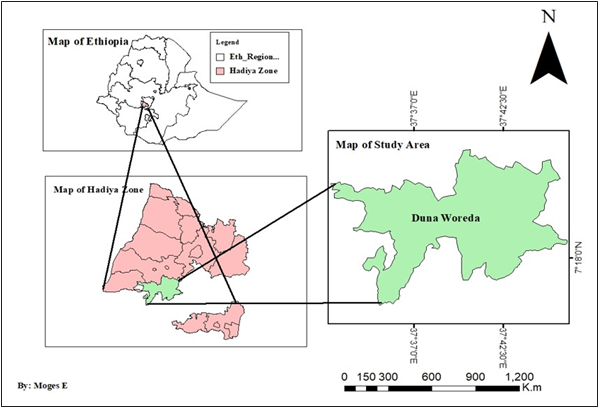
Across sectional study was conducted on randomly selected donkeys within and in the region of Duna Woreda, Hadiya Zone of Southern Ethiopia. Duna woreda is located at a distance of 274 km south of Addis Ababa and it is 42km from Hossana Town and lies at an altitude of 2030m above sea level. The mean annual temperature is 29.2oC and with average annual rainfall is 1000 mm-1500 mm. The vegetation of the woreda is both natural and artificial man planted. The agro-climate of the woreda is as follows woyinedega 35%, dega 54.8%, and kola 10.2%. The estimated livestock population of the woreda is 256,748 bovine, 30,385 equine, 58,961 caprine, 65,340 ovine, 6792 honey bee family, And 464,899 poultry [6].
Study Animals
The study animals were randomly selected donkeys at Duna Woreda, Hadiya Zone. A total of 384 donkeys with different sex, age, and body condition score were included in the study and, the work-related wounds in donkeys were kept under different management systems as the study animals.
Study Design and Sampling
A cross-sectional study was conducted on randomly selected 384 donkeys between December 2017 and September 2018 at Duna Woreda of Hadiya Zone, Southern Ethiopia. Each randomly selected donkey has been examined physically for any external body injury and findings in clouding site severity and type of wound have been recorded on the physical examination sheet. Moderate injuries were involving a coalition of small wounds with tissue sloughing involving no complication and hypertrophy and some with chronic causes. Wounds were categorized as mild when they involve only loss of epidermis and superficial layers with no further trauma. Wounds were also classified as abrasion, laceration, incision, and puncture Age and body condition score (BCS) estimations have been made according to the method described by Svendsen [7]. Wound severity and classification estimation were made as indicated by Biffa and Woldemeskel and Knottenbelt, respectively [8].
Sample Size Determination
To determine the sample size the expected prevalence in the study area was assumed to be 50% at a 95% confidence interval because of the absence of a previous study on the prevalence of wounds in the study area. Therefore, the sample size was calculated based on the formula given by Thrufield and although a total of 384 donkeys are intended to be sampled, in this study 387 donkeys were examined to maximize the precision [9].
2 $$ \mathrm {N} = \frac {1 . 9 6 ^ {2} [ \mathrm {p e x p e} (1 - \mathrm {p e x p e}) ]}{\mathrm {d} ^ {2}} $$
2 $$ \mathrm {N} = \frac {1 . 9 6 ^ {2} \mathrm {p e x p} (1 - \mathrm {p e x p})}{\mathrm {d} ^ {2}} $$ Where N= sample size P= expected prevalence D= desired absolute precision
Data Management and Analysis
Data were entered and managed in Microsoft Excel and SPSS version 20 software was used for the data analysis. The differences in parameters look age sex body condition and other factors of wounds in working donkeys were analyzed by using the X2(chi- square) technique and the level of significance was set at P<0.05.
Results
Overall Prevalence
This study revealed the overall prevalence of wounds in working donkeys was 175 (45.0%). A higher prevalence of wounds was recorded in male donkeys than in females; older than younger and the highest rate was recorded in donkeys with poor body condition than those with good body condition (Table 1).
| No of examined | No of affected | Prevalence (%) | X2 | P-value | |
|---|---|---|---|---|---|
| Sex | |||||
| Male | 208 | 103 | 49.5 | 16.24 | 0.013 |
| Female | 176 | 72 | 40.9 | ||
| Age | |||||
| Young | 32 | 9 | 28 | ||
| Adult | 196 | 90 | 45.9 | 38.66 | 0.001 |
| Old | 156 | 76 | 48.7 | ||
| BCS | |||||
| Poor | 315 | 151 | 47.9 | 7.83 | 0 |
| Good | 69 | 24 | 34.7 | ||
Table 1: Prevalence of wounds concerning sex, age, and body condition of donkeys.
There was a statistically significant (p=0.021) difference among the type of wounds in donkeys. Abrasion was the highest wound type and incise 12(3.12%) was the least type of wound in donkeys (Table 2).
| No of affected | Prevalence (%) | X2 | P-value | |
|---|---|---|---|---|
| Abrasion | 99 | 25.78 | ||
| Laceration | 36 | 9.37 | ||
| Puncture | 28 | 7.3 | 78.33 | 0.021 |
| Incise | 12 | 3.12 | ||
| Total | 175 | 45 |
Table 2: Prevalence of types of wounds in donkeys.
Distribution of Wounds with Sites
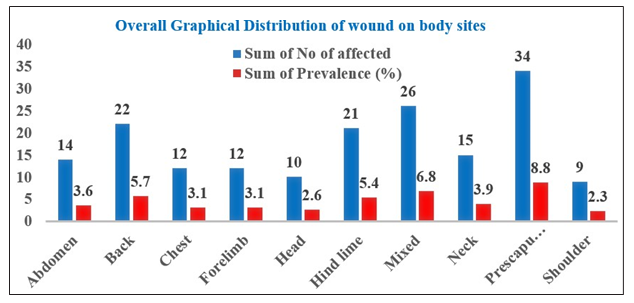
A significant difference (p=0.004) was also observed in the distribution of wounds among different parts of the body in working donkeys where the highest numbers of wounds were recorded on prescapular while the lower number of wounds were recorded on the shoulder.
| No of affected | Prevalence (%) | X2 | P-value | |
|---|---|---|---|---|
| Improper harness | 53 | 13.38 | ||
| Infection diseases | 18 | 4.68 | ||
| Injury by sharp objects | 21 | 5.4 | ||
| Overloading | 15 | 3.9 | 43.63 | 0 |
| Falling | 9 | 2.3 | ||
| Biting | 47 | 12.2 | ||
| Unknown | 12 | 3.1 | ||
| Total | 175 | 45 |
Table 3: Causes of wounds in donkeys.
Discussion
In the current study, the overall prevalence of wounds in working donkeys was 45%. This result was lower than the report of 79.4% in Hawassa, and 59% in Jordan [3, 10]. This might be due to variations in management and husbandry to the donkey in the region. This study found that males had a higher proportion of wounds than females, with 45.5% of wounds occurring in males and 40.9% in females. This might be due to males being most frequently used for work than females and are hence highly exposed to wound injury in the present study area.
The present finding showed that 28% of wounds were in young, 45.9% were in adults, and 48% were in old donkeys. This suggests that older and adult donkeys had a higher prevalence of wounds due to a lack of management, feeding, and health care provision. Donkeys with poor body conditions had the highest rate of wounds (27.1%), followed by those with good body conditions (34.7%). Common
wounds were found in the back and prescapular region, with the hind limb being the most common at 5.4%.
The study found that improper harnessing was the main cause of injuries in the area, leading to uneven distribution of weight and injury. Other common causes of wounds included biting, injury by a sharp object, infectious disease, overloading, and falling. This finding is consistent with results reported by Pearson et al. in central Ethiopia. Infection-related injuries were found to be caused by bacterial infections and colic pathogens, with symptoms such as abscesses and ulceration.
Conclusion and Recommendations
The current study found that the prevalence of wounds in working donkeys at Duna Woreda, Southern Ethiopia was 45%. Male donkeys had a higher prevalence than females, and older and adult donkeys had a higher prevalence. The most common sites of wounds were the prescapular region, back, and hind limb. Improper harnessing and biting were the main causes, followed by injury by sharp objects, overloading, falling, and infection-related injuries. The most common types of wounds were abrasions, followed by lacerations, punctures, and incisions.
Based on the current findings of the study, the following Recommendations were made:
- Improved management practices are needed to prevent and reduce the occurrence of wounds in working donkeys, such as proper harnessing techniques, regular inspection of equipment, and adequate rest and care.
- Donkey owners and handlers should be educated and trained on proper handling, harnessing, and care of donkeys to raise awareness of wound prevention and promote better practices.
- Donkeys should have access to veterinary care for regular health check-ups, vaccinations, and prompt treatment of wounds to prevent and manage them.
- Collaboration with skilled artisans and experts in saddle and harness design can help improve the design and quality of saddles and harnesses used for working donkeys, reducing the risk of injuries.
- Research and monitoring programs are needed to reduce the occurrence of wounds in working donkeys and improve their health and welfare.
References
-
FAO (2006) Livestock’s Long Shadow: Environmental Issues and Options. Rome.
-
Brooke (2007) Bearing heavy burden.
-
Biffa D, Woldemeskel M (2006) Causes and factors associated with the Occurrence of external injuries in working equines in Ethiopia. Intern J Appl Res Vet Med 4(1): 1-7.
-
Behinke R, Metaferia F (2011) the contribution of Livestock to the Ethiopian Economy-Part II. IGAD LPI Working Paper pp: 2-43.
-
Guyo S, Legesse S, Tonamo A (2015) a review on welfare and management practices of working equine. Journal of Animal Science 3(6): 203-209.
-
DWAOS (2017) Duna Woreda Agricultural Development Office. Economy-Part II. IGAD LPI Working Paper pp: 2-43.
-
Svendsen E (1997) Parasites Abroad the Professional Handbook of the Donkey 3rd (Edn.). Whittet Books Limited, London pp: 166-182.
-
Knottenbelt D (2003) Handbook of equine wound management. London.
-
Thrustfield M (2005). Veterinary Epidemiology 2nd (Edn.). Blackwell Science Ltd pp: 182-188.
-
Burn CC, Pritchard JC, Faraiat M, Twaissi AM, Whay HR (2007) Risk factors strap-related lesions in working donkeys at the world heritage site of Petra in Jordan. Veterinary Journal pp: 263-271.
- The Digital Stethoscope: Harnessing AI in Veterinary Medicine Without Losing Our Healing Touch
- Meningoencephalomyelitis of Unknown Etiology: Short-Term Effect of Two Treatment Protocols on Cerebrospinal Fluid
- Safety and Efficacy of the HomeoPet Cough in Domestic Pets –A Clinical and Correction Analysis Based Upon User Response Survey
- Non Human Animals Responses to Social Loss
- Owner Reported Clinical Outcomes of a Homeopathic Proprietary Preparation for the Treatment of Upper Respiratory and Nasal Disorders in Companion Animals
- Effects and Diagnostic Approach of Ultrasound in Veterinary Practice: A Systematic Review